M. Stanton Evans has died at 80

I had known he was very ill, but M. Stanton Evans has passed away. This is from the obituary posted by Steve Hayward at Powerline which were Hayward’s own comments:

We gather tonight in a “let us now praise famous men” mode, but it is a mode distinctly uncongenial to our guest of honor.

So rather than dwell on the usual things, I thought I’d share a few of the items Stan typically leaves off his CV that were crucial and formative to many of his students and protégés.

Start with his lifestyle, as liberals would call it, or, as Stan’s mother would have said, his vices. Winston Churchill once dismissed the socialist Ramsay McDonald, who was a pacifist, a vegetarian, a non-smoker, and, worst of all, a teetotaler, by saying that McDonald had all of the virtues he abhorred and none of the vices he admired.

I think Churchill would have approved of Stan; he has all the right bad habits. . .

Stan is the only person I’ve ever known who can take Socratic irony and actually make it ironic.

Stan is, for example, a fan of America’s Founding Fathers, but does them one better: he’s not so sure that taxation with representation is such a hot idea, either.

Then there was the time in 1968, when he signed on to the McCarthy for President campaign. That lasted about 48 hours, until he discovered that the candidate was Eugene McCarthy.

I have wondered exactly where Stan got the idea to found the National Journalism Center. Back in 1970, William F. Buckley told Playboy magazine that the biggest problem facing the conservative movement was a scarcity of good writers and journalists. Stan’s founding of the NJC helped address that gap, but I don’t think he got the idea from Buckley’s Playboy interview because we all know Stan only buys Playboy for the pictures. . .

The National Journalism Center should be regarded as more than just a training ground for conservative journalists. It represents an apostolic succession of sorts, and is the kind of legacy that lasts longer and goes deeper than the printed word, whose ink will fade, whose pixels will disappear when the hard drive crashes. The larger world does not appreciate the extent to which a cadre of Stan Evans-influenced journalists would be different from writers who emerge from the name-brand journalism schools—and not just ideologically different. For one thing, we can drink more, which is saying a lot in the world of ink-stained wretches.

There was no by-the-numbers didactic instruction in Stan’s method at the NJC. Instead, his method consisted of practicing Yogi Berra epistemology, which the great Yogi summarized with his aphorism that “You can observe a lot just by watching.”

You could not help but absorb Stan’s approach to good journalism and quality writing, just by being around him, and watching how he went about his craft. I like to think Stan had a good eye for talent; after all, he invited into his realm, 30 years ago, lowlifes like myself, John Fund, and Martin Morse Wooster, and many worse after us. I tried to talk them into an NJC karaoke act here tonight, but apparently this would violate several DC laws related to animal cruelty. . .

Stan may not exactly want to lay claim to all of his apostles. But we lay claim to him. In fact, if it wasn’t for Stan and the NJC, I might well have made the dreadful mistake of getting a real job out of college. . .

His Blacklisted by History was a revelation which you should read before going on to Diana West’s American Betrayal. They will change the way you read the news, if nothing else.

The effects of global warming

People in the GTA dig out after one of the worst snowstorms of the year .Although it is groundhog day Torontonians didnt take too much solace in the fact the Wireton Willie claims that  we will not have 6 more weeks of winter

We have had family visiting the past few days from Toronto so I have been keeping even closer watch on the weather. Extreme cold weather warning continues for the GTA (Greater Toronto Area). And Toronto has one of Canada’s milder winters:

Much of the GTA remains under an extreme cold warning, issued by Environment Canada on Wednesday, as temperatures are expected to hit a low of -20 C this morning, with a wind chill of -33 C.

Northwesterly winds, combined with the low temperatures, could keep wind chill values between -30 C and -35 C through to Friday morning, after which we should start to see them rise.

If you must be outdoors today, take care to dress for the weather, as frostbite could affect exposed skin in as little as 10 minutes.

Environment Canada also suggests wearing sunglasses, lip balm and sunscreen to protect the skin and applying moisturizing to prevent windburn.

Those taking part in outdoor winter activities, such as skiing, snowmobiling, and skating are urged to wear a face mask and goggles.

“Keep moving (especially your hands and feet) to keep your blood flowing and maintain your body heat,” says the warning.

“Drink enough fluids, but avoid very cold drinks and consume warm meals regularly,” it adds.

These are from Drudge:

4 Cities Set All-Time Record Lows…
DC hasn’t seen this since 1885 — or ever?!
5-story ‘ice volcano’ forms at NY geyser…
Great Lakes most ice since recorded time…
AND ANOTHER BLAST NEXT WEEK…

If you have not at least had a twinge of doubt about global warming during the past few days (years), you are clearly untouchable by reasoned debate (the synonym for which being “insane”).

The question that must be asked

How’s this for a first para from a mere columnist who wishes to take up Obama’s empty rhetoric about modern Islam and the Christianity of a thousand years ago?

I have written three books and numerous articles about the Crusades, slavery and the Inquisition, so I suppose I am, forgive me, somewhat qualified to discuss them. Not, of course, as expert as President Barack Obama, because he seems to be an authority on pretty much everything.

The columnist is Michael Coren writing in the Toronto Sun, under the heading, Obama dodges tough questions of Islam. His conclusion, in what is anyway a short article, seems to be this:

As I say, I have written entire books about the context and nuance of all this so a column can never satisfy. What Obama was perhaps trying to say was that people use religion to conduct all sorts of evil deeds and in that he is correct. But if he genuinely understood history and religion, he would know that Christ’s actual teachings were seldom the reason for ancient injustices.

The question that must be asked – and Obama and so many like him have neither the courage nor the wit to do so – is whether the same can be said of Islam.

Ahem, ahem. Obama does, of course, know the answer, which is why he does so much to evade the question.

What an anti-terrorist law should look like

This is what every country in the Democratic West must do if we are really going to preserve our freedoms. The article is titled, Canada’s New Anti-Terror Bill Is Everything You Hoped It Wasn’t, but whoever “you” is, it isn’t me. This is exactly what I do think is needed.

Under the broad anti-terror legislation tabled Friday, Canada’s spy agency, the Canadian Security and Intelligence Service (CSIS), will be given broad new powers to investigate and “disrupt” terrorist plots. Canada’s police services will be able to go after online terrorist propaganda.

When the bill was tabled on Friday afternoon, the Prime Minister vowed to prevent attacks like the ones that hit Ottawa and Quebec in October.

The powers included in Bill C-51 come with little new oversight or transparency. The core of the provisions will allow CSIS to disrupt attacks the organization believes may occur in Canada or abroad.

The government calls them “disruption warrants,” and they will let Canada’s spies do just about anything. According to the legislation those warrants authorize the spies to “enter any place or open or obtain access to any thing,” to copy or obtain any document, “to install, maintain or remove any thing,” and, most importantly, “to do any other thing that is reasonably necessary to take those measures.”

To use the new measures, once passed by Parliament, the spies will need to apply to a judge to authorize operations to stop a terrorist attack. The legislation doesn’t offer many caveats on that power, instead enabling the spies to take whatever measures they feel are necessary, in Canada or abroad. So long as a judge agrees, it’s all fair game—even if it’s illegal.

The word install appears to be an indication that CSIS should have powers to install malware and keyloggers, which the government has already moved toward legalizing.

On top of that, the bill offers no new oversight for CSIS. Currently, it is policed by the Security Intelligence Review Committee (SIRC), which has been lambasted for being woefully inadequate and staffed by political appointees.

This legislation does not show the terrorists have won. It shows what needs to be done to make them lose. It is like dealing with paedophiles. You do not give them freedom of speech on the zero chance that they may be in the right and the rest of society in the wrong. You just make anything they say in public, or put online, illegal, and punish them as hard as you can for any breaches whatsoever. Trust me, if they had the chance to shut you up, they would, they absolutely would. We need to do this while we still can.

When they say Israel, they don’t actually mean Israel

anti semitism mediaeval

I am of that unusual middle generation, the post-Holocaust period of Jewish acceptance in the West, which is now being followed by a return to the days of pre-War Europe. My mother’s photo album at home showed a picture of some relative dead upon the sofa, having been murdered during a pogrom in Poland sometime just after World War I. We’re not there yet, but those straws in the wind inside that Kosher butcher shop in Paris are signs of something evil stirring. That is why I find this article so interesting. It comes with the title, The ideological roots of media bias against Israel, but it is not just about Israel. But if you get to its conclusion, and it is a long article, it ends on an upbeat note. And it’s not just about the media, but it does tell you quite a lot about the media that is worth understanding, if you appreciate that the media are a stand-in for the intellectual class, who are a problem all on their own.

The cult’s priesthood can be found among the activists, NGO experts, and ideological journalists who have turned coverage of this conflict into a catalogue of Jewish moral failings, as if Israeli society were different from any other group of people on earth, as if Jews deserve to be mocked for having suffered and failed to be perfect as a result.

Most of my former colleagues in the press corps aren’t full-fledged members of this group. They aren’t true believers. But boycotts of Israel, and only of Israel, which are one of the cult’s most important practices, have significant support in the press, including among editors who were my superiors. Sympathy for Israel’s predicament is highly unpopular in the relevant social circles, and is something to be avoided by anyone wishing to be invited to the right dinner parties, or to be promoted. The cult and its belief system are in control of the narrative, just as the popular kids in a school are those who decide what clothes or music are acceptable. In the social milieu of the reporters, NGO workers, and activists, which is the same social world, these are the correct opinions. This guides the coverage. This explains why the events in Gaza this summer were portrayed not as a complicated war like many others fought in this century, but as a massacre of innocents. And it explains much else.

So prevalent has this kind of thinking become that participating in liberal intellectual life in the West increasingly requires you to subscribe at least outwardly to this dogma, particularly if you’re a Jew and thus suspected of the wrong sympathies. If you’re a Jew from Israel, your participation is increasingly conditional on an abject and public display of self-flagellation. Your participation, indeed, is increasingly unwelcome.

What, exactly, is going on?

Observers of Western history understand that at times of confusion and unhappiness, and of great ideological ferment, negative sentiment tends to coagulate around Jews. Discussions of the great topics of the time often end up as discussions about Jews.

In the late 1800s, for example, French society was riven by the clash between the old France of the church and army, and the new France of liberalism and the rule of law. The French were preoccupied with the question of who is French, and who is not. They were smarting from their military humiliation by the Prussians. All of this sentiment erupted around the figure of a Jew, Alfred Dreyfus, accused of betraying France as a spy for Germany. His accusers knew he was innocent, but that didn’t matter; he was a symbol of everything they wanted to condemn.

To give another example: Germans in the 1920s and 1930s were preoccupied with their humiliation in the Great War. This became a discussion of Jewish traitors who had stabbed Germany in the back. Germans were preoccupied as well with the woes of their economy – this became a discussion of Jewish wealth, and Jewish bankers.

In the years of the rise of communism and the Cold War, communists concerned with their ideological opponents talked about Jewish capitalists and cosmopolitans, or Jewish doctors plotting against the state. At the very same time, in capitalist societies threatened by communism, people condemned Jewish Bolsheviks.

This is the face of this recurring obsession. As the journalist Charles Maurras wrote, approvingly, in 1911: ‘Everything seems impossible, or frighteningly difficult, without the providential arrival of anti-Semitism, through which all things fall into place and are simplified.’

The West today is preoccupied with a feeling of guilt about the use of power. That’s why the Jews, in their state, are now held up in the press and elsewhere as the prime example of the abuse of power. That’s why for so many the global villain, as portrayed in newspapers and on TV, is none other than the Jewish soldier, or the Jewish settler. This is not because the Jewish settler or soldier is responsible for more harm than anyone else on earth – no sane person would make that claim. It is rather because these are the heirs to the Jewish banker or Jewish commissar of the past. It is because when moral failure raises its head in the Western imagination, the head tends to wear a skullcap.

One would expect the growing scale and complexity of the conflict in the Middle East over the past decade to have eclipsed the fixation on Israel in the eyes of the press and other observers. Israel is, after all, a sideshow: The death toll in Syria in less than four years far exceeds the toll in the Israel-Arab conflict in a century. The annual death toll in the West Bank and Jerusalem is a morning in Iraq.

And yet it is precisely in these years that the obsession has grown worse.

This makes little sense, unless we understand that people aren’t fixated on Israel despite everything else going on – but rather because of everything else going on. As Maurras wrote, when you use the Jew as the symbol of what is wrong, ‘all things fall into place and are simplified.’

The last few decades have brought the West into conflict with the Islamic world. Terrorists have attacked New York, Washington, London, Madrid, and now Paris. America and Britain caused the unravelling of Iraq, and hundreds of thousands of people are dead there. Afghanistan was occupied and thousands of Western soldiers killed, along with countless civilians – but the Taliban are alive and well, undeterred. Gaddafi was removed, and Libya is no better off. All of this is confusing and discouraging. It causes people to search for answers and explanations, and these are hard to come by. It is in this context that the ‘Cult of the Occupation’ has caught on. The idea is that the problems in the Middle East have something to do with Jewish arrogance and perfidy, that the sins of one’s own country can be projected upon the Western world’s old blank screen. This is the idea increasingly reflected on campuses, in labour unions, and in the media fixation on Israel. It’s a projection, one whose chief instrument is the press.

Jews understand this very well, or at least some do. But if you wish to be a self-identifying Jew, this is now a reality you face. Two other reminders, both on video. First this, which took place in New York City’s Council Chamber.

And then this, which is what it is. You can watch it here if you want.

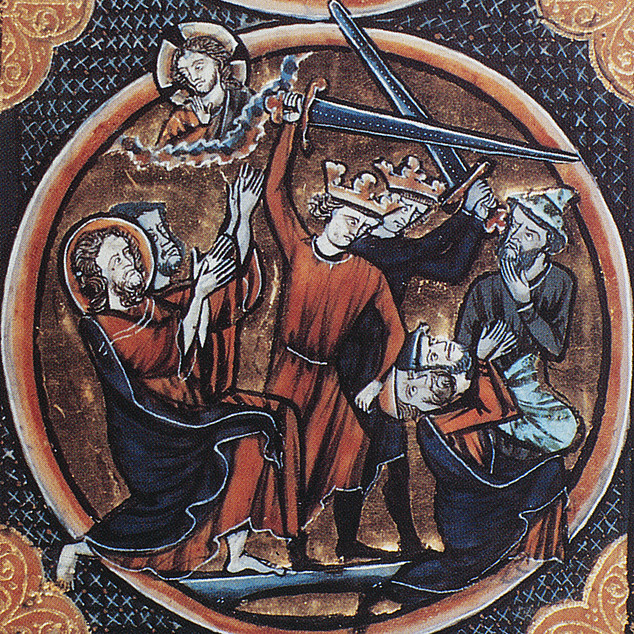
As to the picture at the start of this post, it is from The Return of Anti-Semitism by Jonathan Sacks in The Wall Street Journal on 30 January. The caption runs, “two Jews, kneeling at right, about to be put to death by the sword as revenge for the death of Jesus, who looks on at top left. Manuscript illumination, c1250, from a French Bible”. But as the story makes all too clear, that is not much of an illustration of the issue as the twenty-first century begins. This is closer to it:

According to the Middle East Media Research Institute, an Egyptian cleric, Muhammad Hussein Yaqub, speaking in January 2009 on Al Rahma, a popular religious TV station in Egypt, made the contours of the new hate impeccably clear: “If the Jews left Palestine to us, would we start loving them? Of course not. We will never love them…They are enemies not because they occupied Palestine. They would have been enemies even if they did not occupy a thing…You must believe that we will fight, defeat and annihilate them until not a single Jew remains on the face of the Earth…You will not survive as long as a single one of us remains.”

And then there is the President of the United States, for whom most American Jews have voted for and would no doubt do so again if given the chance. This article from the latest Commentary is titled, America’s Anti-Israeli President, but anti-Israeli is again a synecdoche. Here are the concluding paras:

Mr. Obama wouldn’t be the first world leader to have an irrational animus against Israel. He’s not even the first American president to have an irrational animus against Israel. (See: Jimmy Carter.) But it is fair to say, I think, that no American president has been this consistently hostile to Israel while in office or shown such palpable anger and scorn for it and for Israel’s leader.

Perhaps given President Obama’s history–including his intimate, 20-year relationship with the anti-Semitic minister Jeremiah Wright–this shouldn’t come as a surprise. But that doesn’t make it any less disturbing.

Sinister and very disturbing, but what is to be done? No answers really come to mind.

Only the completely credulous can be atheists

This arrived in my mail box from someone named Jeff Allen, and I am grateful for his posting. I cannot see how this points towards any particular religion as the answer to our origins, but it does make me sit in wonder of it all and how we came into being. The time frames alone defeat me in making sense of it. But to think that this was a self-creating universe, and everything that had to happen for us to be all happened by chance, is asking me to believe the impossible. I have seen other lists like this, but this one seems particularly fine and very readable. I might just mention that I have been reading basic texts on and histories of chemistry because what we have worked out about the mechanism of the world feels like an algorithm. Two hydrogen atoms plus one oxygen atom and we have water. Sure, totally obvious, which is why it took 2500 years to work it out. Anyway, Mr Allen’s list.

Does God exist? The complexity of our planet points to a deliberate Designer who not only created our universe, but sustains it today. Many examples showing God’s design could be given, possibly with no end. But here are a few:

1. The Earth…its size is perfect.

The Earth’s size and corresponding gravity holds a thin layer of mostly nitrogen and oxygen gases, only extending about 50 miles above the Earth’s surface. If Earth were smaller, an atmosphere would be impossible, like the planet Mercury. If Earth were larger, its atmosphere would contain free hydrogen, like Jupiter (R.E.D. Clark, Creation (London: Tyndale Press, 1946), p. 20). Earth is the only known planet equipped with an atmosphere of the right mixture of gases to sustain plant, animal and human life.

The Earth is located the right distance from the sun. Consider the temperature swings we encounter, roughly -30 degrees to +120 degrees. If the Earth were any further away from the sun, we would all freeze. If it were any closer, we would burn up. Even a fractional variance in the Earth’s position to the sun would make life on Earth impossible. The Earth remains this perfect distance from the sun while it rotates around the sun at a speed of nearly 67,000 mph. It is also rotating on its axis, allowing the entire surface of the Earth to be properly warmed and cooled every day.

And our moon is the perfect size and distance from the Earth for its gravitational pull. The moon creates important ocean tides and movement so ocean waters do not stagnate, and yet our massive oceans are restrained from spilling over across the continents (The Wonders of God’s Creation, Moody Institute of Science, Chicago, IL).

2. Does God exist? The universe had a start – what caused it?

Scientists are convinced that our universe began with one enormous explosion of energy and light, which we now call the Big Bang. This was the singular start to everything that exists: the beginning of the universe, the start of space, and even the initial start of time itself.

Astrophysicist Robert Jastrow, a self-described agnostic, stated, “The seed of everything that has happened in the Universe was planted in that first instant; every star, every planet and every living creature in the Universe came into being as a result of events that were set in motion at the moment of the cosmic explosion… The Universe flashed into being, and we cannot find out what caused that to happen.”Robert Jastrow; “Message from Professor Robert Jastrow”; LeaderU.com; 2002.

Steven Weinberg, a Nobel laureate in Physics, said at the moment of this explosion, “the universe was about a hundred thousand million degrees Centigrade…and the universe was filled with light” [Steven Weinberg; The First Three Minutes: A Modern View of the Origin of the Universe; (Basic Books,1988); p 5.].

The universe has not always existed. It had a start…and what caused that? Scientists have no explanation for the sudden explosion of light and matter.
If I told you that the watch on my wrist was designed by a team of engineers, skillfully crafted by a team of highly trained technicians, sent to a jobber, and from there to the store where my wife bought it as a gift for me, would you believe me?

Well, let me tell you what really happened: Millions and millions of years ago, there were atoms freely floating through the universe. Cosmic winds drew them together, clustering them into various materials: silicon, crystals, metals, and other various parts. Through the random effects of chance, over millions of years, of course, these various elements were thrown together into his interesting device that now adorns my wrist, and it has been keeping accurate time ever since!

Ridiculous, isn’t it. The notion that this complex little device “happened” by the caprice of chance alone is, of course, absurd. It is obviously the object of careful and skillful design. Strange that we reject the notion that this watch happened by accident, yet it is vastly simpler than the wrist upon which it resides.

The watch is a simple “open loop” design. The wrist is a “closed loop” servo system, which is vastly more sophisticated. It adjusts to ambient conditions, fights off invaders, even repairs itself and involves design elements we are only just now beginning to understand! Why is it that we require a designer to explain the origin of the watch, yet are willing to ascribe the biological systems which it adorns chance?

3. Does God exist? Design parameters of the universe.

The limits and parameters of the universe have come within the measuring capacity of astronomers and physicists, the design characteristics of the universe are being examined and acknowledged. Astronomers have discovered that the characteristics and parameters of the universe, and our solar system are so finely tuned to support life that nothing less than a personal, intelligent Creator can explain the degree of the universe being fine-tuned It requires power and purpose.

Approximately two dozen parameters of the universe have been identified that must be carefully fixed in order for any kind of conceivable life to exist at any time in the history of the universe. Here are a few examples of these given below.

1. Gravitational coupling constant. If larger: no stars less than 1.4 solar masses, hence short stellar life spans. If smaller: no stars more than 0.8 solar masses, hence no heavy element production.

2. Strong nuclear force coupling constant. If larger: no hydrogen; nuclei essential for life are unstable. If smaller: no elements other than hydrogen

3. Electromagnetic coupling constant. If larger: no chemical bonding; elements more massive than boron are unstable to fission. If smaller: no chemical bonding.

4. Ratio of protons to electrons. If larger: electromagnetism dominates gravity preventing galaxy, star and planet formation. If smaller: electromagnetism dominates gravity preventing galaxy, star, and planet formation.

5. Ratio of electron to proton mass. If larger: no chemical bonding. If smaller: no chemical bonding.

6. Expansion rate of the universe. If larger: no galaxy formation. If smaller: universe collapse prior to star formation.

7. Entropy level of the universe. If larger: no star condensation within the proto-galaxies. If smaller: no proto-galaxy formation.

8. Mass density of the universe. If larger: too much deuterium from big bang, hence stars burn too rapidly. If smaller: no helium from big bang, hence not enough heavy elements.

9. Age of the universe. If older: no solar-type stars in a stable burning phase in the right part of the galaxy. If younger: solar-type stars in a stable burning phase would not yet have formed.

10. Average distance between stars. If larger: heavy elements density too thin for rocky planet production. If smaller: planetary orbits become destabilized.

11. Solar luminosity. If increases too soon: runaway green house effect. If increases too late: frozen oceans.

12. Fine structure constant (a function of three other fundamental constants, Planck’s constant, the velocity of light, and the electron charge each which, therefore, must be fine-tuned) If larger: no stars more than 0.7 solar masses, if smaller: not stars less than 1.8 solar masses.

13. Carbon to Oxygen energy level ratio. If larger: insufficient oxygen. If smaller: insufficient carbon.

14. Decay rate of proton. If greater: life would be exterminated by the release of radiation. If smaller: insufficient matter in the universe for life.

The degree of the universe being fine-tuned for many of these parameters is utterly amazing. For example, if the strong nuclear force were even two percent stronger or two percent weaker, the universe would never be able to support life. More astounding yet, the ground state energies for He, Be, C, and O cannot be higher or lower with respect to each other by more than four percent without yielding a universe with insufficient oxygen and/or carbon for any kind of life. The expansion rate of the universe is even more sensitive, it must be fine-tuned to an accuracy of one part in 1055! Clearly some ingenious Designer must be involved in the physics of the universe.

4. Does God exist? Origin of life

Life. What is it? Where did it come from? What makes it different from dust, the air and the water on earth? From the time we humans achieve self awareness there develops a fascination with the things that crawl, slither, walk, swim and fly. This fascination with the “living protoplasm” on earth is basic to our constitution. This fascination with living things leads us all to the point when we ask “where did they come from?” The question of the origin of life has been debated by philosophers, theologians, scientists for thousands of years and is at the very core of the debate between the atheists and the creationists. Creationists see the creation of life as powerful, visible, manifestation of an awesome designer, creator, God. To the creationist, life is the product of the greatest chemist, biologists, mathematician and engineer in or out of the universe! To the atheist, life is viewed as incredibly lucky result of billions of years and countless violations of the laws of nature acting on non-living matter. As some have put it, life is “The fortuitous occurrence of accidental circumstances.”

Atheists assume that 3 to 4 billion years ago, non-living, inanimate, inorganic matter developed into highly complex living organism, by random chance. No one knows where it happened, but it generally assumed to have occurred somewhere on earth, in a “primordial ooze”, near hot oceanic vents or some shallow tidal pool. No designer, no blue prints, no instructions, no concept or purpose are allowed in the evolutionary scenario of the origin of life. Only the laws of nature, random chance and long periods of time are allowed to act on the raw materials of life.

5. Does God exist? The DNA code informs, programs a cell’s behavior.

All instruction, all teaching, all training comes with intent. Someone who writes an instruction manual does so with purpose. Did you know that in every cell of our bodies there exists a very detailed instruction code, much like a miniature computer program? As you may know, a computer program is made up of ones and zeros, like this: 110010101011000. The way they are arranged tell the computer program what to do. The DNA code in each of our cells is very similar. It’s made up of four chemicals that scientists abbreviate as A, T, G, and C. These are arranged in the human cell like this: CGTGTGACTCGCTCCTGAT and so on. There are three billion of these letters in every human cell!

Well, just like you can program your phone to beep for specific reasons, DNA instructs the cell. DNA is a three-billion-lettered program telling the cell to act in a certain way. It is a full instruction manual.

Why is this so amazing? One has to ask….how did this information program wind up in each human cell? These are not just chemicals. These are chemicals that instruct, that code in a very detailed way exactly how the person’s body should develop.

Natural, biological causes are completely lacking as an explanation when programmed information is involved. You cannot find instruction, precise information like this, without someone intentionally constructing it.

6. Does God exist? Encyclopedia on a Pinhead: Chance or design?

At the moment of conception, a fertilized human egg is about the size of a pin head. Yet, it contains information equivalent to about six billion “chemical letters.” This is enough information to fill 1000 books, 500 pages thick with print so small you would need a microscope to read it! If all the DNA chemical “letters” in the human body were printed in books, it is estimated they would will the Grand Canyon 50 times!

The information on the DNA molecule is transferred to RNA and ultimately to proteins in the form of structural and functional proteins. A fundamental dilemma for the evolution theory is that the duplication and translation of the information on the DNA molecule requires the employment of proteins. However, living cells cannot make proteins until the DNA replication and translation machinery is in place! The only rational explanation for this dilemma is that the protein production and DNA replication and translation machinery system arose simultaneously! This could only happen by design.

Question: Would a DNA molecule that arose by chance possess any information, codes, programs, or instructions? According to the basic principles of information theory the answer is clearly NO!

7. Does God exist? A Complex Engineering Puzzle

Suppose you were asked to take two long strands of fisherman’s monofilament line, 125 miles long, then form it into a double helix structure and neatly fold and pack this line so it would fit into a basketball.

Furthermore, you would need to ensure that the double helix could be unzipped and duplicated along the length of this line, and the duplicate copy removed, all without tangling the line. Possible? This is directly analogous to what happens in the billions of cells in your body every day. Scale the basketball down to the size of a human cell and the line scales down to six feet of DNA.

All of this DNA must be packed so the regulatory proteins that control making copies of the DNA have access to it. The DNA packing process is both complex and elegant and is so efficient that it achieves a reduction in length of DNA by a factor of one million. When the cell needs to divide, the entire length of DNA must be split apart, duplicated and repackaged for each daughter cell. No one knows exactly how cells solve this topological nightmare, but the solution clearly starts with the special spools on which the DNA is wound.

Each spool carries two “turns” of DNA, and the spools themselves are stacked together in groups of six or eight. The human cell uses about 25 million of them to keep its DNA under control. DNA is wound around histones to form nucleosomes. These are organized into solenoids, which in turn compose chromatin loops. Each element in this complex, yet highly organized arrangement is carefully designed to play a key role in the cell replication process.

Free speech is not part of a suicide pact

There is an interesting argument that I think belongs to Leo Strauss, in which he says many of the great philosophers cannot be read straight, but must be seen to have written in a kind of code, because to say exactly what they meant would have landed them in major difficulty. I am not amongst the great philosophers, but I know the feeling. There are some things I don’t say, and others that are said in a way that is intended to diminish the dangers such thoughts must cause. No one is infinitely brave. We all wish to see another day and to continue earning our pitiful incomes and leading our lives without interruption. But we know the kind of world we are in, and hope to shape things for the better. And so we write, but on some things are not entirely straightforward. But to depend on others to see our intended irony, or to deduce what we really mean when we have written words that are intentionally obscure, is, I know, ridiculous.

I have gone back to read William Buckley’s God & Man at Yale which is astonishing, not just because he was 24 when he wrote the book in 1950, but mostly because it speaks to our own times with perfect foresight. He was writing about one form of totalitarianism while we are dealing with another. But his Chapter 4 on “The Superstitions of ‘Academic Freedom'” is so exactly stated that you would think he was observing us today. I found much of it astonishing, but this was right to the point:

“Democracy may not be truth, but so far as at least Yale University is concerned, it is the nearest thing to truth that we possess, so that while a faculty member is perfectly free to point out the limitations, defects, and weaknesses of democracy, as is right and proper, he is not privileged, at the margin, to advocate the abolition of democracy in favour of totalitarianism.” [p. 155]

From which he went on to say:

“Truth does not necessarily vanquish. Truth does not carry within it an antitoxin to falsehood. . . . Truth can win only where people are temperamentally and intellectually disposed to side with it, for the mere act of recognizing it as such does not entail the wilful act of attaching allegiance to it” [p. 157].

His point being that there is right and wrong, and it is our duty to stand up for what is right, and suppress what is unarguably wrong. So one more quote, and then that’s that:

“I hasten to dissociate myself from the school of thought, largely staffed by conservatives, that believes teachers ought to be ‘at all times neutral.’ Where values are concerned, effective teaching is difficult, if not impossible, in the context of neutrality; and further, I believe such a policy to be a lazy denial of educational responsibility.

“I believe, therefore, that the attitude of the teacher ought to reveal itself, and that, assuming the overseers of the university in question to have embraced democracy, individualism and religion, the attitudes of the faculty ought to conform to the university’s.” [p 181]

A wholly different world, since there is little doubt democracy, individualism, and religion, as Buckley understood them, are today opposed by administrations and faculty alike.

And while I’m at it I might mention this very long, but incredibly insightful, post put up online the other day: C. S. Lewis on Mere Liberty and the Evils of Statism by David J. Theroux. You can read the text, or if you prefer, watch the video below which is the better option.

I will just include this from the last part of the address since I think it is so pertinent to the way that economics is now studied and taught. It’s a trivial example, as these things go, but not without serious significance:

For Lewis, science should be a quest for knowledge, and his concern was that in the modern era science is too often used instead as a quest by some for power over others. Lewis did not dispute that science is an immensely important tool to understand the natural world, but his larger point is that science cannot tell us anything that is ultimately important regarding what choices we should make. In other words, Lewis shows that “what is” does not indicate “what ought” to be. Scientists on their own are not able to address moral ethics, and all social and political questions are exclusively questions of morality. Lewis furthermore viewed as nonscience, or scientism, all those disciplines that attempt to replicate the scientific method to analyze man: “[T]he new oligarchy must more and more base its claim to plan us on its claim to knowledge. . . . If we are to be mothered, mother must know best. . . . Technocracy is the form to which a planned society must tend. Now I dread specialists in power because they are specialists speaking outside their special subjects. Let scientists tell us about science. But government involves questions about the good for man, and justice, and what things are worth having at what price; and on these a scientific training gives a man’s opinion no added value” (“Is Progress Possible?” pp. 314-15).

But do read (or watch) it all.

They certainly will if they can

The title is self-explanatory of the article, GERMAN EMBED REPORTER: ISIS PLANS ON KILLING ‘HUNDREDS OF MILLIONS’ IN ‘RELIGIOUS CLEANSING’. This is the whole article:

Jurgen Todenhofer, the first Western reporter to embed with Islamic State fighters and not be killed in the process, spoke to Al Jazeera about his time with the terror group.

Todenhofer lived side by side with the jihadist fighters for ten days in the Islamic State-stronghold city of Mosul, Iraq. He was accompanied only by his son, who served as his cameraman.

“I always asked them about the value of mercy in Islam,” but “I didn’t see any mercy in their behavior,” explained Todenhofer. He added, “Something that I don’t understand at all is the enthusiasm in their plan of religious cleansing, planning to kill the non-believers… They also will kill Muslim democrats because they believe that non-ISIL-Muslims put the laws of human beings above the commandments of God.”

The German reporter then elaborated on how shocked he was about how “willing to kill” the ISIS fighters are. He said that they were ready to commit genocide. “They were talking about [killing] hundreds of millions. They were enthusiastic about it, and I just cannot understand that,” said Todenhofer

He warned that the Islamic State “is much stronger than we think,” and that their recruiting has brought motivated jihadis from across the globe. “Each day, hundreds of new enthusiastic fighters are arriving,” explained Todenhofer. “There is an incredible enthusiasm that I have never seen in any other war zones I have been to.”

The journalist asserted that the U.S.-led bombing campaign was not going to stop the Islamic State and its continuing jihad. He told Al Jazeera that he believed the terror group would only be stopped if fellow Sunni Iraqis would rise up against them.

And then there’s this, Suppose Islam Had a Holocaust and No One Noticed, in which we find a good deal of other things, among which he says the following:

“We will conquer Europe one day. It is not a question of (if) we will conquer Europe, just a matter of when that will happen,” an Islamic State spokesman had warned. “The Europeans need to know that when we come, it will not be in a nice way. It will be with our weapons.”

“Those who do not convert to Islam or pay the Islamic tax will be killed.”

Imagine that the burning towns and villages aren’t in Nigeria or Syria. Imagine them in France or Sweden. It’s not that great of a leap from armed cells carrying out attacks to a militia capturing entire towns and villages. They’re different phases in the same conflict. [My emphasis]

On the road to cultural euthanasia

future we thought we would have

This is David Solway in the same observation mode that I find myself in as well: Watching the World Fall Apart. He writes what I think. The following para is a very grim start, but if you read the whole article, you can find more of what we both think about the future. It is a dark age, which can no longer be avoided, but it is hard to find anyone with a wide public audience to sound the alarm.

The name of the game today is denial of the undeniable all across the spectrum of the major issues that afflict us. Denial that temperatures have been stable for the last eighteen years and that the diminution of sunspot activity heralds an age of global cooling rather than warming, as John Casey, president of the Space and Science Research Corporation, has decisively established in his recently published Dark Winter. Denial that Israel is the only democratic, morally legitimate state in the Middle East and that the Palestinian narrative of historical and cadastral residence is demonstrably false. Denial that Islam is a totalitarian entity and a religion of war that has set its sights on the ruination of western societies; and denial of the fact that Judeo-Hellenic-Christian civilization, for all its flaws, marks the high point of human political, social, cultural and scientific development.

The political creed of our time is progressive internationalism: collectivist central direction in a world of open borders. It won’t last long, but in the meantime our generation gets to be entertained by watching what has been built fall apart. The next generation will get to live amongst the ruins.