“Will the Australians take us now”

If you saw Bruce Hawker on Bolt this morning worrying about the drowning of those illegal migrants yesterday you would have experienced a serious moment of disgust. Since 7 September it is now an official concern within the ALP about these deaths at sea. Before 7 September, not so much.

But what really caught my eye in the report in The Australian Online was this.

Pointing to an older, silent man, Achmad said: “He has lost his wife and eight children.

“Will the Australians take us now,” he asked.

Just like that. He reveals the true contents of his mind. We think of the horrors of what it must have been like on that sinking ship. He, who had been surrounded by it all, who must himself have seen the dead and the drowned, who was still in the midst of it, could only think of how to leverage this tragedy into finding some means to enter Australia as an illegal migrant.

Keynesian claptrap

‘We support genuinely liberal policies based on “Austrian economics” in contrast to the Keynesian claptrap routinely espoused,’ Day explains.

This is a quote from Bob Day, Senator Elect from South Australia in today’s Australian.

He thinks of it as Austrian economics but it is much older and broader than that. It is the economics of the entire economics profession during the entire pre-Keynesian era prior to 1936 starting from about 1776. Today’s macro, as I am fond of pointing out, is a classical economic fallacy. Until 1936, the economics of Y=C+I+G was seen as an absurd fallacy, obviously and unmistakeable nonsense. Now it is universally taught at all levels of economics as the fundamental truth.

Here is the issue. Y=C+I+G means total output in the domestic economy is determined by the total of consumption (C), private investment (I) and government spending (G). And thus, so far as this model is concerned, an increase in government spending is absolutely and in every way equivalent to an increase in private investment. If a mining company develops a new mine, according to macro theory, it is identical in every way in its effect on output and employment as increased spending on school halls. This is the economics taught in every mainstream first year macro course in the world. Claptrap doesn’t even get near how idiotic it is nor how destructive.

Welcome Senator Bob Day.

But it’s a great game

The Grand Final parade is just outside my door here on Swanston Street. And I may have mentioned this before but part of the way I think the Australian personality has been molded into possibly the most tolerant nation on earth is because we began with our football leagues only local. The AFL not all that long ago was the VFL. So when you went to the footy, there you were standing shoulder to shoulder with people who barracked for Collingwood or Essendon. And most of the time – not always but most of the time – people learned to be civilised in spite of all the mean things people said to each other. And the phrase I would hear time and again to cool things off would be, “but it’s a great game”. And so it is. The game is the thing and transcends all personal differences.

The Grand Final is tomorrow, Hawthorn (the first team I followed in Australia but not for very long) against the Dockers of Fremantle. For me, on this one day in September, I will revert to following the colours of my university.

White and purple colours are
Worn by all who know
Just which college is the best
Come and let us show.

But it is a great game, the best form of football found anywhere in the world, and I’ve watched them all.

The Big Rock Candy Mountain

No one is advised to watch the video bringing up so many recent memories. Our erstwhile PM will now write a book about her adventures in politics and the many many good deeds that she did and just like Obama, she will do it all by herself. “The Big Rock Candy Mountain” is a song from my youth that was brought to mind by seeing Julia’s face on the screen. It’s a dosser’s dream of all the good things that a perfect life could bring. That’s what our PM wants to be remembered for. All the good things she wanted to bring to her fellow Australians but was prevented from doing, mostly because they could not be afforded but I suspect that’s not how she will tell the story.

And now we must watch the Coalition grapple with the problems she has been so instrumental in creating. Resurrecting private sector growth, pulling down our levels of debt, bringing the budget back to surplus, dealing with unwanted migrants, fixing up the NBN, getting rid of the carbon and mining taxes and so on and so forth. But what is astonishing is that each of these problems – and they are massive each and every one – Julia and her mates saw as actual solutions. The things that now need fixing are their then solutions. In just about every single thing she and they did as an actual policy decision, the country was made worse for it. Not a benefit anywhere I can see. Just one problem after another that needs to be fixed.

So go on, write your book, grizzle about how unappreciated you were, tell us how compassionate you and your government were. But remember this: for some of us seeing the last of you and your pal Kevin could not have come soon enough.

Andrew Bolt on David Suzuki at Instapundit

In its own way, the ABC may have done its own cause more harm than good (and why does the ABC have causes of its own anyway?). I have now seen David Suzuki’s session on Q&A posted at a few international websites but now Andrew Bolt’s post David Suzuki proves he’s pig ignorant about global warming is linked to at Instapundit. This is all that’s written . . .

REVEALED: Climate Change Activist David Suzuki Doesn’t Actually Know Anything About Global Warming Data.

. . . but the story is there underneath for all to read and many many will.

Still, for the know nothings of the environmental movement knowing nothing is not much of a disadvantage amongst its leaders. It may even be a positive advantage.

Hostage to fortune

Why be hostage to fortune? Take my word for it, if it just so happened that the best possible Ministers in the new government all happened to come from New South Wales it still would not be right to choose an inner Cabinet of only those who had been elected from New South Wales. Symbolism in politics counts but sometimes it is even more than just symbolic. A proper balance of interests and perspectives is what makes a good government an even better government.

This article by the always interesting and sensible Julie Burchill puts a different perspective on how women perceive the world differently from men. It’s titled, “Execution is the way forward for women-murdering scum like Delhi rapists“. This passage particularly caught my attention:

When I think of the lives of women in the 21st Century, I think of a horrible parody of Shakespeare’s Seven Ages Of Man. First she is an aborted female foetus, then a cyber-bullied schoolgirl, then a groomed, raped and trafficked victim of some low-life gang, then a judged predatory Lolita responsible for her own molestation by some dirty old man. And that’s just before she’s old enough to vote.

In young adult life, at the height of her beauty, she will be groped, grabbed and molested in the street as she goes about her daily business.

Seeking refuge from this, she may put herself under the protection of one man through marriage or co-habitation – only to find that one in four British women, for example, will be victims of domestic violence, and that two women a week are killed by partners or ex-partners. (Someone needs to tell a LOT of men that “Till death us do part” doesn’t mean “Till I want you dead”.)

When she loses her beauty, she will become a despised battle-axe butt of a million mother-in-law jokes – and disappear from the television and cinema screens, while her male contemporaries grow more visible and earn more with every decade of decay.

Finally, she will be an unwanted old woman dying for a drink of water on an NHS hospital ward. Rest in peace, indeed.

An “unexpected” deterioration in the labour market

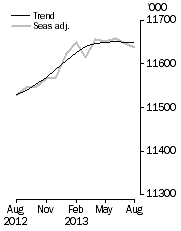
employed persons aug 2013

unemployment rate aug 2013

The left hand picture shows the level of employment and the right hand side the unemployment rate. The one that should be going up is thus going down and the one that should be going down is going up.

This ought to be seen as the benchmark moment with the unemployment rate having returned to its peak level at the height of the Global Financial Crisis. The rate is going to get worse before it gets better but there needs to be some clear recognition that the stimulus was not all that stimulating after all.

The reporter in The SMH is either a regular reader of Instapundit or doesn’t read him at all since he describes this turn of events as “unexpected”. Even the participation rate fell which means things are even worse than the stats actually show.

The economy unexpectedly shed jobs in August, taking the unemployment rate to a fresh-four year high and reviving the chance of a rate cut.

The number of people employed fell by 10,800 from the previous month, when it declined by a revised 11,400, the statistics bureau said today. That compares with expectations of a 10,000 increase. The jobless rate rose to 5.8 per cent from 5.7 per cent. . . .

The number of full-time jobs declined by 2600 in August, and part-time employment fell by 8200, today’s report showed. The participation rate, a measure of the labour force in proportion to the population, dropped to 65 per cent in August from 65.1 per cent a month earlier, it showed.

This is with record deficits and public spending continuing to rise. Needs explanation is all I can say.

[The data and the SMH story first noted by Andrew Bolt.]

The poisonous mind rot of Keynesian economics

The poisonous mind rot of Keynesian economics never seems to go away. I hate to throw an apple of discord into the middle of the party, but this sentence from our new Treasurer should not be allowed to go unremarked. From The Australian today:

Following the election result on Saturday, incoming treasurer Joe Hockey said the Coalition’s victory would encourage consumption. ‘You can go forward and spend your hearts out because we’re going to have a good Christmas,’ he said.

Perhaps I have misjudged what was being said. If the point was that the economy is turning up, real value adding production is going up and you will therefore be able to buy more at Christmas, well OK, although I would not be entirely sure what the point was since in such circumstances you can spend at other times besides Christmas.

But if this is an attempt to get the economy to grow faster through encouraging higher consumer demand, then we are back on the same old Keynesian merry-go-round.

Spending of all kinds draws down on your resource base. Whether it’s by consumers, businesses or government it uses our resources up. Only some of that spending, that drawing down on resources, will eventually add back even more than has been drawn down, and this is almost entirely made up of productive business outlays and innovation that help build the economy.

Not being able to separate the building up from the drawing down is the largest mistake a government can make. Governments can no doubt do all kinds of beneficial things but it should never think that it is making the economy stronger when it is re-distributing the output of industry. The only thing that makes an economy stronger is productive investment, and the benefits do not even occur until the investments are brought on stream and are contributing to the production process. Until then, it is all a negative. It is all drawing down.

I perfectly well understand that Treasury, like economists everywhere, are deluded by the nonsense of Y=C+I+G. Hopefully this government will be different but it won’t be if it believes that strong consumer demand is good for the economy. It is absolutely the other way round. It is a strong economy that is good for consumer demand. The government’s job is to make the economy run better, and if they are going to keep their eye on the ball, it is business investment with a tiny addition of government investment that are the ingredients required. Nothing else will do.

Don’t call me stupid

A fascinating and utterly convincing account of the assessment made of Kevin Rudd’s personality defects and how these were used during the election campaign. From Pam Williams in the AFR:

The Liberal strategy to turn the focus to Rudd’s dysfunction was supported by a secret tactical tool.

Held deep within the top strategy group of the Liberal war room was a document which gave a name and a diagnosis to the personality of Kevin Rudd. It was a document provided to the Liberal’s strategy team on an informal basis by a psychiatrist friendly to the Liberals after Rudd had returned to the Labor leadership on June 26. In a nutshell, this document offered an arm’s-length diagnosis of Rudd as suffering a personality disorder known as “grandiose narcissism”.

The document was not shown to Abbott, but rather remained within the strategy group as an informal check-list, often as a tool for comparison after Rudd had already behaved in ways that the Liberal strategists believed could be leveraged to their advantage. The Liberal war room had reached its own conclusions about Rudd long ago, based on his public behaviour and the damning revelations of his colleagues.

But the document provided an affirmation that the snapshot of the enemy on which a fighting campaign was based had a context. It listed recognisable symptoms and behavioural patterns linking Rudd’s personality to the clinical symptoms for grandiose narcissism – drawing conclusions about Rudd’s mindset. It also proposed tactics to leverage Rudd’s personality.

Describing grandiose narcissism as less a psychiatric disease and more a destructive character defect, the document suggested Rudd was held together by one key strut: an absolute conviction of intellectual superiority over everyone else. “Kick out that strut and he will collapse; basically he is a self-centred two-year-old in an adult body. Prone to wanting everything – now! If not, then he has a two year-old’s tantrum.”

Rudd, the document went on, was vulnerable to any challenge to his self-belief that he was more widely-read, smarter and more knowledgeable than anyone else “on the planet”. Such a condition of grandiose narcissism would make Rudd obsessively paranoid, excessively vindictive – “prepared to wait years to get revenge”, and “a spineless bully” who would strike an easy target; he would predictably be excessively sensitive to personal criticism. If publicly goaded, he could easily have a “mega tantrum”. If described as “stupid”, such a personality would mount an almost impenetrable intellectual defence. If undermined in front of an audience, with his intellect undermined, Rudd could be prone to “narcissistic rage”.

“Later, in attempts to repair the damage, he will claim, in the calmest, coolest and most reasonable way, that his meltdown occurred because those around him are ganging up on him to prevent him from ‘saving Australia’ or some other such grandiose concept.

“Kevin’s explanation for the meltdown will run something like this: ‘Under the difficulties I face trying to save this country from the terrible threats facing it, any reasonable person would have naturally reacted the way I did.’ And then, blah blah, with grandiose ideas of being the country’s saviour.”

Rudd would be threatened by a rival in any of his fields and would be obsessively paranoid and ready to retaliate to real or perceived threats; he would suffer from excessive suspicion. This could be tactically exploited, the document suggested, by promoting the idea that Rudd was merely a caretaker prime minister, to be terminated by colleagues once the election was won.

Inside the Liberal war room the document explained why Rudd “knew best” and “why he had to take over” again as prime minister. And while the document went to explaining behaviour, it also aided the development of pressure points against Rudd – such as pushing the notion that he was full of flimflam, an accusation designed to undermine a superiority complex. The document was a confirmation that many of the tactics and strategic assessments in the war room were on the mark. It crystallised a view of Rudd rather than creating a framework, confirming views of his likely behaviour – a crucial weapon in the psychological warfare of an election campaign.

While Labor fed a storyline (ultimately proved incorrect) that the enemy, Abbott, was so disliked as to be unelectable, the Liberals fed a storyline (ultimately proved correct) that the enemy, Rudd, was so assured of his own superior ability that his campaign would become mired in chaos as he micro-managed and displayed suspicions of those outside his own small cult circle.

The document – simple in its construct and in many ways echoing a view clearly held inside Labor itself where many of Rudd’s colleagues had described him as dysfunctional – raised a riddle no one could answer; if the symptoms were all so obvious and the character flaws so marked, how was it that Labor had chosen Rudd not once, but twice to lead the country?

If Rudd could be interpreted as a grandiose narcissist, then he could not bear to be ignored. He would demand on cue, “Mr Abbott must respond!”

Views on the Australian election

I did the rounds of the usual American news agencies to see what they were saying about our election but aside from saying it was a landslide, there was not much in their writing that I thought captured how we on our side felt had just taken place.

Diplomad 2.0 has the kind of writing on Abbott and the Liberal win that you never see anywhere. It starts from the premise that Labor for the past six years has been a hopeless government. Because unless you start from such a premise, what has just happened before your very eyes makes little sense. Here’s a taste but I, of course, encourage you to read it all:

A big John Howard fan, I admired his blunt speaking, profound patriotism, and willingness to continue the long Aussie tradition of stepping up to defend the West. His rise to power gave me hope that we could avoid four years of Al Gore after eight years of Clinton. Australia, again, proved the land of tomorrow, and we got George W. Bush. I was appalled when Howard’s long run as PM ended and we saw Labor’s Kevin Rudd incumber the office of PM. I saw Rudd more as a European phony than the down-to-earth and very clear-eyed Australians with whom I worked. His kow-towing to the warmist crowd with his signing of Kyoto, and his “apology” for Australia being a great country turned me off completely. I hoped and prayed that Rudd, and his even more bizarre intra-Labor rival, weird Welshwoman Julia Gillard, would not prove a glimpse of what was in store for the USA. This time, Alas! Australia, again, predicted what was to come. We got an inept anti-American Chicago mountebank by the name of Barrack Hussein Obama, who made the shambolic (Note: A great British word!) Rudd-Gilliard-Rudd administration seem like a Swiss railroad in comparison.

And while I’m at it, this was the post from Mark Steyn at National Review he put up on the night.

We get used to not finding our perspectives reflected in the media. And it is not a process of myth making in the normal sense of it’s not being a true reflection of whoever is writing the story. It is an absolutely true reflection. It is just that the people who write the stories do not understand why 53% of the country wanted to see Labor lose. They just don’t get it. They can see that it happened but they can’t explain why, other than as a xenophobic reaction to refugees and the divisions caused by Rudd. That’s why it’s good to read the occasional outside observer who has a take that is similar to our own, just so we can remember the difference when we see it.