
Law of Markets

Dedicated to the economics and politics of the free market

Law of Markets

Compilation of the best reactions to Jordan Peterson/Cathy Newman interview

The first is a compilation of reactions to the Jordan Peterson v Cathy Newman interview on BBC4. The one below is Peterson being interviewed on Fox.

Quotes from the Fox interviews.

His single most important piece of advice: “Stop saying things that make you weak.”

Dealing with critics: “They are not just trying to shut you down but to discredit you. If you are very careful in what you say AND YOU DON’T BACK DOWN ultimately things turn around for you.”

On the question, are you dangerous: “Yeah!” . . . “You should be able to be a monster and then not be one.”

On one form of censorship now very common: “If you are a conservative it is highly probable that your youtube content will be de-monitised. . . . It will not be associated with advertising content” and therefore not be promoted and viewed.

LET ME ALSO NOW ADD THIS: Why Can’t People Hear What Jordan Peterson Is Saying?. An example provided in the article.

Peterson begins the interview by explaining why he tells young men to grow up and take responsibility for getting their lives together and becoming good partners. He notes he isn’t talking exclusively to men, and that he has lots of female fans.

“What’s in it for the women, though?” Newman asks.

“Well, what sort of partner do you want?” Peterson says. “Do you want an overgrown child? Or do you want someone to contend with who is going to help you?”

“So you’re saying,” Newman retorts, “that women have some sort of duty to help fix the crisis of masculinity.” But that’s not what he said. He posited a vested interest, not a duty.

“Women deeply want men who are competent and powerful,” Peterson goes on to assert. “And I don’t mean power in that they can exert tyrannical control over others. That’s not power. That’s just corruption. Power is competence. And why in the world would you not want a competent partner? Well, I know why, actually, you can’t dominate a competent partner. So if you want domination—”

The interviewer interrupts, “So you’re saying women want to dominate, is that what you’re saying?”

And then there is the discussion on the pay gap between men and women, which of course refers to the difference in the averages. An old old story among economists for which the answers are all well known except to those who prefer not to know. But Peterson is a psychologist so takes a very different tack.

The next section of the interview concerns the pay gap between men and women, and whether it is rooted in gender itself or other nondiscriminatory factors:

Newman: … that 9 percent pay gap, that’s a gap between median hourly earnings between men and women. That exists.

Peterson: Yes. But there’s multiple reasons for that. One of them is gender, but that’s not the only reason. If you’re a social scientist worth your salt, you never do a univariate analysis. You say women in aggregate are paid less than men. Okay. Well then we break its down by age; we break it down by occupation; we break it down by interest; we break it down by personality.

Newman: But you’re saying, basically, it doesn’t matter if women aren’t getting to the top, because that’s what is skewing that gender pay gap, isn’t it? You’re saying that’s just a fact of life, women aren’t necessarily going to get to the top.

Peterson: No, I’m not saying it doesn’t matter, either. I’m saying there are multiple reasons for it.

Newman: Yeah, but why should women put up with those reasons?

Peterson: I’m not saying that they should put up with it! I’m saying that the claim that the wage gap between men and women is only due to sex is wrong. And it is wrong. There’s no doubt about that. The multivariate analysis have been done. So let me give you an example––

The interviewer seemed eager to impute to Peterson a belief that a large, extant wage gap between men and women is a “fact of life” that women should just “put up with,” though all those assertions are contrary to his real positions on the matter.

Throughout this next section, the interviewer repeatedly tries to oversimplify Peterson’s view, as if he believes one factor he discusses is all-important, and then she seems to assume that because Peterson believes that given factor helps to explain a pay gap between men and women, he doesn’t support any actions that would bring about a more equal outcome.

Her surprised question near the end suggests earnest confusion:

Peterson: There’s a personality trait known as agreeableness. Agreeable people are compassionate and polite. And agreeable people get paid less than disagreeable people for the same job. Women are more agreeable than men.

Newman: Again, a vast generalization. Some women are not more agreeable than men.

Peterson: That’s true. And some women get paid more than men.

Newman: So you’re saying by and large women are too agreeable to get the pay raises that they deserve.

Peterson: No, I’m saying that is one component of a multivariate equation that predicts salary. It accounts for maybe 5 percent of the variance. So you need another 18 factors, one of which is gender. And there is prejudice. There’s no doubt about that. But it accounts for a much smaller portion of the variance in the pay gap than the radical feminists claim.

Newman: Okay, so rather than denying that the pay gap exists, which is what you did at the beginning of this conversation, shouldn’t you say to women, rather than being agreeable and not asking for a pay raise, go ask for a pay raise. Make yourself disagreeable with your boss.

Peterson: But I didn’t deny it existed, I denied that it existed because of gender. See, because I’m very, very, very careful with my words.

Newman: So the pay gap exists. You accept that. I mean the pay gap between men and women exists—but you’re saying it’s not because of gender, it’s because women are too agreeable to ask for pay raises.

Peterson: That’s one of the reasons.

Newman: Okay, so why not get them to ask for a pay raise? Wouldn’t that be fairer?

Peterson: I’ve done that many, many, many times in my career. So one of the things you do as a clinical psychologist is assertiveness training. So you might say––often you treat people for anxiety, you treat them for depression, and maybe the next most common category after that would be assertiveness training. So I’ve had many, many women, extraordinarily competent women, in my clinical and consulting practice, and we’ve put together strategies for their career development that involved continual pushing, competing, for higher wages. And often tripled their wages within a five-year period.

Newman: And you celebrate that?

Peterson: Of course! Of course!

And so on and so forth.

AND THEN THERE’S THIS:
The Marxist takeover of our schools should make you really really worry

My favourite Canadian website by a long long way is Small Dead Animals. You should make it a permanent rest stop as you go through your skiing the web (it does originate from Saskatchewan).

A couple of related pieces from today, both worth reading along with everything else, which you will have to link to SDA to find. But first these two, on the taking down of our education system by Marxist know-nothings. They are as ignorant as it is possible to be, entirely ideological in their thinking, with minds so filled with empty slogans and manufactured facts that they have almost no ability to understand what others are saying. Carefully considering what others have to say is the last thing any of them ever do. Indoctrination is all they know: reasoned debate never. Two examples below.

SDA regular Ken Kulak left a brilliant comment earlier that everyone should read:

There are many great comments above.
If I may add my two cents. No doubt some of you might think One Trick Kulak. While reading and listening to the material presented by Robert the thought occurred to me that I have seen this before, not literally, but on paper.

Not to brag or blow my horn, but I have close to 200 Russian history books in my library. Almost all are by recognized historians who are or were recognized authorities in their field of study. Some like Richard Pipes were advisors to governments during the cold war. I have read everyone of those books and parts of some more than once and have been used as background resource material for the four family history books I have written.

What has been happening in our universities across North America to stifle free speech and any opposing views to the entrenching of Marxism and seems to be escalating in intensity. Thank goodness there are a few brave warriors like Jordan Peterson and Lindsay Shepard and possibly others attempting to stem the flood.

However, the increasingly more open Marxist controlled events in our higher learning schools is not new. The same thing happened 100 years ago in Russia. What has and is happening in our schools has just been slower, more subtle, and thus more insidious in nature.

Prior to the Russian revolution there was a covert socialist/Marxist/Bolshevik presence in Russian universities. After Russia entered the Great War the agitation in the schools increased and became more overt in the late fall of 1916. When the February revolution broke out and was successful the radical left took over all the schools. Then, after the Bolshevik coup, the effort to expel any opposition by professors and students began, and by the spring of 1918 the Bolsheviks took direct control of the schools.

The troika that Lindsay experienced was the standard method of operation and control in the schools and enforced by the Komsomol under the direction of the education commissary.

So, what happened in Russia in a relatively short time frame has been happening here slowly over a couple of decades and basically come out into the open only recently.

Make no mistake, after they shut up Jordan and Lindsay they will get around to shutting us up. Bill M-103 and the federal refusal to help pay for summer student help unless you tick off the box expressing obedience to full on abortion is all a part of turning up the heat on the pot with the frog in it.

Let’s hope a sufficient number of Canadians will seize the warnings that the likes of Ken and Jordan Peterson and Mark Steyn have been proffering for years. The sheeple are likely too far gone with the “Progressive” indoctrination to wake up though.

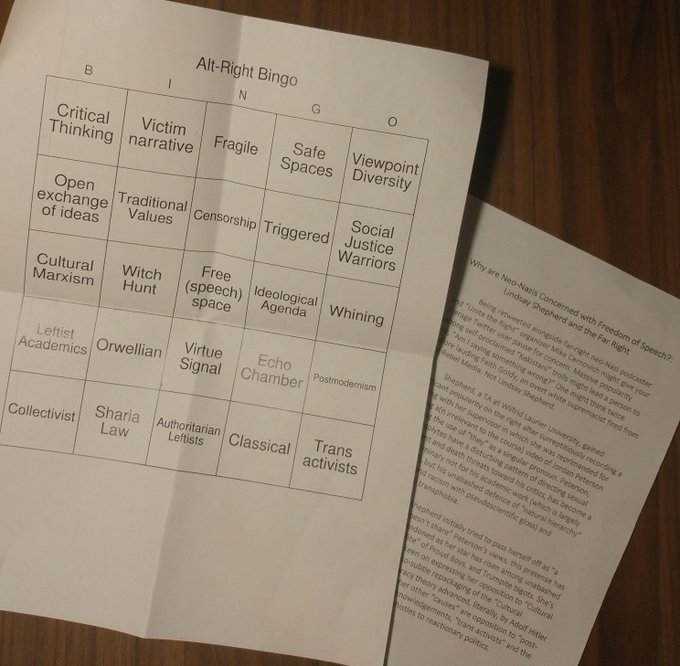
And then there’s this. I take it that “alt-right bingo” is played by these post-modernist clowns with the notion being that you get a space filled in every time one of these ridiculous notions is mentioned, you know, things like “Orwellian”, “virtue signalling”, “ideololgical agenda” and my special favourite, “classical”. Anyway, you’ll see for yourself.

Yesterday Lindsay Shepherd posted a very interesting tweet:

Some literature handed out at the panel discussion I was on at @smuhalifax today. The bingo is kind of funny, but it is a SEVERE mistake for these activists to associate terms such as “critical thinking”, “viewpoint diversity”, and “open exchange of ideas” with the alt-right.

A supporter of hers published a related video.

The “Alt-Right Bingo” game the leftists in the audience were playing seems to imply that they think it is hilarious, and cause for derision, to talk about these things:

  • Critical thinking
  • Viewpoint Diversity
  • Open exchange of ideas
  • Traditional values
  • Free speech space

These people apparently grew up in Canada but clearly don’t hold anything resembling Canadian values.

And the same unfortunately also goes for Australia.

More comment on that interview

Karen Straughan’s Take on Jordan Peterson’s Channel 4 Interview. It lasts 38 minutes but never wavered for a moment. So much to get and she gets it very well. Interesting first comment by Karen Straughan in the youtube comments:

Within ten minutes of this video going up, Channel 4 had hit me with a copyright takedown. I filed a dispute based on fair use and it’s now viewable again, but have lost my monetization privileges on this video for up to 30 days, the fuckers.

The beeb didn’t want to see their shame spread any farther, but too late for that. Good to know that the BBC is embarrassed by the interview, and so they should be.

Via Small Dead Animals

FACEBOOK RESPONSE: A mate of mine put this post up on Facebook and this is the note I just received from him:

Facebook just marked as spam my post of your post

I’m not on Facebook so I don’t know how any of it works, but the response time had to have been less than an hour. These people are evil, genuinely evil.

This is what cultural liars like to say: everything you believe is a lie that only benefits the ruling class

The Jordan Peterson interview by Cathy Newmann continues to resonate through the right-side of the internet. I have seen a number of discussions of which this is one: Jordan B Peterson, Critical Theory, and the New Bourgeoisie. Here’s how it starts but the main point is about Cultural Marxism which I will get to after the prelims:

Earlier this week, clinical psychologist Jordan B. Peterson appeared on Britain’s Channel 4 in an interview with TV journalist Cathy Newman. It didn’t go well. Journalist Douglas Murray described it as “catastrophic for the interviewer”, while author Sam Harris called it a “nearly terminal case of close-mindedness”. Sociologist Nicholas Christakis perhaps described it best:

This man @jordanbpeterson is preternaturally calm and composed in the face of a hostile interviewer who also had simply not thought adequately about her ideas and approach. Facts and reason are powerful allies. https://blogs.spectator.co.uk/2018/01/watch-cathy-newmans-catastrophic-interview-with-jordan-peterson/ 


So onto Critical Theory, about which we find this.

Critical Theory draws heavily on Karl Marx’s notion of ideology. Because the bourgeoisie controlled the means of production, Marx suggested, they controlled the culture. Consequently, the laws, beliefs, and morality of society reflected the interests of the bourgeoisie. And importantly, people were unaware that this was the case. In other words, capitalism created a situation where the interests of a particular group of people—those who controlled society—were made to appear to be universal truths and values, when in fact they were not.

The founders of critical theory developed this notion. By identifying the distorting effects power had on society’s beliefs and values, they believed they could achieve a more accurate picture of the world. And when people saw things as they really were, they would liberate themselves. “Theory,” they suggested, always serves the interests of certain people; traditional theory, because it is uncritical towards power, automatically serves the powerful, while critical theory, because it unmasks these interests, serves the powerless.

All theory is political, they said, and by choosing critical theory over traditional theory one chooses to challenge the status quo, in accordance with Marx’s famous statement: “Philosophers have hitherto only interpreted the world in various ways; the point is to change it.”


And it is the central point of virtually all modern university thought which Peterson represents the movement away from.

The identity of the group providing the intellectual foundation for both critical theory and the social justice movement are mostly white middle-and-upper-class intellectuals from the political left in advanced Western economies. It may be more illuminating to see this group’s interests as the driving force of societal change, rather than those of the ever-changing group of the powerless. In effect, the intellectuals of the political left are creating the type of society they personally want to live in. ‘The powerless’ are temporary allies on this journey.

Not only are they temporary allies, but they are unwilling allies as well. Brexit and the election of PDT are two examples of which many more are likely to follow.

To become a Swiss citizen refugees must first repay all of the welfare money they received

Self-reliance is an old idea from well before the creation of capitalist economies and democratic states. So here’s a thought that others might think about: Switzerland Rejects Citizenship Bids Of Residents Who Were Once On Welfare.

Switzerland doesn’t mess around.

The idyllic nation — where the average annual GDP per capita is nearly $80,000 — doesn’t like deadbeats. The nation recently enacted a new civil rights act that prevents residents who received welfare benefits from becoming citizens until they pay back the money they took.

The new regulations took effect January 1. Asylum seekers and refugees who received handouts in the previous three years can’t become permanent residents without paying back the government.

What’s more, refugees must prove they are making efforts to integrate into society in order to win citizenship. They must show that have “cultivated contacts” with a number of Swiss people, according to Kronen Zeitung. There are also new language requirements, which vary depending on the canton they are living in, the Daily Mail reports.

Via Zylocast on an open thread.

How do you deal with people who know all the answers before they hear the questions?

This is the most significant political problem of our time. The left are on the left because of a will to believe, but have virtually never had a political success other than by taking the reins of power which they quite often do, and not always peacefully either. They have imposed their will time and again because they often temporarily have the numbers, but are removed as soon as possible – which is often not very soon at all – since their beliefs create neither wealth nor freedom.

The outcome has been that no one on the left is any longer willing to debate since they have run out of arguments because virtually everything they say and do has a proven history of failure. And so the question has become, is it worth trying to convince people on the left who never listen to what anyone else says? Is it worth trying to show how markets work better than government direction, for example, or that there is no evidence of the existence of global warming? How do you deal with people who think that Barack Obama was worth electing president, or now even Oprah for heaven’s sake? It is the greatest problem of our day, and may yet lead to the collapse of our Western way of life. Anyway, I came across the brief schematic that I think sums up quite a bit.

Conservative, AKA Normal People = facts, analysis ——-> conclusion.

Liberals AKA Walking Nerve Endings = feelings, conclusion ——> rationalization

They are not “stupid” in the normal sense, political idiots though they are. They cannot learn from history because they do not want to, because history continuously demonstrates the dangers and vacuity of their ideas. If anyone ever works out how to get past the barricades they put up to protect their political prejudices from examination, they will save the world from a good deal of grief. In the meantime, we have to find ways to barricade ourselves from the destruction they cause whenever they achieve political control. There is always another Venezuela just around the corner if these people cannot be made to see how things really are, and that next Venezuela might be right where you happen to live right now.

Capitalism is the only economic system that works

Wandering through the city’s bookshops yesterday I came across this: Is Capitalism Obsolete? with the subtitle, “A Journey through Alternative Economic Systems”. I live in hope that there will be at least one volume somewhere that has no for an answer. Haven’t seen anything in years. The above is my picture of the back cover. If you read how they advertise the book, you will find the least unexpected turn in the history of modern publishing.

After communism collapsed in the former Soviet Union, capitalism seemed to many observers like the only game in town, and questioning it became taboo for academic economists. But the financial crisis, chronic unemployment, and the inexorable rise of inequality have resurrected the question of whether there is a feasible and desirable alternative to capitalism. Against this backdrop of growing disenchantment, Giacomo Corneo presents a refreshingly antidogmatic review of economic systems, taking as his launching point a fictional argument between a daughter indignant about economic injustice and her father, a professor of economics.

Is Capitalism Obsolete? begins when the daughter’s angry complaints prompt her father to reply that capitalism cannot responsibly be abolished without an alternative in mind. He invites her on a tour of tried and proposed economic systems in which production and consumption obey noncapitalistic rules. These range from Plato’s Republic to diverse modern models, including anarchic communism, central planning, and a stakeholder society. Some of these alternatives have considerable strengths. But daunting problems arise when the basic institutions of capitalism—markets and private property—are suppressed. Ultimately, the father argues, all serious counterproposals to capitalism fail to pass the test of economic feasibility. Then the story takes an unexpected turn. Father and daughter jointly come up with a proposal to gradually transform the current economic system so as to share prosperity and foster democratic participation.

Capitalism means a system of production in which the ownership of firms is in the hands of private individuals who use the capital they buy, rent or own, while directing the employees they hire, to produce goods and services in a lawful way to sell what they have produced to others in order to earn a profit for themselves. There are lots of variations on the theme but that is essentially it. Nothing else has ever worked, nothing else will ever work, however many fools and their fictional daughters there may be who think they have come up with something else.

A grasshopper’s view of an ancient fable

An ancient fable updated by Karabar. As he says: “This one is a little different. Two Different Versions. Two Different Morals.” First the original, then the modern.

OLD VERSION:

The ant works hard in the withering heat all summer long, building his house, and laying up supplies for the winter.

The grasshopper thinks the ant is a fool and laughs and dances and plays the summer away.

Come winter, the ant is warm and well fed. The grasshopper has no food or shelter, so he dies out.

MORAL OF THE OLD STORY: Be responsible for yourself!

That’s the story that we have been telling each other for 2500 years. Does it get told any more? Who knows, but that is how things look from the perspective of the ant. We now need to see things from the perspective of the grasshopper.

MODERN VERSION:

The ant works hard in the withering heat and the rain all summer long, building his house and laying up supplies for the winter. The grasshopper thinks the ant is a fool and laughs and dances and plays the summer away.

Come winter, the shivering grasshopper calls a press conference and demands to know why the ant should be allowed to be warm and well fed while he is cold and starving.

Their ABC, the Fairfax Press, Getup, and Crikey show up to provide pictures of the shivering grasshopper next to a video of the ant in his comfortable home with a table filled with food. Australia is stunned by the sharp contrast.

How can this be, that in a country of such wealth, this poor grasshopper is allowed to suffer so?

Kermit the Frog appears on ABC News with Sally Sara and Wendy Harmer along with the grasshopper and everybody cries when they sing, ‘It’s Not Easy Being Green.’ Fran Kelly sings Kumbaya with the Grasshopper and his mates at Breakfast on RN.

Getup stages a demonstration in front of the ant’s house where the news stations film the group singing, ‘We Shall Overcome.’

Then, Sarah Sea Patrol has the group kneel down to pray for the grasshopper’s sake. Jay Weatherill condemns the ant and blames Prime Minister Turnbull, former PM Tony Abbott, Josh Frydenberg, Eric Abetz, Kevin Andrews, George Christensen, and Craig Kelly for the Grasshopper’s’ plight.

Tony Burke and Bill Shorten explain in an interview with Sarah Ferguson that the ant has gotten rich off the back of the grasshopper and both call for an immediate tax hike on the ant to make him pay his fair share.

Finally, the ALP and the Greens in the senate draft the Economic Equity and Anti-Grasshopper Act retroactive to the beginning of the summer.

The ant is fined for failing to hire a proportionate number of green bugs and having nothing left to pay his retroactive taxes, his home is confiscated by the Queensland’s Palace Cook, and given to the grasshopper.

The story ends as we see the grasshopper and his free-loading friends finishing up the last bits of the ant’s food while the government house he is in, which, as you recall, just happens to be the ant’s old house, crumbles around them because the grasshopper doesn’t maintain It.

The ant has disappeared in the Snowy Mountains never to be seen again.

The grasshopper is found dead in a drug related incident, and the house, now abandoned, is taken over by a gang of spiders who terrorize and ramshackle the once prosperous and peaceful neighbourhood.

The entire nation’s economy collapses bringing the rest of the free world with it.

MORAL OF THE STORY:

Be careful how you vote in the next election.

You may wish to pass this on to other ants, but don’t bother sending it on to any grasshoppers because they wouldn’t understand it, anyway.

AND THE STORY CONTINUES: from Ricky Gervais via mh, this time involving mice.

Does one learn by doing or by thinking?

Not exactly the right question since everyone supports government solutions to some things, but the question is still a genuine one: Why Do Intellectuals Support Government Solutions?. I found the link at Instapundit where, not for the first time, the wisdom came from the comments. Let me put up some of it:

” Why Do Intellectuals Support Government Solutions?”
.
A better question: If they support government solutions, are they really intellectuals? Thought intellectuals were more like people who think for themselves. Perhaps not though.


  • Thomas Sowell put it this way: Intellectuals are people whose work product is ideas.

    People in the trades make, install, maintain and repair stuff, and they cannot conceal failure with weasel-words and polysyllabic redefinitions of success and failure.

    People in the physical sciences study reality and in the end their research is either supported or refuted by reality.

    People in the various fields of the humanities produce ideas which whose value and validity are not tested against reality but rather against such criteria as novelty and cleverness and newness–and, of course, progressives. This is maximally true in the grievance studies fields which are designed to promulgate falsehood, a bit less true in literature and philosophy, somewhat less true in sociology and other soft subjects where a talent for blather can replace reasoning, and somewhat true in history where there is seemingly endless room for interpretation but falsehoods can nonetheless be refuted with facts and interpretations can be challenged similarly. So yes, these people who support maximal government power are intellectuals, but bad intellectuals and bad people.


    • Sowell also says ideas are not knowledge, but only potential knowledge.


    • Robert Nozick explained it this way (there is no summation paragraph, it’s a short essay so you might want to read the whole thing):

      The intellectual wants the whole society to be a school writ large, to be like the environment where he did so well and was so well appreciated. By incorporating standards of reward that are different from the wider society, the schools guarantee that some will experience downward mobility later. Those at the top of the school’s hierarchy will feel entitled to a top position, not only in that micro-society but in the wider one, a society whose system they will resent when it fails to treat them according to their self-prescribed wants and entitlements. The school system thereby produces anti-capitalist feeling among intellectuals. Rather, it produces anti-capitalist feeling among verbal intellectuals. Why do the numbersmiths not develop the same attitudes as these wordsmiths? I conjecture that these quantitatively bright children, although they get good grades on the relevant examinations, do not receive the same face-to-face attention and approval from the teachers as do the verbally bright children. It is the verbal skills that bring these personal rewards from the teacher, and apparently it is these rewards that especially shape the sense of entitlement.

      That is a classic essay that should be cited frequently. Another passage:


      “By intellectuals, I do not mean all people of intelligence or of a certain level of education, but those who, in their vocation, deal with ideas as expressed in words, shaping the word flow others receive. These wordsmiths include poets, novelists, literary critics, newspaper and magazine journalists, and many professors. It does not include those who primarily produce and transmit quantitatively or mathematically formulated information (the numbersmiths) or those working in visual media, painters, sculptors, cameramen. Unlike the wordsmiths, people in these occupations do not disproportionately oppose capitalism. The wordsmiths are concentrated in certain occupational sites: academia, the media, government bureaucracy.”

And I found this thread even more remarkable since its conclusion was so unexpected although perfectly sound when you thought about it.

Why Do Intellectuals Support Government Solutions?

Because in a meritocracy there are no excuses.

Update: Of course, there’s always the following view of intellectuals as pottery students, which kinda comes to the same conclusion through the back door, or in this case the “left side” of the studio:

The ceramics teacher announced on opening day that he was dividing the class into two groups. All those on the right side of the studio, he said, would be graded solely on the quantity of work they produced, all those on the left solely on its quality.

His procedure was simple: on the final day of class he would bring in his bathroom scales and weigh the work of the “quantity” group: fifty pound of pots rated an “A”, forty pounds a “B”, and so on. Those being graded on “quality”, however, needed to produce only one pot -albeit a perfect one – to get an “A”.

Well, came grading time and a curious fact emerged: the works of highest quality were all produced by the group being graded for quantity. It seems that while the “quantity” group was busily churning out piles of work – and learning from their mistakes – the “quality” group had sat theorizing about perfection, and in the end had little more to show for their efforts than grandiose theories and a pile of dead clay.

  • Interesting, if true.

    • I read that in a journal sometime in the last decade or so. As I recall, the kids who were graded on quantity ended up, by the end of the term, producing work of significantly higher quality than the group that was told they would be graded on quality. It’s not that the kids graded on quality produced nothing good, but the kids graded on quantity typically produced much better work and lots of it.

      Also: A Classics professor ascribed the stunningly high quality of Classical Greek art to (at least in part) Greece’s foreign trade with Egypt (and elsewhere): vast numbers of jars of olive oil and wine, each of which was decorated with painted designs and scenes.

      •  

        Totally get it. My degree’s in Applied Physics and Electronics, with the emphasis on “Applied.”

        Lots of marks for working experiments, not so much for purely thought experiments.

        That’s one reason why, whenever an opportunity comes up to do something new at work, I’m all over it. Even if I screw up the first couple of attempts, I eventually get it right, and then know the pitfalls and blind alleys.

        It’s also the reason I prefer Howard to Sheldon, though my wife says I’m a Sheldon, through and through.

        • You can’t be a total Sheldon if found a woman who wanted to marry you. Howard is also passionately interested in doing physics, he’s just more socially clued in and for that matter more kind and loving.

          I know lots of scientists and engineers, and they (we) tend to fall somewhere on the asperger’s spectrum, being more skilled with things than with people. But some of us are very skilled at both, and few of us are interested in comic books and cosplay and the other goofy things that are the basis for so many jokes in the Big Bang Theory.

          Engineers know that you become a good engineer by doing lots of engineering: Often this involves making mistakes and understanding why they were mistakes. It also involves, without necessarily making mistakes, applying the lessons you were taught until you have internalized those lessons into how you “instinctively” study a problem and formulate a solution. Classes and textbooks only teach you the basics: You don’t really become good at it by doing lots of it, and there are lots of lessons in how to do good engineering.

The truth is out there

Front page top story at Drudge: Dustin Hoffman Accused of Exposing Himself to a Minor, Assaulting Two Women. Here is the key sentence:

Thomas was 16 years old and a high-school classmate of Hoffman’s daughter Karina at the United Nations International School in New York when she met the actor in 1980.

Two contrasting views from the comments:

Both stories read like a scripted play. Taking chances, by being caught because other people were close or at the scene, would be foolish. Hoffman is no fool or pervert,or thrill seeker, the ME2 crowd has room for more accusers and I think it is more contrived stories. Fame and fortune make people lie and defame others because their personalities are lacking. One shark attacks and then barracudas move in. A feeding frenzy is all, it is. My Opinion.

Too many accusers for this to be untrue. He’s 80. Time to fade away, never to be seen or heard from ever again.

With one more added detail from the story:

Thomas didn’t share the story of her encounter with Hoffman until seven years after it allegedly occurred, when her daughter was born. She told a family member — who confirmed to Variety having heard the story some time in the 1980s — and several close friends.

Might actually mention that the original headline at Drudge was “DUSTIN HOFFMAN’S 16-YEAR-OLD ACCUSER”. In fact, since she was 16 in 1980, she is actually Dustin Hoffman’s 53-Year-Old accuser but for some reason that is not how the story is being played.

All of which, for some reason, brings this to mind: 13 Alien Encounters That Will Make You Believe. As the subtitle says, “the truth is out there”.