Jordan Peterson discusses the crumbling walls of Western Civilisation

Although I am a graduate of the University of Toronto, that’s not why this interests me so much: Jordan Peterson: Why I am no longer a tenured professor at the University of Toronto. Universities are no longer safe territories for anyone other than those on the committed left. It’s an old story by now, but if even a Jordan Peterson is no longer seen as an esteemed colleague in what was Canada’s best university, then no one is. Here are a few highlights from what he has to say.

I had envisioned teaching and researching at the U of T, full time, until they had to haul my skeleton out of my office. I loved my job. And my students, undergraduates and graduates alike, were positively predisposed toward me. But that career path was not meant to be. There were many reasons, including the fact that I can now teach many more people and with less interference online. But here’s a few more.

First, my qualified and supremely trained heterosexual white male graduate students (and I’ve had many others, by the way) face a negligible chance of being offered university research positions, despite stellar scientific dossiers….

Second reason: [The] many issues of appalling ideology currently demolishing the universities and, downstream, the general culture….

Furthermore, the accrediting boards for graduate clinical psychology training programs in Canada are now planning to refuse to accredit university clinical programs unless they have a “social justice” orientation….

And if you think DIE is bad [“Diversity, Inclusivity and Equity mandates (my preferred acronym: DIE)”] , wait until you get a load of Environmental, Social and Governance (ESG) scores . Purporting to assess corporate moral responsibility, these scores, which can dramatically affect an enterprise’s financial viability, are nothing less than the equivalent of China’s damnable social credit system, applied to the entrepreneurial and financial world. CEOs: what in the world is wrong with you?…

Finally, do you know that Vladimir Putin himself is capitalizing on this woke madness?… It may come as a surprise to some people, but Russia has been there already. After the 1917 revolution, the Bolsheviks, relying on the dogmas of Marx and Engels, also said that they would change existing ways and customs, and not just political and economic ones, but the very notion of human morality and the foundations of a healthy society….

And all of you going along with the DIE activists, whatever your reasons: this is on you. Professors. Cowering cravenly in pretence and silence. Teaching your students to dissimulate and lie. To get along. As the walls crumble. For shame.

Jordan Peterson is near unique, not so much in his views but in his prominence in spite of his views. How long he can withstand the pressure we shall only eventually see, but the ruin that others are trying to bring into his life is an all-too vivid example of how one’s life can be completely ruined if one does not toe the line.

How to identify intelligence in other people

This is from Quora: How can you tell if someone has a high IQ? The answer was supplied by Bruno Campello de SouzaProfessor at Federal University of Pernambuco. He sensibly shied away from identifying high intelligence with high IQ. Although they may be related, they are not the same. This was his answer.

There are observable signs of intelligence that tend to be more easily spotted by those with higher IQ than by those with lower ones. The saying below may sound obnoxiously elitist, but it does seem to hold:

Mediocrity knows nothing higher than itself, but talent instantly recognizes genius. – Sir Arthur Conan Doyle

Having said that, in no particular order, the signs that one is interacting with a person that has a very high level of intelligence include perceiving in that person:

  • An appetite for information and knowledge, which includes not only curiosity, but also a veritable “need” for intellectual stimulation;
  • The ability to quickly understand your arguments without the need for much explanation, perhaps even anticipating the final conclusion before you get to it;
  • Identifying interesting implications and consequences of your arguments that you yourself had not considered;
  • Displays of rapid perception, strong learning capacity, and substantial problem-solving abilities;
  • A broad scope and/or depth of knowledge;
  • The ability to perceive and appreciate the relevant talents and accomplishments of others.

When you see most of these signs in someone, you can tell that they are an intellectual “force to be reckoned with”.

The comments that follow his post are also worth a look. There is also this further posting by Professor Campello de Souza: Are more intelligent people more likely to be alone. The post begins:

In a study with 1,383 adults from Pernambuco, Brazil, IQ was negatively associated to both Extraversion and Agreeableness.

He speculates that the following characteristics may be in play.

  • With a higher IQ, there is a tendency for a higher level of working memory and also long-term recall, as well as speed of processing, which grants the ability to generate more and better mental imagery, thereby creating an incentive for “daydreaming” or “zoning out” (think of having your own personal “mental holodeck”);
  • IQ is, by definition, the capacity to deal with abstract thinking, making the intellectually gifted more prone to detach from concrete experiences;
  • The things that many of the Gifted are most interested in are not the things that attract the vast majority of people, the same happening with their life and work experiences, so that the highly intelligent may not find much in common with the majority of people and vice-versa;
  • Being a minority by definition, a relevant portion of the Gifted might be the object of prejudice, making them more prone to withdrawing from social interactions and/or being less inclined to be less empathetic or altruistic;
  • The differences in the size and breadth of vocabulary between the Gifted and most people might make communication more difficult or cumbersome;
  • The Gifted can, at times, become frustrated, impatient or irritated with the slower and/or more limited intelligence of normal individuals, something which can come from elitism, self-importance, sense of superiority and even Narcissism, but can also arise from honest exhaustion from continuously having to wait for, explain to, correct, and accept errors from most of the people one interacts with.

Economic and social reality in a few pics

These are a few graphical representations of something called reality but these are merely statistics which seem to conform with my own view of how things actually are.

I particularly like this one since it demonstrates how useless any composite measure of economic performance is. Comparing today with a century ago using some measure like GDP is beyond full-on empty. 

Then there is this which is inexplicable to no one even though there will be some who pretend to find it incomprehensible.

Finally, I wrote a children’s book one time – Economics for Infants – which explains how governments do not care about any of us whatsoever. My aunt read it to her five year old grandson who had a virtual nervous breakdown crying jag on being told this. My own granddaughter, also five, read it herself and now apparently quotes this to everyone else. She will be so far ahead of the curve as she grows up. But this is the truth.

By the way, there is much more in Economics for Infants than just that. Highly recommended, mostly for children, but also for some adults as well.

These statistical pictures, by the way, came via Powerline’s Geek in Pictures.

Economists are the last people you should ever ask to design an industrial relations system

Went out to dinner a few nights ago and out of nowhere found myself in an argument about industrial relations. Having been involved in one National Wage Case after another, even having presented the employer economic submission on a number of occasions, after having written many others before that, this was an issue close to my heart. And here is my central conclusion having represented employers in so many forums over so many years:

The free market system depends for its survival on providing buffers between buyers and sellers and between workers and employers.

Leaving such matters “to the market” as it is often put is certain to end in some kind of socialist/anarchist revolution which would not be long in coming. The notion that someone who successfully manages a business enterprise is in any way evidence that such a person is actually in any way morally superior is absurd. They may put their own capital at risk, or perhaps it is the capital they have borrowed that has been put at risk, but beyond that, there is no evidence of superior virtue and moral authority of the entrepreneur. There must therefore be laws and regulations in place to create industrial peace as best as a community is able.

That there must be some kind of wage setting process in place has been discovered by every market economy that has ever existed. No one agreed with me, but what’s new about that?

These were then my morning-after thoughts following this conversation. The central issue was whether Australia’s system of conciliation and arbitration, which embeds a minimum wage adjustment process, is consistent with good economic theory and practice. That virtually no economist thinks this is true only shows what a useless preoccupation economic theory has become.

———————
Tampering with the employer-employee relationship that leaves employees without any recourse to the actions of employers will not work anywhere. And I am conservative enough to recognise that a system that has evolved over more than a century embeds within it all kinds of features that no one can identify but which make it work out there in the real world.


The market system depends for its existence on institutions that buffer the relationships between businesses and their customers and between employers and their employees. This is the Australian system.

So let me begin. Even more than ever I was reminded that economists know almost nothing worth knowing about the practicalities of running an economy, and this is shown in spades in their thoughts, such as they are, about industrial relations. The last thing that will work is “to leave it to the market” where union power exists, and where socialist trouble makers are to be found at every turn. So I did the tiniest bit of research when I came home, and was amazed I still remembered where to look, given that I have not been personally involved in any of this for eighteen years.

The Fair Pay Commission

First there was The Fair Pay Commission. How did I even remember its name? And what a name! It might as well have been “The Just Price Commission”. Australia’s IR system was in its origins designed “to prevent and settle industrial disputes” that ranged beyond the compass of a single state. Being fair to both employers and employees was obviously a necessary ingredient if it were to function, but that was not its purpose. The aim was to provide a structure to encourage industrial peace.


“Fair pay” is not a market principle. Do economists nowadays discuss “fair” prices? The discussion of The Fair Pay Commission at the link is a generally sympathetic account, andgets the story mostly the way I remember it. There we find under the heading “2006 decision”:

On 26 October 2006, the Commission handed down its first decision. The Commission’s media release stated: The Australian Fair Pay Commission today announced an increase of $27.36 per week in the standard Federal Minimum Wage and in all Pay Scales up to $700 per week. This covers just over one million Australian workers who rely on the Commission’s decisions for adjustments in their wages.

The Commission also awarded an increase of $22.04 per week to all Pay Scales paying $700 per week and above, or more than $36,000 per year, representing another 220,000 workers, about 2% of the workforce.

In hourly terms, the Australian federal minimum wage increased to $13.47 per hour (for workers on pay scales of less than $700 per week), with effect from 1 December 2006….


Many commentators were surprised the Commission’s first decision was so generous. For example, the Australian Council of Trade Unions had asked for a minimum wage increase of $30 per week.

An absurd decision which virtually granted the entire ACTU claim in full. “Surprised” is not the word for such an extravagant decision based on nothing whatsoever, and certainly neither on economic sense nor industrial need. And just for the record, let me mention who were the members of the FPC who had made this decision.


The inaugural chairman of the Commission was Professor Ian Harper and there were four commissioners: Hugh Armstrong, Patrick McClure AO, Mike O’Hagan, and Honorary Professor Judith Sloan.

Work Choices

Work Choices was the name given to changes made to the federal industrial relations laws in Australia by the Howard Government in 2005, being amendments to the Workplace Relations Act 1996 by the Workplace Relations Amendment (Work Choices) Act 2005, sometimes referred to as the Workplace Relations Amendment Act 2005, that came into effect on 27 March 2006.

This is how it is described.


In May 2005, Prime MinisterJohn Howard informed the Australian House of Representatives that the federal government intended to reform Australian industrial relations laws by introducing a unified national system. WorkChoices was ostensibly designed to improve employment levels and national economic performance by dispensing with unfair dismissal laws for companies under a certain size, removing the “no disadvantage test” which had sought to ensure workers were not left disadvantaged by changes in legislation, thereby promoting individual efficiency and requiring workers to submit their certified agreements directly to Workplace Authority rather than going through the Australian Industrial Relations Commission. It also made adjustments to a workforce’s ability to legally go on strike, enabling workers to bargain for conditions without collectivised representation, and significantly restricting trade union activity.

I was also long gone from involvement with the system by then so just watched from the sidelines. This is where it ended up.


WorkChoices was a major issue in the 2007 federal election, with the Australian Labor Party (ALP) led by Kevin Rudd vowing to abolish it. Labor won government at the 2007 election and repealed the whole of the WorkChoices legislation and replaced it with the Fair Work Act 2009.
The FWA was a disaster and I did a lot of work on trying to overturn it working with various IR organisations. Not mentioned, for some reason, is that not only did Labor win, but John Howard lost his own seat, the only time other than in 1929 this had happened, which also happened to be the only previous occasion when a government had tried to get rid of the Federal industrial relations system. Lots of detail at the link, but this is where it comes down to.


The Australian Government stopped using the name “WorkChoices” to describe its industrial relations changes on 17 May 2007. Workplace Relations Minister Joe Hockey said the brand had to be dropped due to the union and community campaign against the WorkChoices laws. “It has resonated because it has been the most sophisticated and articulate political campaign in the history of this country.” The ACTU countered that the name may have changed but the laws were the same. The Government did not rename the brand, but did launch a new advertising campaign that did not refer specifically to WorkChoices.

And the political washup.

Howard’s successor as leader of the Liberal Party, Brendan Nelson declared that his party has “listened and learned” from the Australian public. He also declared that WorkChoices was “dead” and would never be resurrected as part of Coalition policy, and called on Rudd to move quickly to introduce draft industrial relations legislation. Former IR minister Joe Hockey said the laws “went too deep” but were introduced with “the best intentions”. “As I said yesterday and I’ve said since election day, WorkChoices is dead, and there is an overwhelming mandate for the Labor Party’s policy of tearing up WorkChoices,” he said.And from the sidelines:

Former Prime Minister John Howard broke his post-election silence in March 2008 by attacking Rudd’s industrial relations policy while defending WorkChoices.

Tampering with the employer-employee relationship that leaves employees without recourse to the actions of employers will not work anywhere. And I am conservative enough to recognise that a system that has evolved over more than a century embeds within it all kinds of features that no one can identify but which make it work out there in the real world. 

The market system depends for its existence on institutions that buffer the relationships between businesses and their customers and between employers and their employees. This is the Australian labour-relations system. No one will think of dismantling it any time soon. There may well come a time, but it won’t be in any time soon. 

The meaning of leisure

This is a quite interesting article whose story is not quite revealed by its title, The Value of Work. Let me provide some of the text as a way to encourage you to read it all. It is about the US but has implications everywhere. It seems that people want more from their jobs than just a means to pay the bills, which hardly surprises me since that is what I wanted myself.

It seems 2021 was the year of “footloose and fancy-free.” That’s the impression one would get, at least, from employment trends. Almost 39 million Americans said “au revoir” to their employers in 2021. September alone saw a record-breaking 4.4 million employees voluntarily quitting their jobs. Labor economists are still busy crunching numbers, trying to make sense of this “Great Resignation.”…

My age cohort [late 30s early 40s] is extremely confused about work. Throughout our lives, we have struggled to answer the most basic questions about its meaning and significance. Why do human beings work? What sort of work is most fulfilling and honorable? What do dedicated workers deserve, from employers, the state, or society at large?…

When people expect work to fulfill their deepest hopes and dreams, reality will generally disappoint. This may partly explain why an event like Covid could trigger a flurry of resignations. Even if their current jobs are acceptable, workers want more. Why settle for a job that merely pays the bills, when things could be so much better?…

If the Great Resignation has taught us anything, it is this. No one fully understands what is happening in American labor markets. Our economy is still changing rapidly, but that’s not the only variable. Workers are changing too. Both conservatives and liberals are coming to see the defects in the paradigms that dominated their approach to labor across the last 40 years.

But no matter how you slice it, if we are going to go to cafes and travel the world people will need to work behind the scenes to allow it to happen. Even a day at the beach requires an enormous collective communal effort. Work can give a person meaning, but there are other ways to make sense of one’s life as well. We are not yet in an automated world where human effort can be reduced to a minimum.

But it may be coming and sooner than we might think.


If laughter is the best medicine, will it cure Covid?

This is from Donna Laframboise via Tony who sent these along. One day we will all look back at this and laugh, but why not even laugh at it while we are in the midst of it all? 

Unvaccinated Man Feeling Left Out As All His Vaccinated Friends Have COVID

♥♥

Australian Hospitals Over Capacity With People Beaten By Police For Not Wearing Masks

♥♥

White House Sends Out Christmas Cards With Heartfelt Message, ‘You Will Get Sick And Die This Winter’

♥♥

CDC Reminds People To Listen To All Medical Professionals Except For The Tens Of Thousands Who Refused The Vaccine

♥♥

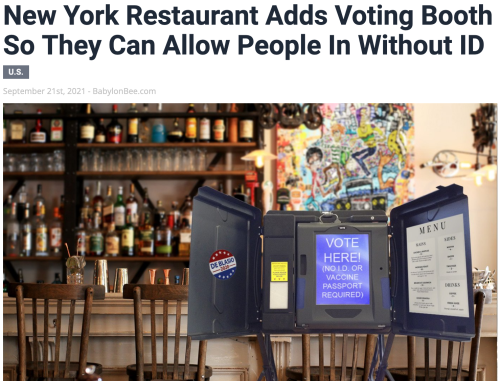
New York Restaurant Adds Voting Booth So They Can Allow People In Without ID

♥♥

‘1984’ Prequel Released Where People Beg Big Brother To Take Away Their Rights To Protect Them From Virus

♥♥

Biden Declares We Must Spray Sunscreen On Everyone To Protect Those Already Wearing Sunscreen

♥♥

Costco Introduces New 5-Gallon Family Size Pfizer Vaccine

♥♥

Experts Warn That If Children Between The Ages of 5-11 Aren’t Vaccinated Then Pfizer Executives Won’t Get Their Sales Bonuses

♥♥

Boy Who Pointed Out The Emperor Has No Clothes Banned For Misinformation

Modern pterosaurs

Picked these up in the comments section here: The Largest Known Flying Animal Was Even Weirder Than We Thought. The historic ancestor was the ptersosaurs.

Thumbnail

The modern descendant is, of all things, the heron. Here are a couple of vids of their predatory habits, first where one eats a gopher which cannot be copied across because it is age restricted but can be seen at the Instapundit link.

And then there is another eating a crocodile which can be copied and is pretty well the same as the one with the gopher.

It’s a jungle out there.