If only you guys on the left would act on your principles

This is a great article about the hypocricy of the left. Matt Walsh is asking the left to stand up for what they believe in, or at least what they said they believed in when Bush was president. With Obama, very different. The kinds of areas he brings up are the one percent, anti-war, civil liberties, war on drugs, guns, race, etc. His final para:

Liberals, you are not slaves. You are independent human beings. I’m not asking you to come to church with me and become a radical right wing fundamentalist Christian like yours truly (although you’re more than welcome to do so), I’m just asking you to have the guts to be what you said you were. And that means you’ll have to oppose Obama, because he’s not on your side. He’s not on anyone’s side.

The left are just cannon fodder for stupidity. They have no consistancy other than to oppose personal merit, achievement and success which they take as an affront to themselves. Ignorant to a remarkable extent of how the world works, they insist it is a conspiracy of the wealthy against the poor, the powerful against the weak. Their numbers are growing as more and more are bought off with the very trinkets that will keep them poor and lacking in ambition and achievement, the essential ingredient of a middle class life. The leaders on the left laugh at their own supporters who in their own personal lives they would have nothing to do with. They don’t live with them, send their children to school with them or associate with them except when looking out for their votes.

It is the right who actually does care because we want everyone to be just like us. We want everyone to become productive, peaceable and independent. We want everyone to get on with their own lives in their own way. We are always willing to help those who need help as part of a journey of self-fulfillment. We are less willing to help those who would rather just live on the meagre handouts of a welfare state.

The Ten Pillars of Economic Wisdom

The Ten Pillars of Economic Wisdom
By David R. Henderson

1. TANSTAAFL: There ain’t no such thing as a free lunch.

2. Incentives matter; incentives affect behavior.

3. Economic thinking is thinking on the margin.

4. The only way to create wealth is to move resources from a lower-valued to a higher-valued use. Corollary: Both sides gain from exchange.

5. Information is valuable and costly, and most information that’s valuable is inherently decentralized.

6. Every action has unintended consequences; you can never do only one thing.

7. The value of a good or a service is subjective.

8. Creating jobs is not the same as creating wealth.

9. The only way to increase a nation’s real income is to increase its real output.

10. Competition is a hardy weed, not a delicate flower.

Numbers 4 and 9 are core elements of Say’s Law.

Falling below the minimal level of truth

There was an interesting article the other day by Bruce Thornton which he has titled, “Lies, Democracy & Obama” but whose central point applies just as well here. He begins with a quotation from Jean-François Revel, a name wrongly disappearing into the past but whose books could be resurrected even more urgently for the present. This is the passage he took from Revel:

Democracy cannot survive without a certain diet of truth. It cannot survive if the degree of truth in current circulation falls below a minimal level. A democratic regime, founded on the free determination of important choices made by a majority, condemns itself to death if most of the citizens who have to choose between various options make their decisions in ignorance of reality, blinded by passions or misled by fleeting impressions.

To which Thornton added, conflating his text from the first and last paragraphs:

If Revel is correct, the rapidly diminishing level of truth in our public discourse suggests that we are in dire straits. . . . Following Revel, we can say a healthy democracy is one in which truth is allowed to circulate freely and inform citizens so they can make the right decisions. But today institutionalized lies have more influence than the truth, with baleful effects visible all around us. This suggests that we are a sick culture, and our condition is worsening.

And Thornton is most emphatically not talking about the fact that politicians don’t always tell the truth but something that goes more deeply. And while he thinks of this as a feature of the left in modern politics, as do I, where it starts is with the media which can no longer be expected to willingly publish anything that harms the political prospects of the left.

Two stories, both found on the editorial page of The Australian on Wednesday, are prime examples of the problem. Both spooked me, and while it is ironic that I am criticising the media for not revealing the facts when I have found out what I know by reading the media, it is still shameful that these are, firstly, opinion pieces rather than news stories and then, secondly, that they are not being splashed across the news so that everyone is aware of what’s happening and those who are responsible made to explain themselves.

The first is a column by Janet Albrechtsen dealing with Penny Wong and the amounts of money she has signed off on while Minister of Finance. The Finance Minister is the gatekeeper for government outlays, making sure governments do not spend too much nor waste what they spend. Well, forget it. The facts so far as they are even willing to admit – and this doesn’t include all kinds of outlays that are kept off the books – are maddening. Of Wong’s performance, Abrechtsen writes in conclusion:

Not even a nice smile can save Wong from being remembered as the $106 Billion Woman and this nation’s most incompetent Finance Minister.

Oh but yes it can. I read Janet’s article and maybe you read it but who else and who has shown that they care? Is it the scandal that it ought to be? Is there a hue and cry about just how badly she has managed her portfolio? Will anyone remember a day from now never mind when the new government tries to fix what is now seriously broken? Not a chance. Wong will walk away with not a care in the world, her credibility intact, remembered for her slick public persona, not for her disastrous role as the Minister of Finance.

And then we have a second opinion piece, this one from a surprising source given the contents. This is by Kevin Morgan who was “the ACTU member of former ALP leader Kim Beazley’s advisory committee on telecommunications”. And what he is trying to do is blow the whistle on the catastrophic hole in which the National Broadband Network is placing the finances of our country never mind the damage it is doing to our infrastructure. A report on the NBN has been given to the government and everyone knows it, but there is no outrage that is being suppressed nor a intensifying demand to have this report released NOW. From the article, where I have conflated the first and last paras:

KEVIN Rudd claims there is a conspiracy surrounding the NBN. He may be right. But it is not a conspiracy in which Rupert Murdoch seeks to bring down the Labor government to sabotage the NBN. It is a conspiracy to hide from the voters, until after the election, just how bad are the finances of the NBN. And the dire straits that the NBN is in can be sheeted back to the deals done by one man: the Prime Minister. . . .

Now Rudd’s back telling us, as he repeatedly did on Sunday night, that his visionary NBN is going marvellously. Well if it is Rudd will have absolutely no problem in immediately releasing an update of NBN Co’s corporate plan that is sitting on the desks of Penny Wong [sic] and Anthony Albanese, the two NBN shareholder ministers. To do otherwise would be a conspiracy and Rudd wouldn’t want to be accused of that.

Rudd cannot engineer this conspiracy of silence on his own. He needs help from the media who are apparently willing to go quiet on a program that is ruining their very own country – the very country they live in themselves – in order to maintain the most incompetent government in our history but so far as they are concerned a government of the right political shade. We have fallen below Revel’s minimal level of truth, well below, and we will pay for this dearly and for a very long time to come.

IQ and elite opinion

As everyone knows, you cannot use IQ as a measure because the number might reveal answers that are unacceptable to our elites. That some people are smarter than other people is unambiguous. That some groups might be smarter than others would however mean that some groups would be less intelligent than others, and that is unacceptable. A quite interesting article by Jason Richwine who is described as a public policy analyst in Washington, D.C, makes the point he only too well understands himself:

Let’s start 25 years ago, with the publication of The IQ Controversy, a book by Mark Snyderman and Stanley Rothman. The authors surveyed more than 1,000 experts in the field of cognitive science to develop a picture of what the mainstream really looks like. It was very similar to the description I’ve supplied above.

Snyderman and Rothman then systematically analyzed television, newspaper, and magazine coverage of IQ issues. They were alarmed to find that the media were presenting a much different picture than what the expert survey showed. Based on media portrayals, it would seem that most experts think IQ scores have little meaning, that genes have no influence on IQ, and that the tests are hopelessly biased. “Our work demonstrates that, by any reasonable standard, media coverage of the IQ controversy has been quite inaccurate,” the authors concluded.

In conducting the expert survey and contrasting the results with media depictions of IQ research, one would think Snyderman and Rothman had performed a valuable service. Surely public discussion of IQ would now be more firmly grounded in science?

It didn’t happen. Richard Herrnstein and Charles Murray’s The Bell Curve was published in 1994, and real science was hard to find in the media circus that ensued. Herrnstein and Murray’s central claim about IQ differences shaping class divisions continues to be the subject of reasoned debate among social scientists. But non-experts in the media questioned whether IQ is even a valid concept. Intelligence research – psychometrics — is a pseudoscience, they said. The tests are meaningless, elitist, biased against women and minorities, important only to genetic determinists. And even to discuss group differences in IQ was called racist.

In short, the media did everything Snyderman and Rothman had warned against six years earlier. As a consequence, the interesting policy implications explored by Herrnstein and Murray were lost in the firestorm.

Smart people often think it’s a tragedy to be stupid. And if it were like money, they would try to redistribute in the way they normally redistribute, from everyone else but themselves. So instead they choose their second favourite tactic, they lie about it and hide the truth. Here’s the conclusion:

What causes so many in the media to react emotionally when it comes to IQ? Snyderman and Rothman believe it is a naturally uncomfortable topic in modern liberal democracies. The possibility of intractable differences among people does not fit easily into the worldview of journalists and other members of the intellectual class who have an aversion to inequality. The unfortunate — but all too human — reaction is to avoid seriously grappling with inconvenient truths. And I suspect the people who lash out in anger are the ones who are most internally conflicted.

But I see little value in speculating further about causes. Change is what’s needed. And the first thing for reporters, commentators, and non-experts to do is to stop demonizing public discussion of IQ differences. Stop calling names. Stop trying to get people fired. Most of all, stop making pronouncements about research without first reading the literature or consulting people who have.

This is not just about academic freedom or any one scholar’s reputation. Cognitive differences can inform our understanding of a number of policy issues — everything from education, to military recruitment, to employment discrimination to, yes, immigration. Start treating the science of mental ability seriously, and both political discourse and public policy will be better for it.

A man of goodwill, obviously, but still unfamiliar with the left. If it shouldn’t be it cannot be and therefore they will not let it be, at least not let it be openly discussed.

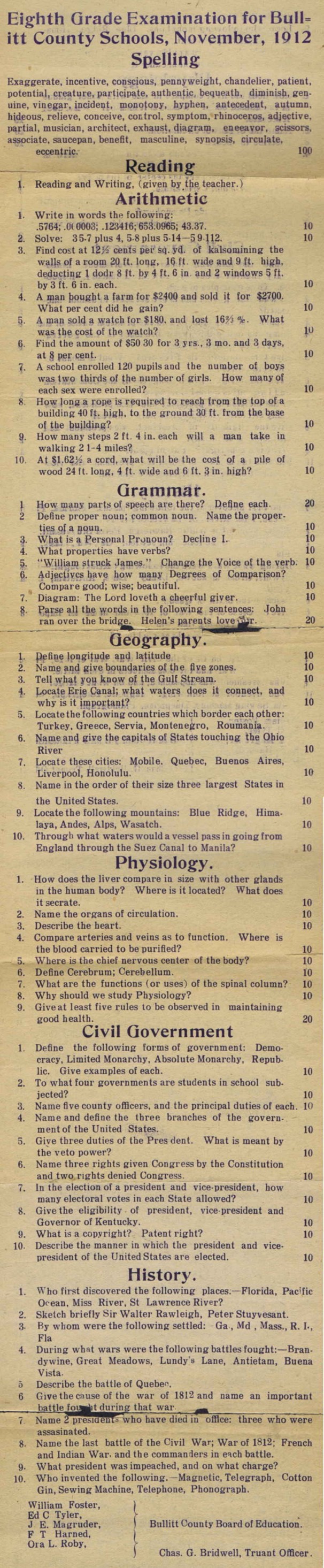
A 1912 Grade VIII test of knowledge

test for the eighth grade in 1912

It is almost unimaginable that anyone at any level could pass a test like this. Yet this would have been pretty standard when I was in Grade VIII which was some fifty years after that. Which is why I can answer them now myself but how likely is it for anyone who graduated from high school since the 1970s? Of course, in any trivia quiz I have no idea who wrote or sang any song at all, at least those written since 1973.

[Via Instapundit]

Letter to an old friend

Sent the following letter to a friend of mine who had last written that he was about to be made redundant. Having not heard from him in a while I sent him this:

Writing for no particular reason other than to see how you are and what’s new in your life. Last you wrote you were on the edge of redundancy which I can only hope has not come to pass, or if it did that you have found your way to something new and better. Our lives are getting so chancy and difficult. Today I went on strike for the first time in my life. Would not have had to except that the union called for a two-hour stoppage right in the middle of my class time so out I went. It was a funny business but in the end and what swayed me to join the strike was the memory of my Father, organiser for the Electrical Trades Union of Canada and a left winger till his last day. More pragmatically, there is no point in joining a union and expecting its help if you cross the picket line when they ask you to take action. I’m not particularly militant since I worry that the claim will do no good for employment prospects generally and mine in particular, but having duly voted against the strike and found the strike was overwhelmingly supported the die was cast.

The other oddity was that I ran into the oldest person in the department whose age I didn’t actually know but white haired he is and clearly of something like my vintage. So I said to him – which I had picked up on the grapevine – that I’d heard he was retiring and why was that? Oh, he said, he’d always intended to retire when he turned 60! Holy mackerel. There must now be at least a decade between me and whoever comes next after him. Where do they go and why do they do it? I’m going to write my own version of Father William, I think, that will begin:

You are young Father William, the old man said.
So what that your hair has turned grey?
There are still many years before you are dead.
Why retire when you can still stay?

A bit morbid perhaps, but the rhyme scheme is all. About half the people I know are still working, and the rest play golf. I don’t play golf so what would I do? I hope you aren’t able to fill me in on that.

Anyway, be well. Hope things are good.

Kind regards.

Evolutionary economics

An evolutionary theorist has an answer for economic theory and I especially like his incorporation of history into the theoretical story:

Evolutionists have a conceptual toolkit that can be applied to the study of any aspect of any organism. This includes asking four questions in parallel, concerning the function, history, physical mechanism, and development of the trait. For example, species that live in the desert are typically sandy-coloured. How do we go about explaining this fact? First they are sandy-coloured to avoid detection by their predators and prey (a functional explanation). Second, the sandy colouration is achieved by various physical mechanisms, depending upon the species — fur in mammals, chitin in insects, feathers in birds (a physical explanation). What is more, the particular mechanism is based in part on the lineage of the species (an historical explanation) and develops during the lifetime of the organism by a variety of pathways (a developmental explanation). Answering these four questions results in a fully rounded understanding of colouration in desert species. All branches of biology are unified by this approach. . . .

And yet, evolutionary theory does lead to a viable concept of the invisible hand, albeit one that is different from the received economic version. Indeed, the biological world has its own version of the invisible hand. Cells, multicellular organisms, and social insect colonies are all higher-level social units that function with exquisite precision without the lower-level units having the welfare of the higher-level units in mind. In most cases, the lower-level units don’t even have minds in the human sense of the word. These miracles of spontaneous organisation exist because selection operating on the higher-level units has winnowed down the small fraction of traits in the lower-level units that contribute to the good of the group. If the invisible hand operates in human groups, it is due to a similar history of selection, first at the level of small-scale groups during our genetic evolution, and then at the level of larger-scale groups during our cultural evolution.

All very micro unfortunately. The big questions, however, are about the overall trend of the entire structure which can only be answered in ways that biologists have little to offer.

The habits of the rich and the poor

How much this is just the point. And what’s more, implied but not directly stated, is that the living standards of those on lower incomes are dependent on the actions of those earning higher incomes:

Tom Corley, on his website RichHabits.net, outlines a few of the differences between the habits of the rich and the poor:

1. 70% of wealthy eat less than 300 junk food calories per day. 97% of poor people eat more than 300 junk food calories per day. 23% of wealthy gamble. 52% of poor people gamble.

2. 80% of wealthy are focused on accomplishing some single goal. Only 12% of the poor do this.

3. 76% of wealthy exercise aerobically 4 days a week. 23% of poor do this.

4. 63% of wealthy listen to audio books during commute to work vs. 5% for poor people.

5. 81% of wealthy maintain a to-do list vs. 19% for poor.

6. 63% of wealthy parents make their children read 2 or more non-fiction books a month vs. 3% for poor.

7. 70% of wealthy parents make their children volunteer 10 hours or more a month vs. 3% for poor.

8. 80% of wealthy make hbd calls vs. 11% of poor

9. 67% of wealthy write down their goals vs. 17% for poor

10. 88% of wealthy read 30 minutes or more each day for education or career reasons vs 2% for poor.

11. 6% of wealthy say what’s on their mind vs. 69% for poor.

12. 79% of wealthy network 5 hours or more each month vs. 16% for poor.

13. 67% of wealthy watch 1 hour or less of TV. every day vs. 23% for poor

14. 6% of wealthy watch reality TV vs. 78% for poor.

15. 44% of wealthy wake up 3 hours before work starts vs.3% for poor.

16. 74% of wealthy teach good daily success habits to their children vs. 1% for poor.

17. 84% of wealthy believe good habits create opportunity luck vs. 4% for poor.

18. 76% of wealthy believe bad habits create detrimental luck vs. 9% for poor.

19. 86% of wealthy believe in life-long educational self-improvement vs. 5% for poor.

20. 86% of wealthy love to read vs. 26% for poor.

Found at Instapundit

This is more than prescient – it’s actually spooky

This is Ayn Rand in Atlas Shrugged published in 1957 quoted by Daniel Hannan:

A few houses still stood within the skeleton of what had once been an industrial town. Everything that could move, had moved away; but some human beings had remained. The empty structures were vertical rubble; they had been eaten, not by time, but by men: boards torn out at random, missing patches of roofs, holes left in gutted cellars. It looked as if blind hands had seized whatever fitted the need of the moment, with no concept of remaining in existence the next morning. The inhabited houses were scattered at random among the ruins; the smoke of their chimneys was the only movement visible in town. A shell of concrete, which had been a schoolhouse, stood on the outskirts; it looked like a skull, with the empty sockets of glassless windows, with a few strands of hair still clinging to it, in the shape of broken wires.

Beyond the town, on a distant hill, stood the factory of the Twentieth Century Motor Company. Its walls, roof lines and smokestacks looked trim, impregnable like a fortress. It would have seemed intact but for a silver water tank: the water tank was tipped sidewise.

They saw no trace of a road to the factory in the tangled miles of trees and hillsides. They drove to the door of the first house in sight that showed a feeble signal of rising smoke. The door was open. An old woman came shuffling out at the sound of the motor. She was bent and swollen, barefooted, dressed in a garment of flour sacking. She looked at the car without astonishment, without curiosity; it was the blank stare of a being who had lost the capacity to feel anything but exhaustion.

“Can you tell me the way to the factory?” asked Rearden.

The woman did not answer at once; she looked as if she would be unable to speak English. “What factory?” she asked.

Rearden pointed. “That one.”

“It’s closed.”

Urban life

From Anthony Tao in a post he titled, “Beijing Subway Can Get A Wee Crowded In The Mornings” via Instapundit. I’m not sure there is anything that can be done to change this, certainly not in anything like a realistic time frame. Yet I suspect that the price of a ticket is well below the cost covering price but what do I know? And it is possible that thirty minutes either side of this moment and things have calmed down quite a lot. Still, quite incredible and not beyond possibility here without proper planning and capital investment.