Alinsky and his rules for radicals

Alinsky’s Rules for Radicals are the playbook of the left. Alinsky, largely a nihilist himself, put together a set of rules on how to win power that contained not an ounce of policy. With the world not a perfect place and envy the single most powerful social force, he constructed guidelines on how to present a critique of others that have proven to be formidable in the midst of political debate.

What Alinsky would never have imagined is that the left would join forces with the media so that almost nothing said by a politician of the left is ever challenged in the popular press or network TV. For the left, it’s almost become too easy. The nature of the political battle for those with a more centralist and conservative perspective is now a minefield of potential explosives. If you are from a party of the centre or the right, these are rules you must know yourself, recognise and carefully think through how they can be dealt with since they will with certainty be used against you. In summary here are Alinsky’s rules but you should also read his book:

1) “Power is not only what you have, but what the enemy thinks you have.”

2) “Never go outside the expertise of your people.”

3) “Whenever possible, go outside the expertise of the enemy.”

4) “Make the enemy live up to its own book of rules.”

5) “Ridicule is man’s most potent weapon.”

6) “A good tactic is one your people enjoy.”

7) “A tactic that drags on too long becomes a drag.”

8) “Keep the pressure on. Never let up.”

9) “The threat is usually more terrifying than the thing itself.”

10) “The major premise for tactics is the development of operations that will maintain a constant pressure upon the opposition.”

11) “If you push a negative hard enough, it will push through and become a positive.”

12) “The price of a successful attack is a constructive alternative.”

13) “Pick the target, freeze it, personalize it, and polarize it.”

I have an article at Quadrant Online that looks at these rules in relation to Rupert Murdoch who is the great villain of the left for no other reason than that he can be effectively used as part of the last of the rules on personalising a target. Rudd has not a constructive thing to say in this election, representing a party with no runs on the board. Every major aspect of policy has deteriorated over the past six years and there is no reason to think they would get better if he were re-elected. The economy is worse, social cohesion has deteriorated, our borders are a sieve, living standards are falling and a series moonbat ideas in a host of areas have been endorsed. Yet what do we hear time and again, that this criticism is evidence of a press conspiracy by the Murdoch papers to see this government thrown out. Forgotten and seen as irrelevant is that these same papers, disastrously, sought to install Rudd in the first place in 2007.

How to deal with this rules-based criticisms is difficult but the first thing is for everyone to know these rules when they see them in action so that they can say, there they go again, using that same old tired Alinsky rhetoric. They bring up Murdoch, you bring up policy. Put the question straight, are you trying to change the subject from these policy failures of yours to the irrelevancy of who sells the most newspapers. Point out that they are trying to change the subject because sticking to the subject will only point up just how little they offer, how empty their policies are.

And let me just finish with a bit of context. In thinking about Alinsky and his rules, it is worth remembering this:

Hillary Rodham as a student at Wellesley in 1969, interviewed Saul Alinsky and wrote her thesis on Alinsky’s theories and methods. She concludes her thesis by writing,

‘Alinsky is regarded by many as the proponent of a dangerous socio/political philosophy. As such he has been feared, just as Eugene Debs or Walt Whitman or Martin Luther King has been feared, because each embraced the most radical of political faiths, ‘democracy.”‘

Alinsky offered Hillary a job upon graduation from Wellesley but she decided to attend Yale Law School where she met her husband Bill Clinton.

And then there’s this from that same source:

Obama taught workshops on Alinsky’s theories and methods for years and in 1985, he started working as a community organizer for an Alinskyite group called, ‘Developing Community Projects.’ While building coalitions of black churches in Chicago, Obama was criticized for not attending church and decided to become an instant Christian. He then helped fund the Alinsky Academy. Obama was a paid director of the Woods Fund, which is a non-profit organization used to provide start-up funding and operating capital for Midwest Academy, which teaches the Alinsky tactics of community organization. Obama sat on the Woods Fund Board with William Ayers, the founder of the, ‘Weather Underground,’ a domestic terrorist organization.

The fact is that irrespective of which side of politics you are on, you are not in the game unless you have made a study of Alinsky’s rules, understand its tactics and if you are on the conservative side of politics, thought through how you will deal with these tactics when they inevitably are brought into play by the other side.

Alinsky’s Rules for Radicals

It is useful to remember Alinsky’s Rules for Radicals at all time when dealing with the left. These are not just an aimless series of generalisations but the actual tactics used in political war.

The abuse piled onto Rupert Murdoch is a straightforward application of Rule 12: “Pick the target, freeze it, personalize it, and polarize it.” People in general don’t understand abstractions but are happy to wallow in a specific upon which any number of negative characteristics can be attributed. It ought to be obvious that this is in part a tactical manoeuvre to rally the troops just as it is, in part, an attempt to silence critics of Labor’s incompetence. How to deal with those who apply these rules is a serious issue.

Everyone on our side should therefore be 100% aware of what is going on when an attack is focused on one individual who is intended to become the metaphor for all that is supposedly wrong on the conservative side of politics. Here are all twelve rules. They really do constitute the tactics applied by the shock troops of the left who have nothing to offer in terms of useful policy but are masters of the rhetoric of the class war.

* RULE 1: “Power is not only what you have, but what the enemy thinks you have.” Power is derived from 2 main sources – money and people. “Have-Nots” must build power from flesh and blood. (These are two things of which there is a plentiful supply. Government and corporations always have a difficult time appealing to people, and usually do so almost exclusively with economic arguments.)

* RULE 2: “Never go outside the expertise of your people.” It results in confusion, fear and retreat. Feeling secure adds to the backbone of anyone. (Organizations under attack wonder why radicals don’t address the “real” issues. This is why. They avoid things with which they have no knowledge.)

* RULE 3: “Whenever possible, go outside the expertise of the enemy.” Look for ways to increase insecurity, anxiety and uncertainty. (This happens all the time. Watch how many organizations under attack are blind-sided by seemingly irrelevant arguments that they are then forced to address.)

* RULE 4: “Make the enemy live up to its own book of rules.” If the rule is that every letter gets a reply, send 30,000 letters. You can kill them with this because no one can possibly obey all of their own rules. (This is a serious rule. The besieged entity’s very credibility and reputation is at stake, because if activists catch it lying or not living up to its commitments, they can continue to chip away at the damage.)

* RULE 5: “Ridicule is man’s most potent weapon.” There is no defense. It’s irrational. It’s infuriating. It also works as a key pressure point to force the enemy into concessions. (Pretty crude, rude and mean, huh? They want to create anger and fear.)

* RULE 6: “A good tactic is one your people enjoy.” They’ll keep doing it without urging and come back to do more. They’re doing their thing, and will even suggest better ones. (Radical activists, in this sense, are no different that any other human being. We all avoid “un-fun” activities, and but we revel at and enjoy the ones that work and bring results.)

* RULE 7: “A tactic that drags on too long becomes a drag.” Don’t become old news. (Even radical activists get bored. So to keep them excited and involved, organizers are constantly coming up with new tactics.)

* RULE 8: “Keep the pressure on. Never let up.” Keep trying new things to keep the opposition off balance. As the opposition masters one approach, hit them from the flank with something new. (Attack, attack, attack from all sides, never giving the reeling organization a chance to rest, regroup, recover and re-strategize.)

* RULE 9: “The threat is usually more terrifying than the thing itself.” Imagination and ego can dream up many more consequences than any activist. (Perception is reality. Large organizations always prepare a worst-case scenario, something that may be furthest from the activists’ minds. The upshot is that the organization will expend enormous time and energy, creating in its own collective mind the direst of conclusions. The possibilities can easily poison the mind and result in demoralization.)

* RULE 10: “If you push a negative hard enough, it will push through and become a positive.” Violence from the other side can win the public to your side because the public sympathizes with the underdog. (Unions used this tactic. Peaceful [albeit loud] demonstrations during the heyday of unions in the early to mid-20th Century incurred management’s wrath, often in the form of violence that eventually brought public sympathy to their side.)

* RULE 11: “The price of a successful attack is a constructive alternative.” Never let the enemy score points because you’re caught without a solution to the problem. (Old saw: If you’re not part of the solution, you’re part of the problem. Activist organizations have an agenda, and their strategy is to hold a place at the table, to be given a forum to wield their power. So, they have to have a compromise solution.)

* RULE 12: “Pick the target, freeze it, personalize it, and polarize it.” Cut off the support network and isolate the target from sympathy. Go after people and not institutions; people hurt faster than institutions. (This is cruel, but very effective. Direct, personalized criticism and ridicule works.)

The list is as compiled by Glenn Beck.

Melbourne the world’s number one city to live in

melbourne

This is a list of The Top Ten Cities in the World published by The Independent in the UK and picked up at Drudge. This is the text that goes with the story:

1. Melbourne, Australia: Australia’s second city may not have the glamour of Sydney, but its colonial heritage and multicultural dynamism more than compensates.

Sydney seventh seems about right.

Who does this remind me of?

This is from a post titled, “Eleven Signs You Might Be Dating a Sociopath“:

RED FLAG #1. Having an oversized ego.

RED FLAG #2. Lying and exhibiting manipulative behavior.

RED FLAG #3. Exhibiting a lack of empathy.

RED FLAG #4. Showing a lack of remorse or shame.

RED FLAG #5. Staying eerily calm in scary or dangerous situations.

RED FLAG #6. Behaving irresponsibly or with extreme impulsivity.

RED FLAG #7. Having few friends.

RED FLAG #8. Being charming–but only superficially.

RED FLAG #9. Living by the “pleasure principle.”

RED FLAG #10. Showing disregard for societal norms.

RED FLAG #11. Having “intense” eyes.

Hmmmmm.

Economics and history

This from Scientific American, a brief article with the title, “Is Economics More Like History than Physics?” The conclusion:

Economics, especially the macro kind, has history-like aspects. Its narratives might be woven with data, but not everything that counts can be counted. It must deal with different kinds of change that (to paraphrase Shakespeare) were never dreamt of in our physics. Perhaps this limits economics to moderately reliable maxims.

It’s clear enough that you cannot do economics without history but history is not what economics is.

Reading Abbott’s speech

It is always nice to find yourself quoted by Andrew Bolt but to match my own high regard for Tony Abbott’s campaign launch he quotes someone else who slates Abbott for the very lack of philsophy that is readily evident to anyone who actually understands philosophy. I realise you have to understand the unifying theme that exists as the foundation for what Abbott has said but it really isn’t so hard, not really. Abbott wants each of us to be self-reliant, to get on with our lives and not depend on the state. He nevertheless wants the state to use its resources to help individuals at particular moments in their lives, such as when they are sick, when they are unable to find jobs or when they have children. He also wants our productive efforts undertaken by business with governments only doing what will not be done by the private sector, either at all or to a socially optimal extent. This is, as Abbott says himself, a quite straightforward reflection of the liberal-conservative take on life. It is Robert Menzies and it is the way that all great leaders in our western tradition have exhibited the philosophy that underpins what they do. I can only say that if you can’t see it for yourself, it is because you either have little understanding of this philosophy yourself or you have a different, more socialist philosophy that does not even recognise not just the existence of this philosophical understanding but cannot see that it is superior to anything else you could possibly find anywhere else at all.

A philosopher PM

The interview with Tony Abbott on Andrew Bolt brought out just what I admire about Tony Abbott so much. He has many qualities but his intuitive understanding of the political philosophy of the liberal-conservative side of politics is what makes this potentially one of the great governments in our history. This is from the interview.

TONY ABBOTT: Andrew, I would like Australians to feel that each of them – each of us – is coming closer to being our best selves. We all know when we are being our best selves, or when we are coming closer to being our best selves, and I’d like each of us, in his or her own way, to feel that at the end of a term of Coalition government. Because my vision is not so much to impose my views on people, but to give each and every one of us more chance to be our best selves, as we see it.

ANDREW BOLT: You seem to be suggesting you would like Australia to be, in some ways, a freer place, where people can go about acting on their own ambitions. In what way do you want Australia to be freer?

TONY ABBOTT: Well, that’s the classic Liberal position, isn’t it? Lower taxes, smaller government, greater freedom – that’s the classic Liberal position. And then of course there’s the classic conservative position – respect for the family, respect for institutions and values that have stood the test of time, and the Coalition that I have the honour to lead is the Australian custodian of both the liberal and the conservative traditions. And I guess in our culture – our English-speaking tradition – what you’ve seen is a happy marriage between liberalism and conservatism. I think it was Tennyson who summed it up, Andrew, when he talked of ‘a land of just and old renown, a land of settled government, where freedom broadened slowly down from precedent to precedent.’ I think that nicely captures the paradox of freedom and order.

Liberal and conservative. Freedom and order. And able to quote Tennyson from memory! The tensions of government are never ending but the need to find one’s way in the midst of the flood of events every political leader is certain to find before them requires a sound philosophical hold and a clear inner vision. This Tony Abbott most certainly seems to have.

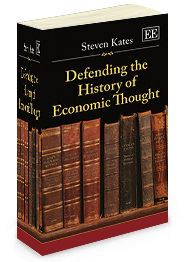
Defending the History of Economic Thought

defending the history of economic thought

My Defending the History of Economic Thought has just been released. As an author, possibly the most interesting part about writing a book is to find the text saying things you had never thought about yourself until you came to write them down. This book is more exceptionally like that than any of the others I’ve written. This is how the text on the back of the book would have read had there been more room:

The aim of this book is to explain the importance of the history of economic thought in the curriculum of economists. Most discussions of this kind are devoted to explaining why such study is of value to the individual economist. It is, of course, but that is not the main point of this book. This book reaches out past the individual to explain the crucial role and importance of the history of economic thought in the study of economics itself. As the book tries to explain, without its history at the core of the curriculum, economics is a lesser subject, less penetrating, less interesting and of much less social value.

It is the orientation that historians of economics give to economics in general that may be its great value. The mainstream is continuously challenged because historians of economics keep bringing other perhaps wrongly neglected economic traditions into the conversation.

The sad reality is that almost no economist being educated today has detailed knowledge of the people who built the ideas found in their texts nor do they know how those ideas evolved. Worse yet, they know almost nothing of those ideas no longer found in our modern texts, many of which had once been central in economic discourse but which have since been moved onto the back shelf for no better reason than because they are no longer part of the mainstream. This book explains not just why anyone who wishes to understand economic theory must understand the history of economics but also, and much more importantly, why the history of economic thought must be preserved as a core component within the economics curriculum if economic theory is to progress.

This fascinating and thought-provoking book will prove invaluable reading for academics, researchers, lecturers and students across the expansive economics field.

The details on where to get a copy of the book may be found here.

Roger Scruton on Ken Minogue

This is Roger Scruton in The American Spectator discussing Ken Minogue:

READERS OF THIS magazine will know that conservatism has been going through a dark time in Britain. Since the premiereship of Margaret Thatcher, the state has expanded relentlessly to take control of just about every aspect of civil life. The media, the universities, and the schools have adopted a soft-left orthodoxy that allows little room for dissent. And the fundamental values on which the conservative vision of society is based—national sovereignty, social continuity, political freedom, and Christian heritage—havebeen condemned and in some measure criminalized by the European machine, without the faintest sign of resistance from our politicians. The same politicians have assumed the right to violate and impose arbitrary changes on our way of life: opening our borders and our national assets to the rest of Europe, redefining marriage and the family without respect for popular opinion, and generally treating our heritage of individual freedom and bottom-up law as a dispensable eccentricity. The things we value are being swept away. But where do we find the people who argue our case? Of course, we had Mrs. Thatcher’s glorious interlude. But she was first and foremost a politician, not a thinker. And the long march of the left, through the institutions of our society and through the brains of its members, continued under her watch.

Of the few intellectuals who stood against the trend and articulated their reasons for doing so, none was more important than Kenneth Minogue, who died on June 28 at the age of 82. Ken was born in New Zealand and educated in Australia. He came to England in 1955 and taught political science, first at the University of Exeter and then, from 1959, at the London School of Economics, where he was a pupil and friend of Michael Oakeshott. Ken enjoyed public debate and was a passionate advocate of the conservative cause. He had the returning colonist’s love for the old country, and a poignant sense of its fragility. But he was also an articulate theorist, who had studied Marxism and its effects, and who saw more clearly than any other political scientist of his generation that the greatest danger presented by socialism was not the expansion of the state but the advance of ideology. By softening the brains of the intellectual class, ideology prepares the way for the statist machine far more effectively than any army. It is a substitute for thought, one that is designed to make thinking impossible.

IN HIS BOOK Alien Powers, published in 1985, Minogue turned Marxism on its head. He showed that the theories of Adam Smith, David Hume, and Adam Ferguson, which Marx dismissed as “bourgeois ideology,” provide the real foundations for social science. The categories of Marxist thought—class, exploitation, oppression, surplus value, capitalism, socialism, communism, and all the dusty, cobweb-covered terms that were the substitutes for observation in the political science departments of British universities—are adopted because they rationalize resentment and provide impenetrable walls of pseudo-thought that are immune to refutation. Minogue took those categories apart. He argued that the classical economists were the true social philosophers, who understood the place of free association in the development of institutions, and the nature of liberty as a moral and legal idea. And he showed the way in which the Marxist categories had poisoned political theory in the British universities. This was not a wise career move for someone employed by one of those universities; but it encouraged and inspired people of goodwill and good sense.

In other books, Minogue expounded the case for classical liberalism, and showed that the tradition that ran from Hume and Smith, through Burke and Tocqueville, to Oakeshott and Hayek, was one of the treasures of our civilization. It is difficult for an American to appreciate how bold it was to go public with this message in the Britain of the 1970s and 1980s. It was not just that Minogue invited the contempt of his colleagues: He found himself shouted down and threatened on university campuses and routinely castigated by the pundits for his articles in the press.

Thanks to his command of English prose and his refined English drinking habits, Minogue belonged to a circle of articulate conservative journalists that included Peregrine Worsthorne, Peter Utley, and Colin Welch. Those writers valued his immense knowledge and culture, and encouraged him to go public with his unfashionable ideas. He played his part in defining and propagating the message of libertarian think tanks like the Institute for Economic Affairs; he was an active member of the Conservative Philosophy Group; he was one of the leading lights in Encounter, the magazine that set out, under Melvin Lasky, to create an alternative voice to the establishment left; and he wrote beautifully and persuasively in the Daily Telegraph, the (London) Spectator, the Salisbury Review, and the Times, as well as in this and other American journals, in ways that both enlightened and entertained his conservative readers. In many ways he was a model of the conservative activist. He was not in the business of destroying things or angering people. He was in the business of defending old-fashioned civility against ideological rage, and he believed this was the real meaning of the freedom that the English-speaking peoples have created and enjoyed. In defense of civility he could be provocative. But it was characteristic of the Britain in which he lived, whose institutions he defended in so heartfelt a way, that his civility was regarded by the left as a kind of aggression.

Ken Minogue was unlike other academic conservatives I have known—unlike Oakeshott in particular—in that he willingly and enthusiastically joined the battle. I knew Ken from the many occasions when we would find ourselves signed up to this or that initiative, institution, or campaign that we both believed in. He did not think, as Oakeshott seemed to think, that conservatism was too sophisticated an outlook to dirty its hands with politics. He did not think that we should rise above the stream of history in a posture of angelic detachment. On the contrary, he was an inspiration precisely because he thought that the conservative vision is true, and that, because it is true, it must be advanced and defended.

Of course, it must be defended with decency. But for Ken Minogue, decency was not just a way of doing things, but also the point of doing them. Like Oakeshott, he recognized that the conservative vision does not define itself by what it seeks to achieve, but by its way of achieving it. His philosophy was a philosophy of the passage through: not where you go, but how. And if this led him, in his last work, to be skeptical of democracy, this is surely understandable. The idea of the state as a benign father figure, who guides the collective assets of society to the place where they are needed, and who is always there to rescue us from poverty, ill health, or unemployment, remained in the foreground of politics in Britain. And it has remained there because people vote for it. Minogue did not merely vote against it. He spoke, thought, and acted against it too. Not surprisingly, therefore, he was hated by all the right people. These days, that is the best that we can hope for, so long as we are also, as Ken was, loved by the right people too.