It is still less than a year and I have posted 450 of these comments. That’s a lot of time and a lot of thought to be drawn into what is really an aimless bit of froth. But since aimless froth is really what life tends to be this is as good as anything and it’s nice to communicate with my son. Hi Joshi. Hope you’re still reading.
Category Archives: Philosophical and speculative
A kinder, gentler fascism
George Orwell’s 1984 has just been removed in secret from Amazon’s Kindle. It’s not an attempt at censorship as such, merely a problem with copyright. But as this article points out, there is a problem all the same:
Thousands of people last week discovered that Amazon had quietly removed electronic copies of George Orwell’s 1984 from their Kindle e-book readers. In the process, Amazon revealed how easy censorship will be in the Kindle age.
It will be a kinder, gentler fascism but we’ll get used to it assuming we are not used to it already.
From Catallaxy on 18 July 2013.
You should get to Freedomfest if you can
I’ve made it back from the right side’s great carnival of ideas and good sense which is the essential nature of Freedomfest. They’re run by Mark Skousen who is an organisational genius not to mention the author of some of the finest books on economics from a libertarian/conservative perspective available anywhere. If you are thinking of going, they are always in mid-July and they are always in Las Vegas. And if you would like to see just about everybody who is anybody on the right side of the political divide in the United States, that is the place to go. There were 2200 who showed up but almost all were from America. I met only one other couple from Australia, from Penguin Tasmania to be exact. But to listen to and even get to meet some of the finest speakers on libertarian and conservative views in the world is an unbelievable treat. If you would like to chat about something, you can find them having coffee with the rest of us. Most of the sessions revolve around economic issues but the compass is well beyond the purely economic.
The debate on global warming, just to take one example, was between Michael Shermer, the editor of Skeptic, and one James Taylor a lawyer who edits a magazine of his own, Environment & Climate News. I had, after many years, become a subscriber to Skeptic, in 2006 I think it was, but cancelled after the first issue when the magazine was devoted to arguing that global warming was settled science and that debate was over (some skeptic he was). But there he was, extraordinarily articulate and filled with argument and facts, discussing the certainty of global warming and the need to take immediate action. And as you would expect, he made the case as well as it could possibly be made.
But Taylor took him apart (and that was my wife’s view). As Taylor said, he was seldom in a room where the majority were on his side, but how expertly he carved Shermer up. But unfortunately I missed the very end of the Q&A since we had to go off to watch “The Republican Party on Trial” with Steve Moore, the main editorial writer of the Wall Street Journal prosecuting and Dinesh D’Souza the defence attorney. The jury, for what it’s worth, split six to six but if you understand that the point was entirely serious within a framework of fun and good vibes, you will see the kind of event that Freedomfest is.
From Catallaxy 16 July 2013.
Piltdown man and global warming
I’m in London and on the first day here I went to see the skull of the Piltdown Man, the notoriously faked missing link with the skull of a human but a monkey like jaw. The reason for the exhibit was that it was in 1913 that it had been discovered so, settled science as it was all the way through to the 1950s when carbon dating proved that it was a very cleverly designed artifact whose actual creator no one has ever known (except the person who did it). So I said to the guide that I looked forward to a similar exhibition in fifty years time about global warming as the greatest scientific con in history, a thought to which he took exception but was very nice about it. But it will happen. How anyone in London can worry about global warming is beyond me. Bring it on should be the idea.
Meanwhile the Bank of England has installed its new Governor, Mark Carney, as a Canadian the first foreigner ever to be given that position. Well, he is considering a QE of his own to revive a sinking economy. My worries, as conventional as his own ideas on monetary policy seem to be, is that they are about as sound as his wife’s who was in the paper worrying about green issues, with the one she picked to discuss being the amount of paper used in making tea bags. It’s good to see people with their finger on the pulse of the major issues of our time.
From Catallaxy on 3 July 2013.
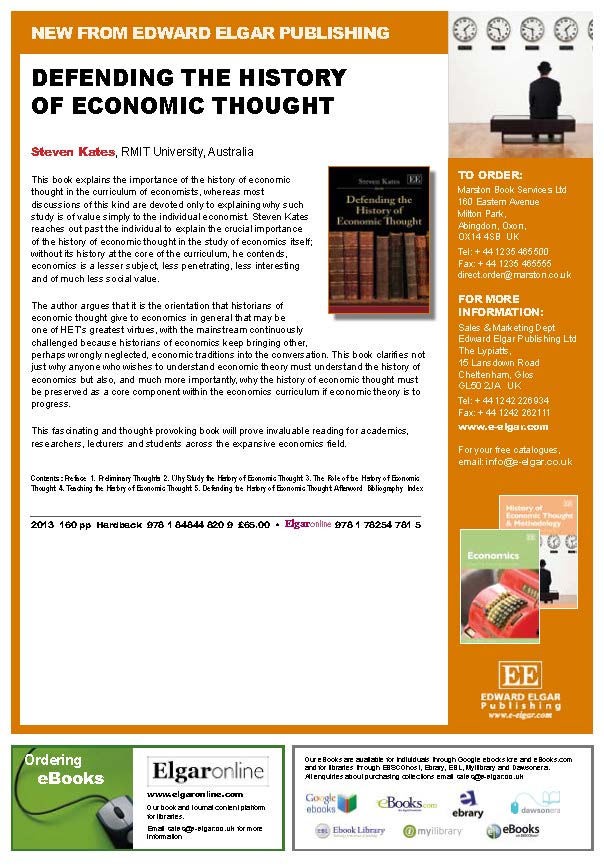
Defending the History of Economic Thought
Arnold Kling on George Gilder
I will want to write my own post on George Gilder’s brilliant Knowledge and Power but I have just run across this review by Arnold Kling who is favourably mentioned in the book. Kling is not all that enamoured with the book, as seen in this passage:
Gilder would argue that redistribution is baked into the methodology of economic models that downplay agency and instead treat economic outcomes as random. For example, finance professors will describe the effort to “beat the market” when investing in stocks as a sort of coin-flipping tournament. Start with a very large number of players, have them each flip a coin five times, and see which flippers get the most heads. Some players will get heads five times in a row, making it appear that they are very skilled coin-flippers. By analogy, if we start with a large number of stock market investors, a few of them will outperform the market several years in a row. These sorts of models imply that wealth accumulation results from a combination of risk taking and luck. Instead, Gilder insists that it results from better knowledge, which has been used to create products and services that promote human flourishing. (He would make an exception, of course, for knowledge that only exploits government-created noise.)
In Gilder’s view, entrepreneurs create information where none existed before. Rather than sustain the equilibrium, their role is to disturb it.
On this issue, I have mixed views. On the one hand, when it comes to business success, I agree with Gilder. Even though luck plays some role, skill matters much more, because there are so many little choices that must be made wisely in order for an enterprise to succeed. The more skilled business team usually will win, just as in tennis the more skilled player usually will win. On the other hand, with financial speculation, skill and luck are more difficult to separate. To me, financial speculation is more like a multiple-choice question on a test. One can easily make a good choice for a bad reason, or vice-versa.
There is much to quarrel with in Gilder’s book. For one, his political and social conservatism will put off many readers. Also, in his attempts to sharpen the contrast between his views and those of other thinkers, he often paints a caricature of the individual he is criticizing. For example, his depiction of Burton Malkiel, the American economist best known for his support of the efficient market hypothesis, as an adherent of technical analysis was completely unfair.
Funny business this. His political and social conservatism hardly put off this reader since, to tell the truth, I didn’t even notice it. As far as I can see, there was little ideology as such, only a drawing of the implications of the basic premises that his arguments were built upon.
The state of western liberty according to Mark Steyn
This is a post by Mark Steyn on the state of our freedoms and their rapid disappearance.
Three snapshots of western liberty:
1) A few weeks ago, I wrote about a Canadian police department’s diversity enforcer attempt to shut down a Pamela Geller speech by getting her bounced from a Toronto synagogue. In Britain, the shut-up-he-explained crowd cut to the chase: They went to the (supposedly Conservative) Home Secretary, the ghastly Theresa May, and got Miss Geller and Robert Spencer banned from the entire country on the grounds that their presence in the United Kingdom would not be “conducive to the public good“.
By contrast, the presence of, say, Anjem Choudary, philosophical mentor of the Woolwich head hackers and a man who calls for the murder of the Prime Minister, is so “conducive to the public good” that British taxpayers subsidize him generously and provide a half-million-dollar home for him to live on. Mrs May’s Home Office has just admitted to the UK Muhhamed al-Arefe who advocates wife-beating. Perhaps Mr May will try out Imam al-Arefe’s expert advice on the beneficial effects of “light beating” on Theresa this weekend – or is spousal abuse only “conducive to the public good” of Muslim women?
The reflexive illiberalism of Britain’s so-called liberals – the urge to ban the debate rather than win it – is now so deeply ingrained they will soon be hungry for new victories. Nearly four centuries after Milton’s Areopagitica, freedom of speech is dead in England. In denying her charges access to dissenting ideas, Mrs May is inviting them to find alternative means of expression. No good will come from this.
2) On the other hand, the Canadian Senate voted today to join the House of Commons and repeal Section 13 – the “hate speech” provisions of the country’s “human rights” law:
OTTAWA – An Alberta MP has succeeded in his bid to repeal a section of the Canadian Human Rights Act long seen by free-speech advocates as a tool to squelch dissenting opinions.
Conservative MP Brian Storseth saw the Senate give third and final reading late Wednesday to his Bill C-304 which repeals Section 13 of the Human Rights Act, an act that had been used to, among other things, attack the writings of Sun News Network’s Ezra Levant and Maclean’s columnist Mark Steyn…
Last summer, Storseth’s bill cleared the House of Commons in a free vote and, now that it’s through the Senate, it will get Royal Assent and Section 13 should soon disappear.
I believe it received Royal Assent a couple of hours ago. So victories against the state’s encroachments on free speech are protracted and difficult, but still just about possible. I am honored to have played a small role in a modest victory for liberty in Canada, and I hope my friends in London ashamed by what their government has done will take heart.
3) What connects the above to today’s decisions in Washington is the slapdash contempt of Anthony Kennedy’s opinion. Whatever the merits of gay marriage, it ought to revolt anyone with a decent respect for self-government that this incompetent jurist could find no other way to frame the issue than to besmirch the motives of those who oppose him. As Justice Scalia wrote:
To defend traditional marriage is not to condemn, demean, or humiliate those who would prefer other arrangements, any more than to defend the Constitution of the United States is to condemn, demean, or humiliate other constitutions. To hurl such accusations so casually demeans this institution. In the majority’s judgment, any resistance to its holding is beyond the pale of reasoned disagreement… It is one thing for a society to elect change; it is another for a court of law to impose change by adjudging those who oppose it hostes humani generis, enemies of the human race.
What I always objected to in Canada about Section 13 was its casual contempt for the citizenry, the same contempt on display today in Washington and London. Like Theresa May, Justice Kennedy would rather impute motive than engage argument. The need to delegitimize those who disagree does indeed “demean this institution”, and is profoundly disturbing.
On childcare
Quite a commotion over childcare and childcare workers but as it happens my wife is in the industry so I thought I might add my own perspective.
Before children she worked in the administration area of IBM so when I say that we have million dollar children this is literally true. She tried to go back to work but couldn’t do it. Worth every penny and not a moment of regret from any of us, neither from the parental side nor from our children.
So as kind of a career change when they went off to school, my wife took up the post as before-and-after school care coordinator at the school where our children went. She ran the place, and was in fact the person who set the program up from scratch. And what you must understand is that running one of these centres is not so much an example of early school learning, which it is, but is more like running a small business with a tonne of responsibility and a million things to get right with lots of possibilities for things to go wrong.
In a school that goes from Kindergarten to Grade VI made up of both boys and girls there are a mess of individual activities that have to keep the children engaged for upwards of three hours a day and it has to vary day after day. There are people to hire and sometimes fire. There are, besides the children, parents to deal with, a board overseeing the program and the school itself. There is money to collect and accounts to keep. A childcare program doesn’t run itself. It needs the entrepreneurial hand of someone who has an eye for what is needed and can ensure that everything is run with both the order necessary to keep things in harmony in the midst of the disorder necessary where upwards of a hundred kids are engaged. Try it yourself if you think it’s so easy. Most people couldn’t do this for a day without packing it in.
After we moved to Canberra which coincided with our youngest leaving his primary school, my wife preferred to work casual in childcare so got to see quite a number of different centres and also got to meet quite a number of politicians whose children she looked after. You wouldn’t know this but she sure as hell did know this, that there are good and bad centres and the person in charge makes the most colossal difference to the outcomes. And think of this. There are children being dropped off at 8:00 in the morning who are not picked up until five minutes to six at night. You make a program that will keep a three year old content with life five days a week in the company of adult strangers and other children who are not necessarily the nicest of people to each other.
And then the other day, my wife came home and kind of mentioned as in another day at the office that one of the children had a seizure and she had to tend to him before the ambulance arrived. All routine. It is very difficult work, very creative and requires imagination and good humour. It is difficult in a way that we university trained paper-writers never understand and know little about. And the amount of talent required is greater than most people might ever understand.
And as was once wisely stated, anything that can be done can be done better or worse. Learning to run a childcare centre properly and well is one of those tasks in life one should not look down one’s nose at. In comparison, doing economics is a piece of cake. And I reckon there are about as many people good at childcare as there are economists who are any good at doing economics.
This troublesome fact
Make sense of this from an article titled The obesity era by David Berreby:
Consider, for example, this troublesome fact, reported in 2010 by the biostatistician David B Allison and his co-authors at the University of Alabama in Birmingham: over the past 20 years or more, as the American people were getting fatter, so were America’s marmosets. As were laboratory macaques, chimpanzees, vervet monkeys and mice, as well as domestic dogs, domestic cats, and domestic and feral rats from both rural and urban areas. In fact, the researchers examined records on those eight species and found that average weight for every one had increased. The marmosets gained an average of nine per cent per decade. Lab mice gained about 11 per cent per decade. Chimps, for some reason, are doing especially badly: their average body weight had risen 35 per cent per decade. Allison, who had been hearing about an unexplained rise in the average weight of lab animals, was nonetheless surprised by the consistency across so many species. ‘Virtually in every population of animals we looked at, that met our criteria, there was the same upward trend,’ he told me.
It isn’t hard to imagine that people who are eating more themselves are giving more to their spoiled pets, or leaving sweeter, fattier garbage for street cats and rodents. But such results don’t explain why the weight gain is also occurring in species that human beings don’t pamper, such as animals in labs, whose diets are strictly controlled. In fact, lab animals’ lives are so precisely watched and measured that the researchers can rule out accidental human influence: records show those creatures gained weight over decades without any significant change in their diet or activities. Obviously, if animals are getting heavier along with us, it can’t just be that they’re eating more Snickers bars and driving to work most days.
[Sourced at Instapundit]
Spinoza and the enlightenment
Having finally come to an understanding of sorts about Spinoza’s ideas which have an enormous appeal to me, I try to deepen my knowledge about him wherever I can. This is a review of a 3000 page work on Spinoza and the enlightenment which I will never read, but I did at least read the review, “Seeing reason: Jonathan Israel’s radical vision” written by Kenan Malik. The central point of the review:
Like many before him, Israel lauds the Enlightenment as that transformative period when Europe shifted from being a culture “based on a largely shared core of faith, tradition and authority” to one in which “everything, no matter how fundamental or deeply rooted, was questioned in the light of philosophical reason” and in which “theology’s age-old hegemony” was overthrown. And, yet, despite language and imagery that hark back to Kant, Israel is also deeply critical of much of the Enlightenment, and hostile to the ideas of many of the figures that populate the works of Cassirer and Gay. At the heart of his argument is the insistence that there were two Enlightenments. The mainstream Enlightenment of Kant, Locke, Voltaire and Hume is the one of which we know, which provides the public face of the Enlightenment, and of which most historians have written. But it was the Radical Enlightenment, shaped by lesser-known figures such as d’Holbach, Diderot, Condorcet and, in particular, the Dutch philosopher Baruch Spinoza, that provided the Enlightenment’s heart and soul.
The two Enlightenments, Israel suggests, divided on the question of whether reason reigned supreme in human affairs, as the radicals insisted, or whether reason had to be limited by faith and tradition – the view of the mainstream. The mainstream’s intellectual timidity constrained its critique of old social forms and beliefs. By contrast, the Radical Enlightenment “rejected all compromise with the past and sought to sweep away existing structures entirely.”
In Israel’s view, what he calls the ‘package of basic values’ that defines modernity – toleration, personal freedom, democracy, racial equality, sexual emancipation and the universal right to knowledge – derives principally from the claims of the Radical Enlightenment.
This is the Enlightenment project that I understand Spinoza to have helped set in motion. This is part of the interview that Kenan has with Israel that seems to summarise the point:
“If you are going to construct a moral order in the modern world what other basis do you have?” asks Israel. “If it is not the voluntaristic preferences of some divinity to be interpreted for us, then the only way we are going to come to an agreement is if we agree to consider our interests as equal. Why would we agree to cooperate unless we start by saying, ‘OK, we want different things but we will treat each other as moral equals.’”
But the separation of the notion of equality from its underpinning Judeo-Christian theology has been the problem. Not a few Stalins, Hitlers and Pol Pots have ridden the wave of this enlightenment philosophy as part of a con man’s approach to political power. Nicely put as well at the end of the article:
Why did Hobbes and Hume and Voltaire row back on ideas of equality and democracy, freedom and liberty, while Spinoza and Diderot and Condorcet embraced more radical beliefs? It was not so much that the unwillingness of the moderates to break with tradition and theology made it impossible for them to accept a radical stance. It was more that their fear of revolutionary change led them to embrace tradition and theology. Because of Israel’s attachment to the old-fashioned history of ideas, this relationship between the intellectual and the social gets submerged in his narrative. But implicit in his argument is the acknowledgement that the division between the radicals and the moderates was not simply an intellectual distinction but an expression also of social conflict – and that it is this that also lies at the heart of contemporary debates about the meaning of the Enlightenment.
And about contemporary debates about the best social order as well.