Time and ill will

An earlier take of my own on Obama’s character. Now this, titled The Schizophrenia of Barack Obama, which begins:

Barack Obama is a man with only one core conviction. He has, as the basic foundation of his otherwise disorganized and uncertain belief system, the irrefutable tenet that the United States, because of its European roots, has been the epitome of oppression and arrogance throughout its history. Therefore, he is able to rationalize the need to say or do anything as the transformation of American society and the end of the pre-eminent status of the United States are his sole objectives. He has, thus, adopted a pre-meditated schizophrenic personality wherein he comports himself as an apologist and appeaser on the international stage and a narcissistic autocrat at home.

The autocrats that ran roughshod throughout the nineteenth and twentieth century were determined to aggregate power in a central authority and to achieve an exalted position for their countries. Barack Obama, on the other hand, is determined to denigrate and diminish the stature of his nation as he otherwise emulates the tactics of these despots.

Beyond his one immutable and core tenet, Obama wavers between acceptance of hybrid fascism with its emphasis on crony capitalism and inflexible government dominance of the individual and the economy on the one hand, and on the other post-World War II European-style socialism rather than rigid socialist/Marxist ideology. This may be anathema to the hard core left from whence he came, but little do they understand that Barack Obama is driven by retribution not ideology.

That it is so little recognised that Obama is driven by hatred for the country that made him President is one of the mysteries of the modern world. The left in the US shares the same hatreds – in the media and across the academic world. If you’re so stupid, why are you rich; if I’m so smart, why do you have more money than me? The unfairness because those fellow students who never could work out quadratic equations are now wealthy while all those guys at the top of the honour roll are still driving Fords. And they are going to ruin this civilisation if they can. And they can so they are going to. Time and ill will is all it needs.

The science is unsettled

What do you make of this?

Scientists are now beginning to rethink their climate change models and are seriously discussing the possibility the earth is entering into a period of global cooling.

Environmentalist Lawrence Solomon writing in the Financial Post cites the fact that solar activity is currently decreasing at one of the fastest rates as anytime the last 10,000 years. Because of this, he says many scientists are actually reverting from the mantra of global warming and are now subscribing to the possibility of global cooling as occurring.

When the shift finally comes from global warming to global cooling, the important thing will be to ensure that the anti-free-market types are prevented from using falling temperatures to attack the capitalist system. That’s all they were interested in anyway. Anyone who had publicly worried about global warming without a degree in climate science should be prohibited from commenting on any area of public policy for the next ten years.

[Via Instapundit]

Ha-Joon Chang – interviewed in the FT

An economist after my own heart, Ha-Joon Chang by name, and interviewed in The Financial Times. These are the passages from the interview that related to economics and economic theory:

‘I am one of the most successful economists, according to what markets tell us, though most of my professional colleagues, who are much keener to accept market outcomes than I am, would dismiss me as a crank or – the worst of all abuses among economists – a “sociologist”.’

Chang conducts his guerrilla war against economic orthodoxy from a cramped office at Cambridge university’s Sidgwick site. For him, economics is a tool for changing the world, not for explaining why the world is as we find it. He is a reader at Cambridge rather than a full professor, a relative sidelining he attributes to his heterodox approach. ‘I don’t do maths,’ he says, blinking softly through his round, silver-rimmed spectacles. ‘A lot of economists think I’m not an economist.’

He is, though, a star with a big following. In the wake of the global financial crisis, organisations such as the International Monetary Fund – which used to regard him as ‘an oddity’ – regularly invite him to speak. Still, he reckons the economics profession overall remains resistant to fresh ideas, clinging to its status as a pseudoscience undergirded by unbreakable mathematical rules. ‘These things do not change overnight. The German physicist Max Planck once said science progresses one funeral at a time.’ . . .

‘The predominant view in the profession is that there’s one particular way of doing economics. It’s basically to set up some mathematical model, the more complicated the better,’ he says, advocating instead what he calls a multidisciplinary approach. ‘In a biology department, you have people doing all sorts of different things. So some do DNA analysis, others do anatomy, some people go and sit with gorillas in the forests of Burundi, and others do experiments with rats. But they are called biologists because biologists recognise that living organisms are complex things and you cannot understand them only at one level. So why can’t economists become like that?

‘Yes, you do need people crunching numbers, but you also need people going to factories and doing surveys, you need people watching political changes to see what’s going on.’ . . .

‘They don’t get huge brownie points for writing for the general public because a lot of economists have a very dim view of what the general public can understand,” he says. “But the Freakonomics guys are accepted as part of the mainstream because they have this very particular view of human behaviour, which is “rational choice”. That is: “We are all selfish, we basically do our best to promote our self-interest and that choice is made in a rational way.”‘

‘I don’t take that view,’ he says. ‘Rational thinking is an important aspect of human nature, but we have imagination, we have ambition, we have irrational fear, we are swayed by other people, we get indoctrinated and we get influenced by advertising,’ he says. ‘Even if we are actually rational, leaving it to the market may produce collectively irrational outcomes. So when a bubble develops it is rational for individuals to keep inflating the bubble, thinking that they can pull out at the last minute and make a lot of money. But collectively speaking . . . ’

I ask how the economics profession has been hijacked by a single methodology. ‘Hijacked, yes. I think that’s right,’ he says, evidently pleased with my choice of word. ‘Unfortunately, a lot of economists wanted to make their subject a science. So the more what you do resembles physics or chemistry the more credible you become. The economics profession is like the Catholic clergy. In the old days, they refused to translate the Bible, so unless you knew Latin you couldn’t read it. Today, unless you are good at maths and statistics, you cannot penetrate the economic literature.’

This, he says, leaves economic decision-making to a high priesthood of technocrats and central bankers. ‘Fat chance that a union official in Bradford will be able to beat the academic spouting rational choice theory,’ he says. This – and here is his punchline – suits those with money and power. ‘If you have a professor from MIT or Oxford saying that things are as they are because they have to be, then as a person benefiting from the status quo you can’t be happier.’
. . .

‘A lot of social democrats bought into that fairy tale [of market perfection],’ he says. ‘That’s why I am writing these popular books, because people have been told a very particular story and they need some antidote to it. I’m not saying I have some kind of monopoly over truth, but at least you need to hear a different side of the story.’

We turn to his childhood, when he witnessed first-hand how economic policies can transform a country’s fortunes. He was born in Seoul in 1963. His father was a finance ministry official and his mother a teacher. Two years before Chang was born, Korea’s gross domestic product per capita was $82 compared with $179 in Ghana. He remembers how red the soil was in Seoul, now one of the world’s most neon-filled cities, because all the trees had been cut down for firewood. ‘I wasn’t deprived,” says Chang, who grew up in a house with two maids and the neighbourhood’s first television set. “But poverty was everywhere.’

Park Chung-hee had recently seized power in a military coup. Korea established a steel industry, a seemingly eccentric choice for a country without iron ore (it had to import it from Australia and Canada) or coking coal. Yet steel became a foundation of Korea’s industrial success. Chang believes that Park, though a dictator, made some smart choices and that the only countries to have prospered are those that ignored the siren call of free markets and comparative advantage – the idea that you stick to growing bananas if you’re a tropical island – and planned their escape from poverty. . . .

His studies consolidated his thinking. Countries, he argued, needed to develop their capabilities, just as a child’s potential is stretched in school. In 1955, for example, when General Motors alone was producing 3.5m cars, Japan had 11 or 12 manufacturers collectively producing 70,000. ‘From the short-term point of view, it was madness for Japan to try to develop an auto industry,’ he says. ‘Except that the Japanese realised, “We will get nowhere if we stick to what we are already good at, like silk.”‘

But can’t the protection of infant industries go terribly wrong? In countries such as Argentina and India, closed economies led to lazy monopolies selling shoddy goods in the name of self-sufficiency. Chang agrees. Only those states that forced their entrepreneurs to compete internationally succeeded, he says. ‘In Bad Samaritans, I have this chapter called “My Six-Year Old Son Should Get a Job”. I’m trying to explain that the reason I don’t send this little guy to the labour market is because I believe that it pays, in the long run, for him to have an education rather than shining shoes and selling chewing gum. Protection is given with a view to eventually pushing your companies into the world market in the same way that you send your kids to school but [you] don’t subsidise them until they’re 45.’ . . .

‘We have been led to believe that the market is some kind of natural phenomenon. But in the end, the market is a political construct.’ The regulations around us – for instance those banning child labour or private money-printing – are invisible, he says. He cites the example of how Park’s government engineered a 30 per cent jump in wages through a massive shrinkage of the labour force. It was achieved, he explains, by making education compulsory up to the age of 12, removing at a stroke millions of children from the labour pool. Policy changed the market reality. . . .

We’ve been talking for nearly two hours but he still has bags of energy and I still have bags of questions. What’s all this about the washing machine and the internet?
‘I was not trying to dismiss the importance of the internet revolution but I think its importance has been exaggerated partly because people who write about these things are usually middle-aged men who have never used a washing machine,’ he replies. ‘It’s human nature to think that the changes you are living through are the most momentous, but you need to put these things into perspective. I brought up the washing machine to highlight the fact that even the humblest thing can have huge consequences. The washing machine, piped gas, running water and all these mundane household technologies enabled women to enter the labour market, which then meant that they had fewer children, had them later, invested more in each of them, especially female children. That changed their bargaining positions within the household and in wider society, giving women votes and endless changes. It has transformed the way we live.’

Finally, I ask whether he thinks economics is a moral pursuit. Chang’s starting point seems to be that economic policies can make the world better. ‘Moral dilemmas are unavoidable,’ he says as I signal for the bill. ‘Don’t forget that, at least in this country, economics used to be a branch of moral philosophy. Adam Smith, Karl Marx, Joseph Schumpeter – they’re not just writing about economics, but about politics and culture and society and morality.’ He drains his cup. ‘How has this wonderful subject we call economics become so narrow-minded? I find that really sad.’

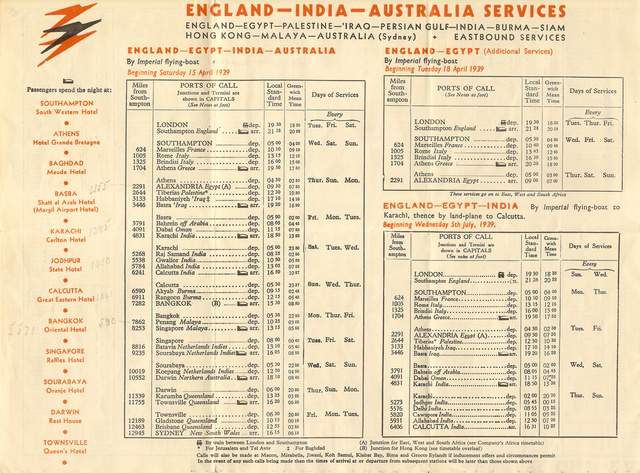
The early days of passenger flight

england to australia in 1929

Long service leave is uniquely Australian. After working with the same employer for an extended period of time – it used to be twenty years but has fallen to ten in some places – an employee would receive three months paid leave. It was a nineteenth century innovation and the idea was that it would allow someone the time to visit home, home of course being the UK. The calibration was one month travelling back, one month to visit and then one month to return.

Moving home truly meant something in those days. A lifetime of separation and often having left never to see one’s parents or relations or friends ever again.

The schedule above was for travel from England-to-Australia in 1929 via India. Only eight days it by then took but no one went steerage although by today’s standards no one anywhere would have any kind of an experience similar to what was the best there was back then. This is from a fascinating article, What International Air Travel Was Like in the 1930s picked up at Instapundit. The story is of a different world not all that long ago but immensely remote. The pictures are even more incredible. How quaint we will no doubt look to those peering back at us from the twenty-second century.

It’s only the weather, folks, only the weather

record low temps us 21.11.13 to 28.11.13

This is the story from Drudge and I must say it is bizarrely startling. Over the past week the figures show:

Almost 1000 record low max temps vs 17 record high temps

Records in the last 7 days:

205 snowfall records.
969 Low Max. 203 Low temps.
17 High Temp.
61 High minimum.

What I don’t know, of course, is how unusual it is to be setting temperature records like this at this time of year, but my guess is that this is a very unusual result. Snow in Texas in November does not seem like the norm. Of course since the global warming crowd stopped worrying about global warming and have defined the problem as climate change, this fits right into their narrative but somehow I don’t think they will be pointing this out themselves.

AND JUST FOR GOOD MEASURE: Found this as well which underscores the above. If I read this right, there is more ice this year in the arctic than in any of the previous years, and even if my reading is not perfect, there certainly isn’t less.

polar ice caps nov 2013

Studying the humanities today will make you ignorant

We’re not talking about just anywhere here, we are talking about UCLA. This is a report on a presentation given by Heather Mac Donald of the Manhattan Institute about the current state of our culture:

“Until 2011,” she noted, “students majoring in English at UCLA had been required to take one course in Chaucer, two in Shakespeare, and one in Milton — the cornerstones of English literature.

“Following a revolt of the junior faculty, however, during which it was announced that Shakespeare was part of the ‘Empire,’ UCLA junked these individual author requirements and replaced them with a mandate that all English majors take three courses in the following four areas: Gender, Race, Ethnicity, Disability, and Sexuality Studies; Imperial, Transnational, and Postcolonial Studies; genre studies, interdisciplinary studies, and critical theory; or creative writing.”

As Mac Donald put it, “In other words, the UCLA faculty was now officially indifferent as to whether an English major had ever read a word of Milton, Chaucer or Shakespeare, but was determined to expose students, according to the course catalogue, to ‘alternative rubrics of gender, sexuality, race and class.'”

If nothing else, it’s easier on the students and no doubt on the junior staff as well. You will end up knowing bugger all but have strong opinions about it.

The grass is browner on the far side of the fence

I never thought that I would turn into an anti-drugs campaigner but there you are. As a 60s child I was there at the beginning but it amazes me now to reflect that I haven’t been near any of it for more than forty years. And I’m not sorry or a bit regretful.

The one thing I knew from the start was that this stuff has the potential to tear you psychologically apart. If you have some kind of flaw in your mental makeup, drugs will do a demolition job on your mind. Taking drugs is a form of Russian roulette; some make it through all right and others are scarred, and sometimes ruined for life. When I think back on the people I knew whose lives were destroyed by the drugs available at the time, and today they are worse because more powerful, I cannot believe how lax we are about these dangerous chemicals which we do too little to deter people from indulging in.

When someone I know’s younger son turned 16, every birthday present from his son’s friends was alcohol related. Not alcohol itself, but things like glasses and decanters. Now I don’t know how you might have felt but he was relieved. As my colleague pointed out had his son’s friends thought that the most appropriate presents were hash pipes and hookahs then he would have been seriously alarmed. Lots can go wrong with alcohol too but the damage from the drug culture is worse. And even if it’s not, we provide a great many social warnings and make a massive effort to deter people from overindulging in alcohol, and the effort has grown over the years. There is nothing comparable about drugs. With the drug culture, you are on your own. No one warns you about how fantastically dangerous they are.

I got onto this issue because of Rob Ford, the mayor of Toronto. He smokes crack cocaine but my point was not that it’s OK, my point was that only someone on the conservative side would be pilloried for it. Nigella Lawson admits to having used cocaine and the description of the haze she entered into is quite remarkable. Alan Fels, who is seeking assistance for the mentally ill, had this to say with the drugs problem mentioned almost as an aside when it is probably one of the most important problems at the present time:

He said a ‘scandalous’ example of the problem was a lack of treatment for people who had both mental health and substance problems.

No other mention of narcotics in the story but the statistic that four in ten Australians will have a mental problem during their lifetime does make it seem like there is quite a bit of evasion of the central problem going on.

There is this story in The Spectator about someone named Trinny Woodall who I never heard of but must be a celebrity in the UK. And this is from her story:

I’d always hated alcohol, but over the next five years I developed a drink problem. I drank a bottle of vodka a night, with cocaine and pills. And I started to get into trouble. Not the kind of trouble that ended in prison, but it ended up with me feeling lonely and isolated. Every night I’d tell myself, ‘This is my last time,’ and the next day I’d end up using again. Then one night when I was 26, three of my very closest friends and I said, ‘Tomorrow we’ll stop.’ I desperately wanted to — the first time in ten years of using that I’d had that feeling. I called up my psychiatrist and told him that I needed to get away.

These are stories the like of which you can read every day about someone famous. But I dwell on the ones who ruined their lives and are no longer a presence at my age level. I used to think of survivors of the drug culture of the 1960s as my generation’s form of war veteran. Some of us came back but others did not.

Narcotics and “recreational” drugs are a poison. There may be some parents who have a joint with their kids but most adults live in mortal fear of their children entering into the dark worlds of drug abuse. Trinny Woodall is just one story out of many. Why we are so light handed about drug abuse I cannot know – I do not believe you can be arrested in Australia for possession of marijuana at the present time, or if you can virtually no one is. That’s not how things ought to be but that is unfortunately how they are going to stay.

The highest quality climate science

At least they met but why the secrecy. This is by Nigel Lawson in the latest edition of The Spectator:

The long-discussed meeting between a group of climate scientists and Fellows of the Royal Society on the one side, and me and some colleagues from my think-tank, the Global Warming Policy Foundation on the other, has now at last taken place. It was held behind closed doors in a committee room at the House of Lords, the secrecy — no press present — at the insistence of the Royal Society Fellows, an insistence I find puzzling given the clear public interest in the issue of climate change in general and climate change policy in particular.

The origins go back almost a year, to a lecture by the president of the Royal Society, the biologist Sir Paul Nurse. In it he chose to launch a gratuitous personal attack on me, making a number of palpably false allegations. I wrote to him, pointing out his errors, and he replied — somewhat changing his tune — conceding that ‘it is quite legitimate for both of us to talk about climate change policy, but before doing so we need to have access to the highest quality climate science. I am not sure you are receiving the best advice, and I would be very happy to put you in contact with distinguished active climate research scientists if you think that would be useful.’

So now the highest quality climate science has been provided but we don’t know what it was or how Nigel Lawson replied. All I do know is that Lawson has not changed his mind. But again, why the secrecy?

Partisans without a policy

I didn’t like the Rudd/Gillard/Rudd Government because it did things that I thought were perniciously wrong. And I was pleased to read the Murdoch press because on many of these issues we saw eye to eye.

But it is maddening to read the left wing press today. Do they actually want the things that Labor did? Do they want an open borders policy? Are they happy to see boat people drown to prove some obscure point? Do they want us to spend our way into perennial debt? Are they happy to see money thrown away on one wasteful project after another? Do they want Australia’s relationships with Indonesia and China poisoned in perpetuity?

These people make no sense to me. They are partisans without a policy. They are journalists without judgment. Where do their opinions come from? How do they get to write for newspapers or pontificate at the ABC? Do they think there is a perfect world in the offing if only this, that or the other?

Shallow, ignorant and dangerous. Their aim is to prove that a free press has limits. But a free press also must be disciplined by the market. Let The Age and The SMH do their worst. If there is a market for the junk they write, well on you go. But the ABC, it belongs to all of us and if we no longer want what they offer what is to be done? I can only hope that someone has a plan because it is an organisation out of control.

Coke is it

From The Telegraph in London:

Crack-smoking antics of Rob Ford do not appear to have put off his supporters, poll shows.

And this from The Australian:

Nigella ‘Higella’ Lawson had the taste for cocaine, her ex-husband has told a court.

Illegal narcotics are a curse on our society but they are as deeply embedded as alcohol and are used extensively by our political elites. But it is only conservatives who will be whipsawed into political destruction by even a hint of such impropriety. I am no defender of the use of cocaine but I am not content to let the sanctimonious hypocritical mobs of the left deprive us of some of our potential leaders because of rules they do not abide by themselves. I will be surprised if this revelation about Nigella Lawson ruins her career but it might (she is, after all, the daughter of Nigel Lawson). But if she were an established participant on the right, whatever the facts of the case might be, the certainty would be that her career would be over.

As for the real Rob Ford, or at least for another side, see this.