He’s a truther and a cheat?

He’s a truther and has a history of cheating! Pete Carroll, that is.

The right team won, no remaining doubt.

But he was also out-coached. The thought in my mind as the game wound down was why doesn’t Boston call a timeout? It was certain Seattle was about to score. Therefore, although there was virtually no time left, you would think they would want all the time they could grab to run a play or two themselves. However:

Seattle took over at the Patriots’ five with 1:06 remaining. After Jermaine Kearse’s amazing catch, Seattle had wasted a timeout after getting the play in late. So Seattle had first-and-goal with one timeout remaining.

Marshawn Lynch bulled to the one. Most everyone in the stadium expected Beilchick to use one of his two timeouts, to preserve time for a possible last-second drive.

Belichick just stood there, watching the clock run.

What was he thinking?

Maybe this:

If he calls timeout, then Seattle has the possibility of running three plays from inside the one, with their whole playbook available to them. They could run it, and if they didn’t score, run it again, knowing they could call timeout to set up a fourth down call if they didn’t score on third down.

By letting the clock run, Belichick prompted Carroll to worry about the clock. After the game, Carroll said he wanted to “waste a play” on second down. What he seemed to be saying was, his intent was to run the ball, but he wanted his second-down play, with time running down, to be a pass play, so if the Seahawks didn’t score, an incompletion would stop the clock and leave him with two plays and one timeout remaining.

Carroll also knew that if he ran on second down, the Patriots would know he would have to throw on third down, and Carroll probably wanted to avoid being that predictable.

Belichick, thinking a few moves ahead, probably anticipated Carroll wanting to pass on second down once the clock ran down, and sent a third cornerback onto the field.

When I talked to Patriots reserve cornerback Malcolm Butler last night, he said he was on the sideline for first down. He ran in when his cornerbacks coach yelled, “Goalline 3-corners.” So the Patriots had five defensive backs on the field for a play against a powerful running back from inside the one. In other words, the Patriots anticipated a pass on second down, even though Carroll was throwing on second down because he didn’t want to face a sure-passing down on third down.

That is million dollar coaching and then some.

And then there’s the most important question of all: Why Does Tom Brady Have a Menorah?

Maybe it was a gift from Brady’s brother-in-law Kevin Youkilis, the Jewish retired Red Sox first baseman who married his sister Julie in 2012. Maybe Patriots owner Robert Kraft, who, along with his late wife Myra, is known for his Jewish philanthropy, sent it over as a housewarming present (Kraft lives around the corner, and according to Leibovich encouraged his “fifth son” to move to the neighborhood). Maybe Gisele just loves Hanukkah.

Or to quote Tom Brady himself:

“We’re not Jewish,” Brady said when I asked him about this. “But I think we’re into everything. . . . I don’t know what I believe. I think there’s a belief system, I’m just not sure what it is.”
What an anti-terrorist law should look like

This is what every country in the Democratic West must do if we are really going to preserve our freedoms. The article is titled, Canada’s New Anti-Terror Bill Is Everything You Hoped It Wasn’t, but whoever “you” is, it isn’t me. This is exactly what I do think is needed.

Under the broad anti-terror legislation tabled Friday, Canada’s spy agency, the Canadian Security and Intelligence Service (CSIS), will be given broad new powers to investigate and “disrupt” terrorist plots. Canada’s police services will be able to go after online terrorist propaganda.

When the bill was tabled on Friday afternoon, the Prime Minister vowed to prevent attacks like the ones that hit Ottawa and Quebec in October.

The powers included in Bill C-51 come with little new oversight or transparency. The core of the provisions will allow CSIS to disrupt attacks the organization believes may occur in Canada or abroad.

The government calls them “disruption warrants,” and they will let Canada’s spies do just about anything. According to the legislation those warrants authorize the spies to “enter any place or open or obtain access to any thing,” to copy or obtain any document, “to install, maintain or remove any thing,” and, most importantly, “to do any other thing that is reasonably necessary to take those measures.”

To use the new measures, once passed by Parliament, the spies will need to apply to a judge to authorize operations to stop a terrorist attack. The legislation doesn’t offer many caveats on that power, instead enabling the spies to take whatever measures they feel are necessary, in Canada or abroad. So long as a judge agrees, it’s all fair game—even if it’s illegal.

The word install appears to be an indication that CSIS should have powers to install malware and keyloggers, which the government has already moved toward legalizing.

On top of that, the bill offers no new oversight for CSIS. Currently, it is policed by the Security Intelligence Review Committee (SIRC), which has been lambasted for being woefully inadequate and staffed by political appointees.

This legislation does not show the terrorists have won. It shows what needs to be done to make them lose. It is like dealing with paedophiles. You do not give them freedom of speech on the zero chance that they may be in the right and the rest of society in the wrong. You just make anything they say in public, or put online, illegal, and punish them as hard as you can for any breaches whatsoever. Trust me, if they had the chance to shut you up, they would, they absolutely would. We need to do this while we still can.

Mudita

This is from an article that talks a lot about Tom Brady’s training regime. In the middle of the article, there is this:

He shares with me a word he learned in Sanskrit, “mudita.” “It’s like, fulfillment in seeing other people fulfilled,” Brady says.

The kindest word I have seen, the opposite of envy, the irritation one feels in seeing other people fulfilled. Does such a word exist in English?

We are a world of tribes

This story caught my eye: Departing From Country’s Pacifism, Japanese Premier Vows Revenge for Killings. It’s not that I don’t feel much the same, but still, this did make me stop:

When Islamic State militants posted a video over the weekend showing the grisly killing of a Japanese journalist, Prime Minister Shinzo Abe reacted with outrage, promising “to make the terrorists pay the price.”

Such vows of retribution may be common in the West when leaders face extremist violence, but they have been unheard of in confrontation-averse Japan — until now. The prime minister’s call for revenge after the killings of the journalist, Kenji Goto, and another hostage, Haruna Yukawa, raised eyebrows even in the military establishment, adding to a growing awareness here that the crisis could be a watershed for this long pacifist country.

ISIS has gone around murdering its way across the Middle East and elsewhere, and everyone who has died has been a human soul. But what has upset the Japanese is that in this case, it was one of their own who died, and that has made all the difference. You can sing The International all you like, and our elites can think there is a world of peace and harmony in open borders. The reality is that we seem to identify with people like ourselves and less so with those who are not.

Capitalism and its absence in the third world

This from J.R. Dunn on The Elites bow to Mecca. Worth reading in full, but this is the most salient point:

The reigning ideology of the leftist segment of the elite class — which sets the tone for the moderates (whoever the hell they may be) and the wet conservatives, is multiculturalism. This can be stated as the contention that all whites are guilty of oppressing all nonwhites and must constantly be prepared to atone for it.

It used to be that the working class was the salt of the earth, until it turned out that they liked what capitalism had created for them. Now it is the people for whom the capitalist system remains unreachable, and therefore remain in deepest poverty, who are the recipients of socialist solicitude. Except that these same third world people have shown a very strong attraction to the capitalist system. And if the system cannot be brought to them, they are determined to make it to capitalist countries, where even the crumbs from such a bountiful system leave them better off than would anything else they might have done back in the places they have departed from.

Iraqi sniper

We went to see American Sniper when it first came out and I would have written on it right at the time but there was something about it that remained suspended in mid-air that I couldn’t quite pull down. Today I discovered that Clint Eastwood had opposed both the war in Iraq and the war in Afghanistan (which I found out here in a really excellent take on the film). I now see the movie more clearly, and also see why it did not blow me away as I had been by Unbroken.

The movie is the Iraqi war without the politics. There are two sets of soldiers, each side fighting for the values it believes in. Chris Kyle, the American sniper, is matched by an Iraqi sniper who is equally committed to his own side, and is as patriotic as Kyle. There is no difference in bravery on the two sides. If anything separates them, it is technology. It is a patriotic film in the tradition of “my country, right or wrong”.

Except that it is Chris Kyle’s country that is right and not wrong, although that would not be the view of the soldiers on the other side, nor of the thousands of young Muslims going off from their homes to fight in the Middle East.

It is welcoming to see a film in which the bravery and honour of the American soldier is shown so clearly. And I have to assume that Kyle is more or less as he is portrayed, which is brave beyond any possibility of my ever understanding how someone can do what he did. And he is no more brave than the others who fight along side of him. But then he is no braver, either, than the Iraqis who attack him in numbers even though the American army is armed with technologies, such as armoured cars and helicopters, unavailable to their side.

What the film surprisingly did not do was dwell on why we are fighting this war, but perhaps that wasn’t its purpose. It did show 911, and it identified some barbarities by the Iraqis. But without the purpose, without an explanation about why the fighting is and was necessary, there was little in the film to make it clear why Chris Kyle and the others had been putting their lives on the line, and what difference it would make if we lost and pulled out. I, of course, bring this understanding along to the film on my own. I only wish there were more of it in the storyline. It seems that most Americans already understand the point which is why the film has broken box office records. But since the reason why this war is necessary never seems to get explained anywhere else, it’s a shame it was not more fully explained here. It is not a film designed to change anyone’s mind. The only marker for me is how much the left hates the film. It may therefore be a better film than I have been able to understand for myself.

The trailer, by the way, shows the opening sequence of the film. You will have to go yourself to see what happens next. As for the ratings, as per usual in a film like this, the audiences have liked it more than the critics.

Rotten Tomatoes: Critics 72% and Audiences 88%
IMDb: 7.6

I hope he didn’t stick it under his chair

It’s in Hindi, but every so often you hear the words “chewing gum” and there’s no doubt what it’s about. Is he still a smoker? Does he need Nicorettes even after at least six years? Is the media in the US covering up even about this too? In India, apparently, it is GWB they prefer, which may be why this bit of disrespect was reported on.

“Indians are pro-Bush,” said Gurcharan Das, a prominent writer. “He saw that with China rising, America needed a big country to be an ally. He hyphenated India with China and de-hyphenated it with Pakistan and Indians loved that.”

Whatever the view may be of him elsewhere, in India the 43rd president is seen as a straight-talking statesman. In 2008, Modi’s predecessor as prime minister, Manmohan Singh, assured Bush: “The Indian people deeply love you.”…

The things that drive other foreigners nuts—the unshakable certitude, the folksy language—Indians like.

“George W. Bush occupies a special place in the minds of many Indian foreign policy elites,” Sadanand Dhume, an India-born specialist on the country at the American Enterprise Institute in Washington, D.C. “In a nutshell, Bush took India seriously.”

Meanwhile, Obama takes nothing seriously, other than his amour-propre.

Toronto the Good in the 1910s

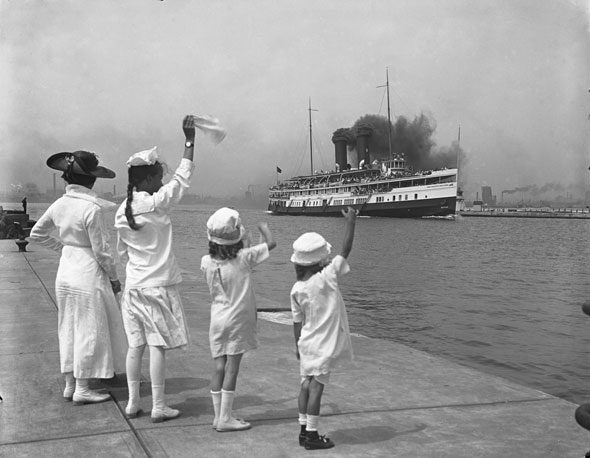
toronto ferry 1910

Next month it will be forty years since I arrived in Australia but nothing will remove the warmth I feel for my first home and where I grew up. These are photos sent to me under the heading A 1910s Toronto photo extravaganza, each one of which brings with it distinct memories of the city I grew up in. My thanks to David Kwinter – whom I have known for almost 60 years – for sending these to me. Two more because they have such meaning to me.

First the picture of the Toronto main library which was something like a seven minute walk from the house I grew up in. The caption says it’s at the corner of College and Beverly but it’s actually at College and St. George.

toronto library

There is then a picture of a pharmacy in the middle of “Kensington” which is as far from the London version as you could get. But that was still how it looked when I was around. In fact, if anything, it has a much more orderly look than it had later, and even now. The owner of the shop is E. Rutherford, but the first wave of Eastern European immigration is shown by the Yiddish above the door, which is not a translation but a transliteration of “Cut Rate Drug Store”. The signs today are as likely to be in Chinese as anything else.

toronto kensington

OK. One more, taken at the corner of Yonge and Richmond. These are Toronto streetcars at the start of the last century, but the ones in the picture were still on the road when I was just growing up. In 1948, GM offered to give buses to any city that tore up its streetcar tracks. Toronto was amongst the few in North America who turned the offer down.

toronto streetcars yonge and richmond

LATEST NEWS: And now Toronto is officially the best city in the world, according to the Economist. Melbourne remains the most liveable, but Toronto wins overall even though it did not win in a single category. Just overall excellence. Therefore a picture of something more recent:

toronto fort york

OK. It’s not so recent, but Fort York is an actual frontier fort that you can find in the heart of the city, surrounded by skyways and highways, and which no one ever goes to, except me. But it’s the genuine article, and if they had any sense, would make it a major feature, not some almost-embarrassment that you get taken to when you are in Grade V and never go to again. So I will finish with this, which is a video put together for a condo at Yonge and Richmond, as in the photo above. What I had not heard, but must be a Toronto cliche, is that this is the area of the Yonge & Rich, get it? Well you will, but only if you know how to pronounce “Yonge”, and it’s not Yon-Gee.

Greece opts for spending 120% of domestic output

One more experiment in Keynesian economics. The politics of living within your means are what they are. The Greeks have reason to believe that they can blackmail the rest of the EU into funding their debts. But literally in this case, where will the money come from?

Syriza’s demands for a debt restructuring have raised the prospect of a stand-off between Athens and other European leaders that might lead to “Grexit” although financial markets were treating that as a marginal risk on Monday.

The potentially disastrous consequences of such a move for Greece and Europe were likely to force policymakers to find an agreement, analysts said.

So they’re beggars? So what do they care? You want to save your precious Euro, this is what you got to do? However as Daniel Hannan notes:

It would, indeed, be very difficult to make an economic case for euro membership.

The past six years have seen a greater depression in Greece than that of 1929 to 1935. Output is down by an almost unbelievable 25 per cent. A quarter of all Greeks – half of all youngsters – are unemployed, and tens of thousands more have emigrated in search of jobs.

Their currency is overvalued and market disciplines are almost invisible. If they leave the Euro, there are actually things they might be able to do.

Abusing our tradition of tolerance

This is by Henry Ergas, Australia’s finest economist, in an article today in The Australian on Australia Day. It is titled, Islamists cannot be permitted to abuse our tradition of tolerance.

THE French love the idea of France, Americans their country’s shining ideal of liberty.

Australians simply love their country as it is. And nothing is more integral to the achievement we celebrate on Australia Day than the easygoing tolerance of difference.

But tolerance was hardly on display at the demonstration Hizb ut-Tahrir organised last Friday night in Lakemba, which refused to condemn the attack on Charlie Hebdo. And though the organisation is on the fringe of Australia’s Muslim community, its views, and those of other fundamentalists, find a broad and growing echo in the Islamic world.

Whether our model of pluralism can remain unchanged as religious hatred spreads, including into Australia’s suburbs, is a problem that demands honest discussion. At the heart of that problem lies the fact that Islam finds it difficult to accept religious freedom and the freedom of expression that goes with it.

The UN’s Universal Declaration of Human Rights defines religious freedom in terms of each person’s ability to “change his religion or belief” and to manifest that religion or belief “in teaching, practice, worship or observance”. But data from the Association of Religion Data Archives shows that while they endorse that declaration, severe restrictions on religious freedom are imposed in almost 80 per cent of Muslim-majority countries with a population of two million or more, compared to 10 per cent of Christian-majority countries.

Those restrictions have dramatic consequences, with serious religious persecution more than twice as likely in Muslim-majority countries than in their Christian-majority counterparts. What were once large Jewish populations have almost entirely disappeared; increasingly, Christians are targeted too, with their numbers plummeting, while Christian proselytism is commonly prohibited and routinely punished. As for the Baha’is and Zoroastrians, repression is their daily fate.

That is not to deny that many victims are themselves Muslims: in 70 per cent of Muslim- majority countries, governments persecute other Muslims, typically from minority sects. But that merely betrays a fanaticism which continually breathes fresh life into centuries-old doctrinal disputes.

Catholics and Protestants in Northern Ireland may fight, but their quarrels never invoke 16th- century differences on transubstantiation.

Every day, however, Sunnis and Shi’ites slaughter each other over the rightful successor to the prophet Mohammed.

That fanaticism breeds a demonisation of enemies, apparent in Islamists’ portrayal of Jews, that encourages religiously-inspired violence. Muslim-majority countries have a relatively low incidence of conventional homicide; but even excluding the conflict in Chechnya, Muslims account for more than 60 per cent of all high-casualty terrorist bombings since 1999, with most of those bombings targeting civilians in Islamic lands.

As Muslims comprise less than a quarter of the world’s population, the thesis Montesquieu advanced 250 years ago — that “the Mohammedan religion, which speaks only through the sword, continues to act on men with the destructive spirit which founded it” — retains its element of truth.

That truth grates against Australia’s founding principles. It wasn’t by accident that the founders of the federation ensured it would accommodate religious diversity, not favouring one faith or denomination over any other. Rather, the Constitution’s reticence on matters of religion was a conscious choice, made despite what might readily have been overwhelming pressures.

Just on its first day, for example, the 1897 Constitutional Convention received a petition with more than 17,000 signatures asking for the constitution to state that “God is the Supreme Ruler of the world and the source of all law and authority”; and in the next three days alone, that petition was joined by 16 others, signed by 140,000 people. But though they were deeply religious, the founders rejected those requests, convinced that the expression of faith had to be a private matter. That position, abhorrent to the Islamists, remains vital to the “feeling of free citizenship” Henry Parkes exalted. The issue is how it can now be defended.

To that question there are no simple answers: just as Jonathan Swift wisely observed that “it is useless to attempt to reason a man out of a thing he wasn’t reasoned into”, so the abject failure of costly “deradicalisation” programs shows the intolerant cannot be lulled into tolerance. What is clear, however, is that religious neutrality can no longer mean indifference. It is, in other words, an illusion to believe “tolerance for the tolerant, Islamism for the Islamists” makes any more sense as a policy than “liberalism for the liberals, cannibalism for the cannibals” (to use Martin Hollis’s phrase): for like all plans to appease wolves by throwing them carcasses, what begins with other people’s bodies invariably ends with one’s own.

Rather, a response is needed that measures up to the threat. Yes, the fanatics will smoulder with rage; but no Islamist should qualify for Australian residence or citizenship. And if the government sees merit in retaining section 18C, it should see even greater merit in enforcing longstanding prohibitions on incitement to violence, which have played too little role in dealing with the Islamists and their fellow travellers.

All that raises many legitimate questions. How can it be, for example, that the government blocks access to websites suspected of breaching copyright, but allows jihadi websites to flourish? And how can it be that SBS, using taxpayers’ funds, helps subsidise Al-Jazeera, whose executive producer called “I am Charlie” an “alienating slogan” while suggesting the Paris attacks might only be a “targeted” response to Abu Ghraib and to French action against Islamic State?

That is not the country today celebrates. Nor should it be that our children inherit. Australia’s “indissoluble Federal Commonwealth”, the Constitution tells us, was achieved “humbly relying on the blessing of Almighty God”. It will take all our human vigilance to keep those blessings intact.

From the comments at Henry’s thread, there is this, which is correctly subtitled “a non-racist, unbigoted inquiry into the core teachings of Islam and what it all means (if anything) for non-Muslims”. These are the 28 headings. Detailed explanations for each of the 28 are found at the link.

1. A standardized version of the idea-collection is written down.
2. The Quran includes instructions for its own spread.
3. The idea-collection includes instructions for its own preservation, protection, and duplication.
4. Islam commands its followers to create a government that supports it.
5. Permission to spread the religion by war.
6. Lands must be conquered.
7. The idea-collection provides new soldiers by allowing polygamy.
8. It is a punishable offense to criticize Islam.
9. You can’t leave Islam once you’re in.
10. Islam must be your first allegiance.
11. Dying while fighting for Islam is the ONLY way to guarantee a man’s entrance into Paradise.
12. You must read the Quran in Arabic.
13. You must pray five times a day.
14. The prayers involve moving together in time.
15. A woman is in a thoroughly subordinate position.
16. The only way a woman can guarantee her passage into Paradise is if her husband is happy with her when she dies.
17. Allah gives Himself permission to edit his own work.
18. The Quran uses the carrot and stick to reinforce behaviour.
19. Islam provides a huge and inspiring goal.
20. Non-Muslims must pay a large tax.
21. A Muslim is forbidden to make friends with a non-Muslim.
22. The Quran counsels the use of deceit when dealing with non-Muslims.
23. Islam must always be defended.
24. Islamic writings teach the use of pretext to initiate hostilities.
25. The explicit use of double standards.
26. It is forbidden to kill a Muslim (except for a just cause).
27. If Muslims drift away from Mohammed’s teachings, Allah will end the world.
28. The message in a standard Quran is difficult to decipher.