Went to see Noah last night. Let me put it this way. There was a chap named Noah and he had three sons named Shem, Ham and Japteth. There was a flood. As for the animals trooping in two by two, in over two hours that part might have taken up three minutes of movie time. But at least the film showed how Noah was able to find the labour needed to build a boat big enough to carry two of every kind of animal in the world. I can only think a film like this is possible today because no one any longer actually knows the story. More evidence, as if it were needed, that our Judeo-Christian culture will not hold and something else will be arriving very soon.
Category Archives: Books and movies
Defenceless against history
The drama issues from the assailability of vital, tenacious men with their share of peculiarities who are neither mired in weakness nor made of stone and who, almost inevitably, are bowed by blurred moral vision, real and imaginary culpability, conflicting allegiances, urgent desires, uncontrollable longings, unworkable love, the culprit passion, the erotic trance, rage, self-division, betrayal, drastic loss, vestiges of innocence, fits of bitterness, lunatic entanglements, consequential misjudgment, understanding overwhelmed, protracted pain, false accusation, unremitting strife, illness, exhaustion, estrangement, derangement, aging, dying and, repeatedly, inescapable harm, the rude touch of the terrible surprise — unshrinking men stunned by the life one is defenseless against, including especially history: the unforeseen that is constantly recurring as the current moment.
A reply to a reviewer of my DHT
My comment to a friend who sent me his forthcoming review of Defending the History of Economic Thought. The Feyerabend quote I refer to below is “the history of a science becomes an inseparable part of the science itself . . . essential for its further development a well as giving content to the theories it contains at any particular moment” (Against Method p 21).
Dear Anthony
It’s good to see the book being reviewed and it could not be in better hands than yours. And I have learned quite a number of things about my own book by reading your review. But perhaps because of the battles I have been through I see this differently from you and in the end you do not answer the one question that matters: should HET remain within the economics classification and be counted as a social science or should it be removed to the history and philosophy of science and become part of the humanities? And I also do not know whether you think I have made a useful case for studying HET by an individual or for ensuring that there are historians of economics dotted throughout the discipline to keep the others on their toes.
Economics as we teach it is the shifting outcomes of research agenda with the latest manifestations rising to mainstream textbook level, with all of its history embedded in even these answers, but with many other answers given over the entire history of economic thought still in contention amongst some blocs of economists. You cannot make a physicist or a chemist a better physicist or chemist by teaching them the history of their subject but as your own testimony of your own students shows, you can with economics. The sentence you quote on p viii, for example – that HET is economics in and of itself – is a sentence that is explained in the rest of the para which seems perfectly true to me. Having watched the failure of the stimulus over the past five years, and especially in the United States, you may be sure that every aspect of John Stuart Mill’s statement, that “demand for commodities is not demand for labour”, has been more than confirmed for me. Mill to me is not HET but live theory with genuine real world implications you cannot find in your average textbook although you will find it in mine (Free Market Economics: an Introduction for the General Reader whose title I took from Henry Clay (1916) – have you seen it?).
That HET is both history of economic ideas (HEA) and intellectual history (IH) is clear enough to me but Winch’s example, which I haven’t read so don’t know, would be part of that history and philosophy aspect which is no more than half of HET and probably less. But it is the other half and more – which you capture with the lovely Feyerabend quote which I’d never come across but will use ever after – is also HET and it is that that needs to be preserved and recognised for what it is. So in your terms, I am trying to preserve HEA as a subset of economics but recognise that IH is also part of HET. And if you think Samuelson is part of IH, then what to do with that killer quote, that to be an academic success “you must read the works of the great economists”. This seems completely to be making the point I am making. Indeed, your conclusion on Heyne, which you state that my view is “not incompatible” with his, but what difference does it make for me here since the book is aimed at another issue, which is the need to study HET if one is to be a better economist and the need to keep HET within the economics curriculum if the economic theory itself is to thrive.
In trying to deal with this issue, a major problem I have found with the academic world is that for all the departmental politics that goes on, academics are politically in the wilderness. My days as a lobbyist really did matter. I am trying to put together a book that defends the position of HET which will wither and die if it is relegated to history and philosophy of science. We have the disdain of the mainstream to contend with while even some of our own stellar lights – Margaret Schabas and Roy Weintraub for example – are trying to remove HET in just that direction. What your review has said is that there are two kinds of HET, this one and that one, and that I did not make this distinction well enough. But since you agree that HET is important to the study of economics, which is the first sentence of the intro, why are you not supporting this? Why are you not saying somewhere that Kates is onto something important and even while it might have been better if it had been done in some other way, at least it has been done, and imperfect though it may be, is a welcome addition to the literature. In real politics, finding agreement is the most important part of what we do. In the academic world, unfortunately, finding disagreement is our bread and butter.
Anyway, I am thinking of having a session on my book at the HES in Montreal which I am going to, funding permitting. If you are going to be there as well, would you be interested in being part of a session that discusses the book? It is a funny thing that we in Australia have been so on this issue from the start, which I attribute to John Lodewijks, who has continually stirred us into action. And funny again, there have been enough genuinely politically minded people who have been able to work together to achieve common objectives on a few occasions. I will copy my reply to you to Robert Leonard who is organising the conference. I’m usually quite happy to stand at the back of the room – a speciality for lobbyists – but on the question of the preservation of HET I can see that if I don’t do it there is no one else who will. Maybe there’s no danger and I am over-reacting, but if you look at the story of the European Research Council, which was as recent as 2011, I would not be all that certain that these same troubles might not arise again.
Anyway, I thank you for the review, and specially for the Feyerabend and Samuelson quotes which are perfect for me. Had I known of them, each would have been at the front of some chapter. And I do hope to see you in Montreal.
With kindest best wishes.
Steve
Classical economic theory and the modern world
A post in two sections.
Section I
The March issue of Quadrant has an article of mine which has just been put up online. In the magazine itself the title is, The Dangerous Return of Keynesian Economics – Five Years On. What it is five years on from is an article of mine that found its way into the March 2009 issue which dealt with that very dangerous return of Keynesian economics in the form of the worldwide stimulus that economies across the world were beginning to apply. The original title was The Dangerous Return to Keynesian Economics for which this was the single most important passage:
Just as the causes of this downturn cannot be charted through a Keynesian demand deficiency model, neither can the solution. The world’s economies are not suffering from a lack of demand and the right policy response is not a demand stimulus. Increased public sector spending will only add to the market confusions that already exist.
What is potentially catastrophic would be to try to spend our way to recovery. The recession that will follow will be deep, prolonged and potentially take years to overcome.
That this outcome was absolutely assured in my own mind is, of course, not the same as it being absolute assured in reality. And indeed, it is not too much to say that 99% of the economic opinion of the world went quite the other way. The best example of this attitude may be seen in this comment made to me by Senator Doug Cameron during my appearance before the Senate Economic References Committee in September 2009.
Why have the IMF, the OECD, the ILO, the treasuries of every advanced economy, the Treasury in Australia, the business economists around the world, why have they got it so wrong and yet you in your ivory tower at RMIT have got it so right?
This is, of course, a question I ask myself but also one for which I have an answer. The odd part is that no one else asks this question although it is the question that ought to go to the heart of the matter. Which takes me to the second part of this post.
Section II
The economics I use I did not invent but am near enough unique in applying it to economic questions in the modern world. This is the economic theories of the cycle as developed by classical economists which was the theory accepted universally across the profession prior to the coming of the Keynesian Revolution in 1936. So to see things as I see things about the nature of this theory, let me take you to the opening part of a form I have just sent to my publisher on how to advertise the second edition of my Free Market Economics. It was a book whose first edition I wrote at white heat over the twelve weeks of the first semester in 2009, from March to May, to explain in more detail why the stimulus would with certainty fail, as fail it did.
1. Please describe the book in non-technical layman’s terms (in no more than 150 words). Include brief details of the book’s main objectives and conclusions.
Have you ever wondered why no public sector stimulus has ever worked? You are holding in your hands a book that is unique in our times. It is a text on economic principles based on the economics before Keynesian theory became dominant in macroeconomics and equilibrium analysis became standard in micro. It looks at economics from the perspective of an entrepreneur making decisions in a world where the future is unknown, innovation occurs at virtually every moment, and the future is being created before it can be understood.
Of particular significance, this book assumes Keynesian theory is flawed and policies built around attempting to increase aggregate demand by increasing non-value-adding public spending can never succeed but will only make conditions worse. The theories discussed are the theories that dominated economic discourse prior to the Keynesian Revolution and are thus grounded in the economics of some of the greatest economists who have ever lived.
It is, of course, possible that I might have been right for the wrong reasons, but it might also be the case that I was right for the right reasons. I go on about Say’s Law, John Stuart Mill and classical theory, but you know, when have they ever let me down? The world, so far as the evidence shows, works exactly like their theory says it does. And it’s not even that I picked this downturn as a one-off instance, but I also picked the upturn that followed the massive cuts to public spending after the Costello budget in 1996. Who else did that then? What theory is there other than the classical theory of the cycle that could even explain it let alone predict it? And there is no other text anywhere in the world written more recently than the 1920s that can tell you what that theory is other than mine.
You could, of course, buy the first edition right now or you can wait until the much improved second edition is published in July or August.
FME 2nd ed book description
This is from a form I have just sent to the publisher on how to advertise the second edition of my Free Market Economics.
1. Please describe the book in non-technical layman’s terms (in no more than 150 words). Include brief details of the book’s main objectives and conclusions.
Have you ever wondered why no public sector stimulus has ever worked? You are holding in your hands a book that is unique in our times. It is a text on economic principles based on the economics before Keynesian theory became dominant in macroeconomics and equilibrium analysis became standard in micro. It looks at economics from the perspective of an entrepreneur making decisions in a world where the future is unknown, innovation occurs at virtually every moment, and the future is being created before it can be understood.
Of particular significance, this book assumes Keynesian theory is flawed and policies built around attempting to increase aggregate demand by increasing non-value-adding public spending can never succeed but will only make conditions worse. The theories discussed are the theories that dominated economic discourse prior to the Keynesian Revolution and are thus grounded in the economics of some of the greatest economists who have ever lived.
I might also mention this which is a notice I received this week from the publisher:
I am delighted to be writing to all of our authors, contributors, customers and business partners with the exciting news that Edward Elgar Publishing has won another important industry award.
The Frankfurt Book Fair Academic & Professional Publisher of the Year 2014 award was presented to us by the Independent Publishers Guild at a ceremony on Thursday evening.
The judges commented that Edward Elgar Publishing turned in a very impressive sales growth in 2013, achieved on the back of a prolific publishing programme and successful Elgaronline platform. Judges liked its smart customer profiling and forays into international markets. “Edward Elgar is incredibly professional, responsive and imaginative. It is a great example of how a relatively small publisher can be at least as innovative as those many times its size.”
The difference between left and right
Andrew Bolt has quite a neat list of what divides left and right, socialists and conservatives, progressives and small-l liberals, or however you might like to name and frame the differences between the two sides of politics. This is in answer to the ABC’s Jonathan Green who thinks that he, like the rest of the ABC, represents the middle ground. This is the list to which no doubt others might be added.
– restrictions on free speech
– the retribalising of our nation
– changing the constitution to effectively divide us by race
– our high levels of immigration
– massive overspending on entitlements and welfare schemes
– workplace restriction which employers say cost jobs and investment
– government handouts to prop up companies from Qantas to car-makers, involving billions of dollars and thousands of jobs
– preventing illegal immigration, which under Labor was reaching levels approaching 40,000 people a year
– the global warming faith and its carbon tax, responsible in part for the loss of thousands of Australian jobs
– the Renewable Energy Target, who helps make electricity a luxury for the poor without doing anything for the environment
– the green bans on nuclear power and on dams to water our growing cities.
– appeasing or defying rising Third World or developing powers such as China
– surrendering elements of our self-government to multinational fora such as the United Nations
– limiting the reach and bias of our massive state media
– green restrictions on the use of our natural resources, costing possibly tens of thousands of jobs
– how to fight Islamist extremism, already responsible for the loss of hundreds of Australian lives
For more on these issues, there is an interesting article, naturally written by someone on the left, that deals with Are left and right a feature (or bug) of evolution?. It’s a review of two books that look at politics and evolution. You should read it all, but this I thought was precious:
Liberals and conservatives, conclude Hibbing et al., “experience and process different worlds.” No wonder, then, that they often cannot agree. These experiments suggest that conservatives actually do live in a world that is more scary and threatening, at least as they perceive it. Trying to argue them out of it is pointless and naive. It’s like trying to argue them out of their skin.
I, of course, see this in exactly the reverse way. It is the Candides of the left who see no danger and create havoc through their ignorance and blindness to actual problems they ignore. Every one of the issues raised on Andrew’s list is a minefield for which so far as I can see there is not a single realistic solution being offered by the left.
Kishinev 1903
Why have I never heard of this? This is the review of a book published on the 100th anniversary of this pogrom.
Kishinev 1903: The Birth of a Century. Reconsidering the 49 Deaths That Galvanized a Generation and Changed Jewish History.
by: J.J. Goldberg
The Forward, April 4, 2003One hundred years ago, on April 6, 1903, the Jewish community of Kishinev in what was then czarist Russia suffered two days of mob violence that shocked the world and changed the course of Jewish history.
Provoked by a medieval blood libel, flashed around the globe by modern communications, Kishinev was the last pogrom of the Middle Ages and the first atrocity of the 20th century. The event, and the worldwide wave of Jewish outrage that it evoked, laid the foundations of modern Israel, gave birth to contemporary American-Jewish activism and helped bring about the downfall of the czarist regime.
Much of that, curiously, resulted from a misreading of events at the time.
Kishinev, the capital of the czarist province of Bessarabia, today’s Republic of Moldova, was a town of some 125,000 residents, nearly half of them Jewish. Ethnic tensions were running high that spring, thanks to a noisy, months-long campaign of antisemitic incitement by local nationalists.
The rioting began on Easter Sunday, after rumors spread through town that a Christian had been killed by Jews in a ritual murder. Mobs rampaged through Jewish neighborhoods for two days, burning, smashing, raping and killing. When it was over, 49 Jews were dead and 500 wounded, 1,300 homes and businesses were looted and destroyed and 2,000 families were left homeless.
The brutality sent shock waves across Russia and around the world. Leo Tolstoy spoke out. Mass rallies were held in Paris, London and New York. Western governments protested the apparent complicity of the czar’s police, who had refused repeated pleas to intervene. The Forward reported the news with a banner headline: “Rivers of Jewish Blood in Kishinev.”
From nearby Odessa, the great center of Russian Jewish culture, the young Hebrew poet Hayyim Nahman Bialik was sent to Kishinev by the Jewish communal commission to interview survivors and report firsthand on the bloodbath. Before returning home he composed one of his most powerful poems, “On the Slaughter,” with its unforgettable cry that Satan himself could not forgive the death of a child. A year later Bialik would publish his epic masterwork, “The City of Slaughter,” a searing condemnation of Jewish passivity, from which the following is taken.
Descend then, to the cellars of the town,
There where the virginal daughters of thy folk were fouled,
Where seven heathen flung a woman down,
The daughter in the presence of her mother,
The mother in the presence of her daughter,
Before slaughter, during slaughter, and after slaughter!
Touch with thy hand the cushion stained; touch
The pillow incarnadined:
This is the place the wild ones of the wood, the beasts of the field
With bloody axes in their paws compelled thy daughters yield:
Beasted and swined!
Note also, do not fail to note,
In that dark corner, and behind that cask
Crouched husbands, bridegrooms, brothers, peering from the cracks,
Watching the sacred bodies struggling underneath
The bestial breath,
Stifled in filth, and swallowing their blood!
Watching from the darkness and its mesh
The lecherous rabble portioning for booty
Their kindred and their flesh!
Crushed in their shame, they saw it all;
They did not stir nor move;
They did not pluck their eyes out; they
Beat not their brains against the wall!
Perhaps, perhaps each watcher had it in his heart to pray:
A miracle, O Lord ¡ª and spare my skin this day!Bialik’s poem fell on ready ears. Young Jews across Russia, electrified by the events, took the poem as a call to arms and organized themselves into self-defense units, most led by fledgling socialist or Zionist parties. Thousands threw themselves into revolutionary movements, determined to bring down the murderous czarist regime. Their rage and energy gave new momentum to the revolutionary movement and led directly to the abortive Russian revolution of 1905, which in turn set the stage for the cataclysm of 1917.
Others, despairing of any Jewish future in Russia, began making their way to the land of Israel in a wave of immigration that would come to be known as the Second Aliya. Influenced by socialism, led by young radicals such as David Ben-Gurion and Yitzhak Ben-Zvi, the pioneers set about remaking the Zionist settlement in Palestine on a foundation of Jewish labor and Jewish self-defense. Driven by visions of Kishinev and the shame of Jewish passivity, they created the kibbutzim, the towns and factories, the militias and political parties that were the cornerstone of modern Israel.
In fact, the image of Jewish passivity was largely untrue. Eyewitness accounts of the pogrom tell a very different story. Here is a front-page report from the Forward of April 24:
Armed with knives and machetes, the murderers broke into Jewish homes, where they began stabbing and killing, chopping off heads and stomping frail women and small children. If such a vicious, enraged mob would have attacked a Jewish town somewhere in Volin or Lithuania, thousands of Jews would have been killed in an hour’s time. But Kishinev Jews are tough, healthy, strong as iron and fearless. When the murderous pogromists began their horrible slaughter, Jewish boys and men came running and fought like lions to protect their weaker and older brothers and sisters. Even young girls exhibited amazing heroism. They defended their honor with supernatural strength…. The Jews, however, fought with their bare hands and the murderers, armed with machetes and knives, were primed to annihilate and decimate all the Jewish townspeople.
How did Bialik get it so wrong? Like many young Russian Jews, Bialik was ready to believe in the shame of Jewish passivity even before he got to Kishinev. Zionist essayists had been hammering the theme home for decades, none more powerfully than the Kishçnev-born physician Leon Pinsker, whose 1882 essay “Autoemancipation” is still regarded widely as the founding manifesto of Russian Zionism.
Pinsker’s essay was on Bialik’s mind when word of the bloodbath reached Odessa on the second day of the rioting, April 7. Bialik appears to have spent the evening at a meeting of the city’s Jewish literary circle, the Beseda (“Conversation”) Club, which included such luminaries as the historian Simon Dubnow, the Hebrew essayist Ahad Ha’am and editor-publisher Yehoshua Ravnitzky. The circle’s April 7 meeting was devoted to a lecture by a little-known journalist named Vladimir Jabotinsky, age 23. His theme for the lecture, his first major public appearance, was “Autoemancipation.”
Here is how the historian Dubnow recalled the evening in his memoirs:
It was the night of April 7, 1903. Because of Russian Easter, the newspapers had not been issued for the previous two days so that we remained without any news from the rest of the world. That night the Jewish audience assembled in the Beseda Club, to listen to the talk of a young Zionist, the Odessa “wunderkind” V. Jabotinsky [….] The young agitator had great success with his audience. In a particularly moving manner, he drew on Pinsker’s parable of the Jew as a shadow wandering through space and developed it further. As for my own impression, this one-sided treatment of our historical problem depressed me: Did he not scarcely stop short of inducing fear in our unstable Jewish youth of their own national shadow?… During the break, while pacing up and down in the neighboring room, I noticed sudden unrest in the audience: the news spread that fugitives had arrived in Odessa from nearby Kishinev and had reported of a bloody pogrom in progress there.
When Bialik set out for Kishinev later in the week his mission was to collect the facts, but it could be that his narrative was formulated in advance, etched in his mind by Jabotinsky.
Most of Russia’s Jews, to be sure, wanted nothing more than to flee the czar’s charnel house. Emigration to America, already a flood tide, more than doubled by the end of the year. In America, Jews scrambled to cope with the human tidal wave, leading to an explosive growth of Jewish philanthropy and social service agencies. When Russia launched its ill-fated war against Japan the next year, America’s leading Jewish philanthropist, investment banker Jacob Schiff, volunteered to underwrite Japan’s war bonds and personally financed Russia’s defeat. Schiff and other prominent Jewish business figures entered a series of negotiations that led three years later to the formation of the American Jewish Committee, arguably the world’s first modern human-rights lobby. President Theodore Roosevelt greeted the committee’s formation by inviting its best known figure, the former diplomat Oscar Straus, to become his secretary of commerce and labor, the first Jew to serve in an American cabinet. And not a word about color-blind meritocracy: “I want to show Russia and some other countries,” Roosevelt wrote to Straus, “what we think of the Jews in this country.”
For all that, the enduring image of Kishinev is Bialik’s.
The historian Rufus Learsi once wrote that the 1903 Kishinev pogrom must be seen as “a dress rehearsal” for the far bloodier wave of antisemitic violence two years later, following the 1905 revolution, which left some 3,000 Jews dead. But that violence was only a rehearsal for the genocidal fury of the 1918 Russian civil war, in which Ukrainian militias under Simon Petlura massacred as many as 200,000 Jews. And that, of course, was just a dress rehearsal for the Holocaust.
Like Kishinev in its time, the Holocaust was taken by survivors and heirs to be an object lesson in the human capacity for evil and the Jewish duty to stand up and fight. But for all the earnest lessons, whether at Kishinev or at Auschwitz, the atrocities of the 20th century seem to be little more than forerunners one for the next, descending not as warnings but as dress rehearsals for new and greater horrors. In Cambodia, Rwanda, Bosnia and now Liberia and Congo, neighbors continue to slaughter neighbors while the world is busy elsewhere. Only the technologies improve. The mold was set in Kishinev.
Proposed cover design – Free Market Economics – 2nd edition
This would be the main motif within a field of brown similar to the first edition of my Free Market Economics but perhaps shading towards the colour of the first cover design of Henry Clay’s 1916 first edition of Economics: an Introduction for the General Reader which is similar to the red in the upper half of the photo. But in the middle of the cover would be this picture, which is a waterwheel fashioned out of clay. This is taken from an ebay ad for the plaque shown which was up for sale and I have now bought and own. The picture credit goes to the original seller who I do not think will ask for very much to use his picture but if he does, I am sure that we can do something else along the same lines, although the photo you see is near perfect for me.
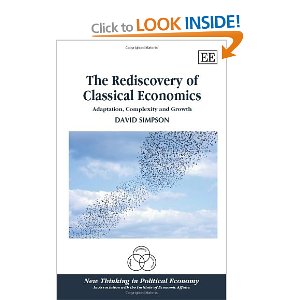
The actual cover design would follow along these lines from the cover shown below which is the cover of The Rediscovery of Classical Economics (Elgar 2013). A more red/brown version where this one is white is my idea. But I would like some kind of adaptation of this since the underlying themes are so similar and also because both books are being co-published with the Institute of Economic Affairs (IEA) as it says on this book and will say on mine.
Which side are you on?
We went to see Lone Survivor last night and then we came home and I watched Canada-USA in the hockey. And while you may think the two have nothing to do with each other, let me explain.
In the hockey, Canada won it by the soccer score of 1-0. That Channel 10 chose to show the Koreans winning the speed skating while the only goal was scored took some of the pleasure away but nice to see. Sunday it’s Canada v Sweden.
And then there was Lone Survivor, the most nail-biting film of the year, as good as any movie I’ve seen over the past twelve months. The subject matter, though, has created quite a divide within the US. This is what the film is about.
LONE SURVIVOR, starring Mark Wahlberg, tells the story of four Navy SEALs on an ill-fated covert mission to neutralize a high-level Taliban operative who are ambushed by enemy forces in the Hindu Kush region of Afghanistan.
Given the description, you will not be surprise to hear that so far as Academy Awards and other such laurels go, nothing at all. It is a major success across the Red States of America but goes nowhere in the blue states. And this is why I think that is. It is because you can only enjoy the movie if you side with the Americans. Everyone comes to the cinema with their politics fully engaged, specially a film such as this. For me and those I went with, we side with the Americans. The movie therefore completely works. For blue state America, however, it doesn’t work at all. They are disengaged and, I fear, even wish America’s enemies success. The movie is therefore an ordeal for those of a different view. This is from the review at The Washington Post:
What’s missing here is something, or rather, someone, to care about. Written and directed by Peter Berg (“Battleship”), the film presumes our emotional investment in Luttrell and his fellow soldiers’ mission, simply by virtue of — well, it’s never quite clear what. The questions of who exactly Shah is, other than one of many murderous thugs, and why we should care so deeply about his fate, is never really explained in a way that grabs the imagination.
The film must have been an endless torment to him. It’s only a film but if your instincts are not with the Americans then the film is lost on you. You are either with Team USA or you are not. In the war in Afghanistan, blue state America is not.
So when I come home to watch the hockey, no longer was I with Team USA. I have ancient views and attitudes that I bring to the match. Not quite like a Canada-USSR match of days of yore but fully engaged. And so in this film, as in so many other ways, the fifth column of Americans who were born and raised in our culture but hate it and wish to see it fail, have their attitudes engrained at such depth that it is hard to think what could ever save us now.
Diana West first introduced by M. Stanton Evans
M. Stanton Evans introduces Diana West winning the 2013 Mightier Pen Award.
And this is Diana’s speech.