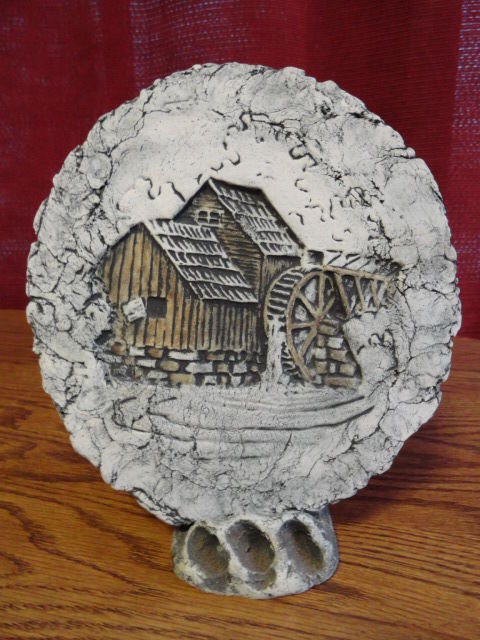
From Shapes of Clay
http://cgi.ebay.com/ws/eBayISAPI.dll?ViewItem&item=360858765531#shpCntId


This is a quote from Norman Podhoretz’s 1963 review of Eichmann in Jerusalem. It is found in an excellent review of the film, Hannah Arendt by Ed Driscoll.
This habit of judging the Jews by one standard and everyone else by another is a habit Miss Arendt shares with many of her fellow-Jews, emphatically including those who think that the main defect of her version of the story is her failure to dwell on all the heroism and all the virtue that the six million displayed among them. But the truth is—must be—that the Jews under Hitler acted as men will act when they are set upon by murderers, no better and no worse: the Final Solution reveals nothing about the victims except that they were mortal beings and hopelessly vulnerable in their powerlessness. And as with the victims, so with those who were lucky enough to survive the holocaust. There is no special virtue in sheer survival, whatever Bruno Bettelheim may say, and there is no martyrdom in sheer victimization, whatever certain sentimentalists among us may think.
The Superbowl is about to start and while I might have preferred Denver on other grounds, this epic rant by Richard Sherman after the NFC championship game has me totally won over. Defensive corners are seldom the stars, but Sherman in the very last minute had gone one-on-one with the star receiver of the 49ers and had tipped the ball away after an acrobatic half twist and pike that ended up with a Seahawk interception. So there he was, being interviewed, moments later.
Might just mention here the best book on North American football ever, The Blind Side, which is about how the least glamorous position in the game, left offensive tackle – which incidentally was the position I used to play – became the second highest paid position on the team. An amazing story in many ways, by the incomparable Michael Lewis.
Enjoy the game for those who enjoy the game.
That Barack Obama is not the author of his own autobiography should at least be common knowledge to anyone who comes to this site. I have discussed this myself in a previous post and I will repeat it here since when I mentioned writing Dreams from my Father as part of Bill Ayer’s cv, there seemed to be some dissent. His life story as told by himself was Obama’s only qualification for office so it should be understood that he had and still has absolutely no qualifications for president whatsoever. If you would like to hear it from the person who picked up this fraud, you can go here. What follows below is my own previous post repeated.
Only if you depend on the New York Times for your news would you be unaware that Barack Obama did not write his Dreams From My Father. It was written by Bill Ayers, that “someone in the neighbourhood”, that ex-Weatherman terrorist, who actually knows how to stitch three coherent sentences together on his own. That Dreams was literally the only qualification Obama had for the job of President, it should be clear just how hopelessly off centre the American political system has become. The prime responsibility for this lies with the American media who are more like Bill Ayers in their thoughts than they are like someone of the actual mainstream of American society.
Another book has just been published by one David Maraniss, of The Washington Post of all things, that make it almost certain that Dreams is a concoction of fantasies and lies. The book, Barack Obama: The Story, “documents the many ways — some very small, a few large — in which Mr. Obama’s youthfully constructed narrative appears to be contradicted by the people and events in his life.” It is a scandal that ought to be gigantic but will, like much else about the President, be suppressed. Still, in being by who it is and being as prominent as it is, the book is chipping away at the President’s credibility. And there is more coming out every day, drip by drip.
What did surprise me when the first pre-publication revelation from the book was made about Obama’s Australian girlfriend, was that no one to my knowledge has ever bothered to interview her to ask her for some additional detail. Especially since Obama’s girlfriend in Dreams is anyway a “composite”, it would, you think, have actually been interesting to know some true details about Obama, especially since the fictional account of this composite girlfriend is actually a description of Bill Ayer’s own true love, Diana Oughton, who blew herself up while putting a bomb together back in the 1970s.
Andrew Bolt has a post which he has titled, “Our grants aren’t meant to sponsor McCarthyism” whose first sentence reads:
The new McCarthyists should not be subsidised by taxpayers. Nor should fools unable to distinguish rational, conservative democrats from genocidal Nazi totalitarians.
As it happens, I am particularly sensitive to this issue at the moment because of my having read American Betrayal which deals with the massive communist influence on American conduct of World War II. The book has opened a major debate in the United States on the significance of Soviet penetration of the Roosevelt White House which has led to a further discussion of Senator McCarthy which has been an eye-opener itself. These are the opening paras of an article at Breitbart by M. Stanton Evans titled, “‘McCarthyism’ by the Numbers” which goes to the heart of this issue:
The orchestrated attack on Diana West’s important book, American Betrayal, has been brutal and unseemly, but in one respect at least it has served a useful purpose.
This lone positive angle–counter-intuitive at first glance–is that her iconoclastic Cold War history has sparked a barrage of charges about “McCarthyism” and the senator from Wisconsin who gave his name to a decisive epoch in America’s long death struggle with the Kremlin.
As is well-known, “McCarthyism” was an alleged focus of political evil in the 1950s: accusations of Communist taint, without any factual basis; bogus “lists” of supposed Communists who never existed; failure in the end to produce even one provable Communist or Soviet agent, despite his myriad charges of subversion.
Such is the standard image of “McCarthyism” set forth in all the usual histories and media treatments of the era. Such is the image relied on by the critics of Ms. West to discredit her book and dismiss her as a crackpot and “conspiracy theorist.” By arguing that pro-Red elements in our government exerted baleful influence on US policy to suit the aims of Moscow, it is said, she becomes “McCarthy’s heiress,” reprising the evils of the fifties.
It does no one any good at this stage to actually try to turn back this tide but we do what we must. And before I go on, I would like to emphasise that this is SENATOR McCarthy who had nothing to do with the HOUSE Committee on UnAmerican Affairs (HUAC). You must read the above article, but unless you have read Stanton Evans’ Blacklisted by History, it is unlikely you will have very much if any personal knowledge about Joe McCarthy that has not come from sources so tainted you would never normally accept any unvarified statement from them about anything of a political nature. Stanton Evans’ concludes:
All told, the McCarthy cases linked together in such fashion amounted to several hundred people, constituting a massive security danger to the nation. However, numbers per se were not the central issue. By far the most important thing about his suspects was their positioning in the governmental structure, and other posts of influence, where they could shape American policy or opinion in favor of the Communist interest. This they did on a fairly regular basis, a subject that deserves discussion in its own right.
For now, there is enough to note that the standard version of McCarthy and “McCarthyism” being wielded to discredit Diana West is, throughout, a fiction.
Yesterday I discussed the never ending attack on Walt Disney by the left which has recently re-surfaced in a speech by Meryl Streep in which she accused Disney of being a misogynist and anti-semite. In his defence of Disney, one of the points made was this, in which he referred to the views of someone who had known Disney extremely well:
As you might imagine, my friend and his wife bristled at Streep’s accusations, noting that she was recycling smears that originated with the communist attempts to take over Hollywood following the Second World War. This was the same period in which Ronald Reagan was fighting the communists in the Screen Actors Guild, first as a member of the union’s board, then as its president. When Reagan said at his first presidential press conference that the Soviets “openly and publicly declared that the only morality they recognize is what will further their cause, meaning they reserve unto themselves the right to commit any crime, to lie, to cheat,” he was speaking in part from his experience with Hollywood communists. Disney, my friend and his wife attest, was a target of the kind of lying and cheating to which Reagan referred.
Accusing someone of McCarthyism is to fall into a trap set by the left, McCarthy being as honest and brave as anyone has ever been. To smear and defame are the tactics of the left which you can see before you at every turn which is exactly the point that Andrew Bolt is trying to make but with the wrong analogy. But it is an analogy that by employing it oneself assumes into the very middle of the debate an equivalence that simply does not exist.
I’ve read the book myself and agree with how exceptional it is. But here we have the same thing said in this article by Kori Schake who is Research Fellow and member, military history working group. The title of the article is War: The Gambling Man’s Game and this is the opening para:
Geoffrey Blainey’s The Causes of War is a genuinely wonderful book. I had it pressed on me by one of the Pentagon’s most thoughtful people, and while it’s not a new book, it should be at the top of the reading lists of people interested in international relations. Like much else in the book, Blainey is straightforward in his title: he is examining why wars occur. He quotes Clausewitz to the effect that of all the branches of human activity, war is the most like a gambling game, and Blainey’s approach is very much marked by game theory.
[Found at Instapundit.]
I am two days away from finally sending the manuscript of the 2nd edition of my Free Market Economics off to the publisher. What do academics do when they aren’t teaching? This, at least, is what one of them has done. But for interest and comment, I am putting the following up which I have just finished writing not five minutes ago. It will be at the very start of the book, right after the preface which I will get to as soon as I finish this section on the definitions.
And I hope you all have as much fun on this long weekend as I hope to have myself.
Before venturing into the full text before you, it is useful to have a few definitions in your mind. The language of economics is entirely made up of words that have ordinary meanings in everyday life. But these words, when they cross over into economics, suddenly take on very specific meanings that can cause someone to lose the thread during an economic discussion. We therefore provide a series of definitions of the specialised words used in the text. Having at least a preliminary grasp of these words and their more technical meaning will also in itself provide a grounding in the nature of the economic theory you will meet in the rest of the book.
Economics often looks easy because everyone already thinks they understand what’s going on in an economy without even having to study. Not true at all. For an economist it is painful to hear the mistakes that those who have not studied economics to at least a reasonable depth constantly make. But there are also major differences in the conclusions different economists reach and these are often at a very deep level that no lay person could possibly resolve.
This text will teach you everything you will find in studying economics in a normal, usual way. But it also provides a second perspective that has been taken from the economic theories that were dominant during the nineteenth century. But unlike with the natural sciences, economic theory does not progress to higher plains and then remain there. Economic theory is infused with the hopes and wishes of policy makers and of those who study the subject who are predisposed to some particular point of view. People just wish the world was one way when the way things are turn out to be something else again, and their wishes cause them to accept economic theories that are not properly grounded in the way the world actually is.
The definitions found here are already pointing in a particular direction. The very first definition is “entrepreneur”. These are the people who run our businesses and often, if they are successful, become very wealthy as a result. As this book will explain, entrepreneurially-managed firms are the foundation for wealth and prosperity for an entire community but also for personal freedom and independence from government. Economic attitudes are often determined by one’s reactions to entrepreneurs running our firms. Some people don’t agree that we should allow people to run firms any way they like as long as they follow the law. Some people think that governments should run our businesses or at least our major businesses. Or if they don’t run them should have a major say in what they do.
These are, of course, philosophical and political issues that are absolutely part of economics when thought about in the widest sense, but are not part of what gets taught at the introductory level when starting out on economic theory. Yet this is the foundational point. Economics, as we teach it and learn it today, assumes that most of what is produced is produced by businesses independent of governments and are run by entrepreneurs for a profit. These businesses sell goods and services on a market and these goods and services are bought by consumers with money they have for the most part earned by providing either their own labour or some other input into the production of some other good or service. How this process works in detail is what the study of economic theory is about.
This is such an incredible story. How the movie Annie Hall was really made:
The main plot of Annie Hall — the love story between Alvy Singer, played by Allen, and Annie, played by Keaton — was originally only one of many subplots in Anhedonia, an exploration of Singer’s midlife, Ingmar-Bergman-esque search for meaning after turning 40. Allen himself had just turned 40 when he and Marshall Brickman wrote the script in 1975.
The movie was a philosophical odyssey not just through Singer’s entire life — from a girl-obsessed 6-year-old living under a roller coaster to a neurotic 40-year-old comedian — but through his detailed, hilarious assessment of that life. This version made room for a murder mystery, a sci-fi spoof, a basketball match between Singer and philosophers like Kierkegaard and Nietzsche, a trip to Nazi Germany, another to the Garden of Eden and an elevator tour through all nine layers of hell (and much more).
According to Ralph Rosenblum, who edited the film from sprawling pilgrimage to its final rom-com incarnation, you’d be hard-pressed to see a love story as the original’s primary focus. Annie didn’t even show up on screen until halfway through.
Rosenblum divulges the entire cutting process in his memoir, When the Shooting Stops. Of the first cut, which took six weeks, he says, “I felt that the film was running off in nine different directions … The film never got going.” He calls the first cut “nondramatic and ultimately uninteresting, a kind of cerebral exercise.”
And what’s more, they serve almost no human purpose, which is partially why I like them. From a review of Cat Sense: How the New Feline Science Can Make You a Better Friend to Your Pet, a book on cats by John Bradshaw.
Bradshaw, a biologist at the University of Bristol in England, has studied animal behavior and cats in particular for the last 30 years. The starting point of his analysis is that cats are still essentially wild animals. They wandered into our encampments when we first started to store harvested grains, which attracted mice.
Unlike dogs, which have been greatly changed by domestication from their wolf ancestor, cats have almost never been bred for a purpose. They caught mice well enough, and their kittens made attractive companions. So cats have stayed much the same, with any evolutionary trend toward domestication constrained by frequent interbreeding with wild cats.
To this day the population of domestic cats is maintained in a semiferal state by the practice of neutering. About the only males available for domestic female cats to breed with are the wildest and least people-friendly tomcats who have escaped into the feral cat population. Some 85 percent of all cat matings, Dr. Bradshaw writes, are arranged by cats themselves, meaning with feral cats.
The result is that when cats interact with people, they have to rely almost entirely on their natural social behaviors, which are not highly developed. . . .
Also in the cat behavioral repertory are grooming and rubbing against known cats. When cats rub up against you or invite their head to be stroked, they are treating you as a nonhostile cat. An upright tail is a greeting sign between cats, and ‘is probably the clearest way cats show their affection for us,’ Dr. Bradshaw writes.
Biting the hands that feed her and attacking my toes – as my own feral-born pussy cat routinely does – does not seem to show an entirely well developed sense of self-preservation, at least not the preservation of the cushy life she is currently privileged to lead. Still, she’s in no danger of being asked to fend for herself.

Diana West has posted my Quadrant review of her book at her blog, The Death of the Adult. The picture is from her blog and shows an ox attacked by wolves, the very image of its title, “America, a Big Dumb Ox”. This is her intro, the rest is what I wrote:
An interesting new review of American Betrayal from the January 2014 issue of the Australian journal Quadrant, edited by Keith Windshuttle.
She has highlighted various parts of the review so you can see what she thinks are particularly relevant. But why this book has caused the commotion that it has I have no answer to.
 Law of Markets