A joke I heard at a wonderful Freedomfest presentation on “The Intellectual Battle for South America”. Here, however, the central question was not about economics but about philosophy. The basis for the talk:
If the evidence of failure is so striking, why keep trying with different forms of socialism?
Their answer: because it’s not about economics but about philosophy and psychology. It’s a moral question, with the almost universal mantra in South America contrary to a market based economy. Two quotes of interest which help sum up the problem. First Eva Peron:
Where there is a need there is a right.
And then from a poster that does seem to help make sense of Venezuela:
If you think greed is bad, wait till you hear about capitalism.
The perfect way to remain very poor but also extremely resentful. I was more than primed for this by my airplane book which I picked up in an op shop just before I left.
Socialism and International Economic Order by Elizabeth Tamedly
I had never come across even its title before, nor the author, but I cannot recommend it highly enough. You see it in South America but unless we are all very careful, what she describes may be coming to a country very near to you very soon.
This is from a commentary on an interview in The New York Times with Michael Ignatieff, someone who almost defines the meaning of the word globalist, and titled, “Who Belongs?”.
Q. Brexit took a lot of people by surprise as a specific political event, but also as an expression of some larger trends. One of those is rising nationalism despite globalization and the development of cross-border institutions like the European Union. Where are these coming from?
A. One thought that does strike me is: Why should we be surprised?
Globalization and a borderless world have been terrific for the educated, the young, the mobile, the multilingual, the multicultural. But globalization has been really tough for people whose jobs are tied to a community, whose mobility is limited by limited education, and — more positively — whose first allegiance is to their community, their locality, their place of birth.
Cosmopolitans are perpetually surprised that, A, they’re only 1 percent of the population, and, B, most people don’t think like them. …
They feel the global, mobile, cosmopolitan world is simply out of reach. Not only out of reach, but malign, in the sense that the global cosmopolitan elite are the people who are shipping the jobs out. …
This is a story not just about nationalism. It’s also a story about inequality. The division between cosmopolitans and nationalists is going to define the 21st century. Brexit is not just a little hiccup on the path toward a bright cosmopolitan future. Nor is nationalism. Cosmopolitans continually condescend to nationalism, but my patriotic pride is your nationalism, right?
Q. But if nationalism comes from positive feelings of pride and connection to one’s community, why does that often seem to manifest in fears of immigration as a threat to that community, as it did with Brexit?
A. The issue always is: Who belongs?
In many ways, global migration is exacerbating the salience of the division between a citizen and a stranger. Citizens are saying everywhere, “The one thing that political community means to me, the one thing a nation means to me, is control of my borders and the right to define who comes in and who doesn’t.”
Brexit was an amazing spectacle in which people who are recent immigrants, Indians, Pakistanis in origin, were saying, “No more Poles.” These were citizens saying: “We’ve lost control of our frontiers. Free movement of people is simply incompatible with democracy. It’s incompatible with the self-determination of peoples.”
That’s what nationalism is: “Take back control, control of our borders. Take back control of our economy.”
The problem, in a globalized world, is that all control is relative.
And here’s some more.
I do think that there’s a real disconnect between an international cosmopolitan discourse about rights — the rights of migrants, the rights of refugees — versus the way in which ordinary people in most democracies see this question.
For ordinary people, a citizen’s relation to a stranger is a gift relationship, not a rights relationship.
They think it’s up to the citizen to decide who gets in. It’s up to the citizen who decides what the boundaries of a political community are.
That’s what democracy means to them. That’s what democracy promises them: control of borders and the handing out of discretionary gifts to those they decide belong in the community.
There are a lot of Brexiters who think a decent country is generous to strangers, is compassionate to strangers. But that’s the language of the gift. That’s not a language of rights. This is an emerging theme that a lot of liberal cosmopolitan politicians — and I have been one! — didn’t understand.
This is a key element of this nationalist turn. We’ve all been slow to see that happening, but that’s a big trend going down, the distinction between rights and gifts. It helps to understand that.
I’m here at Freedomfest which is the annual meeting place in the United States for all of the political groups on the right. I am part of that strand of conservatives which is well represented but is hardly even a plurality. My paper, however, is about an issue that I think of as extremely important, have raised it often but never really received an answer that satisfies. And the issue is why do Austrians virtually never take on Keynesian economics. This was as much as admitted by Israel Kirzner in his brilliant biography, Ludwig von Mises (ISI Books, 2001: 160).
Ludwig von Mises adopted a vigorously dissenting stance towards this Keynesian economics. Although he rarely offered frontal rebuttal to Keynesian theory, his contributions to the topic dealt with in this chapter constituted a well-developed (if implicit) basis for his rejection of Keynesianism.
My argument is that it is only classical economists who had crafted their theories to deal with Keynes since it was they who had fought off Malthus and demand deficiency during the general glut debates of the 1820s, whereas Austrian theory had been designed to refute Marxist theory but also was itself constructed on a demand-side focus based on marginal utility. And while Marxism has not gone away, the crucial battles in our time deal with the Keynesian theory of deficient aggregate demand.
Off on an airplane and heading to the United States on the way to two conferences. No blogging for a while, and definitely not till I’m on the other side. I therefore thought I’d leave this little puzzle with you before I went.
Suppose you’re on a game show, and you’re given a choice of three doors. Behind one door is a car; behind the other doors, goats. You pick a door – say, No. 1 – and the host, who know what’s behind the doors, opens another door – say, No. 3 – which has a goat. He then says to you, “Do you want to pick door No. 2?” Is it to your advantage to switch your choice?
There was an age thing when I taught this when I first got to Australia those many years ago. Happily I can still see why the right answer is the right one, but I knew already which one was right. Happy to be getting away from local politics for a while and seeing what things are like in the United States.
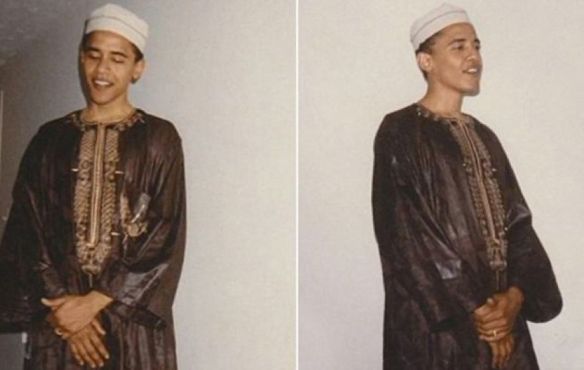
From: Photo of Obama in Muslim garb shows deep ties to faith, O’Reilly says. And how does it affect American foreign policy! But the American media and its voting class are so insistent on showing their lack of racist intent that all they show is their profound lack of common sense and judgment.
“Her supporters were by and large nice people with little money who were largely uninterested in politics. They were suffering badly from the effects of competition policy, which had seen basic services and jobs stripped out of their towns. They loved Hanson’s grit and plain speaking. Most of all, they loved that she listened. . . . When I tried to converse with supporters about politics I misinterpreted everything they said, and likewise. I thought they were racists and they thought I was a racist. Communication was impossible without getting to know each other first. . . . Western democracies are splitting up into warring tribes. I think Hanson’s return to our parliament is a chance to bring ours together a little bit. If we try.”
And this from the comments at Instapundit:
:”…One Nation’s policy. Its vote collapsed..” Actually, that is wrong. What happened was the main parties, LIB, Labour, DEMs , Greens, NATs all “preference’d” her at the bottom, as that is what you used to be able to do Down Under. The final vote is your actual vote plus preferences from others…..The smart Rich Guy who did a hostile takeover of the LIB/NAT Coalition party decided that he would change the system to get rid of the “kooks” from the Senate. He did that with the support of the Greens (never a good sign). What he did not understand was that the parties like One Nation get pretty solid *primary* voter support. Once people could pick their own preferences, the independents like Hanson and others leaped above the Family First and Palmer party types… They are now here to stay, for at least the next 3-6 years…
More than likely, the smart rich guy is going to need the support of Bob Katter (Google his videos!) and Hanson to get anything done…Good Times!
Whatever kind of times they are, they are certainly a changing.
That Malcolm is a dud with the worst political instincts in Australian political history was evident from a long way back. That he is shallow to the point that he actually believes global warming is a problem only emphasises how pathetic he is. That he has no idea how an economy works was clear long before he said during the GFC that he would have done the same as Labor. That he knows nothing about our infrastructure needs was made plane by his inability to lay a rhetorical glove on the NBN. But while all this is plain as day to me and thee, to the man himself, he is all that stands between us and ….
It should of course be what stands between us and another Labor Government. What he really thinks is that what he stands in the way of is something worse by his lights, a return of Tony Abbott. I’m afraid articles such as this How the Liberals could win with Abbott will only make him dig in more.
But Malcolm’s crass and obnoxious willingness to take the ship down with the captain comes across even more in reading these absurd post-election polling statistics from the other day:
The latest Morgan poll of 3587 electors, conducted yesterday following the weekend election, shows 51 per cent regard Mr Turnbull as better prime minister, just ahead of Opposition Leader Bill Shorten on 47 per cent.
That’s a decrease of six percentage points in a month for Mr Turnbull and a 23 point increase for Mr Shorten in the same period. But Mr Turnbull is clearly preferred as Liberal leader over Tony Abbott by 71 per cent to 25 per cent.
But when only those who identify as Coalition voters are asked who they would prefer as party leader, the result becomes closer — 60 per cent for Mr Turnbull and 38 per cent for Mr Abbott.
Whatever doubts we might have about the numbers, suppose they are right. That means that 38% of Coalition voters prefer Abbott. That is a very large part of the Coalition’s voter base. Anyone with an ounce of common sense, never mind the slightest whiff of political calculation, would understand that to strengthen the party and its appeal, those 38% should be appeased. Instead, he remains stubborn to the point of mulish in not even considering a return to cabinet of the man who for many of us was the main reason making the Coalition worth our vote. Now that everyone can see how politically stupid Malcolm is – even those who have tried to defend him in public since the election – the facts of political life will need to be explained. My worry is that he really is just as stupid as he seems.
I have been at an economics conference today which brings the following to mind. I tend to hang out among economists who want to see the end of the basic “neo-classical synthesis” approach to the way we teach economics, which is something I dearly wish for myself. But unlike the others, I find the combination of Keynesian macro and marginal micro so poisonous to clear economic thought that my aim is to see economics move back towards the theoretical approach of the great classical economists who you can find from the publication of John Stuart Mill’s Principles of Political Economy in 1848 through to Henry Clay’s Economics in 1916.
But for those I’ve been dealing with, today’s mainstream isn’t radically left wing enough and are continuously looking to replace what we have with some kind of far-left monstrosity.
I have therefore begun to ask the question, what is there in the way you would teach economics that would assist the government of Venezuela to understand what has gone wrong in their economy? You know, they have no answer. They don’t even try to explain what great insights they have or would offer. We are in dangerous times in so many ways, and this loss of economic understanding about what makes an economy work is not anywhere near the bottom of our list of problems.
The fact is that Malcolm in the election just past ran against Tony Abbott. Had he been as hard and angry dealing with Bill Shorten and Labor it would have been a different story. But it was all anti-Abbott and hardly much of an anti-ALP.
My doubts about whether Tony will come back were increased by Peta Credlin’s answer to Andrew Bolt about whether he would try for another go as PM. She said, “Why would he?” Why would he when there were so many ungrateful and politically stupid fools that remain inside the party room. And perhaps outside as well. In this story, 2016 Federal Election: Australia faces another ‘week’ without government, we find this:
The latest Morgan poll of 3587 electors, conducted yesterday following the weekend election, shows 51 per cent regard Mr Turnbull as better prime minister, just ahead of Opposition Leader Bill Shorten on 47 per cent.
That’s a decrease of six percentage points in a month for Mr Turnbull and a 23 point increase for Mr Shorten in the same period. But Mr Turnbull is clearly preferred as Liberal leader over Tony Abbott by 71 per cent to 25 per cent.
But when only those who identify as Coalition voters are asked who they would prefer as party leader, the result becomes closer — 60 per cent for Mr Turnbull and 38 per cent for Mr Abbott.
Well, if that’s what they think, they got what they deserved. But the notion that there is a more conservative Liberal Party just waiting to be formed from the ashes of the present mob is just fantasy.
VIDEO UPDATE: The video has been added as an update. Quite, quite extraordinary, specially since Comey makes it clear that anyone else doing the same would be prosecuted.
The reality is that every email sent and received by Hillary was illegally kept on a private server which also meant, firstly, that every email she sent and received was monitored by every foreign agency across the world and secondly, that much of what she wrote is unavailable for others within the American political system to review, should they actually wish to. Naturally Donald Trump has criticised. I imagine most others will say hardly a word. Whatever else, the story has already blown over even before it became a story.
Meanwhile, on Instapundit, The IRS Scandal, Day 1153. The US political system is corrupt to its very core, but the complicity between the Democrats and the media will ensure no issue is ever allowed to blow up about anything that harms its party of choice. Again from Instapundit, the media are Democrat Operatives with Bylines.
BTW the story at Instapundit is titled, The fix was in all along which is, of course, true but hardly pictures the gravity of the story. From the comments:
1) The most mendacious paragraph of the whole statement: “In looking back at our investigations into mishandling or removal of classified information, we cannot find a case that would support bringing criminal charges on these facts. All the cases prosecuted involved some combination of: clearly intentional and willful mishandling of classified information; or vast quantities of materials exposed in such a way as to support an inference of intentional misconduct; or indications of disloyalty to the United States; or efforts to obstruct justice. We do not see those things here.”
She set up the server explicitly in a premeditated attempt to obstruct justice, in order to at a minimum, deny Freedom of Information requests. I would say this outcome is unbelievable, but I have realized since November 2012 there is no organization of government not utterly corrupted by this President and his cabal. USA RIP
2) This goes beyond, far beyond, Prosecutorial Discretion……We’re deep into “Parador” country here.
We no longer have a Criminal Justice System, buy a System of Justice of Criminals!
3) The worst national security breach in the history of the US doesn’t warrant anything more than a shoulder shrug from the DOJ.
Disgusting. If she were a Republican they’d be literally calling for her head on a pike.
Not much heat in the response, only resignation about that is how things are.
Call it conspiracy theory, coincidence or just bad luck, but any time someone is in a position to bring down Hillary Clinton by testifying they wind up dead. In fact, there’s a long history of Clinton-related body counts, with scores of people dying under mysterious circumstances.
I do not think any of it is true, but I do find it interesting that it is being said and repeated outside the National Enquirer.
FURTHER VIDEO UPDATE: This is Donald Trump in his own more direct version of the contrast between what Comey said and what Hillary said. Trump’s video, which can be seen at this link, has already had more than five million hits. Below is the same taken from Youtube.

 Law of Markets