Ever wondered what supply-side economics is?

In a sense you could say I have spent thirty years writing this paper which will be given twice in Shanghai the following week. The proper understanding of supply-side economics is found in late classical economic theory which I date from 1848-1936, that is, from the publication of Mill’s Principles until the publication of Keynes’s General Theory. If you would like to come, please email Dr Sveta Angelopoulos on sveta.angelopoulos@rmit.edu.au to let her know. These are the details:

You are warmly invited to attend the School of EFM Brown Bag Seminar Series presentation by Associate Professor Steven Kates: Classical Economics Explained: Understanding Economic Theory Before Keynes.

Abstract: Since the publication of The General Theory, pre-Keynesian economics has been labelled “classical,” but what that classical economics actually consisted of is now virtually an unknown. There is, instead, a straw-man caricature most economists absorb through a form of academic osmosis but which is never specifically taught, not even as part of a course in the history of economics. The paper outlines the crucial features that differentiate classical theory from modern macroeconomics. Based on the differences outlined, a model of classical economic theory is presented which explains how pre-Keynesian economists understood the operation of the economy, the causes of recession and why a public-spending stimulus was universally rejected by mainstream economists before 1936. The classical model presented is an amalgam of John Stuart Mill’s 1848 Principles and Henry Clay’s 1916 first edition Economics: an Introduction for the General Reader, a text which was itself built from the economics of Mill.

Venue:
RMIT Building 80
Level 10 Room 44 & 45
445 Swanston Street
Melbourne

Date: Tuesday 23rd August

Time: 1.00 – 2.00pm
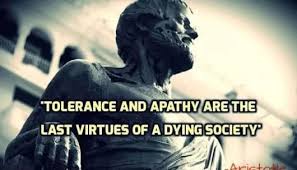
Tolerance and apathy

I think we are at the stage where those of us at a certain age reckon we will get our three score and ten in before the deluge. I am not particularly tolerant, but the will to fight does dissipate as time goes by. I cannot see current trends ending well since far too few any longer understand the virtues of the social arrangements that have been inherited from the past – which had required tremendous battles along the way – but which are now taken as the way things are and can never change. We are, alas, all too soon going to find out how not true that is, and the Dark Age that is descending may last a very long time. This is the sentiment that got me to think about these things:

tolerance and apothy

I came across the quote above first which may seem a bit cryptic, but not if seen in the context of this one which was close by. Caring about such matters requires a philosophy of freedom which is disappearing into a blur of licensed self-absorption.

tolerance is the virtue of

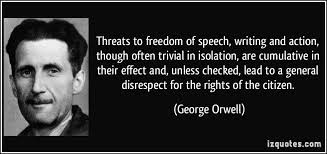
The previous two were accompanied by this which is relevant to the previous two. Bit by bit we are losing everything that has made our civilisation what it is.

orwell threats to freedom

Ages of high technology are well known for being culturally barren.

“Turnbull has to be relentless and show he is the one in charge”

Were it not for Andrew Bolt, I would have no idea that Nikki Savva is still going on about Malcolm, but there she is: As the real game begins, Malcolm Turnbull needs quick runs. You would think she would finally get the point why anyone who had previously seen Malcolm in action could not possibly have supported him. And to tell the truth, though I tried, I could not get through her column, but I did manage her hilarious first para:

As he approaches his first anniversary as Prime Minister, the number of items on Malcolm Turnbull’s to-do list continues to multiply. His singular achievement so far has been to win the election, if only by a whisker, but it would help his standing inside and outside the government if he could score a few more runs and quickly.

If that is all he has done, he has done less than nothing, his contribution has been entirely negative. He won only because of Tony, but his almost losing the lot was entirely due to his own incompetence. I eventually skipped to the end of her column where there was this exhortation:

Individual ministers have to drive their issues, but they can do it only if the Prime Minister is in the forefront. A year into the job, and almost two months since the election, he needs to pick up the pace. He cannot give eloquent speeches (unfortunately marred by protesters) or drop ideas, then vacate the field for a few days before reappearing.

He has to be a persistent as well as persuasive advocate using all media, particularly radio and from the office, not home, so that there are visuals as well as audio. He needs to convince the public, then, having convinced them, use that to exert pressure on parliament. It is circular and never-ending.

Turnbull has to be relentless and show he is the one in charge, not Abbott, not Shorten, not Xenophon, not even Barnaby Joyce.

By now, Malcolm is completely gun shy since he has shown time and again that his own ideas are poison for most of those who vote for the Coalition. Every time he opens his mouth, three-quarters of the back bench roll their eyes. He’s in the wrong party, should not even be on the back bench, never mind its leader.

Glenn Stevens – the best central banker in the world

Australia is about to lose the world’s greatest central banker and it will make a difference. Others may have watched him in action over the years, but unless they have understood things properly, they cannot have seen what he’s been doing. We may have some of the worst fiscal policy found anywhere, but our monetary and interest rate policies have been second to none. Where else can you get such good sense as this?

“Australia wants to be open to foreign capital. That’s our national philosophy. I think in that discussion it would be helpful to think about the kind of foreign capital we want.

“Foreign capital that builds new assets — like some of the capital that funded the mining boom — that’s one thing. Foreign capital that buys up the existing assets, I’m not saying that we should be closed to that, but that’s not ­creating new capital for the country. That’s just altering the allocation of who owns the capital that’s here now.

“When we all talk about ‘we want capital inflow’, we can probably have a bit of nuance and subtlety over what kind of inflow we mean and ask ourselves ­whether we’re attractive enough to the kind of capital that actually builds new assets.”

The distinction he makes is between capital in the form of money and capital in the form of things. It’s a distinction that was once at the core of economic theory but has absolutely disappeared from view. Stevens is one of the few remaining who would even understand the difference and why it matters. But there are shifts going on in central banking orthodoxies since what is crystal clear is that the low interest rate policies of the last few years have been disastrous. This is from The AFR today: .

A new economic reality calls for a new approach to central banking. . . . In the new low-natural rate environment, the Fed’s policy of targeting low inflation will no longer make sense, he said.

It actually never made sense, but they are only just beginning to figure it out. And what has also not made sense is lowering interest rates to zero (and even into negative territory). With such low rates of interest we are actually riding a tiger and I have no idea how we will ever escape this dilemma without a serious “economic restructuring”. But unless we are going to continue down this path of low productivity and sinking real incomes, interest rates at some stage are going to have to rise.

Will talking sense work?

This is Donald Trump talking directly to America’s black communities:

Republican Donald Trump made his most direct appeal yet Tuesday for black voters in the presidential race, pushing forward an agenda to restore law and order and revitalize inner-city neighborhoods that he said suffer from years of misguided Democratic policies.

In a speech delivered not far from Milwaukee neighborhoods rocked by anti-police riots, Mr. Trump laid the blame for urban despair and conflict between police and minorities at the feet of Democratic nominee Hillary Clinton.

“I am running to offer you a much better future,” Mr. Trump said in a speech in West Bend, Wisconsin. “Crime and violence is an attack on the poor and it will never be accepted in a Trump administration.”

He said the policies holding back minority neighborhoods were part of the “rigged system” led by Mrs. Clinton, who he said pandered to black voters but didn’t really care about their suffering.

“The political class that Mrs. Clinton has been a part of for 30 years has abandoned the people of this county. They only care about themselves,” he said. “I am going to give the people their voice back.”

And there’s more at the link. There is also no doubt he means it. What has disappeared into history is that the entire Ku Klux Klan was Democrat. This really does look like America’s last chance, but it’s a genuine one.

Meanwhile, there is only +/-2% in it. And Hillary is not a well woman.

Maybe things can get better

It’s not the individual here who matters, but the official reactions by both the Olympic Committee and the Egyptians who would not accept such behaviour:

Olympic officials say an Egyptian judo athlete has been reprimanded and sent home after refusing to shake his Israeli opponent’s hand.

The International Olympic Committee says Islam El Shehaby received a “severe reprimand” for his behaviour following his first-round heavyweight bout loss to Or Sasson on Friday.

When Sasson extended his hand, El Shehaby backed away, shaking his head.

The referee called the 34-year-old El Shehaby back to the mat and obliged him to bow. He gave a quick nod and was loudly booed as he exited.

Olympic action from day 7 of the Rio games

The IOC says the Egyptian’s conduct “was contrary to the rules of fair play and against the spirit of friendship embodied in the Olympic values.”

The IOC says the Egyptian Olympic Committee also “strongly condemned” El Shehaby’s actions “and has sent him home.”

“Terrorists are insane people”

You may be sure no leader in a Western democracy, home of free speech etc, would be allowed to say any of this. But the President of Kyrgystan can:

“Terrorists are insane people. . . .

“If you do not like Kyrgyzstan you can leave our country and go wherever you want.

“We can pay your travel expenses, even to Syria.”

The final comment is a reference to claims around 350 Kyrgyz citizens our fighting with jihadi groups in the country.

In 2014 President Atambayev said that it was not the Islamic traditions he had a problem with but more “Arabisation of society [and the] deprivation of the Kyrgyz nation of its language and traditions”.

Tolerating the intolerant in the name of stupidity

Here’s the final para in an article at Quadrant Online on: Let’s Lift the Veil on Asylum Seekers

For a host nation to naively infect itself with a metastasising societal malignancy through mindless adherence to ill-conceived notions of political correctness affords an excellent prospect for a Darwin Award on a national level. If ever there has been the need for the precautionary approach this must surely be it.

Read the whole article, but let me supplement with this comment from “Jody”:

The people in Melbourne know all too well about crime gangs and anti-social behaviour, all started by sub-Saharan African ‘migrants’. There’s the cone of silence over all of this and the people going on suffering and watching the value of their real estate decline. The bien pensant have this attitude: “Don’t discuss race because that makes you a racist; we must work out what is wrong with AUSTRALIAN society that criminal gangs can run rampant. We want an immigration policy which is non-discriminatory and if you oppose that you are xenophobic and racist. Also, we have obligations to these refugees and we think it’s a good idea to take them – and they need to go to YOUR area”.

Then when you’ve read that, you can read this from the same source: The Illiberal Left and Political Islam. Towards the end you come to this para, but again it is worth reading it all, though it is much darker and fills you with a deep pessimism about where all of this will end up:

The rising price of political freedom, it seems, is too high for many Western governments to pay. The long war for cultural freedom which began in 1989 is in serious danger of being lost. As Karl Popper observed of an earlier totalitarian threat to the open society, “If we are not prepared to defend a tolerant society against the onslaught of the intolerant, then the tolerant will be destroyed, and tolerance with them.” We should therefore claim “in the name of tolerance, the right not to tolerate the intolerant”. Unfortunately, this argument does not gets much air-time, let alone political support.

Science weird and broken

Two stories on the same day about scientific puzzles that completely uproot our conventional views of how the universe operates. First this: Meet Niku, the Weird Object Beyond Neptune That Nobody Can Figure Out. And what’s weird?

Authored by the astronomer Ying-Tung Chen of Academia Sinca in Taiwan and an international team of astronomers from Harvard to Hawaii to Germany, the paper describes a sense of utter confusion regarding the behavior of this little object.

Niku orbits on a plane that is tilted 110 degrees from the plane of the rest of the solar system. One theory is that a large object’s gravity is influencing Niku, causing it to orbit at an angle to everything else as well as backward.

And then this: Researchers orbit a muon around an atom, confirm physics is broken.

Although tiny, a proton takes up a finite amount of space, enough to fit three quarks, a host of virtual particles, and their associated gluons. The size of a proton’s radius is determined by these particles and their interactions, and so is fundamentally tied in to theories like the Standard Model and quantum chromodynamics.

We can measure the radius because the proton’s charge is spread across it, which influences the orbit of any electrons that might be circling it. Measurements with electrons produce a value that’s easily in agreement with existing theories. But a few years back, researchers put a heavier version of the electron, called a muon, in orbit around a proton. This formed an exotic, heavier version of the hydrogen atom. And here, measuring the proton’s radius produced an entirely different value—something that shouldn’t have happened.

This “proton radius puzzle” suggests there may be something fundamentally wrong with our physics models. And the researchers who discovered it have now moved on to put a muon in orbit around deuterium, a heavier isotope of hydrogen. They confirm that the problem still exists, and there’s no way of solving it with existing theories.

I say the same about our economic problems, but this is on a very different plane.