Trump Derangement Syndrome

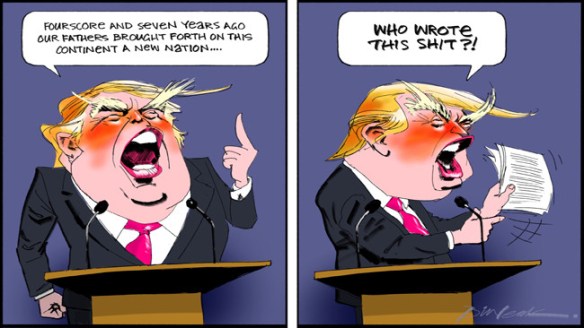
trump leak cartoon

It is annoying that even the brave Bill Leak is filled with Trump Derangement Syndrome. Apparently Melania told her speech writer that she admired Michelle Obama, the speech writer took a couple of passages from Michelle’s speech and put it in Melania’s and Donald Trump has refused to sack the speech writer. That this absolute nothing has become anything of the frenzied talking point it has is a reminder of how corrupt the media has become. It is also something of a sign of how little there really is to criticise Trump about that won’t resonate with most American voters.

Trump embraced the swirling attention.

“Good news is Melania’s speech got more publicity than any in the history of politics especially if you believe that all press is good press!” Trump said on Twitter.

What a maelstrom of contending views surround a presidential candidate. How anyone can keep a calm weather eye in the midst of it I’ll never know but Donald is more likely to do it than anyone.

Focusing on the small stuff

Reading the puppet columnists at The Australian – you know the ones, for example, who went after Tony Abbott on orders from their boss – is a trial that too often starts the day on the wrong foot. Here we have that empty vessel, Greg Sheridan going after Melania Trump’s speech writer for cribbing a passage from Michelle Obama. At least it wasn’t the passage where Michelle had said she was for the first time proud to be an American. So as we decide the fate of Western civilisation, this is what Sheridan writes: US Republican race: Donald Trump circus adds plagiarism to act. From which:

There were the rowdy demonstrations from anti-Trump ­Republicans, the powerful theme of Make America Safe Again, a stage entry from The Donald himself straight out of World Championship Wrestling, former New York mayor Rudy Giuliani doing his version of “I’m Mad as Hell and I’m Not Gunna Take It Anymore”, and Melania Trump plagiarising her cliches from ­Michelle Obama. I didn’t know that anyone would bother to plagiarise cliches. After all, they’re cliches, right?

Given that Sheridan is repeating the identical meme from the left-media in the US, you can see how useless his analysis is going to be for the rest of the American presidential election. Nothing on Guiliani, for example. So for your interest, here is his speech which you will learn nothing about from reading The Oz.

Supply-side economics in China

I am back in Australia in the technical sense that I may be found at the Chinese Economic Society Australia meeting in Cairns but it was a long flight from Las Vegas, most of which was spent reading Donald Trump’s The Art of the Deal. More on that later but let me tell you about CESA and my presentation. Although I presented the paper at Freedomfest, with its focus on the failure of Austrians to take on Keynesians with all the venom they deserve, the paper was written for the Chinese who have become interested in supply-side economics. Although Keynes remains dominant in China, as he is everywhere (and you are kidding yourself if you think he’s not), the Chinese are interested in alternatives, with supply-side economics their own specific area of interest. And as I argue, you cannot find a supply-side model outside the classical economics of John Stuart Mill and Henry Clay. Here’s the list of modern schools, in a highly aggregated way:

Classical
Marxist/socialist
Keynesian (which includes monetarists)
New Classical
Austrian

Only classical specifically incorporates all of the elements needed for clarity in economic thought: the entrepreneur, value adding as the core concept, Say’s Law, a complete rejection of demand as a macro variable, and a theory of recession based on disorder within the structure of production. And I have to tell you that I have had one of the best receptions to a presentation of mine ever. I should also add that my presentation in Las Vegas was attended by the great George Gilder, co-inventor of supply-side economics with Art Laffer during the Reagan Revolution. We need to do it again, but interestingly it seems as if the Chinese are now way ahead of the game.

Politics discussed – from Trump to Rand Paul

I am now listening to the Libertarian candidate for President, Gary Johnson. Former Governor of New Mexico whose Vice President would be the former Governor of Massachusetts. Warmish applause, and if he can’t do better here, he will not do well anywhere else. What can you do with someone who has just said the biggest international threat in the world is North Korea.

More to the point was “Trump Pro and Con: The YUGE Debate”. Wayne Allan Root and Dan Mangru versus Jeffery Tucker and Matt Welch. A year ago Trump was himself here whose favourite son was Rand Paul. Today, a full room who had no patience for any of the anti-Trump people. The issues that came up as questions:

Hillary
Supreme Court
Islam
immigration
pseudo-free trade

The vote by applause at the end was 90% Trump. The booing and catcalls from the audience for Tucker and Welch was amazing. Tucker literally tried to win the argument by declaring Trump is a fascist, about as empty an argument as I could imagine, but he had no other. His colleague began by stating that Hillary was unfit to be president, but then discussed Trump’s threats to Bezos and The Washington Post.

What has been astonishing in the six days I have been here is that I have not seen or heard a single pro-Trump story in the media.

Brent Bozell

This is now Brent Brozell discussing the media and the election. Trump, he says, understands what no Republican has understood re the media – you attack me, I attack you. The new approach by the national press has been not just to lie by statement but now there has been bias by omission. You all know about Benghazi, the IRS, the emails here, but in the media, it is deliberate misrepresentation.

Not one “investigative” reporter in seven and a half years has looked at Barack Obama. We are in the middle of the greatest communication technological innovation, with the social media now connecting 80% of the world. In 2012, Obama spent most of his money on social media. It is this that the right will have to do to overcome the left-media.

Rand Paul

And now Rand Paul. Starts with Brexit – he not only thinks they should have left, he thinks they should never have joined. Talks about the EU Regulated Man from Brexit the Movie. Regs is like being surrounded by invisible barbed wire. US predicament is not much different.

The presidency is a thousand-fold more powerful than Congress. No one wishes to pull it back. But the lesson from history is that power corrupts. Need to surround the power of government with invisible barbed wire.

Brings up the surveillance state. FBI wants judgeless-warrants. Needed 60 votes to pass and got to 58 on the Senate floor. And then there was twenty minutes to find another two. Ultimately failed but close.

The question remains, how can we have a constitutional republic. The question he now has is, “are we doomed”? The majority can now plunder the minority. We can continue but will only work if most Americans still have hope in the American dream. Will only survive if the majority continue to believe in the capacity in self-advancement. People must believe they can be personally successful.

I look at immigrants are assets. Must offer migrants and children of migrants the promise of success. Individuals must believe they can succeed. We should leave their tax money with individuals. If we don’t voters will be seeking wealth by voting.

Conclude: it is harder to sell our message. But that is what has to happen.

In answer to a question on Trump v Clinton, very weak support, based on no more than his promise at the debates to support the eventual nominee.

What did socialists use before they had candles?

Electricity!

A joke I heard at a wonderful Freedomfest presentation on “The Intellectual Battle for South America”. Here, however, the central question was not about economics but about philosophy. The basis for the talk:

If the evidence of failure is so striking, why keep trying with different forms of socialism?

Their answer: because it’s not about economics but about philosophy and psychology. It’s a moral question, with the almost universal mantra in South America contrary to a market based economy. Two quotes of interest which help sum up the problem. First Eva Peron:

Where there is a need there is a right.

And then from a poster that does seem to help make sense of Venezuela:

If you think greed is bad, wait till you hear about capitalism.

The perfect way to remain very poor but also extremely resentful. I was more than primed for this by my airplane book which I picked up in an op shop just before I left.

Socialism and International Economic Order by Elizabeth Tamedly

I had never come across even its title before, nor the author, but I cannot recommend it highly enough. You see it in South America but unless we are all very careful, what she describes may be coming to a country very near to you very soon.

“Free movement of people is simply incompatible with democracy”

This is from a commentary on an interview in The New York Times with Michael Ignatieff, someone who almost defines the meaning of the word globalist, and titled, “Who Belongs?”.

Q. Brexit took a lot of people by surprise as a specific political event, but also as an expression of some larger trends. One of those is rising nationalism despite globalization and the development of cross-border institutions like the European Union. Where are these coming from?

A. One thought that does strike me is: Why should we be surprised?

Globalization and a borderless world have been terrific for the educated, the young, the mobile, the multilingual, the multicultural. But globalization has been really tough for people whose jobs are tied to a community, whose mobility is limited by limited education, and — more positively — whose first allegiance is to their community, their locality, their place of birth.

Cosmopolitans are perpetually surprised that, A, they’re only 1 percent of the population, and, B, most people don’t think like them. …

They feel the global, mobile, cosmopolitan world is simply out of reach. Not only out of reach, but malign, in the sense that the global cosmopolitan elite are the people who are shipping the jobs out. …

This is a story not just about nationalism. It’s also a story about inequality. The division between cosmopolitans and nationalists is going to define the 21st century. Brexit is not just a little hiccup on the path toward a bright cosmopolitan future. Nor is nationalism. Cosmopolitans continually condescend to nationalism, but my patriotic pride is your nationalism, right?

Q. But if nationalism comes from positive feelings of pride and connection to one’s community, why does that often seem to manifest in fears of immigration as a threat to that community, as it did with Brexit?

A. The issue always is: Who belongs?

In many ways, global migration is exacerbating the salience of the division between a citizen and a stranger. Citizens are saying everywhere, “The one thing that political community means to me, the one thing a nation means to me, is control of my borders and the right to define who comes in and who doesn’t.”

Brexit was an amazing spectacle in which people who are recent immigrants, Indians, Pakistanis in origin, were saying, “No more Poles.” These were citizens saying: “We’ve lost control of our frontiers. Free movement of people is simply incompatible with democracy. It’s incompatible with the self-determination of peoples.”

That’s what nationalism is: “Take back control, control of our borders. Take back control of our economy.”

The problem, in a globalized world, is that all control is relative.

And here’s some more.

I do think that there’s a real disconnect between an international cosmopolitan discourse about rights — the rights of migrants, the rights of refugees — versus the way in which ordinary people in most democracies see this question.

For ordinary people, a citizen’s relation to a stranger is a gift relationship, not a rights relationship.

They think it’s up to the citizen to decide who gets in. It’s up to the citizen who decides what the boundaries of a political community are.

That’s what democracy means to them. That’s what democracy promises them: control of borders and the handing out of discretionary gifts to those they decide belong in the community.

There are a lot of Brexiters who think a decent country is generous to strangers, is compassionate to strangers. But that’s the language of the gift. That’s not a language of rights. This is an emerging theme that a lot of liberal cosmopolitan politicians — and I have been one! — didn’t understand.

This is a key element of this nationalist turn. We’ve all been slow to see that happening, but that’s a big trend going down, the distinction between rights and gifts. It helps to understand that.

Austrian economists and Keynesian economics

I’m here at Freedomfest which is the annual meeting place in the United States for all of the political groups on the right. I am part of that strand of conservatives which is well represented but is hardly even a plurality. My paper, however, is about an issue that I think of as extremely important, have raised it often but never really received an answer that satisfies. And the issue is why do Austrians virtually never take on Keynesian economics. This was as much as admitted by Israel Kirzner in his brilliant biography, Ludwig von Mises (ISI Books, 2001: 160).

Ludwig von Mises adopted a vigorously dissenting stance towards this Keynesian economics. Although he rarely offered frontal rebuttal to Keynesian theory, his contributions to the topic dealt with in this chapter constituted a well-developed (if implicit) basis for his rejection of Keynesianism.

My argument is that it is only classical economists who had crafted their theories to deal with Keynes since it was they who had fought off Malthus and demand deficiency during the general glut debates of the 1820s, whereas Austrian theory had been designed to refute Marxist theory but also was itself constructed on a demand-side focus based on marginal utility. And while Marxism has not gone away, the crucial battles in our time deal with the Keynesian theory of deficient aggregate demand.

Suppose you’re on a game show

Off on an airplane and heading to the United States on the way to two conferences. No blogging for a while, and definitely not till I’m on the other side. I therefore thought I’d leave this little puzzle with you before I went.

Suppose you’re on a game show, and you’re given a choice of three doors. Behind one door is a car; behind the other doors, goats. You pick a door – say, No. 1 – and the host, who know what’s behind the doors, opens another door – say, No. 3 – which has a goat. He then says to you, “Do you want to pick door No. 2?” Is it to your advantage to switch your choice?

There was an age thing when I taught this when I first got to Australia those many years ago. Happily I can still see why the right answer is the right one, but I knew already which one was right. Happy to be getting away from local politics for a while and seeing what things are like in the United States.