A review of my Free Market Economics

A review of the first edition of Free Market Economics, which is even more so than this now that it is in its second edition. This is how it starts:

Not since 1924 has there been a comprehensive yet readable book on economics aimed at the ordinary but intelligent citizen that defends and incorporates the field’s foundational principle, Say’s Law (named after Jean-Baptiste Say, 1767–1832) and its main corollaries: the primacy of production, the entrepreneur as prime mover, and prices as the commercial language that coordinates economies and their subsectors. Now we have such a book: Free Market Economics: An Introduction for the General Reader by Australian business economist Steven Kates. His prior books examined the prevalence of Say’s Law among top economists during the pro-capitalist 19th century and its abandonment by most economists in the anti-capitalist 20th century.

The handful of texts on economic principles since the 1920s that recognize the superiority of a free economy have been too technical, narrowly devoted to refuting economic fallacies, or tainted by dubious philosophy. This book avoids such flaws. Kates accomplishes what was last achieved by Oxford professor Henry Clay (1883–1945) in Economics: An Introduction for the General Reader (1924). Better still, Kates’s book offers a modern, more sophisticated, more pro-capitalist treatment than did Clay’s book, and it provides the ideas people need to grasp and refute the disastrous dogmas and policies of Keynesianism.

Free Market Economics and Say’s Law

This post is the second of a series I am writing on the second edition of my Free Market Economics that has been published in association with the Institute of Economic Affairs in London. This post focuses on the single most important principle in economics which now goes under the name Say’s Law. But it is a principle that was deliberately eliminated from within mainstream economic theory by Keynes in his General Theory and has disappeared from virtually all economic discourse since that time.

The book was itself written because there is literally no economics text of any kind anywhere that discusses Say’s Law. Yet it was this principle that made it perfectly obvious that the stimulus being applied across the world from the end of 2008 would lead to an economic stagnation that would last years on end. That is why I immediately began to write the book then and there, but it is also why I had published in February 2009, just as the stimulus was getting under way, an article with the title, “The Dangerous Return to Keynesian Economics”. The article specifically discussed the crucial disappearance of Say’s Law and included this forecast:

“Just as the causes of this downturn cannot be charted through a Keynesian demand-deficiency model, neither can the solution. The world’s economies are not suffering from a lack of demand, and the right policy response is not a demand stimulus. Increased public sector spending will only add to the market confusions that already exist.

“What is potentially catastrophic would be to try to spend our way to recovery. The recession that will follow will be deep, prolonged and potentially take years to overcome.”

While virtually the whole of the economics profession remains flummoxed by what has happened since the stimulus, neither my students nor myself have been in any doubt. It has been as obvious as the noonday sun, but invisible to anyone brought up on modern macroeconomics which has embedded the theory of aggregate demand, Keynes’s disastrous contribution to economic theory.

Say’s Law specifically stated that demand deficiency, that is, a deficiency of aggregate demand, could never be the cause of a recession (or in the archaic language of the classics, “there is no such thing as a general glut”). It then specifically told governments that while some additional public expenditure during recessions might do some small good, such a stimulus would never restore an economy to robust health but would, instead, do serious damage, and the larger the stimulus the more damage it would do.

The book explains the nature of Keynesian economics but also explains why a stimulus could not possibly have returned our economies to rapid rates of growth and low unemployment. The experience of the past six years ought to have made all this supremely evident in practice. But without an understanding of Say’s Law, there is not a chance in the world anyone will understand why the stimulus has been the colossal failure it has been.

Although named Say’s Law after the early nineteenth century French economist J.-B. Say, it was a principle that was part of the bedrock foundation of economic theory right up until 1936. But what will never be told to you by any Keynesian economist (in large part because they don’t even know themselves) is that the term Say’s Law was invented in the twentieth century by an American economist who thought it was absolutely essential for clear thinking in economics and brought into active use only in the 1920s.

If for no other reason, I commend my book to you because it is the only place where one can have Say’s Law explained in a way that makes you understand what economic theory has lost. It will also explain why the stimulus did not work and what must be done instead, reasons enough to buy the book I would hope. But there are also others which I will come back to in later posts.

Saving and investment as understood in 1886

This is from a note I have just written discussing the 2nd ed of my Free Market Economics. What is most interesting perhaps is the question that was found at the back of a chapter in an economics text published in 1886. Note the assumption that higher saving leads to higher growth, and more mysteriously, that money placed in a bank is not what savings really consist of. All very routine in 1886, now near incomprehensible.

The book being so far from the standard, even people who are potentially sympathetic to what it is trying to explain will be puzzled because of the way in which economic theory is currently taught. I have had the experience now for the past ten semesters in seeing students who don’t get it at the start, specially if they have done economics before, suddenly catching on. What now establishes the course material is that everyone is perfectly aware that neither the stimulus nor the low interest rate regime have brought recovery with it but cannot understand why. So I point out that if you were a classical economist, the economics you would have been taught would have explained all that already, and then I explain what every good classical economist would have known. The question below is one of my favourite questions for this part of the course.

What did Simon Newcomb mean when he asked this question in his 1886 Principles of Political Economy text:

“Trace the economic effect of the frugal New England population putting their money into savings banks. What do such savings really consist of?”

a) for a community the amount of money in banks is not what is meant by saving
b) the economic effect is that a larger proportion of its resources are made available for investment
c) high saving would mean high unemployment
d) money facilitates exchange but resources are what matters
e) the New England economy would be expected to grow only very slowly

It’s useful to me since I try to emphasise that I didn’t make this up but that there is a long pedigree to what I teach. It’s only that since 1936 there has been such a discontinuity in economics that the kind of question found at the end of an introductory text in 1886 would be virtually unanswerable using modern theory. “What do such savings really consist of?” is near on incomprehensible to anyone who has only learned modern macro.

Economics a wasteland

The front page story in The Australian today comes with the title, Economics course is ‘beyond redraft’. The story begins:

THE national economics curriculum is unsalvageable, with ­errors in key definitions and omissions of fundamental concepts that make it “misleading, unbalanced, too imprecise to be useful and … beyond redrafting”, experts have concluded.

Griffith University economics professor Tony Makin and lecturer Alex Robson, in their advice to the federal government’s ­curriculum review, say the cur­riculum incorrectly defines some fundamental concepts including gross domestic product, ­effici­ency and productivity.

They argue that the curriculum omits key concepts, such as the difference between micro­economics and macroeconomics or between recessions and booms.

It also fails to include the great economic thinkers, including the father of economics Adam Smith and his coinage of the term “invisible hand” to describe the forces of the free market.

What can I say, and if you ask me, they may be a little light in their criticism. It is for this reason that I built my own economics course and wrote my own text to go with it, Free Market Economics, now in its second edition. You may think of this as an ad for my book (and my course), but really I am only about to point out the ways in which my own text exactly matches what Makin and Robson are looking for. There is more in the book than just this:

Definitions: The opening is a chapter with the very title “Definitions”. And rather than being at the end of the book as most glossaries are, it is the first thing you come to. Moreover, it is not alphabetic but thematic. If you go through the definitions in order, you are provided with an overview of everything the rest of the book will say but in a condensed form (and not all that condensed since it goes on for 24 pages).

Micro­economics and macroeconomics: I am surprised to find that other texts leave out the micro/macro division, but whatever others may do, I do not. It lays the foundation of the macro side by starting from the most micro of micro concepts, the role of the entrepreneur, a category, I might add, found in virtually no text on economics I am aware of other than perhaps for a sentence or two. If you want a reason to disqualify most courses on economics, leaving out the role of the entrepreneur would be high on my list.

Recessions and booms: My text is the only text anywhere in the world that discusses the classical theory of the cycle. And by being about the cycle, it’s not like that junk Keynesian rubbish which only discusses recessions and what causes them, it discusses why the cycle is actually cyclical. Downturns reach a trough and then economies turn up. Everyone once knew that, but it has been more than three quarters of a century since these have been discussed at any level, never mind within an economics text.

The great economic thinkers: There are two entire chapters on the history of economics which take you from the earliest times through until the Keynesian Revolution. I have written an entire book on how essential studying the history of economic thought is for an economist. It is, but virtually no one does it any more which makes economists less able to think through economic issues. Without a grasp of history, economics has no anchor in anything that truly matters.

The Invisible Hand: In studying Adam Smith, there is, of course, a discussion on the invisible hand. But the book is itself a discussion on the very essence of what a free market is based around the notions of an invisible hand. No economics book that I know of teaches the way a market economy works. The most you get is a bit on supply and demand and from that moment on it is all about how market failures of one kind or another are there at every turn. It is the nature of the way economic theory is presented. To take just one example, I go on myself about how inane calling the one form of market that by definition cannot exist “perfect” competition and how everything after that is described as “imperfect” competition. Not really all that subtle, but the basic point is there is much work for governments and economists to fix.

I am therefore pleased that Tony and Alex have taken on this monster. The failures of the Keynesian stimulus might, you would have thought, started some kind of soul searching within the profession about how badly served we are with the economic theory we now teach. But a billion dollars or more now tied up in textbooks which carry received economic theory into every classroom, wrong though they may be, misleading page after page, they will nevertheless continue onwards. I will merely mention the first of the quotes on the back of my book:

Free Market Economics is virtually a must read for serious economists. . . . Highly recommended.

The book is a synthesis of the economics that existed prior to the Keynesian Revolution. It is where economic theory must go if we are to salvage the study of economics.

John Stuart Mill and the logic of economics

I have just been confronted by two articles I have refereed, both on the economics of John Stuart Mill, that I rejected because they have no idea what Mill is trying to explain or the logic of what he is getting at. Both, however, are likely to be published no matter what I might think. Here was Mill, the man with the nineteenth century’s highest IQ, the author of the book on logic that was used for two generations across the English speaking world, a book still eminenty worth reading to this day, yet both of these papers criticise Mill for contradicting himself and faulty logic.

Mill’s Principles of Political Economy is far and away the best book on economic theory ever written. My own book on Free Market Economics (now in its second edition) is Mill brought up to date with a few modern gadgets. Also brought into the text and heavily criticised are the various additions to economic theory that have made economics far worse as a tool of analysis and a basis for policy, most notably MC=MR and Keynes.

All I can say is how exasperating it is to read these critics of Mill who cannot even begin to understand the problems with their interpretations. But what is the peculiar bit is that in being possibly the only economist in the world who thinks of Mill as the best economist who has ever lived, there is not a soul alive who I can turn to for support. I am not the smartest person on the world today, but I do come closer to understanding Mill than anyone else writing on economics. The massacre of our economies by the modern doctors of economic theory is as obvious to me as it is invisible to them. So on it will go but the certainty is that if we keep up in the way we have, we will never ever generate a recovery worth having and living standards will continue to fall.

Free Market Economics 2nd ed

fme2 cover_Page_1

When I wrote the first edition of my Free Market Economics in 2009, I thought of it even then as the best introduction to economic theory anywhere. It combined five features that were unique to this book: an uncompromising anti-Keynesian core, a microeconomics that rejected the notion of an equilibrium, a focus on the role of the entrepreneur, a discussion of the classical theory of the cycle and the installation of uncertainty as the crucial element in any serious discussion of how an economy runs.

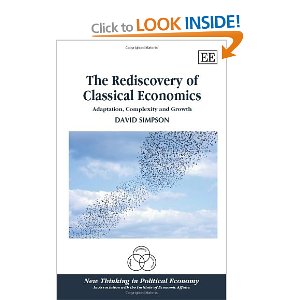
I also had no idea how much more I wanted to say until I came to write the second edition which to my eyes has transcended the first, having been fashioned out of what I learned by teaching the first edition for five years while watching how economic events unfolded following the stimulus. You may only have the author’s word for it here, but there is no book like it. If you want to understand how an economy works based on the English tradition in economic theorising that goes from Adam Smith to John Stuart Mill, there is literally only a single place you can go. The book reverses two “revolutions” in economics, not just the Keynesian of the 1930s, but the marginalist revolution of the 1870s as well. It is a companion volume to David Simpson’s wonderful The Rediscovery of Classical Economics, also co-published by the IEA. Reading the two will provide you with an understanding of just what is wrong with economic theory today. That traditional policy based on standard economic theory is ruining our economies is beyond any doubt, but the reason why that is so will nevertheless remain incomprehensible to anyone who continues to believe that aggregate demand is a valid concept in trying to make sense of economic events or that equilibrium has much if anything to do with how an economy works.

My Free Market text was written in a kind of white heat over twelve weeks as the text for the course I was giving during the first months of the worldwide introduction of stimulus packages pretty well everywhere. The absolute dead certainty I had was that public sector spending whose only aim was to create jobs would end in disaster, as it most assuredly has. Our economies are sinking under the weight of massive levels of unproductive public spending and debt levels that continuously subvert every attempt to wind them back. Yet you cannot go to any standard economics text even for an inkling of why that is.

To understand any of this you must first understand Say’s Law. Say’s Law was the bedrock principle of economic theory from the earliest years of the nineteenth century until swept away in a fit of distraction by the publication of Keynes’s General Theory in 1936. It is founded on recognising that only value adding production can create economic growth and add to the number of jobs. The most central chapter in the book is the chapter on Value Added, a chapter found in no other text that I know of. Yet without understanding value added, understanding that every form of production not just creates more goods and services but also at the same time uses up existing goods and services during the production process, it is impossible to think about public spending and economic policy correctly. Only if what is produced has greater value than the resources used up can an economy grow. Government spending seldom creates value. The stimulus was therefore doomed to fail as is so much of the policy matrix found today.

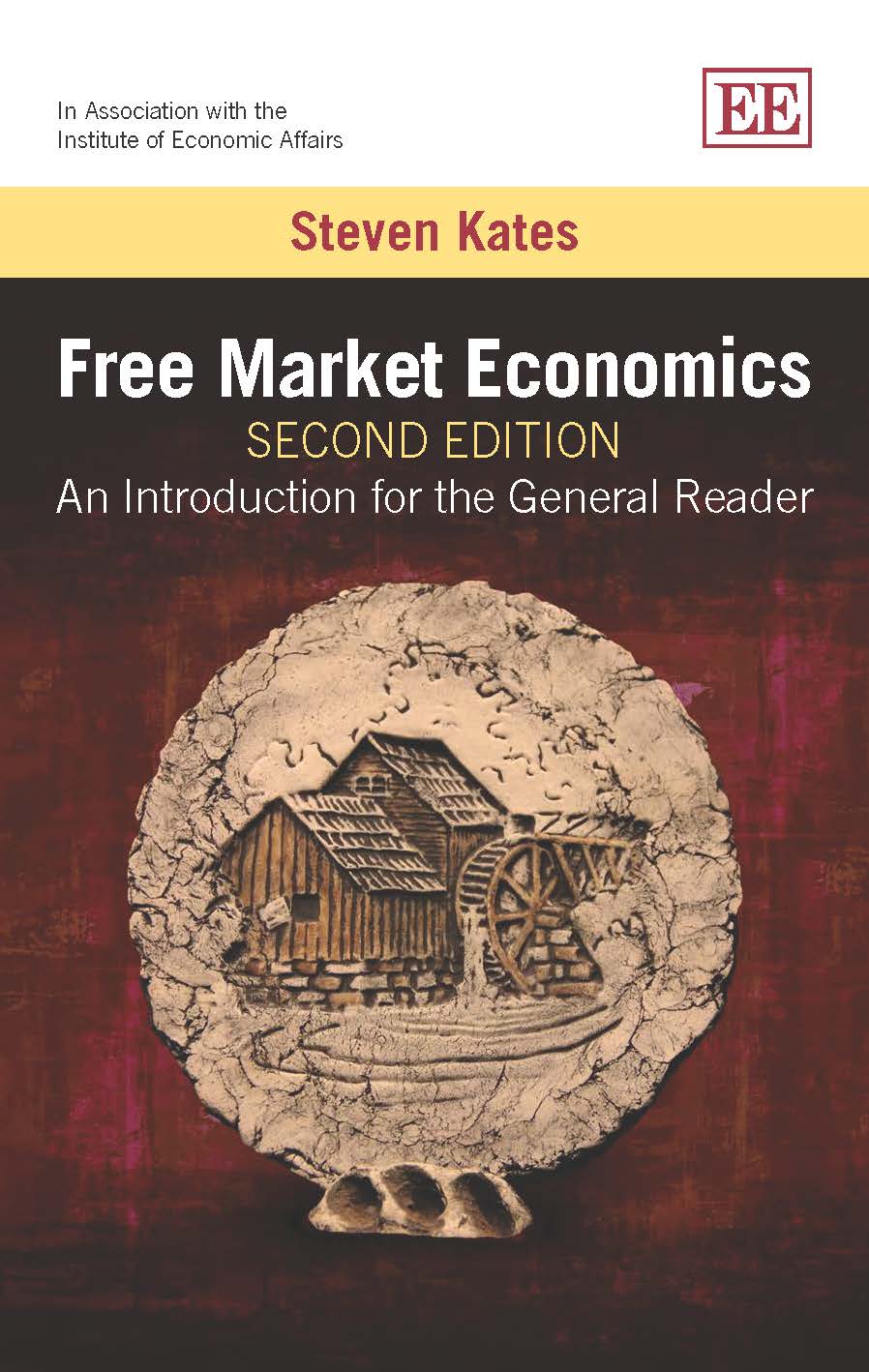
The strangest part about the book, however, was for me to discover my own beliefs on the nature of economic theory. There is not a chapter in it that would fit into a standard economics text. All of it takes you back to an earlier time and a different theoretical matrix. Space is too short to tell you much more but let me draw you to the cover which shows a water mill on a plaque made of clay. This is because the two most important influences on my own way of thinking have been two of the greatest economists England has ever produced, John Stuart Mill and Henry Clay.

I can do no more than encourage you to read this book. It is a defence of the market economy published at a time when there may never been a greater need for such a defence.

FME2 cover

fme2 cover_Page_1

fme2 cover_Page_2

The cover of the second edition. I’d forgotten about the first of the cover endorsements. It was provided by a reviewer at Choice which is the magazine subscribed to by libraries to help them choose which books to buy.

Free Market Economics is virtually a must read for serious economists…. Highly recommended.

The second edition should be available in about a month.

Economic definitions

I start the 2nd ed. of my Free Market Economics with a set of definitions of the common words that are brought across into economics and then used as technical terms. But while technical in economics (e.g. neither “demand” nor “supply” are, for example, specific amounts) their slithery meanings create an imprecision that makes discussion sometimes difficult. The book therefore starts with a set of definitions that try to nail down what each term means in the context in which they are used. But the definitions are also ordered so that they present the entire argument of the book, which is an explanation of why only a market-based economy can create economic prosperity. And here a market based economy is defined as one in which private entrepreneurs, who are unknown and unrelated to anyone in government (except by chance), make most of the economic decisions in an economy and personally carry the responsibility for the success or failure of the enterprises they run.

Each term should therefore be seen as itself carrying part of the weight of the argument. They are each discussed because they provide an important part of the story. You cannot understand how an economy works unless you understand supply and demand in a particular way, which you are very unlikely to have thought of unless you have formally studied economics.

But it is also necessary to fit each of these concepts into a larger framework representing the economy as a whole. The parts are then seen in relation to some fuller context. In this I am following Aristotle as discussed by Mary Midgley* who was looking at biology when she wrote:

[Aristotle] starts from the basic, primitive question about each particular, “What’s this for?” and proceeds by looking for whatever outcomes can, in the particular context, be intelligibly seen as advantages. By doing this systematically it begins to understand these various functions as parts of larger wholes, systems within which the relations between the various parts continually makes better sense of them.

The productive apparatus of a community, the aspects that contribute to the production and distribution of both goods and services and of incomes, works in some way. These definitions are the words necessary to understand both how these outcomes are explained as well as being able to follow the theories that are used. Theory is a representation of reality. These words used as they are properly defined are the necessary elements in making sense of the theory. And I might add, it is necessary to understand the theories to make sense of the words as they are used. The fusion of the words within properly specified theories is what an education in economics is about.

* Mary Midgley. 2014. Are You an Illusion? Durham UK. Acumen.

FME 2nd ed book description

This is from a form I have just sent to the publisher on how to advertise the second edition of my Free Market Economics.

1. Please describe the book in non-technical layman’s terms (in no more than 150 words). Include brief details of the book’s main objectives and conclusions.

Have you ever wondered why no public sector stimulus has ever worked? You are holding in your hands a book that is unique in our times. It is a text on economic principles based on the economics before Keynesian theory became dominant in macroeconomics and equilibrium analysis became standard in micro. It looks at economics from the perspective of an entrepreneur making decisions in a world where the future is unknown, innovation occurs at virtually every moment, and the future is being created before it can be understood.

Of particular significance, this book assumes Keynesian theory is flawed and policies built around attempting to increase aggregate demand by increasing non-value-adding public spending can never succeed but will only make conditions worse. The theories discussed are the theories that dominated economic discourse prior to the Keynesian Revolution and are thus grounded in the economics of some of the greatest economists who have ever lived.

I might also mention this which is a notice I received this week from the publisher:

I am delighted to be writing to all of our authors, contributors, customers and business partners with the exciting news that Edward Elgar Publishing has won another important industry award.

The Frankfurt Book Fair Academic & Professional Publisher of the Year 2014 award was presented to us by the Independent Publishers Guild at a ceremony on Thursday evening.

The judges commented that Edward Elgar Publishing turned in a very impressive sales growth in 2013, achieved on the back of a prolific publishing programme and successful Elgaronline platform. Judges liked its smart customer profiling and forays into international markets. “Edward Elgar is incredibly professional, responsive and imaginative. It is a great example of how a relatively small publisher can be at least as innovative as those many times its size.”

Proposed cover design – Free Market Economics – 2nd edition

This would be the main motif within a field of brown similar to the first edition of my Free Market Economics but perhaps shading towards the colour of the first cover design of Henry Clay’s 1916 first edition of Economics: an Introduction for the General Reader which is similar to the red in the upper half of the photo. But in the middle of the cover would be this picture, which is a waterwheel fashioned out of clay. This is taken from an ebay ad for the plaque shown which was up for sale and I have now bought and own. The picture credit goes to the original seller who I do not think will ask for very much to use his picture but if he does, I am sure that we can do something else along the same lines, although the photo you see is near perfect for me.

watermill made of clay

The actual cover design would follow along these lines from the cover shown below which is the cover of The Rediscovery of Classical Economics (Elgar 2013). A more red/brown version where this one is white is my idea. But I would like some kind of adaptation of this since the underlying themes are so similar and also because both books are being co-published with the Institute of Economic Affairs (IEA) as it says on this book and will say on mine.

rediscovery of classical economics