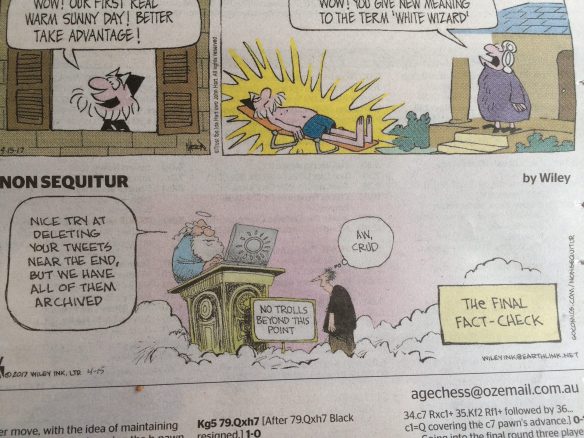
And if you are wondering why I was reading The Age, we were in a cafe and the comics are right next to the sudoku.

And if you are wondering why I was reading The Age, we were in a cafe and the comics are right next to the sudoku.
It may be absurd but this is how I look upon my The Art of the Impossible, my blog history of the election of DJT as president. You can order a copy here. The discourse were, of course, written by Niccolo Machiavelli. I naturally say “of course” in recognition to the fullest extent of its ironical intent. Our educated classes are the shallowest political generation in history.
DISCOURSES ON THE FIRST DECADE OF
TITUS LIVIUS.
BOOK I.
* * * * *
PREFACE.
Albeit the jealous temper of mankind, ever more disposed to censure than to praise the work of others, has constantly made the pursuit of new methods and systems no less perilous than the search after unknown lands and seas; nevertheless, prompted by that desire which nature has implanted in me, fearlessly to undertake whatsoever I think offers a common benefit to all, I enter on a path which, being hitherto untrodden by any, though it involve me in trouble and fatigue, may yet win me thanks from those who judge my efforts in a friendly spirit. And although my feeble discernment, my slender experience of current affairs, and imperfect knowledge of ancient events, render these efforts of mine defective and of no great utility, they may at least open the way to some other, who, with better parts and sounder reasoning and judgment, shall carry out my design; whereby, if I gain no credit, at all events I ought to incur no blame.
When I see antiquity held in such reverence, that to omit other instances, the mere fragment of some ancient statue is often bought at a great price, in order that the purchaser may keep it by him to adorn his house, or to have it copied by those who take delight in this art; and how these, again, strive with all their skill to imitate it in their various works; and when, on the other hand, I find those noble labours which history shows to have been wrought on behalf of the monarchies and republics of old times, by kings, captains, citizens, lawgivers, and others who have toiled for the good of their country, rather admired than followed, nay, so absolutely renounced by every one that not a trace of that antique worth is now left among us, I cannot but at
once marvel and grieve; at this inconsistency; and all the more because I perceive that, in civil disputes between citizens, and in the bodily disorders into which men fall, recourse is always had to the decisions and remedies, pronounced or prescribed by the ancients.
For the civil law is no more than the opinions delivered by the ancient jurisconsults, which, being reduced to a system, teach the jurisconsults of our own times how to determine; while the healing art is simply the recorded experience of the old physicians, on which our modern physicians found their practice. And yet, in giving laws to a commonwealth, in maintaining States and governing kingdoms, in organizing armies and conducting wars, in dealing with subject nations, and in extending a State’s dominions, we find no prince, no republic, no captain, and no citizen who resorts to the example of the ancients.
This I persuade myself is due, not so much to the feebleness to which the present methods of education have brought the world, or to the injury which a pervading apathy has wrought in many provinces and cities of Christendom, as to the want of a right intelligence of History, which renders men incapable in reading it to extract its true meaning or to relish its flavour. Whence it happens that by far the greater number of those who read History, take pleasure in following the variety of incidents which it presents, without a thought to imitate them; judging such imitation to be not only difficult but impossible; as though the heavens, the sun, the elements, and man himself were no longer the same as they formerly were as regards motion, order, and power.
Desiring to rescue men from this error, I have thought fit to note down with respect to all those books of Titus Livius which have escaped the malignity of Time, whatever seems to me essential to a right understanding of ancient and modern affairs; so that any who shall read these remarks of mine, may reap from them that profit for the sake of which a knowledge of History is to be sought. And although the task be arduous, still, with the help of those at whose instance I assumed the burthen, I hope to carry it forward so far, that another shall have no long way to go to bring it to its destination.
There are so many different directions from which cultural Marxism comes that it is impossible to keep up. If you do not understand and wish to sustain a society of free individuals whose aim is to live in freedom and direct their own lives in their own way, and by the way to also live in prosperity, then there is almost no defence against the centralising force that are found at every turn. There was a comment on my post on Communism for Kids that has added yet another dimension to this web. I am going to quote what “Robin” has written but will slightly reconstruct the order in which he brought out his points in a way I find easier to understand. This is what he wrote in the second of his comments:
I actually dropped in from the US to alert Australians to this push from March to force a shift to Human Capability Theory [HCT] in the name of supposed preparation for work.
Amartya Sen and Martha Nussbaum seem to have created HCT to implement the Marxist Humanist view of education globally without that being appreciated. The Capability Approach and Human Development is what the global change agents call this theory and they get together now quite a lot to plan how to implement it out of our collective sight for the most part.
Communism for Kids is published by MIT Press. I’m no longer surprised to see a university engaged in such kinds of work, but it’s not because they are a publisher and publish what they think will sell along the lines of selling the rope that will be used to hang them. They do it because HCT is part of a project MIT is involved with. The background to the book was outlined in the first of his comments.
This is translated into English from German I believe and relates to what I refer to as little ‘c’ communism. It is also what Gorbachev and others call Marxist Humanism. Its ties to what Marx called the Human development Society and education are covered here.
Marxist Humanism and little c communism are what the Sustainable Development Goals of the UN and its Dignity for All by 2030 campaign are all about once we become familiar with the theory. MIT’s involvement makes far more sense once we know they are partners with the UN in its Earth Systems Science Partnership that is about the behavioral and social sciences, including education.
Also the necessary premise for the Human Development Society where “from each according to abilities and to each according to needs” would be the operating principle was that capitalism would have produced a necessary level of technological innovation. ICT [Information and Communication Technology] is regarded as that magic technology worldwide and MIT is essentially homebase. China and Russia installed Communism on an agricultural base. Therefore, unfortunately, the theorists insist that their history does not invalidate what communism might entail if the theory can be implemented on the right technological base.
This remains a dangerous theory if not correctly understood. Letting it come in as ‘systems science’ for example is just as dangerous and much harder to see.
One superficially negative review of the book however ends with this.
There were a couple of positive reviews of the book, though none of them verifier buyers. “I loved this book so much!” wrote Sophia Nachalo. “It’s not really a kid’s book, but rather a book for everyone written in a fun and easy way that uses stories, fables, and funny characters to explain everyday life. It makes marxism cool again!”
Fredrick Jameson, a Duke University Professor, endorsed the book, claiming “this delightful little book may be helpful in showing youngsters there are other forms of life and living than the one we currently ‘enjoy,’ and even some adults might learn from it as well.”
And in another negative review there was nevertheless this at the end which totally reversed whatever mild criticisms there were:
CNN’s Chris Cuomo said communism is “uplifting” as he talked fondly of Cuba. This is the state of affairs in the United States today.
“The concern was the freedom of the people,” he continued. “What is the point of this communist regime if it is not to truly make everyone equal — not at the lowest level; not by demoralizing everyone; but lifting everyone up?”
I had a friend from the far left who was overjoyed by the fall of the Soviet Union now almost three decades ago. With no negative example before us, he was sure Marxism would come back stronger than ever. It may be the only political judgement he has ever been right about, but it is one that should worry you all.
I suppose the basic point is that economics remains in such a primitive state that it is impossible for anyone really to be sure what is true and what is not. Most people just make it up as they go along, with no true means to validate one version of reality in comparison with another.
These are excerpts from the Testimony of Marriner Eccles to the Committee on the Investigation of Economic Problems in 1933. And who is Marriner Eccles? Other than being in his time one of the richest men in Utah, he was appointed by FDR to the Chairmanship of the Fed in 1935 where he remained until 1951. A proto-Keynesian disciple of Foster and Catchings, this is how he is described at the first link by “The London Banker (TLB):
Below are excerpts from the testimony of Marriner Eccles to the Senate Committee on the Investigation of Economic Problems in 1933. It is an historic document – laying out the future terms of the Federal Deposit Insurance Corporation, the management of money supply nationally through open market operations, the Bretton Woods Accord on currency stability, mortgage refinancing as monetary stimulus, and reforms of the Federal Reserve System to eradicate the excesses of untamed capitalism and financial dominance of Wall Street. He proposes higher income and inheritance taxes as essential to promote economic growth, curb inequality and forestall political instability. He encourages federal regulation of child labor, unemployment insurance, social security and other farsighted reforms. And he avows himself a capitalist throughout.
The following are excerpts from the excerpts of the testimony printed by TLB.
We have all and more of the material wealth which we had at the peak of our prosperity in the year 1929. Our people need and want everything which our abundant facilities and resources are able to provide for them. The problem of production has been solved, and we need no further capital accumulation for the present, which could only be utilised in further increasing our productive facilities or extending further foreign credits. We have a complete economic plant able to supply a superabundance of not only all the necessities of our people, but the comforts and luxuries as well. Our problem, then, becomes one purely of distribution. This can only be brought about by providing purchasing power sufficiently adequate to enable the people to obtain the consumption goods which we, as a nation, are able to produce. The economic system can serve no other purpose and expect to survive. . . .
We could do business on the basis of any dollar value as long as we have a reasonable balance between the value of all goods and services if it were not for the debt structure. The debt structure has obtained its present astronomical proportions due to an unbalanced distribution of wealth production as measured in buying power during our years of prosperity. Too much of the product of labor was diverted into capital goods, and as a result what seemed to be our prosperity was maintained on a basis of abnormal credit both at home and abroad. The time came when we seemed to reach a point of saturation in the credit structure where, generally speaking, additional credi was no longer available, with the result that debtors were forced to curtail their consumption in an effort to create a margin to apply on the reduction of debts. This naturally reduced the demand for goods of all kinds, bringing about what appeared to be overproduction, but what in reality was underconsumption measured in terms of the real world and not the money world. . . .
What the public and the business men of this country are interested in is a revival of employment and purchasing power. This would automatically restore confidence and increase profits to a point where the Budget would automatically be balanced in just the same manner as the individual, corporation, State, and city budget would be balanced. . . .
Mr Eccles: Of course, the way I look at this matter is that we have the power to produce, just as in the period of prosperity after the war demonstrated when we had a standard of living for a period from 1921 to 1929 which, of course, was far in excess of what it is now. Yet in spite of that standard of living we saved too much a I have previously tried to show.
Senator Gore: You have got Foster in the back of your head?
Mr Eccles: I only wish there were more who had. We saved too much in this regard, that we added too much to our capital equipment. Creating overproduction in one case and underconsumption in the other because of an uneconomic distribution of wealth production. . . . Of course, we are losing $2,000,000,000 per month in unemployment. I can conceive of no greater waste than the waste of reducing our national income about half of what it was. I can not conceive of any waste as great as that. Labor, after all, is our only source of wealth. . . .
The program which I have proposed is largely of an emergency nature designed to bring rapid economic recovery. However, when recovery is restored, I believe that in order to avoid future disastrous depressions and sustain a balanced prosperity, it will be necessary during the next few years for the Government to assume a greater control and regulation of our entire economic system. There must be a more equitable distribution of wealth production in order to keep purchasing power in a more even balance with production. . . .
Such measures as I have proposed may frighten those of our people who possess wealth. However, they should feel reassured in reflecting upon the following quotation from one of our leading economists:
It is utterly impossible, as this country has demonstrated again and again, for the rich to save as much as they have been trying to save, and save anything that is worth saving. They can save idle factories and useless railroad coaches; they can save empty office buildings and closed banks; they can save paper evidences of foreign loans; but as a class they can not save anything that is worth saving, above and beyond the amount that is made profitable by the increase of consumer buying. It is for the interests of the well to do – to protect them from the results of their own folly – that we should take from them a sufficient amount of their surplus to enable consumers to consume and business to operate at a profit. This is not “soaking the rich”; it is saving the rich. Incidentally, it is the only way to assure them the serenity and security which they do not have at the present moment.
This was reprinted by TLB because of his full agreement with Eccles which was mirrored by all of the comments, except for one, by Ron Paul who wrote:
What a load of statist drivel and what a bunch of Roosevelt worshiping sycophants. I’ll bet Krugman and the entire Nobel prize committee would love this post too.
Statist drivel isn’t the half of it, but it is clearly not the majority view, not then and not now.

Just like the article says, this is MIT’s new publication ‘COMMUNISM FOR KIDS’. You can pick it up at Amazon where you can find the following blurb:
Once upon a time, people yearned to be free of the misery of capitalism. How could their dreams come true? This little book proposes a different kind of communism, one that is true to its ideals and free from authoritarianism. Offering relief for many who have been numbed by Marxist exegesis and given headaches by the earnest pompousness of socialist politics, it presents political theory in the simple terms of a children’s story, accompanied by illustrations of lovable little revolutionaries experiencing their political awakening.
It all unfolds like a story, with jealous princesses, fancy swords, displaced peasants, mean bosses, and tired workers–not to mention a Ouija board, a talking chair, and a big pot called “the state.” Before they know it, readers are learning about the economic history of feudalism, class struggles in capitalism, different ideas of communism, and more. Finally, competition between two factories leads to a crisis that the workers attempt to solve in six different ways (most of them borrowed from historic models of communist or socialist change). Each attempt fails, since true communism is not so easy after all. But it’s also not that hard. At last, the people take everything into their own hands and decide for themselves how to continue. Happy ending? Only the future will tell. With an epilogue that goes deeper into the theoretical issues behind the story, this book is perfect for all ages and all who desire a better world.
You would hope that it’s all intended to be ironic but given the way of the world, every word is meant just as it is written. “Happy ending?” they ask. Complete idiots which often comes with high IQ grade stupidity.
So I will just mention that I have written my own little book which is titled Economics for Infants, the first children’s book ever premised on the classical economics of Say’s Law and John Stuart Mill’s On Liberty.

More details to come.
[The story on The Children’s Guide to the Gulag comes via Instapundit]
No namby-pamby PC.
From the accompanying note that came with the vid:
Today we are launching the website: www.marklathamsoutsiders.com
Have a look at the site: hopefully it will become a handy resource for folks wanting to fight back against the loss of our institutions and Australian values.
I genuinely believe conservatives and social democrats need to unite in the fight against cultural Marxism and segregationist identity politics.
The best things about our country, many of which we had taken for granted, are now at risk.
many thanks, Mark
This is from an article on “The New Deal” written by H.L. Mencken in May, 1935 and published in A Mencken Chrestomathy [Vintage Books New York 1982: pages 424-25]. It discusses how the first application of Keynesian economics by the Roosevelt Administration came about even before The General Theory had been written. The article begins with excerpts from two articles in The New Republic and The Nation describing how FDR’s closest advisor, Harry Hopkins, in collaboration with three others, came up with the idea of massive increases in public spending to bring the Depression to an end. Although tentative in approaching Roosevelt about such a massive spending program without even having done the slightest bit of analysis, he expected Roosevelt to be reluctant about spending such immense amounts of money, all the more so since Roosevelt had committed himself to balancing the budget. That was not, however, how it went.
[Hopkins] expected to be told to develop the idea and come back with a fuller outline. He still expected that when he left the White House that evening. But it so happened that he had caught the New Deal Messiah in one of his periods of infatuation with the spending art, and Hopkins literally woke up the next morning to discover that Roosevelt without further ado had proclaimed the CWA* in effect.
It is now more than two years later. Mencken is here looking back on the fantastic amounts of spending and the effect such spending has had.
The money began to pour out on November 16, 1933, to the tune of a deafening hullabaloo. By December 1 more than 1,000,000 were on the CWA pay roll; by January, 1934, the number reached 4,100,000. Press agents in eight-hour shifts worked day and night to tell a panting country what it was all about. The Depression, it was explained, was being given a series of adroit and fatal blows, above, below and athwart the belt. In six months there would be no more unemployment, the wheels of industry would be spinning, and the More Abundant Life would be on us. Brains had at last conquered the fear of fear.
What actually happened belongs to history. By the opening of Spring Hopkins had got rid of his billion, and the whole thing had blown up with a bang. More people were out of work than ever before. The wheels of industry resolutely refused to spin. The More Abundant Life continued to linger over the sky line. There ensued a pause for taking breath, and then another stupendous assault was launched upon the taxpayer. This time the amount demanded was $4,880,000,000. It is now in hand, and plans are under way to lay it out where it will do the most good in next year’s campaign.
Go back to the clippings and read them again. Consider well what they say. Four preposterous nonentities, all of them professional uplifters, returning from a junket at the taxpayer’s expense, sit in a smoking car munching peanuts and talking shop. Their sole business in life is spending other people’s money. In the past they have always had to put in four-fifths of their time cadging it, but now the New Deal has admitted them to the vaults of the public treasury, and just beyond the public treasury, shackled in a gigantic lemon-squeezer worked by steam, groans the taxpayer. They feel their oats, and are busting with ideals. For them, at least, the More Abundant Life has surely come.
Suddenly one of them, biting down hard on a peanut, has an inspiration. He leapt to his feet exultant, palpitating like a crusader shinning up the walls of Antioch. How, now, comrade, have you bitten into a worm? Nay, gents, I have thought of a good one, a swell one, the damndest you will ever heard tell of. Why not put everyone to work? Why not shovel it out in a really Large Way. Why higgle and temporize? We won’t be here forever, and when we are gone we’ll be gone a long while.
But the Leader? Wasn’t he babbling again, only the other day, of balancing the budget? Isn’t it a fact that he shows some sign of wobbling of late – that the flop of the NRA has given him to think? Well, we can only try. We have fetched him before, and maybe we can fetch him again. So the train reaches Washington, the porter gets his tip from the taxpayer’s pocket, and the next day the four brethren meet to figure out the details. But they never get further than a few scratches, for The Leader is in one of his intuitive moods, and his Christian Science smile is in high gear. Say no more, Harry, it is done! The next morning the money begins to gush and billow out of the Treasury. Six months later a billion is gone, and plans are under way to collar five times as much more.
Such is government by the Brain Trust. Such is the fate of the taxpayer under a Planned Economy. Such is the Utopia of Damned Fools.
We never seem to learn a thing. Not from the experience of the 1930s, the 1970’s, Japan in the 1990’s and everywhere across the world since the GFC. Keynesian economics is junk science; no public sector stimulus has ever brought an economy in recession into recovery. It would only be about one economist in a hundred who even knew an economy is not driven forward by aggregate demand, never mind could explain why the stimulus, either now or then, didn’t work. Indeed, there are probably still many who would argue the stimulus had been a great success.
__________
* The CWA was the Civil Works Administration, the stimulus program put in place by FDR in 1933 that worked as well as Obama’s stimulus program after it was put in place three-quarters of a century later.
The alt-lite v the alt-right explained
I was willing to give Trump the benefit of the doubt over what he was up to in Syria, but if he actually intends to put America on a path to war over the use of chemical weapons in Syria then he had better go to Congress before he takes another step. I thought I would check with The Diplomad to see what he thought and this is what he wrote last Friday in a post titled On Syria: The Morning After.
Now to some basics. I have written before wondering why it is that death by gas strikes us as more horrific than, say, death by napalm or by a .223 round. As I noted in the just linked piece which I wrote almost four years ago,
Despite the temptation, the US did not use gas against well-entrenched Japanese troops in the Pacific, even when gas likely could have saved many American lives. FDR did not want to be known as the President who used gas–he, of course, was developing an atomic bomb . . .
We wouldn’t use gas against Japan but used two atomic bombs to destroy Hiroshima and Nagasaki, not to mention burning nearly all of their other cities to the ground, and flushing their troops out of caves with flame throwers–all justifiable, by the way.
Would we have bombed Assad, if he had merely used conventional explosives delivered by either artillery or aircraft to kill 80 civilians? Are those killed by gas more dead than those killed by explosives? Last July, vacationers in the beautiful French city of Nice were attacked by a jumped up jihadi driving a large truck; he killed over 80 persons. I saw no visible French retaliation against the Muslim world or truck makers.
OK, I don’t want to push this too far, but let me just conclude with a question: Is Assad, despicable as he is, and his alleged use of gas a threat to the United States? We, as noted above, will all have to decide, I guess.
Theresa May has also waded in since she has similar concerns: Split opens between Washington and London over Syria after Theresa May refused to back new strikes on Assad.
Donald Trump’s National Security Adviser HR McMaster and his ambassador to the UN Nikki Haley have both warned the US is “prepared to do more” to enforce an international red line on chemical weapons.
But Downing Street refused to back President Trump’s tough stand when repeatedly pressed today.
The Prime Minister’s official spokesman would only say the question was “hypothetical”, adding: “Our focus is on building international support for a political solution to end the conflict and bring lasting peace and stability to Syria”.
No10 also said Theresa May has no plans to go back to the House of Commons to ask for approval for the UK to stand alongside the US and join future strikes on Assad.
A vote by MPs in December 2015 only authorises the RAF to join attacks on ISIS in Syria.
That is a war aim I understand. What is possibly the most ridiculous part of what is happening is that these actions, which are in themselves senseless and without strategic purpose, are popular in the United States and have Democrat support.
UPDATE: In light of all of this, it is very pleasing to find the American Secretary of State reiterating the same points made by Theresa May, and found in a longer and astonishing discussion of what is going on in an article at The Conservative Treehouse on Recording of Secretary Kerry Admitting President Obama Armed Extremists in Syria – And Now Secretary Tillerson and President Trump are Dealing With Consequences…... This is a direct quote from Tillerson.
So it’s to defeat ISIS; it’s to begin to stabilize areas of Syria, stabilize areas in the south of Syria, stabilize areas around Raqqa through ceasefire agreements between the Syrian regime forces and opposition forces. Stabilize those areas; begin to restore some normalcy to them. Restore them to local governance — and there are local leaders who are ready to return, some who have left as refugees — they’re ready to return to govern these areas.
Use local forces that will be part of the liberation effort to develop the local security forces — law enforcement, police force. And then use other forces to create outer perimeters of security so that areas like Raqqa, areas in the south can begin to provide a secure environment so refugees can begin to go home and begin the rebuilding process.
In the midst of that, through the Geneva Process, we will start a political process to resolve Syria’s future in terms of its governance structure, and that ultimately, in our view, will lead to a resolution of Bashar al-Assad’s departure.
How bad Obama has been for the West and our survival will never be fully known but the bits are coming out and Trump may yet make the needed difference.
An interesting and very timely article on Rules of Warfare in Pre-Modern Societies. In the wake of Trump’s attack on the Syrians over their use of poison gas, with all the risks involved, apparently has ancient roots and is founded on keeping even the mayhem of war within bounds. From the article:
How have rules of war been maintained throughout history without a central enforcing agency? This question is fundamental to the understanding of the nation-state in IR theory, and is also an astonishing example of spontaneous order in an anarchic and chaotic scenario.
The quandary exists because even the laudable negative rights of life, liberty, and property ownership, as Eric Mack discusses in his essay on Just War Theory, require a positive enforcement by others. Similarly, “rules of war” – such as refraining from attacking non-regulars, not attacking neutral parties, abiding by the terms of treaties, treating prisoners of war with respect, etc. – are, theoretically, difficult to establish and dependent on positive enforcement. This is because if Party A respects these rules, they provide a perverse incentive to Party B to take advantage of Party A’s restraint, and if doing so gives Party B the upper hand, they can enjoy the benefits of betraying the rules of war with impunity. This is a classic Prisoner’s Dilemma, and if it generalized across many nations, the theory of rational choice would lead us to expect a coordination problem, in which those using the strategy of Party B would dominate the Party A’s.
Seems, however, not. If these things interest you, and I cannot see why they wouldn’t, you should go to the link.
 Law of Markets