The modern rules of free speech

The modern rules of free speech are pretty clear and enforced everywhere.

The political and social views of anyone on the right are always open to the most extensive criticisms while criticisms of anyone on the left are strictly forbidden.

You can be as negative as you like about white males while nothing critical can ever be said of any person who is not a white male.

You can criticise Christianity and Judaism as much as you please while the practices of every other religion must never be criticised.

You are compelled to praise every form of human relationships other than a non-adulterous relationship between a man and a woman.

Paedophilia is forbidden except where it’s not (such as with child brides).

The ordering here is also important. The higher issues dominate anything below them. For example, if a woman says something positive about some conservative belief, she is no longer protected even under the “white male” rule.

The unassailable principles of a free society

This is from The Wall Street Journal where, presumably, the editors and journalists agree with what they are reporting on. The report discusses a statement of principles issued by a number of academics following the incident described at the start of the story.

On Thursday roughly 100 of our 2,500 students prevented a controversial visiting speaker, Charles Murray, from communicating with his audience on the campus of Middlebury College. Mr. Murray was silenced by loud chants and foot-stomping; the commotion lasted nearly half an hour before college officials moved him to a private room to deliver his address into a camera. But even the simulcast to the auditorium was silenced by more protests and multiple fire alarms.

As Mr. Murray was leaving, a group of as-yet-unidentified assailants mobbed him and seriously injured one of our faculty colleagues. In view of these unacceptable acts, we have produced a document stating core principles that seem to us unassailable in the context of higher education within a free society. Many colleagues have joined us by signing their names to this document; the full list of signatories is available online.

***
The principles are as follows:

Genuine higher learning is possible only where free, reasoned, and civil speech and discussion are respected.

Only through the contest of clashing viewpoints do we have any hope of replacing mere opinion with knowledge.

The incivility and coarseness that characterize so much of American politics and culture cannot justify a response of incivility and coarseness on the college campus.

The impossibility of attaining a perfectly egalitarian sphere of free discourse can never justify efforts to silence speech and debate.

Exposure to controversial points of view does not constitute violence.

Students have the right to challenge and even to protest non-disruptively the views of their professors and guest speakers.

A protest that prevents campus speakers from communicating with their audience is a coercive act.

No group of professors or students has the right to act as final arbiter of the opinions that students may entertain.

No group of professors or students has the right to determine for the entire community that a question is closed for discussion.

The purpose of college is not to make faculty or students comfortable in their opinions and prejudices.

The purpose of education is not the promotion of any particular political or social agenda.

The primary purpose of higher education is the cultivation of the mind, thus allowing for intelligence to do the hard work of assimilating and sorting information and drawing rational conclusions.

A good education produces modesty with respect to our own intellectual powers and opinions as well as openness to considering contrary views.

All our students possess the strength, in head and in heart, to consider and evaluate challenging opinions from every quarter.

We are steadfast in our purpose to provide all current and future students an education on this model, and we encourage our colleagues at colleges across the country to do the same.

A literary dispute of the highest political importance

huxley-to-orwell

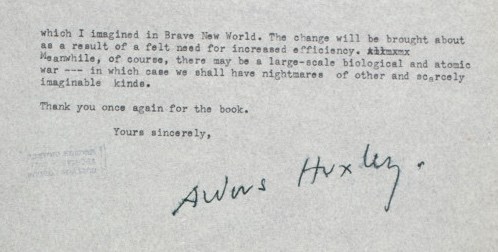
The writer of Brave New World had previously taught high school French to the writer of 1984! What follows below is the text of the letter Huxley wrote to Orwell in 1949. But what is truly fascinating and worth dwelling on is that Huxley argued that a soft fascism, guided by a gentle and soothing elite who made their prisoners love their almost invisible chains, was the way totalitarian governments would evolve, rather than a world of increasingly brutalised citizens, the mailed fist and the gulag. I will note that the bolding in the text below is my own.

Shortly after George Orwell published Nineteen Eighty-Four in 1949, he received a letter from his onetime high school French teacher, Aldous Huxley, who had published Brave New World 17 years earlier. Here are Huxley’s comments, via Letters of Note:

Wrightwood. Cal.

21 October, 1949

Dear Mr. Orwell,

It was very kind of you to tell your publishers to send me a copy of your book. It arrived as I was in the midst of a piece of work that required much reading and consulting of references; and since poor sight makes it necessary for me to ration my reading, I had to wait a long time before being able to embark on Nineteen Eighty-Four.

Agreeing with all that the critics have written of it, I need not tell you, yet once more, how fine and how profoundly important the book is. May I speak instead of the thing with which the book deals — the ultimate revolution? The first hints of a philosophy of the ultimate revolution — the revolution which lies beyond politics and economics, and which aims at total subversion of the individual’s psychology and physiology — are to be found in the Marquis de Sade, who regarded himself as the continuator, the consummator, of Robespierre and Babeuf. The philosophy of the ruling minority in Nineteen Eighty-Four is a sadism which has been carried to its logical conclusion by going beyond sex and denying it. Whether in actual fact the policy of the boot-on-the-face can go on indefinitely seems doubtful. My own belief is that the ruling oligarchy will find less arduous and wasteful ways of governing and of satisfying its lust for power, and these ways will resemble those which I described in Brave New World. I have had occasion recently to look into the history of animal magnetism and hypnotism, and have been greatly struck by the way in which, for a hundred and fifty years, the world has refused to take serious cognizance of the discoveries of Mesmer, Braid, Esdaile, and the rest.

Partly because of the prevailing materialism and partly because of prevailing respectability, nineteenth-century philosophers and men of science were not willing to investigate the odder facts of psychology for practical men, such as politicians, soldiers and policemen, to apply in the field of government. Thanks to the voluntary ignorance of our fathers, the advent of the ultimate revolution was delayed for five or six generations. Another lucky accident was Freud’s inability to hypnotize successfully and his consequent disparagement of hypnotism. This delayed the general application of hypnotism to psychiatry for at least forty years. But now psycho-analysis is being combined with hypnosis; and hypnosis has been made easy and indefinitely extensible through the use of barbiturates, which induce a hypnoid and suggestible state in even the most recalcitrant subjects.

Within the next generation I believe that the world’s rulers will discover that infant conditioning and narco-hypnosis are more efficient, as instruments of government, than clubs and prisons, and that the lust for power can be just as completely satisfied by suggesting people into loving their servitude as by flogging and kicking them into obedience. In other words, I feel that the nightmare of Nineteen Eighty-Four is destined to modulate into the nightmare of a world having more resemblance to that which I imagined in Brave New World. The change will be brought about as a result of a felt need for increased efficiency. Meanwhile, of course, there may be a large-scale biological and atomic war — in which case we shall have nightmares of other and scarcely imaginable kinds.

Thank you once again for the book.

Yours sincerely,

Aldous Huxley

No one in 1949 could possibly imagine what our world would be like, but of the two forms of totalitarian control, the vision Huxley had then is the one more true to form about the world in which we find ourselves living today. But Orwell did get the part about those who control the past controlling the future. We have gone beyond the memory hole to the point where some events are never recorded while what never occurred instantly becomes the official narrative even while millions perfectly well know none of it is or was ever true. There is plenty of both of these disturbing and prophetic books in our modern world.

“The proportion of those who can explain the world is gradually shrinking”

I really notice this in discussions of global warming and replacement technologies: The proportion of those who can explain the world is gradually shrinking. A very interesting article from which you find:

Too many everyday things are already indistinguishable from magic to the average man. Four centuries ago everyone knew how everything in their village worked. Even a hundred years ago an intelligent person could figure out how anything he would likely encounter, even the steam locomotive. But today people are surrounded by things about whose workings they haven’t a clue. Medical devices, synthetic pharmaceuticals, designer pathogens. The proportion of those who can explain the world is gradually shrinking.

Cell phones, robots, mesh nets, remote imaging, data mining, stealth, invisible lethal chemicals and contagious diseases exist cheek by jowl with ox drawn carts, subsistence agriculture, illiteracy and fanaticism around Mosul and in other global cities.

I used to ask all my engineering type friends if they could explain to me what happens when I push the number 5 on a calculator and then multiply it by 7. They would all explain it in similar ways but nothing ever made true sense. They understood, but I was a primitive. And while my knowledge and skills are sufficient for me to earn a living today, if I were transported back to 1000 A.D. I would have nothing I could tell them that would be of the slightest use to them in raising the standard of living or deepening their knowledge of the world.

On the other hand, maybe these people are just insane

The election results, the Superbowl and now the Academy Award results apparently lead to the conclusion DID THE OSCARS JUST PROVE THAT WE ARE LIVING IN A COMPUTER SIMULATION?. From The New Yorker.

Once this insight is offered, it must be said, everything else begins to fall in order. The recent Super Bowl, for instance. The result, bizarre on the surface—with that unprecedented and impossible comeback complete with razzle-dazzle catches and completely blown coverages and defensive breakdowns—makes no sense at all in the “real” world. Doesn’t happen. But it is exactly what you expect to happen when a teen-ager and his middle-aged father exchange controllers in the EA Sports video-game version: the father stabs and pushes the buttons desperately while the kid makes one play after another, and twenty-five-point leads are erased in minutes, and in just that way—with ridiculous ease on the one side and chicken-with-its-head-cut-off panic infecting the other. What happened, then, one realizes with last-five-minutes-of-“The Twilight Zone” logic, is obvious: sometime in the third quarter, the omniscient alien or supercomputer that was “playing” the Patriots exchanged his controller with his teen-age offspring, or newer model, with the unbelievable result we saw.

There may be not merely a glitch in the Matrix. There may be a Loki, a prankster, suddenly running it. After all, the same kind of thing seemed to happen on Election Day: the program was all set, and then some mischievous overlord—whether alien or artificial intelligence doesn’t matter—said, “Well, what if he did win? How would they react?” “You can’t do that to them,” the wiser, older Architect said. “Oh, c’mon,” the kid said. “It’ll be funny. Let’s see what they do!” And then it happened. We seem to be living within a kind of adolescent rebellion on the part of the controllers of the video game we’re trapped in, who are doing this for their strange idea of fun.

So why worry? Wait for the reset and you can have the universe just the way you like it.

The dumb terminals of the left

Got into an argument with someone on the left the other day about Donald Trump. So I asked what in particular that Trump is doing doesn’t he like? Just name anything at all, just tell me what it is and what it is you don’t like. Could not elicit a single statement of any kind about any issue. So I said, what do you think of the wall? Do you think that the United States should just let anyone enter the country without checking who they are or whether it might be to the advantage of Americans that these non-Americans be allowed to settle where they please and then live off the welfare state. So he said he was against walls. So I said, well what about the wall that separates Israel from Hamas in the Gaza? No, there should be no walls, he replied. Does that also include Egypt who has also put a wall between itself and Gaza? But you know nothing went any further.

And here is the thing. The terminology is a bit old fashioned, but it finally occurred to me that in discussing anything with anyone on the left, you are dealing with a dumb terminal. From Wikipedia:

A dumb terminal is a computer terminal that consists mostly of just a display monitor and a keyboard (and perhaps a mouse as well). It has no internal CPU (central processing unit), and thus has little or no processing power. Sep 2, 2005

The definition goes back to 2005 so far as computers go, but so far as people on the left it’s as modern as this morning. There is some central body of thought which everyone subscribes to without any independent personal contribution of their own. It’s not ignorance since there cannot be any doubt that as far as no walls in Gaza is concerned, the consequence would mean the immediate destruction of Israel. And there is no doubt an answer to what the left believes about the Gaza and the border but since he didn’t know what it was, he was damned if he was going to concede and inch. Independent thought and an ability to be responsive in an open discussion is impossible.

Blind, dumb and stupid; just attached to the left’s cpu for all answers to all political question. This is the great benefit of being on the left since one never ever has to think through any single issue on one’s own.

More light

Publius Decius Mus, the name behind which Michael Anton wrote some of the most enlightening articles during the election, has now not only been brought out into the light, but is, on that account, also on the high intensity receiving end of the usual slanders of the left. Only we on our side of the divide will ever listen to what he has to say, but he has turned out to be one of the most insightful persons in this Age of Stupidity, helping to clarify the political issues of our time. Below I excerpt from Decius Out of the Darkness: A Q&A with Michael Anton but you do need to read it all.

On being called an anti-Semite

It’s completely outrageous but sadly typical of the slander culture perfected by the modern Left. They can’t debate ideas anymore and don’t even want to try. They just look for any way to connect their enemies—that’s what I am to them, an enemy—to some scurrilous person or outlook. Once that taint is on you, they then work to make it impossible to scrub out.

On the notion of America First

It means prioritizing American interests in our foreign policy and the American people in our domestic policy. Which is what every state—at least every government that is acting as it should—tries to do.

This is such a “well, duh” statement and idea that the fact it would be super controversial shows how corrupt our intellectual discourse has become.

But there’s another layer here, too. There is now, and has been for some time, a broad consensus from the center-right all the way to the far left that America’s only legitimate role is to be a kind of savior of and refuge for the world. It’s not a country with citizens and a government that serves those citizens. It belongs to everyone. Everyone has a right to come here, work here, live here, reap America’s bounty. We have no legitimate parochial interests. Rather America exists for others. This standard does not seem to be held to any other country, although one sees it increasingly rising in Europe.

So Donald Trump’s forthright stance against that, insisting that this country is ours, belongs to us, and demands that we prioritize our own interests, sounds like the most horrible blasphemy against this universalist consensus. I think that explains so much of the freakout against his presidency and the travel executive order, for instance. People ask, “How can he do that? Doesn’t he realize that America belongs to the whole world?” And Trump’s response is: “Don’t be silly, of course it doesn’t. It’s ours and we must do what’s best for us.” No prominent leader has said that or acted on that in ages. So the reassertion of basic common sense sounds shocking.

On immigration

The proper basis is what is best for the existing citizenry—period, full stop. It’s also important to note that the existing citizenry is entitled to base its judgement on whatever considerations it wants. That is to say, the existing citizenry is free to be “wrong” in the eyes of expert or elite opinion.

Expert and elite opinion definitely wants high immigration and views opposition as “inaccurate” or “in error” and therefore illegitimate. This is true not just of immigration but of a whole range of policies that a majority of ordinary citizens don’t want but that the elites want. The elites then make an elaborate case for why their preferences are “correct” and any opposition is based on simple ignorance, not a legitimate, political difference. This is a much larger topic, that I explored in my previous writings, but that’s the heart of administrative state rule. Your wishes don’t count. Right and wrong are replaced by correct and incorrect and political government by the people is replaced by administrative rule by experts.

Much more at the link.

The circling of the elites

Sunday morning so thought I would look at the paper and there we have this column by PVO on Political discourse coarsened by reactionary war against ‘elites’. It’s not every reactionary who becomes the wave of the future, but there is this possibility in DJT. It is a bit old timey, but let me take you back to what I still think makes a lot of sense:

The circulation of elite is a theory of regime change described by Italian social scientist Vilfredo Pareto (1848–1923). Changes of regime, revolutions, and so on occur not when rulers are overthrown from below, but when one elite replaces another.

There will always be leaders in every society and they will come from a variety of directions and use different means to hold on when challenged. But this is the essence of what PVO has to say:

A book by American professor Tom Nichols titled The Death of Expertise: The Campaign Against Established Knowledge and Why It Matters, explores how and why modern society has embraced such a lowbrow approach. [My bolding]

Let me take my own area of expertise, economics. You can certainly accuse me of campaigning against modern textbook theory which, so far as I can see, has brought our economies very low although making some people very rich. Go back to the first civilisations and you will see this everywhere you go. There are some few who are very rich and there are others who are not. The thing about our societies in the West is that those who are not do very very well by historical standards. But if your expertise is founded on the belief that increased aggregate demand and higher public spending are good for growth and employment, then your expertise, in my view, is junk science.

And the fact is, there is a lot of that kind of stuff around at the moment, with agw as large a danger to our communal wealth and well being as I have ever seen. So what does PVO say about that?

Climate change scientists might be the specialists when it comes to assessing global warming, and I’ll defer to their judgment rather than embrace the conspiracy theories of polemicists who dispute the evidence. But when climate scientists seek to influence policy mechanisms for addressing climate change, they move outside their area of expertise. Scientists recommending how best to structure tax or energy trading systems is akin to me offering medical advice: buyer beware. [My bolding again]

Those lowbrow polemicists attacking our elites who indulge in various forms of crony capitalism as they sell us massively government-subsidised wind farms and solar panels may actually have a point, and even more so if you think that these very same elites want to open our borders to anyone who decides to show up.

Populism and the madness of crowds

Although written in 1841, it has always been in print: Extraordinary Popular Delusions and the Madness of Crowds. The reason, of course, is because everyone – and that means you (and me) – likes to laugh at the stupid ideas other people have. The problem with the governance in our democracies is that those at the top – our elites – harbour a set of delusions so truly unfounded it is hard to credit anyone with such bizarre ideas. Open borders, global warming, demand-driven crony-capitalist economic theories, are forms of delusion that for some reason make these elites rich while making the rest of society poor. So they do all the laughing and we try to wok out how to stop them from ruining us even further.

Let me take you to the delusion I know best, the belief taught in virtually every economics course across the West, that economies can be made to grow through public spending on unproductive forms of capital. In a recession, lift the level of “G”. Works every time, other than on every single occasion it has been tried. But if you are on the receiving end of this expenditure, the idea seems utterly fantastic.

Donald Trump and conservative values

What would they know about the meaning of conservative? First we have Paul Kelly writing his column with the heading Conservative principles and values are being trashed. And then there’s Brian Loughnane with this as the highlighted quote from his article, also in The Oz, “Trump is the most serious challenge to conservatism since World War II”. Really, what would then know? Michael Anton, on the other hand, does know.

And the question asked in this column, naturally not at The Australian, is this: Why did so many conservative intellectuals become Trumpists. And here is the conservative answer: there was and is no other way to save our civilisation from collapse. Even with the election, there is hardly any certainty we have turned the corner, but at least there is now the possibility. This, apparently, is the part of the conservative world in which I belong. The Anton referred to in the passage below is Michael Anton who wrote, under the pseudonym Publius Decius Mus, the much-discussed article, “The Flight 93 Election” which I blogged on at length on three separate occasions during the election. Since he and I see things almost identically, this is how we are described:

The crux of Anton’s case for supporting Trump was that if he didn’t win, it would mean the effective end of self-government in the United States. For eight years Obama expanded the administrative state more radically than any president since Lyndon Johnson, injecting intrusive regulations much further than ever before into the health-care sector, the energy sector, marriage, religion, even bathroom use in public schools. If Hillary Clinton prevailed, it would mean that those innovations would become the new baseline for even more acts of administrative overreach. After four to eight more years of that, the century-long progressive transformation of the American regime would be complete, rendering constitutional government and the conservative movement lost causes once and for all.

Desperate times call for desperate measures. Anton (as Decius) came out in favor of Trump, in part, because he hoped the real-estate mogul would serve as a blunt instrument to bring down key elements of the administrative state, including those outposts of the conservative movement (which he memorably dubbed “Conservative, Inc.”) that live like parasites off of the federal government even while criticizing it and waiting for the next election that gives them an opportunity to trim it at the margins and change nothing fundamental about it at all. But Anton also hoped that Trump’s full-throated defense of the nation, borders, and citizenship would catch fire among the American people, who would at long last rise up to demand that the administrative state be put back in its place — to make room once again for constitutionalism, statesmanship, and republican government of free and equal citizens.

I remain mystified by anyone who does not see things this way. And if you do not, you cannot call yourself a conservative. And if you don’t understand his point, you have no idea what being a conservative is or what conservative principles are.