I wish I knew how better to deal with the lying and duplicity of the left. And for some, the triumvirate of media, entertainment and the academic world is almost enough to generate a majority in every situation. It is also clearly not enough to just answer their stupidities with logic, facts and reason. We have to make their opinions uncool and widen the appreciation that their solutions to everything are uncaring and heartless. They only do harm. We need a better means to make clear that in supporting typical Democrat/left-side solutions to a problem, many people, specially among those who are poor or on low incomes will inevitably be made worse off in the medium term and even more so in the longer run, even if not immediately. But thinking past the immediate moment is the shortest of suits among the left. Historical thinking is no more their forte than logic. Impractical sentimentality is their means to a solution which is why none of their solutions have ever provided an answer to any social problem. We are better off today only because the left live within a capitalist economic structure that provide the goods and services they do nothing to create and very little to distribute towards those on the bottom of the income scale.
It is a conundrum for us. We collectively have only the thinnest sliver of an attachment any longer to the principles of individual responsibility that made our societies what they are. Where we go from here is a great worry. I laugh at the “OK Boomer” notions of the millennial generation whose notion of wisdom today is the hippy idiocies of my generation way back then. We, at least, had the leavening of the actual adults amongst us when we were kids. Now we are the adults so there is all too little that any longer provides that leavening so far as I can tell.
Anyway, we shall see. It worries me that even Donald Trump seems to take this virus business as a serious matter. I think at the beginning he did know it was a scam, but he has been isolated by those others with another view. Socialist isolation is a very bad outcome.
The left are like a plague of locusts, destroying everything in its path. The phrase I use is that we need some means to deal with the “flock immunity” of the left. Those on the left seem impervious to either logic or the real world horrors where their policies have been put into place. More needs to be done. Beyond that, there needs to be greater coordination amongst us on the conservative side of the political divide on how to deal with the viral intellectual toxicity that is highly contagious, specially among the young.
This is from Dara Macdonald, a new voice at the IPA, in a post titled, A crisis should not stop democracy. Great to hear all this being said.
Australia right now like the rest of the world is fighting a battle on two fronts. We are trying to stop the spread of a dangerous virus and we’re trying to ensure that we mitigate the effects on society and the community of that fight. But I don’t believe that democracy and the accountability of the government to the people should be a fatality of the coronavirus.
Many states, in particular New South Wales and Victoria, have restricted activities such as walking the dog, reading a book, or getting some sun, all activities which do not constitute a “reasonable excuse” to leave the house, but which can be conducted whilst keeping an appropriate social distance. This is an impingement on civil liberties above and beyond what is required to ensure that people are socially distancing. Making people justify being outside, even when they are alone, is extreme. There is no risk being averted by restricting people’s movement to this extent that could not be prevented by observing them and their adherence to social distancing orders.
These restrictions are more than just disproportionate, they also don’t adhere to principles of due process. They reverse the burden of proof. People are not presumed to have left their house legally, but have to be ready to prove they have a lawful excuse to be outside.
Our legal system is designed in accordance with the idea that it is so egregious to deprive one innocent man of their liberty that it is better that 10 guilty men are acquitted. There is a presumption that the state has resources and knowledge at their disposal that the individual does not. It is incumbent on the accuser to prove the guilt of the accused as opposed to them having to prove their innocence.
The enforcement methods used by police at the moment exemplifies the inequity between individuals and law enforcement and further illustrates the importance of due process. Some examples of policing that are particularly invasive include:
the couple in Victoria that were “fined $1,652 each for breaching coronavirus restrictions after sharing year-old holiday snaps on Facebook” that were found by police with time and resources to sift through people’s social media accounts for infractions.
Tasmanian police posted a picture of a helicopter with the text “if you are somewhere you shouldn’t be, even a remote campsite, then expect to be spoken to by police and directed to return home.”
Western Australian police are using drones and internal tracking devices.
At the same time as emergency powers are being wielded our parliamentary democracy based on representation, debate, and transparency is being suspended.
It is of paramount importance that the parliament remains open and functioning.
The seizure of emergency powers asks something very significant of Australians. It asks us to place an enormous amount of trust in our institutions. However, at the same time as our institutions are being empowered, the norms, such as due process and democracy, which enable our confidence are being discarded.
Trust in institutions must be earned, but the institutions we are asked to place our trust in are the same ones that have been riddled with scandal and deserve our suspicion.
We are asked to trust that the Victorian Police will show discretion when empowered to hand out fines for petty infractions. Yet this same organisation is the one that has recently seemed to have no concern for the basic principles of justice as exemplified in the Lawyer X debacle and the recent collapse of the case against Cardinal George Pell in a 7-0 High Court judgment. Likewise the NSW Police that were hurled before the Law Enforcement Conduct Commission for the strip-search of minors have in response to the current health crisis been granted discretionary powers to hand out fines of up to $11,000 for anyone not complying with the lockdown restrictions.
With our institutions so eroded the amount of trust that people are willing to give our institutions has been surprising. It is a wonder that the removal of our civil liberties and democracy hasn’t been met with more uproar. This is likely a product of enormous goodwill that has been built up through many years of a functioning liberal democracy. For Australians authoritarianism and tyranny is so outside the realm of experience that we trust that our government has our best interests at heart. However, those in power must be reminded that this trust in our government and institutions is neither limitless or indefinite, and senseless overreach and prolonged uncertainty will wear out the public’s confidence.
The hounding of people who dissent to take every government edict as gospel, like Peter Hitchens or Lord Sumption in the UK, or my colleague Gideon Rozner for a video suggesting that this lockdown should begin to be ended, is akin to a kind of heresy worthy of being burned at the Twitter stake is telling. It suggests that maybe people don’t want to know how the sausage is made at the moment. They don’t want to hear debates or contemplate that there might be trade-offs or need for political judgments because that implies that the models we are all relying on to determine policy are not prophecy.
Jonathan Sumption is a former judge of the UK Supreme Court and what he said on the BBC a few weeks ago continues to echo:
The real problem is that when human societies lose their freedom, it’s not usually because tyrants have taken it away. It’s usually because people willingly surrender their freedom in return for protection against some external threat. And the threat is usually a real threat but usually exaggerated. That’s what I fear we are seeing now. The pressure on politicians has come from the public. They want action. They don’t pause to ask whether the action will work. They don’t ask themselves whether the cost will be worth paying. They want action anyway.
Perhaps it is not just Orwell that has come to life in the form of incursions on civil liberties, but also Aldous Huxley. Technology has facilitated the enforcement of lockdown, but also made it tolerable. Our wish is our command. Everything from entertainment to food can be ours with a click of a button without having to leave the lounge. As our interactions have moved online we have become more and more physically isolated for years making the final leap to complete isolation barely noticeable.
I saw this letter to the editor the other day and have now come to agree with how important the efforts being made to protect us are. Social isolation must be absolute, no exceptions, and must last until the Corona Virus is completely eradicated, not just here but across the world. This was the letter which I found completely compelling.
My partner and I are around 70 but due to recent health issues and underlying conditions we are in a very high risk category, to the extent that I am not prepared to risk experimenting with life as usual. Can I say that neither of us is a vegetable in a nursing home. We have lives and plans, are active with our friends, we travel and have children and grandchildren. We have many years to enjoy.
A look around the world highlights that Australia is better off than some mainly because of the tough measures we have taken, not in spite of them. To suggest the extent of the battle is to isolate the vulnerable while the rest of you go about your business is short-sighted. As a member of the vulnerable let me say I’m not prepared to take one for the team.
He describes my own situation perfectly and what else is there to say? We vulnerable members of the community are not prepared to accept such selfishness from the rest of you, from all of those younger people who wish to get on with their lives, earn an income, save for the future, pay off their mortgages and continue meeting up with their friends and relations. Do they not understand that this will put people such as myself at much greater risk? Already so many American having died from the Corona Virus. If present trends continue, this number might well rise to well over one million, but at least it won’t be the two million some have predicted.
With GDP in the US around $20 trillion, the loss of 10 percent of our economic growth for the coming year is a mere $2 trillion, although the actual number may, of course, be even higher. But sticking with the $2 trillion figure, the cost of preserving that additional 100,000 from an early death – we are up to around 25,000 at the moment – will come at a cost of only $20 million dollars for each life saved.
Of course, even to think of money saved at a time like this is an ethical abomination.
The country has made a moral commitment to preserve lives at all cost. With my own life in such danger, along with the lives of all of our friends who are in that same boat, it would be an eternal disgrace for the country to choose to abandon us to the possibility of an early demise, or if not exactly early, to a demise sooner than might otherwise have occurred.
Good for Dr Fausi and Dr Birx who have shown such leadership in ensuring that every life is seen as precious.
And just to be sure we are all on the same page, this is my own version of Swift’s A Modest Proposal which also wasn’t meant to be taken literally. The sad part of the times in which we live is that this even needs to be said. But what is not satirical are the numbers which are very real indeed.
The Gell-Mann Amnesia Effect originates with a speech by Michael Crichton. I will highlight the Gell-Mann effect where it occurs in the speech. In essence, people recognise that the media gets virtually everything wrong in media reports they know something about but credulously accept media accounts about everything else where they actually themselves know nothing.
Why Speculate? A talk
by Michael Crichton
International Leadership Forum
La Jolla
April 26, 2002
My topic for today is the prevalence of speculation in media. What does it mean? Why has it become so ubiquitous? Should we do something about it? If so, what? And why? Should we care at all? Isn’t speculation valuable? Isn’t it natural? And so on.
I will join this speculative trend and speculate about why there is so much speculation. In keeping with the trend, I will try express my views without any factual support, simply providing you with a series of bald assertions.
This is not my natural style, and it’s going to be a challenge for me, but I will do my best. Some of you may see that I have written out my talk, which is already a contradiction of principle. To keep within the spirit of our time, it should really be off the top of my head.
Before we begin, I’d like to clarify a definition. By the media I mean movies television internet books newspapers and magazines. Again, in keeping with the general trend of speculation, let’s not make too many fine distinctions.
First we might begin by asking, to what degree has the media turned to pure speculation? Someone could do a study of this and present facts, but nobody has. I certainly won’t. There’s no reason to bother. The requirement that you demonstrate a factual basis for your claim vanished long ago. It went out with the universal praise for Susan Faludi’s book Backlash, which won the National Book Critics Circle Award for General Nonfiction in 1991, and which presented hundreds of pages of quasi-statistical assertions based on a premise that was never demonstrated and that was almost certainly false.
But that’s old news. I merely refer to it now to set standards.
Today, of course everybody knows that “Hardball,” “Rivera Live” and similar shows are nothing but a steady stream of guesses about the future. The Sunday morning talk shows are pure speculation. They have to be. Everybody knows there’s no news on Sunday.
But television is entertainment. Let’s look at the so-called serious media. For example, here is the New York Times for March 6, the day Dick Farson told me I was giving this talk. The column one story for that day concerns Bush’s tariffs on imported steel. Now we read…
Mr. Bush’s action “is likely to send the price of steel up sharply, perhaps as much as ten percent..” American consumers “will ultimately bear” higher prices. America’s allies “would almost certainly challenge” the decision. Their legal case “could take years to litigate in Geneva, is likely to hinge” on thus and such.
Also note the vague and hidden speculation. The Allies’ challenge would be “setting the stage for a major trade fight with many of the same countries Mr. Bush is trying to hold together in the fractious coalition against terrorism.” In other words, the story speculates that tariffs may rebound against the fight against terrorism.
By now, under the Faludi Standard I have firmly established that media are hopelessly riddled with speculation, and we can go on to consider its ramifications.
You may read this tariff story and think, what’s the big deal? The story’s not bad. Isn’t it reasonable to talk about effects of current events in this way? I answer, absolutely not. Such speculation is a complete waste of time. It’s useless. It’s bullshit on the front page of the Times.
The reason why it is useless, of course, is that nobody knows what the future holds.
Do we all agree that nobody knows what the future holds? Or do I have to prove it to you? I ask this because there are some well-studied media effects which suggest that simply appearing in media provides credibility. There was a well-known series of excellent studies by Stanford researchers that have shown, for example, that children take media literally. If you show them a bag of popcorn on a television set and ask them what will happen if you turn the TV upside down, the children say the popcorn will fall out of the bag. This result would be amusing if it were confined to children. But the studies show that no one is exempt. All human beings are subject to this media effect, including those of us who think we are self-aware and hip and knowledgeable.
Media carries with it a credibility that is totally undeserved. You have all experienced this, in what I call the Murray Gell-Mann Amnesia effect. (I refer to it by this name because I once discussed it with Murray Gell-Mann, and by dropping a famous name I imply greater importance to myself, and to the effect, than it would otherwise have.)
Briefly stated, the Gell-Mann Amnesia effect is as follows. You open the newspaper to an article on some subject you know well. In Murray’s case, physics. In mine, show business. You read the article and see the journalist has absolutely no understanding of either the facts or the issues. Often, the article is so wrong it actually presents the story backward—reversing cause and effect. I call these the “wet streets cause rain” stories. Paper’s full of them.
In any case, you read with exasperation or amusement the multiple errors in a story, and then turn the page to national or international affairs, and read as if the rest of the newspaper was somehow more accurate about Palestine than the baloney you just read. You turn the page, and forget what you know.
That is the Gell-Mann Amnesia effect. I’d point out it does not operate in other arenas of life. In ordinary life, if somebody consistently exaggerates or lies to you, you soon discount everything they say. In court, there is the legal doctrine of falsus in uno, falsus in omnibus, which means untruthful in one part, untruthful in all. But when it comes to the media, we believe against evidence that it is probably worth our time to read other parts of the paper. When, in fact, it almost certainly isn’t. The only possible explanation for our behavior is amnesia.
So one problem with speculation is that it piggybacks on the Gell-Mann effect of unwarranted credibility, making the speculation look more useful than it is.
Another issue concerns the sheer volume of speculation. Sheer volume comes to imply a value which is specious. I call this the There-Must-Be-A-Pony effect, from the old joke in which a kid comes down Christmas morning, finds the room filled with horseshit, and claps his hands with delight. His astonished parents ask: why are you so happy? He says, with this much horseshit, there must be a pony.
Because we are confronted by speculation at every turn, in print, on video, on the net, in conversation, we may eventually conclude that it must have value. But it doesn’t. Because no matter how many people are speculating, no matter how familiar their faces, how good their makeup and how well they are lit, no matter how many weeks they appear before us in person or in columns, it remains true that none of them knows what the future holds.
Some people secretly believe that the future can be known. They imagine two groups of people that can know the future, and therefore should be listened to. The first is pundits. Since they expound on the future all the time, they must know what they are talking about. Do they? “Brill’s Content” used to track the pundit’s guesses, and while one or another had an occasional winning streak, over the long haul they did no better than chance. This is what you would expect. Because nobody knows the future.
I want to mention in passing that punditry has undergone a subtle change over the years. In the old days, commentators such as Eric Sevareid spent most of their time putting events in a context, giving a point of view about what had already happened. Telling what they thought was important or irrelevant in the events that had already taken place. This is of course a legitimate function of expertise in every area of human knowledge.
But over the years the punditic thrust has shifted away from discussing what has happened, to discussing what may happen. And here the pundits have no benefit of expertise at all. Worse, they may, like the Sunday politicians, attempt to advance one or another agenda by predicting its imminent arrival or demise. This is politicking, not predicting.
The second group that some people imagine may know the future are specialists of various kinds. They don’t, either. As a limiting case, I remind you there is a new kind of specialist occupation—I refuse to call it a discipline, or a field of study—called futurism. The notion here is that there is a way to study trends and know what the future holds. That would indeed be valuable, if it were possible. But it isn’t possible. Futurists don’t know any more about the future than you or I. Read their magazines from a couple of years ago and you’ll see an endless parade of error.
Expertise is no shield against failure to see ahead. That’s why it was Thomas Watson, head of IBM, who predicted the world only needed 4 or 5 computers. That is about as wrong a prediction as it is possible to make, by a man who had every reason to be informed about what he was talking about. Not only did he fail to anticipate a trend, or a technology, he failed to understand the myriad uses to which a general purpose machine might be put. Similarly, Paul Erlich, a brilliant academic who has devoted his entire life to ecological issues, has been wrong in nearly all his major predictions. He was wrong about diminishing resources, he was wrong about the population explosion, and he was wrong that we would lose 50% of all species by the year 2000. He devoted his life to intensely felt issues, yet he has been spectacularly wrong.
All right, you may say, you’ll accept that the future can’t be known, in the way I am talking. But what about more immediate matters, such as the effects of pending legislation? Surely it is important to talk about what will happen if certain legislation passes. Well, no, it isn’t. Nobody knows what is going to happen when the legislation passes. I give you two examples, one from the left and one from the right.
The first is the Clinton welfare reform, harshly criticized by his own left wing for caving in to the Republican agenda. The left’s predictions were for vast human suffering, shivering cold, child abuse, terrible outcomes. What happened? None of these things. Child abuse declined. In fact, as government reforms go, its been a success; but Mother Jones still predicts dire effects just ahead.
This failure to predict the effects of a program was mirrored by the hysterical cries from the Republican right over raising the minimum wage. Chaos and dark days would surely follow as businesses closed their doors and the country was plunged into needless recession. But what was the actual effect? Basically, nothing. Who discusses it now? Nobody. What will happen if there is an attempt to raise the minimum wage again? The same dire predictions all over again. Have we learned anything? No.
But my point is, for pending legislation as with everything else, nobody knows the future.
The same thing is true concerning the effect of elections and appointments. What will be the effect of electing a certain president, or a supreme court justice? Nobody knows. Some of you are old enough to remember Art Buchwald’s famous column from the days of the Johnson Administration. Buchwald wrote a “Thank God we don’t have Barry Goldwater” essay, recalling how everyone feared Goldwater would get us into a major war. So we elected Johnson, who promptly committed 200,000 troops to Vietnam. That’s what happens when you choose the dove-ish candidate. You get a war. Or, you elect the intellectually brilliant Jimmy Carter, and watch as he ends up personally deciding who gets to use the White House tennis courts. Or you elect Richard Nixon because he can pull the plug on Vietnam, and he continues to fight for years. And then opens China.
Similarly, the history of the Supreme Court appointments is a litany of error in predicting how justices will vote once on the court. They don’t all surprise us, but a lot of them do.
So, in terms of imminent events, can we predict anything at all? No. You need only look at what was said days before the Berlin Wall came down, to see nobody can predict even a few hours ahead. People said all sorts of silly things about the Communist empire just hours before its collapse. I can’t quote them, because that would mean I had looked them up and had facts at hand, and I have promised you not to do that. But take my word for it, you can find silly statements 24 hours in advance.
NOBODY KNOWS THE FUTURE.
Now, this is not new information. It was Mark Twain who said, ‘I’ve seen a heap of trouble in my life, and most of it never came to pass.”
And much of what politicians say is not so much a prediction as an attempt to make it come true. It’s argument disguised as analysis. But it doesn’t really persuade anybody. Because most people can see through it.
If speculation is worthless, why is there so much of it? Is it because people want it? I don’t think so. I myself speculate that media has turned to speculation for media’s own reasons. So now let’s consider the advantages of speculation from a media standpoint.
1. It’s incredibly cheap. Talk is cheap. And speculation shows are the cheapest thing you can put on television, They’re almost as cheap as running a test pattern. Speculation requires no research, no big staff. Minimal set. Just get the talking host, book the talking guests—of which there is no shortage—and you’re done! Instant show. No reporters in different cities around the world, no film crews on location. No deadlines, no footage to edit, no editors…nothing! Just talk. Cheap.
2. You can’t lose. Even though the speculation is correct only by chance, which means you are wrong at least 50% of the time, nobody remembers and therefore nobody cares. You are never accountable. The audience does not remember yesterday, let alone last week, or last month. Media exists in the eternal now, this minute, this crisis, this talking head, this column, this speculation.
One of the clearest proofs of this is the Currents of Death controversy. It originated with the New Yorker, which has been a gushing fountainhead of erroneous scientific speculation for fifty years. But my point is this: many of the people who ten years ago were frantic to measure dangerous electromagnetic radiation in their houses now spend thousands of dollars buying magnets to attach to their wrists and ankles, because of the putative healthful effects of magnetic fields. These people don’t remember these are the same magnetic fields they formerly wanted to avoid. And since they don’t remember, as a speculator on media, you can’t lose.
Let me expand on this idea that you can’t lose. It’s not confined to the media. Most areas of intellectual life have discovered the virtues of speculation, and have embraced them wildly. In academia, speculation is usually dignified as theory. It’s fascinating that even though the intellectual stance of the pomo deconstructionist era is against theory, particularly overarching theory, in reality what every academic wants to express is theory.
This is in part aping science, but it’s also an escape hatch. Your close textual reading of Jane Austen could well be found wrong, and could be shown to be wrong by a more knowledgeable antagonist. But your theory of radical feminization and authoritarian revolt in the work of Jane Austen is untouchable. Your view of the origins of the First World War could be debated by other authorities more meticulous than you. But your New Historicist essay, which might include your own fantasy about what it would be like if you were a soldier during the first war…well, that’s just unarguable.
A wonderful area for speculative academic work is the unknowable. These days religious subjects are in disfavor, but there are still plenty of good topics. The nature of consciousness, the workings of the brain, the origin of aggression, the origin of language, the origin of life on earth, SETI and life on other worlds…this is all great stuff. Wonderful stuff. You can argue it interminably. But it can’t be contradicted, because nobody knows the answer to any of these topics—and probably, nobody ever will.
But that’s not the only strategy one can employ. Because the media-educated public ignores and forgets past claims, these days even authors who present hard data are undamaged when the data is proven wrong. One of the most consistently wrong thinkers of recent years, Carol Gilligan of Harvard, once MS Magazine’s Scientist of the Year, has had to retract (or modify) much of what she has ever written. Yet her reputation as a profound thinker and important investigator continues undiminished. You don’t have to be right, any more. Nobody remembers.
Then there is the speculative work of anthropologists like Helen Fisher, who claim to tell us about the origins of love or of infidelity or cooperation by reference to other societies, animal behavior, and the fossil record. How can she be wrong? It’s untestable, unprovable, just so stories.
And lest anyone imagine things are different in the hard sciences, consider string theory, for nearly twenty years now the dominant physical theory. More than one generation of physicists has labored over string theory. But—if I understand it correctly, and I may not—string theory cannot be tested or proven or disproven. Although some physicists are distressed by the argument that an untestable theory is nevertheless scientific, who is going to object, really? Face it, an untestable theory is ideal! Your career is secure!
In short, the understanding that so long as you speculate, you can’t lose is widespread. And it is perfect for the information age, which promises a cornucopia of knowledge, but delivers a cornucopia of snake oil.
Now, nowhere is it written that the media need be accurate, or useful. They haven’t been for most or recorded history. So, now they’re speculating….so what? What is wrong with it?
1. Tendency to excess. The fact that it’s only talk makes drama and spectacle unlikely—unless the talk becomes heated and excessive. So it becomes excessive. Not every show features the Crossfire-style food fight, but it is a tendency on all shows.
2. “Crisisization” of everything possible. Most speculation is not compelling because most events are not compelling—Gosh, I wonder what will happen to the German mark? Are they going to get their labor problems under control? This promotes the well-known media need for a crisis. Crisis in the German mark! Uh-oh! Look out! Crises unite the country, draw viewers in large numbers, and give something to speculate about. Without a crisis, the talk soon degenerates into debate about whether the refs should have used instant replay on that last football game. So there is a tendency to hype urgency and importance and be-there-now when such reactions are really not appropriate. Witness the interminable scroll at the bottom of the screen about the Queen Mother’s funeral. Whatever the Queen mother’s story may be, it is not a crisis. I even watched a scroll of my own divorce roll by for a couple of days on CNN. It’s sort of flattering, even though they got it wrong. But my divorce is surely not vital breaking news.
3. Superficiality as a norm. Gotta go fast. Hit the high points. Speculation adds to the superficiality. That’s it, don’t you think?
4. Endless presentation of uncertainty and conflict may interfere with resolution of issues. There is some evidence that the television food fights not only don’t represent the views of most people—who are not so polarized—but they may tend to make resolution of actual disputes more difficult in the real world. At the very least, these food fights obscure the recognition that disputes are resolved every day. Compromise is much easier from relatively central positions than it is from extreme and hostile, conflicting positions: Greenpeace Spikers vs the Logging Industry.
5. The interminable chains of speculation paves the way to litigation about breast implants, hysteria over Y2K and global warming, articles in the New Yorker about currents of death, and a variety of other results that are not, by any thoughtful view, good things to happen. There comes to be a perception—convenient to the media—that nothing is, in the end, knowable for sure. When in fact, that’s not true.
Let me point to a demonstrable bad effect of the assumption that nothing is really knowable. Whole word reading was introduced by the education schools of the country without, to my knowledge, any testing of the efficacy of the new method. It was simply put in place. Generations of teachers were indoctrinated in its methods. As a result, the US has one of the highest illiteracy rates in the industrialized world. The assumption that nothing can be known with certainty does have terrible consequences.
As GK Chesterton said (in a somewhat different context), “If you believe in nothing you’ll believe in anything.” That’s what we see today. People believe in anything.
But just in terms of the general emotional tenor of life, I often think people are nervous, jittery in this media climate of what if, what if, maybe, perhaps, could be…when there is simply no reason to feel nervous. Like a bearded nut in robes on the sidewalk proclaiming the end of the world is near, the media is just doing what makes it feel good, not reporting hard facts. We need to start seeing the media as a bearded nut on the sidewalk, shouting out false fears. It’s not sensible to listen to it.
We need to start remembering that everybody who said that Y2K wasn’t a real problem was either shouted down, or kept off the air. The same thing is true now of issues like species extinction and global warming. You never hear anyone say it’s not a crisis. I won’t go into it, because it might lead to the use of facts, but I’ll just mention two reports I speculate you haven’t heard about. The first is the report in Science magazine January 18 2001 (Oops! a fact) that contrary to prior studies, the Antarctic ice pack is increasing, not decreasing, and that this increase means we are finally seeing an end to the shrinking of the pack that has been going on for thousands of years, ever since the Holocene era. I don’t know which is more surprising, the statement that it’s increasing, or the statement that its shrinkage has preceded global warming by thousands of years.
The second study is a National Academy of Sciences report on the economic effects to the US economy of the last El Nino warming event of 1997. That warming produced a net benefit of 15 billion dollars to the economy. That’s taking into account 1.5 billion loss in California from rain, which was offset by decreased fuel bills for a milder winter, and a longer growing season. Net result 15 billion in increased productivity.
The other thing I will mention to you is that during the last 100 years, while the average temperature on the globe has increased just .3 C, the magnetic field of the earth declined by 10%. This is a much larger effect than global warming and potentially far more serious to life on this planet. Our magnetic field is what keeps the atmosphere in place. It is what deflects lethal radiation from space. A reduction of the earth’s magnetic field by ten percent is extremely worrisome.
But who is worried? Nobody. Who is raising a call to action? Nobody. Why not? Because there is nothing to be done. How this may relate to global warming I leave for you to speculate on your own time.
Personally, I think we need to start turning away from media, and the data shows that we are, at least from television news. I find that whenever I lack exposure to media I am much happier, and my life feels fresher.
In closing, I’d remind you that while there are some things we cannot know for sure, there are many things that can be resolved, and indeed are resolved. Not by speculation, however. By careful investigation, by rigorous statistical analysis. Since we’re awash in this contemporary ocean of speculation, we forget that things can be known with certainty, and that we need not live in a fearful world of interminable unsupported opinion. But the gulf that separates hard fact from speculation is by now so unfamiliar that most people can’t comprehend it. I can perhaps make it clear by this story:
On a plane to Europe, I am seated next to a guy who is very unhappy. Turns out he is a doctor who has been engaged in a two-year double blind study of drug efficacy for the FDA, and it may be tossed out the window. Now a double-blind study means there are four separate research teams, each having no contact with any other team—preferably, they’re at different universities, in different parts of the country. The first team defines the study and makes up the medications, the real meds and the controls. The second team administers the medications to the patients. The third team comes in at the end and independently assesses the effect of the medications on each patient. The fourth team takes the data and does a statistical analysis. The cost of this kind of study, as you might imagine, is millions of dollars. And the teams must never meet.
My guy is unhappy because months after the study is over, he in the waiting room of Frankfurt airport and he strikes up a conversation with another man in the lounge, and they discover—to their horror—that they are both involved in the study. My guy was on the team that administered the meds. The other guy is on the team doing the statistics. There isn’t any reason why one should influence the other at this late date, but nevertheless the protocol requires that team members never meet. So now my guy is waiting to hear if the FDA will throw out the entire study, because of this chance meeting in Frankfurt airport.
Those are the lengths you have to go to if you want to be certain that your information is correct. But when I tell people this story, they just stare at me incomprehendingly. The find it absurd. They don’t think it’s necessary to do all that. They think it’s overkill. They live in the world of MSNBC and the New York Times. And they’ve forgotten what real, reliable information is, and the lengths you have to go to get it. It’s so much harder than just speculating.
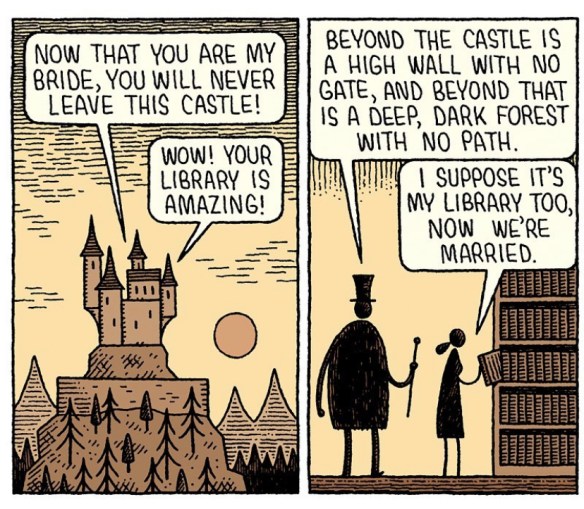
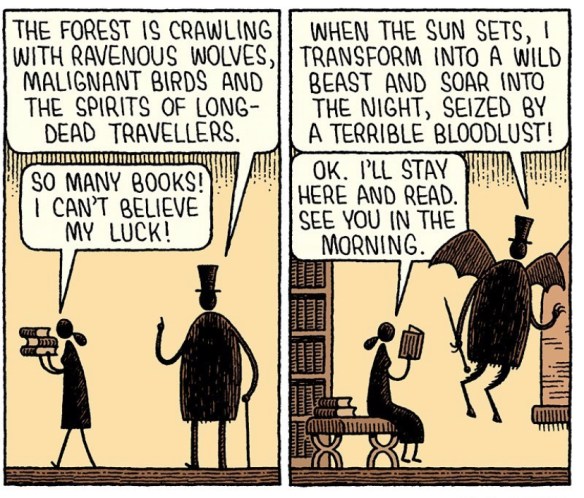
An interesting ad that in far too many ways mirrors our present predicament. Everything is a perfect caricature about the CV shutdown other than the attitude of the rest of the inmates or the attitude of the authorities. One person’s freedom is everyone else’s annoyance. The reality is that others resent everyone’s good fortune. If this chap really did try to liberate himself, even in such a miniature fashion, all of the other residents would have joined the establishment to make sure he was locked down. And even on the premise shown here, the authorities would not have allowed him to run free but have trebled its efforts to make an example of him to all the others.
Maybe we will, but what’s the evidence? I am amazed that such profound changes in our entire societies have occurred in just nothing flat. In an instant, we are no longer a market economy where anyone who wishes to try their hand operating some enterprise can just go ahead and do it. We are no longer allowed to wander down to the shops, or walk in the park, or lie on the beach. We can be harassed by the police unless we are undertaking some officially sanctioned purpose. Our incomes are being dispensed by the government and not via the businesses that employ us.
We are less free as citizens today than anyone was during Mussolini’s Fascist state. Bookshops are closed. Libraries are closed. Newspapers and media are in the hands of the far left. Is there any likelihood the ABC will ever say an unkind word about Daniel Andrews or complain about the complete cessation of our civil liberties? We are living in a modern totalitarian socialist’s dream state. And the Deep State is continuously menacing us with how our hospitals will be soon overrun, and if not yesterday, then maybe tomorrow. We are endlessly warned about dying from a plague that virtually no one under the age of 70 is dying from, and hardly any of these either.
Dwell on this. This is the extent of civil disobedience in our world today. This is right around the corner from where I live.
MAN FINED OVER SYNAGOGUE GATHERING
Police shut down a religious gathering after a prayer meeting failed to heed social distance warnings in Ripponlea today.
Officers slapped the male organiser with a $1652 fine after he was caught disobeying a warning given to him yesterday.
Sources said at least 10 people were found at the gathering and as many as thirty may have attended.
Photos taken by the Herald Sun show police officers in protective masks entering the property on Glen Eira Rd about 11am and speaking to men in ultra-Orthodox attire.
The crackdown comes as Melbourne’s Jewish community celebrated Passover this week.
Police indicated the gathering was not at a formal Synagogue but still flouted the COVID-19 rules which ban religious gatherings.
I still assume that we are living in an opportunistic moment by the American left to undo Donald Trump. Whether they can bring it off remains to be seen but this must bring them very close. If you haven’t read Ninety Eighty-Four and absorbed its message, then perhaps you should while you can. It’s about how a party leadership with virtually total control over the flow of information runs the whole of society from the centre. Major events have no evident or necessary reality, but exist as news reports alone. Winston Smith’s job is to revise news accounts of the past so that what it says in the historical archive conforms to the political lies of the moment. Oh so farfetched. Could not happen. Yet we have seen, just to take one example, the American “news” networks rewrite before our eyes the account of when Donald Trump did or did not block planes from arriving from China. The scare stories about how our hospitals would be overwhelmed by the Corona Virus are virtually no longer even discussed, but who cares anyway?
The Democrats have all but nominated a man deep in senility and will run him for president with full-on hopes of having him in the White House. The American left will vote for him in droves, not because they want his personal leadership, but because they don’t. They are voting for a socialist Deep State to run their affairs from the top with Joe Biden as their acting Big Brother.
The farms are producing food, we will have food to eat, places to live, a more or less stationary economy that never grows but with a political leadership that will remain in place for who knows how long, with virtually all of us peasants and technicians in the return of a mediaeval society based on status and not personal and individual rights.
The economy must be opened immediately. Scott Morrison should unpack as much of these present closures as possible. He should tell us when we are going to go back the previous normal. I don’t know why there is any delay in this. The only thing dying is our freedom and prosperity. Whatever risks there may be, and they seem slight, we need a timetable to open things up placed before us. If you don’t think this can all happen even as you are experiencing it, what will it take to make you believe just how dangerous all this is?
Decision-makers need to appreciate how public policy will affect different communities and individuals. We can do this through a willingness to listen to as many different voices as we can – from the broadest possible spectrum of society. Only then can we get the full ‘truth’ of the potential impact of our decisions.
We all have a responsibility to protect ourselves, our friends, our families and our communities from the spread of COVID-19. Toronto still has the opportunity to slow this virus spread, but we need to work together. We all need to practice physical distancing and stay home if you can and only leave if you have to. People returning from travel from anywhere outside of Canada, including the United States, need to stay home, even if they don’t have symptoms of illness. Staying home not only protects you from this virus spread, it also protects our city’s most vulnerable residents: people who are elderly and those with a chronic health condition. Evidence shows these groups are more likely to be severely affected by COVID-19.
Much, if not almost all, of what we now call Canada is actually not Canada because the original nations on this land never gave up the right to govern themselves. This is not the truth that most Canadians have been taught, and it’s not the truth that most Canadians believe. But it’s a universal truth for Indigenous Peoples here on Turtle Island in 2020. Acknowledgment and understanding of this is the key to moving past it. It will require a fundamental rethink and reimagining of what Canada is as a country.
Cooper’s three-year investigation culminated in recommendations to create a more diverse and inclusive campus. For her, the experience also highlighted, yet again, the importance of looking at a historical episode from different points of view to create a fuller version of the “truth.”
If casting directors hire somebody with a disability to play a role they are good for instead of it having to be about the fact that they’re in a wheelchair, then that breaks down stigma. It shows: Look, we’re everyday people and we live our lives and we fall in love. Just because we move around differently doesn’t make us less capable.
Women are realizing there is an innate power in these stories – and it’s not just women; it’s any marginalized group that doesn’t have a chance to speak or change things because they’re not in power. Just saying these things is very important. Now, if doctors make excuses about why they don’t want to give anesthetics, women are not accepting that anymore. [Might just add that seven of the eleven chosen to give their views were women.]
North, the rocks are choked with millwort.
South, starlings rustle through the cedars:
brought by a man who spent his life importing
every bird in Shakespeare. New worlds
forever measured by the Old. For every measure,
an equal and opposite erasure. How, over the fire,
the family friend said, Jap, not Japanese.
One of our most dominant narratives tells us that happiness equals wealth. But this doesn’t serve us when it leads to damaging the environment beyond repair. I consider an activist to be a storyteller who disarms these destructive narratives. I try to show that we are not in competition with each other for the planet’s resources, and that we can live in a low-impact society that still meets our needs.
Shammaa also wants to put an end to the stigma surrounding steroid users. Like any addiction or body-image issue, this is a mental health concern, he says, and the people who are experiencing it are vulnerable: They do not want to admit weakness, when they are trying so desperately to appear strong.
It’s the same with climate change. I study the difference between the future where we continue to depend on fossil fuels versus the future where we transition to clean energy. And I can tell you there is a night- and-day difference. There is the future where there are significant impacts, but we can adapt to them, prepare for them and build resilience so that when they come we’re ready. Or there is the future where the changes overwhelm us far beyond our capacity to adapt.
We need investigative journalism to get to the truth. But to be meaningful, and to resonate with an audience, investigative journalism needs to do more than just find out what happened. It needs to hold people in power to account.
For these people whatever truths they think they hold will have no consequences in any hierarchy within the establishment in which they wish to rise. I find each of these people fatuous fools. None of them would know what an original thought would look like, never mind how to make one make sense to themselves if they came across it. Mis-educated and uneducated, each and every one.


 Law of Markets