The calculus of sexual consent

There’s been a lot of discussion lately about “consent” but the entire concept remains extraordinarily vague and imprecise. I’m all for consent, but still do not know what anyone is being asked to consent to or how that consent is to be obtained, or proved to have been obtained at a later date. In my day, which was a long long time ago, one asked for consent either with the words, “Will you marry me?” or even with the words, “I do”. Well, I’m not actually that old, but grew up during the 1960s which was a very decadent period, I can assure you, where sexual morality changed for all time, and I cannot say that it has changed for the better. We had, to assist our philosophical growth on such matters, Germaine Greer’s The Female Eunuch on the one hand and Hugh Hefner’s The Playboy Philosophy on the other. Oddly, in their own way they both conveyed the same message.

So into this moral mess we are engaging in a public debate on who should be allowed to do what to whom and under what circumstances. So in this vein we have this today: Embed consent education in school curriculum, Liberal MP urges. The only problem with this article is that it does not answer any of the questions that need to be answered. This is not a promising start:

The member for Reid, who was a psychologist before entering federal Parliament, says this would set up children for a life of healthy relationships and the ability to recognise coercive control and sexual abuse.

Which ends with this absolutely empty piece of advice:

Dr Martin said education about protective behaviours should begin as soon as children started to talk, in an age-appropriate way such as reading a picture book like Tess Rowley’s Everybody’s Got A Bottom. Protective behaviours include teaching young children the proper names for body parts, what is private and how to respect and protect their bodies. Relationship skills could also start being taught to preschool children through conversations about who their friends were, who they played with and what made a good friendship, she said. As children got older, this could evolve into assertiveness training, giving them the confidence to speak up against bullying or about other unhealthy relationships.

We are not discussing dealing with Uncle Fred or the next door neighbour. We are not discussing paedophilia. We are instead talking about a girl going out on a date (or whatever the term nowadays is) in a post-Monica-Lewinsky world where internet porn is universally available along with contraceptives. And where often, but not always, the girl is as keen for some kind of sexual adventure as the boy. Will You Love Me Tomorrow is a very old song with a very modern message. It was released in 1960 just a few years before Germaine Greer and Hugh Hefner were releasing their books.

The most decadent pop song in history. And it has nothing to do with consent. The question today is whether she will try to bring a prosecution for rape in two and a half years’ time.

Camper/staff relations in the real world

I really feel sorry for young girls today having been so badly educated on boy/girl relations. First let me provide this for context and then come back to what I wish to say: ‘Need to reflect on this’: Victorian schools respond to movement calling for better consent education.

Several Victorian schools have issued messages to parents in response to a deluge of sexual assault claims made by young women across the country who voiced their stories as part of a movement demanding better education around consent. Private schools Xavier College and Geelong Grammar School wrote to their school communities this week after a petition started by Sydney woman Chanel Contos called for sexual consent to be taught in schools from a young age. It saw hundreds of young women come forward with disturbing allegations of sexual assault and rape from their time as students or soon after, with many describing being forced to perform sex acts or being assaulted while intoxicated or passed out.

However, before reading another word, you should look at the 79 pages of disturbing allegations. We are dealing with what is potentially a lost generation, and of both young girls and young boys. These are basically high school girls and the best they can think to ask for is that “sexual consent to be taught in schools from a young age”.

I have no idea what the answer here is, but I imagine there are quite a large number of young women who buy into sexual relations at far to young an age and with no idea what their destination is. I know I am old (really ancient) but no one went out with someone else unless they were perhaps thinking this might be the preliminaries of love, children and a marriage unto death. And this from the age of around 13 or 14. No one was messing around, and if you were both as a male or female your dating life was almost certain to be brought to an end.

Consent in my day came with a set of commitments that no one would dare breach. I imagine happiness and fulfilment even today come with similar sets of commitments.

But we live in a post-Monica-Lewinski world, pornography is everywhere and available across the net, and we have, right now, the example of the American Vice-President having slept her way to the top.

At the moment, the supposed issue is in relation to camper/staff relations among the backroom people in Parliament House. Everything about the way the story has unfolded looks as if it is intended to influence how people vote. The two issues need to be separated, but that is very unlikely to happen when our news media make these stories the feature political issues of the day.

The people who run these stories are evil people whose political morals make me sick. They do it to get more people to vote for Labor and fewer to vote for the Coalition. How to get boys and girls to show greater respect and, dare I say it, more modesty and common sense in their first approaches to dealing with each other sexually, must be the aim. How to get there is completely beyond me, other than to keep these issues away from politics.

Conservative views of “Liberalism”

Thumbnail

This is a question asked at Quora – Liberals, what are some things you think Conservatives get wrong about your beliefs, and intentions? – and this was the sample answer provided. Remember, it is some lefty who has answered this.

Trump’s followers seem to think that anyone who does not like Trump is a Democrat and that all Democrats believe one or more of the following:

  • You want completely open borders.
  • You’re Communist.
  • You want to take everyone’s gun away.
  • You hate Christianity and are trying to destroy every church in the nation.
  • You’re just angry because Hillary Clinton lost.
  • You’re jealous of Donald Trump.
  • You hate America.
  • You just want free stuff.

“One or more” means “at least one”. I will rephrase the answer, but the list is put in a way that these people might weasel out of but the following seems about right. It only takes one of these to be true according to the “one or more” criterion.

  • You support an open borders policy and the relatively unrestricted entry of illegal aliens
  • you are economically in favour of “socialism” always bearing in mind that every socialist has a different interpretation of what “socialism” means
  • you are opposed to the market economy being the most important element in the allocation of goods and services within the community
  • you are hostile to Christianity and Christian beliefs and values
  • you are angry that a free election allowed Donald Trump to win the presidency in 2016
  • you have some kind of deep resentment against Donald Trump personally aside from the policy positions he advanced
  • you are deeply hostile to the historical values of individual rights and personal freedom associated with the United States and traditional liberalism
  • you believe in the continuous expansion of programs designed to provide goods and services to individuals paid for entirely or in large part by governments through increased tax revenues or simply by increasing the size of public debt.

If these are not part of what “Liberals” believe, I am happy to be corrected. But at the bottom of it all is an adolescent view of “fairness” that would ask the government to adjudicate between real world outcomes, and then to take from one set of citizens to give to other sets of citizens based a belief in some kind of historical wrong that has harmed such groups in the past that ought to be rectified today through a series of payments made in the present.

All this omits the deeply racist and sexist beliefs everywhere on the left who in almost every instance base policy decisions on the racial background of individuals or according to their somehow defined “gender”. Every form of “affirmative action” is based on advancing someone ahead of someone else because with aim of achieving something referred to as “equity”. Equity* is defined as “the quality of being fair and impartial” with “fair and impartial” being entirely in the eye of the beholder.

And please note that Liberalism is written with a capital-L since this modern Marxist version is entirely different from the small-l liberal values that the United States was founded on.

* Equity – The word equity is defined as “the quality of being fair or impartial; fairness; impartiality” or “something that is fair and just.”

Thumbnail

Mad, Saad and dangerous to know

From The Abyss of Infinite Lunacy by Gad Saad. We really do live in crazy times. 

The rate at which our society is sinking into madness is truly bewildering:

1) It is now racist for a white person to translate the work of a black person

2) It is now homophobic for a straight actor to play a gay character

3) It is now racist for a white therapist to treat a black client

4) It is now racist to have advanced high school programs

5) It is now transphobic for biological females to reject having to compete against trans women (biological males)

6) It is now Islamophobic to criticize any tenets of Islam

7) It is now science denialism to question the ongoing COVID lockdowns

8) It is now science denialism to question any tenets stemming from climate change alarmists

9) It is now epistemological bigotry to support the scientific method as THE means by which you adjudicate scientific hypotheses

10) It is now racist to argue that mathematics yields right and wrong answers

11) It is now racist to promote the ethos of individual dignity over collectivist identity politics

12) It is now racist to criticize a Noble Person of Color be it a famous athlete or celebrity

13) It is now transphobic to posit that only women menstruate

14) It is now racist to publicly proclaim your support for “wrong think” black individuals such as Thomas Sowell or Larry Elder

15) It is now misogynistic to note that women greatly outnumber men in universities

16) It is now sexist to publish scientific research that yields sex differences that are contrary to accepted politically correct orthodoxy

17) It is now racist to point to FBI murder stats broken down by interracial markers of victim and perpetrator

18) It is now racist to openly support national borders

19) It is now racist to seek to curb immigration from countries that espouse values that are deeply hateful and anti-liberty

20) It is now racist to not decolonize philosophy and literature departments

21) It is now racist to request that job offers be based on the merits of an individual’s dossier rather than on the use immutable traits.

Let me also add this: Has Everyone Gone Insane? Not everyone of course, not me or thee, and I’m never all that sure about thee. By Noah Rothman who writes:

Does Amazon really think that their app design could honestly be mistaken for Hitler? Does Hyatt actually believe CPAC’s stage designers embedded an obscure Nazi symbol into its program to signal an affinity for fascism—a semaphore that seems to have backfired spectacularly, seeing as only the conference’s critics got the message? Does Syracuse University really suppose that their own student [a female lacrosse player who posted a supposedly racist picture of her making an “OK” sign] is in the wrong here, and not the overwrought agitators on the Internet whose only joy in life seems to be making others miserable?

The answer to these questions would be valuable, but they are also beside the point. Whether they believe it or not, they say they do. Or, at least, they think they have no choice but to say they do.

It’s all part of being “in” and not “out”. The madder whatever it is you must say you believe the easier it is to work out who is not playing along.

Sexual morality is more than just about consent

I really feel sorry for young girls today having been so badly educated on boy/girl relations. First let me provide this for context and then come back to what I wish to say: ‘Need to reflect on this’: Victorian schools respond to movement calling for better consent education.

Several Victorian schools have issued messages to parents in response to a deluge of sexual assault claims made by young women across the country who voiced their stories as part of a movement demanding better education around consent.

Private schools Xavier College and Geelong Grammar School wrote to their school communities this week after a petition started by Sydney woman Chanel Contos called for sexual consent to be taught in schools from a young age.

It saw hundreds of young women come forward with disturbing allegations of sexual assault and rape from their time as students or soon after, with many describing being forced to perform sex acts or being assaulted while intoxicated or passed out.

However, before reading another word, you should look at the 79 pages of these disturbing allegations. We are dealing with what is potentially a lost generation, and of both young girls and young boys. These are basically high school girls and the best they can think to ask for is that “sexual consent to be taught in schools from a young age”.

I have no idea what the answer here is, but I imagine there are quite a large number of young women who buy into sexual relations at far too young an age and with no idea what their destination is. I know I am old (really ancient) but no one went out with someone else unless they were perhaps thinking this might be the preliminaries of love, children and a marriage unto death. And this from the age of around 13 or 14. No one was messing around, and if you were, both as a male or female, your dating life was almost certain to be brought to an end. Reputation was all.

Consent in my day came with a set of commitments that no one would dare breach. I imagine happiness and fulfilment even today come with similar sets of commitments.

But we live in a post-Monica-Lewinski world, pornography is everywhere and available across the net, and we have, right now, the example of the American Vice-President having slept her way to the top. Beyond even that, there is now birth-control and failing that, abortion almost on demand.

At the moment, the supposed issue is in relation to camper/staff relations among the backroom people in Parliament House. Everything about the way the story has unfolded looks as if it is intended to influence how people vote. The two issues need to be separated, but that is very unlikely to happen when our news media make these stories the feature political issues of the day.

The people who run these stories are evil people whose political morals make me sick. They do it to get more people to vote for Labor and fewer to vote for the Coalition. How to get boys and girls to show greater respect and, dare I say it, more modesty and common sense in their first approaches to dealing with each other sexually, must be the aim. How to get there is completely beyond me, other than to keep these issues away from politics.

What it is like to be clinically mad


Supposedly one person in a hundred is schizophrenic and if their experience is anything like that of Kate Richards as described in her incredible Madness: A Memoire it is amazing that so many people are able to make it through the day. There are also many different forms of madness so a fairly high proportion of people we meet all the time must be mad in one way or another. She herself says that she first entered into madness at around 15-16 but did not know she was in any way unusual until she was in her twenties.

Aside from her own personal experience, which is quite astonishing, is the array of medical and therapeutic facilities that are available in Australia to assist people such as her. I cannot recommend the book more. If these issues interest you, this is a book really worth your time.

Interesting in particular for me are her descriptions of the various psychiatrists she had to deal with who she found aloof and distant. And to tell the truth, it is the kind of work that you would need nerves of steel to undertake. You cannot reason anyone out of their psychoses nor can you be sure they will take their meds.

Here is an an excerpt from her book which gives you some sense of what this kind of madness is like and the kinds of frustrations that must come from trying to help such people. Aaron is her psychiatrist.

In the evening I visit my doctor, Aaron. ‘How are you?’ he asks, as usual. I stand in front of him with my hands on my hips, sticking my pelvis out and then I start giggling and I can’t stop, I keep giggling and now tears are seeping out from the sides of my eyes and smudging the mascara I put on this morning for the first time in years. I’m rocking back and forth on my feet, laughing and crying in equal measure. Aaron doesn’t say anything; he reaches over to the phone on his desk and rings the Mental Health Team at the local hospital.

‘Are you taking your medication?’ he asks, mid-conversation.

‘Of course,’ I say. I have no idea where the bottle of tablets is – somewhere in my bedroom, probably under the bed where the cats sometimes pee.

He hangs up the phone. ‘Are you sleeping?’

‘Thorough waste of time.’ I sit down. ‘I do miss dreaming though. You know Freud thought that dream-life was just as important as waking-life for the illumination of the psyche. I think I agree with him, well I do at this particular moment, God, your taste in art is awful, Aaron.’

‘Kate,’ says Aaron. ‘I would like you to take one of these – now.’ He pulls a blister pack of tablets out of his top desk drawer. His desk is old, made of some wood with lines and whorls and stained dark chestnut.

‘What’s this?’ I ask.

‘It’s an anti-psychotic. Also good for hypomania.’ He stands and says, ‘Just stay there a minute.’ I sway from side to side on the chair. Aaron gives me a glass of water and a round, white tablet.

‘How much?’ I ask.

‘200 milligrams,’ he says.

I stare at it. The tablet is changing shape in my palm. It’s circular, then oval, then it expels a part of itself and becomes two tablets.

I stare at Aaron. ‘What are you doing?’

‘I’m trying to stabilise your mood.’

He waits, leaning on his desk with his arms crossed. The creases in his shirt catch the light and shine. I smile.

‘Take the medication, please.’

The tablet is furry round the edges where it has mixed with my sweat. I put it in my mouth and take a swig of water and swallow down its bitterness.

‘Happy?’

‘Thank you,’ he says. ‘The Mental Health Team are going to visit you later tonight.’

‘Excellent,’ I say and stand up and bow so that my forearms touch the ground. ‘It has been a pleasure doing business with you, Sir.’

Aaron almost smiles.

Madness is like being captured by terrorists, only worse. And the patient is often their own worst enemy.


Equality discussed by Andrew Jackson in 1832

This is Andrew Jackson in 1832, sounding not that different from Donald Trump.

It is to be regretted that the rich and powerful too often bend the acts of government to their selfish purposes. Distinctions in society will always exist under every just government. Equality of talents, of education, or of wealth can not be produced by human institutions. In the full enjoyment of the gifts of heaven and the fruits of superior industry, economy, and virtue, every man is equally entitled to protection by law; but when the laws undertake to add to these natural and just advantages artificial distinctions, to grant titles, gratuities, and exclusive privileges, to make the rich richer and the potent more powerful, the humble members of society – the farmers, mechanics and laborers – who have neither the time nor the means of securing like favors to themselves, have a right to complain of the injustice of their government. There are no necessary evils in government. Its evils exist only in its abuses. If it would confine itself to protection, and, as Heaven does its rains, shower its favors alike on the high and low, the rich and the poor, it would be an unqualified blessing.

This is from Andrew Jackson’s Bank Veto message of 1832. The entire message is worth your time.

Bettina Arndt’s Monthly Newsletter

This is Bettina Arndt’s Monthly Newsletter which may be unique in the world as putting up posts about men that is actually fair to both men and women. You should subscribe yourself. This is the email address and her various links.

E: bettina@bettinaarndt.com.au
Website: www.bettinaarndt.com.au
Facebook: https://www.facebook.com/thebettinaarndt
Twitter: https://twitter.com/thebettinaarndt

The rest is entirely from Bettina who says things found nowhere else anywhere.

Hi Everybody,

What a week. My inbox is overflowing with emails from people bombarding me with commentary on the Brittany Higgins affair – comments they uniformly tell me they don’t dare express publicly.

It’s a very telling example of how readily our mainstream media hops onboard the prescribed feminist narrative, silencing anyone who challenges their view on how this should all play out.

For those of you living overseas, or under a rock, Brittany Higgins is a young woman who last week announced, through the media, that she was raped two years ago, when working as an adviser for the Defence Minister, Linda Reynolds.

As the story unfolded, it was used to mount a ferocious attack on the government. Note the timing – coinciding with the arrival of the Covid vaccine, which should have been a high point for the Coalition which is decimating the Opposition in the polls. It is also hardly a coincidence that Higgin’s current partner, David Sharaz, is a former press gallery journalist, now working for SBS and known to be a fierce critic of the government.

My correspondents, many of whom were women, made some very telling points:

She may well be telling the truth, but the man has been convicted under ‘trial by media’. The same media who’ve repeatedly referred to the young woman having ‘been raped’ – an emotive term designed to ensure the man is denied the right to the assumption of innocence.”
“Yet another instance of allegation by public announcement which has the effect of creating a smear on all men who work in Parliament house. No proper investigation, no facts.”

“She was 24 years old – not some naive teenager. She was pissed out of her mind, and that’s how she excuses herself from culpability. He was likely pissed out of his mind – but no such excuses allowed there.  She was counselled by the Minister to report it to police but didn’t follow through, which fact does not sit congruently with her alleged fear of losing her job. Now we can expect a huge compo claim, backed by all the woke activists. This crap makes me sick!”

“How close to the truth do you think this might be? Young woman starts out on Kingston ‘pub crawl’ with a date. Accepts drinks all night off another bloke from her workplace. She allows herself to get ‘shitfaced’…goes off with the latter in a taxi which stops at PH so bloke can duck into an office to get something. Rather than stay in taxi until he returns, she goes with him for non-work purposes. He signs her in going through security as she does not have her pass with her. They both finish up on a couch in a Minister’s suite where they get it on. He leaves her to wear off the night’s activities & goes home to his own bed. She gets sprung sometime later half naked by a security guard. Caught in an extremely embarrassing situation, she makes the excuse ‘I was raped’. Now she is expecting politicians including the PM & others to salvage her dignity by doing what?”

“I notice that now, two years later, she has announced she wants a comprehensive police investigation – ‘in a timely manner as to date I have waited a long time for justice.’ Whose fault is that? Two Ministers urged her to go to the police, she made an initial report and then pulled out because she was concerned it could damage her career. And now this is the fault of the Ministers, The Prime Minister, the system, anyone but her. No one buys this twaddle except the female journalists conducting their ‘believe the victim’ witch hunt aimed at damaging the government.”

I’ve been thinking about the Higgins business and relating it to the focus on sexual assault in universities. A major campus advocate is Sharna Bremner of “End Rape on Campus” – see below one of her recent tweets, responding to idea that police should have been called. As you can see, she advocates that police only be involved if that is emphatically chosen by the victim – part of being caring and kind. But the problem with that approach is that two years later the victim can change her mind and then the institution is placed in a difficult position – was there a cover up?”
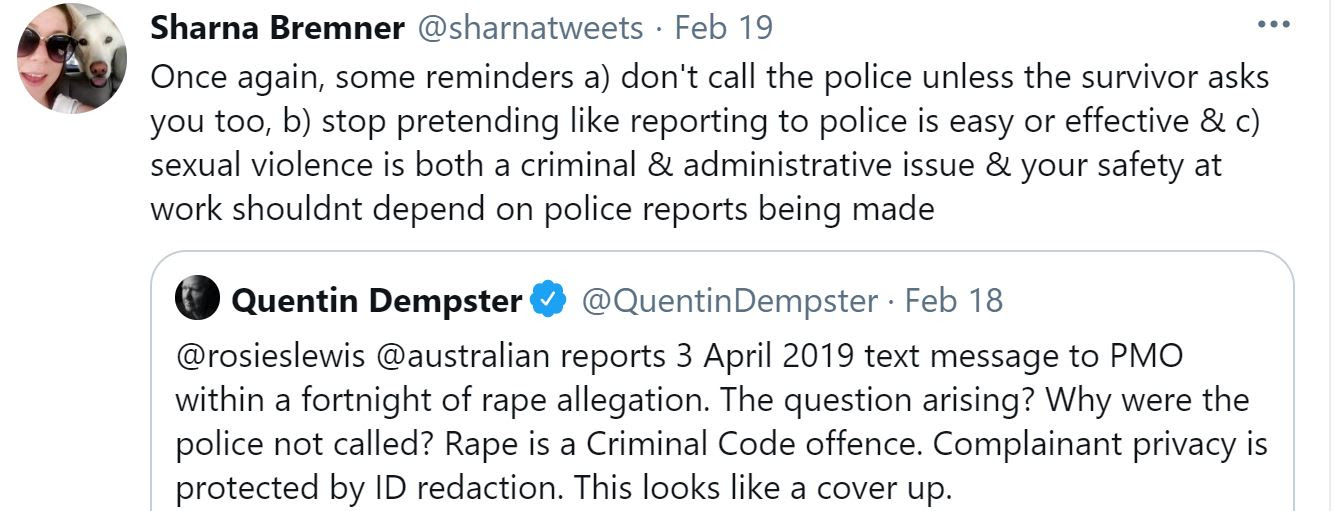
Once again, ordinary people reach their own conclusions but in public remain silent, nervously watching what happens, even to those who do their best to dance to the feminist tune. A Prime Minister ripped apart for “victim blaming” as he bends over backwards to be sympathetic to Higgins, Linda Reynolds in tears in parliament after being savaged for doing the wrong thing when handling the complaint.

And barely a word about Higgin’s acknowledgement that she was so drunk she fell over even before going back to parliament. The rare exception was a carefully-worded comment piece by Jennifer Oriel, which laments our failure to stop “the scourge of rape” but bravely mentions a Royal Australasian College of Surgeons report showing excessive use of alcohol is related to about half of reported sexual assault cases. Drug and alcohol researchers point to large numbers of studies showing sexual assault is most likely to happen if both parties have been drinking.

Brittany Higgins has acknowledged she chose to speak out after seeing the Prime Minister congratulating Grace Tame, Australian of the Year, and a “survivor of sexual assault.” In turn, Higgins’ decision to speak out has inspired two other women to make allegations about the same man – both also claiming to be heavily intoxicated when the events took place – and now a fourth claiming he put his hand on her thigh whilst they were drinking in a favoured bar. And now there’s a petition which has attracted over 2000 testimonials from school girls who claim to have been sexually assaulted.

#Metoo seems to have fizzled out and been replaced by far more potent allegations about men’s abhorrent behaviour. 2021, the year of the rape victim.

Facebook censored Mother of Sons

Along with other Facebook pages across Australia, the Mother of Sons Facebook page was taken down by the belligerent media giant five days ago – despite MOS clearly not being a news organisation. And despite making official protests to Facebook, there’s no sign yet of the MOS pages being restored.

As I mentioned last week, the next Facebook live event was planned for tomorrow so the MOS mothers have postponed that event. This will now, hopefully, take place on their Facebook page next Thursday, March 4 at 7PM, AEST. So please keep an eye on that page. They have an amazing story to share with you.

Grim news for American men

If you’d like to hear my thinkspot chat last week with Cynthia Garrett about worrying developments for men under the Biden administration, here’s the link. There’s every reason to be nervous about the well-being of young American men, particularly those on campus.

That’s it for now. Cheers, Tina

Harry Harlow’s experiments on love and affection

Rhesus monkey clings to surrogate mother.

I have  just run across this experiment in the psychology of mother love and it is fascinating. This is from Harlow’s Classic Studies Revealed the Importance of Maternal Contact. What amazes me is the criticism he endured for his supposed cruelty to animals.

Infant rhesus monkeys were taken away from their mothers and raised in a laboratory setting, with some infants placed in separate cages away from peers. In social isolation, the monkeys showed disturbed behavior, staring blankly, circling their cages, and engaging in self-mutilation. When the isolated infants were re-introduced to the group, they were unsure of how to interact — many stayed separate from the group, and some even died after refusing to eat.

Even without complete isolation, the infant monkeys raised without mothers developed social deficits, showing reclusive tendencies and clinging to their cloth diapers. Harlow was interested in the infants’ attachment to the cloth diapers, speculating that the soft material may simulate the comfort provided by a mother’s touch. Based on this observation, Harlow designed his now-famous surrogate mother experiment.

In this study, Harlow took infant monkeys from their biological mothers and gave them two inanimate surrogate mothers: one was a simple construction of wire and wood, and the second was covered in foam rubber and soft terry cloth. The infants were assigned to one of two conditions. In the first, the wire mother had a milk bottle and the cloth mother did not; in the second, the cloth mother had the food while the wire mother had none.

In both conditions, Harlow found that the infant monkeys spent significantly more time with the terry cloth mother than they did with the wire mother. When only the wire mother had food, the babies came to the wire mother to feed and immediately returned to cling to the cloth surrogate.

This is what he said in reply to his critics:

Remember, for every mistreated monkey, there are a million mistreated children. If my work will point this out, and save only one million human children then I can’t get overly concerned about ten monkeys.

At least his colleagues seemed to understand the nature and importance of his work.

In 1958, Harlow was elected president of the American Psychological Association. At the APA’s annual meeting on August 31 of that year, he delivered a seminal paper titled “The Nature of Love,” cited in Love at Goon Park (public library) — Deborah Blum’s masterful chronicle of how Harlow pioneered the science of affection.

This is the experimental result that mattered.

His most famous experiment involved giving young rhesus monkeys a choice between two different “mothers.” One was made of soft terrycloth but provided no food. The other was made of wire but provided nourishment from an attached baby bottle.

Harlow removed young monkeys from their natural mothers a few hours after birth and left them to be “raised” by these mother surrogates. The experiment demonstrated that the baby monkeys spent significantly more time with their cloth mother than with their wire mother.

In other words, the infant monkeys went to the wire mother only for food but preferred to spend their time with the soft, comforting cloth mother when they were not eating. Harlow concluded that affection was the primary force behind the need for closeness.

I suspect this is as much true for adults as it is for children.

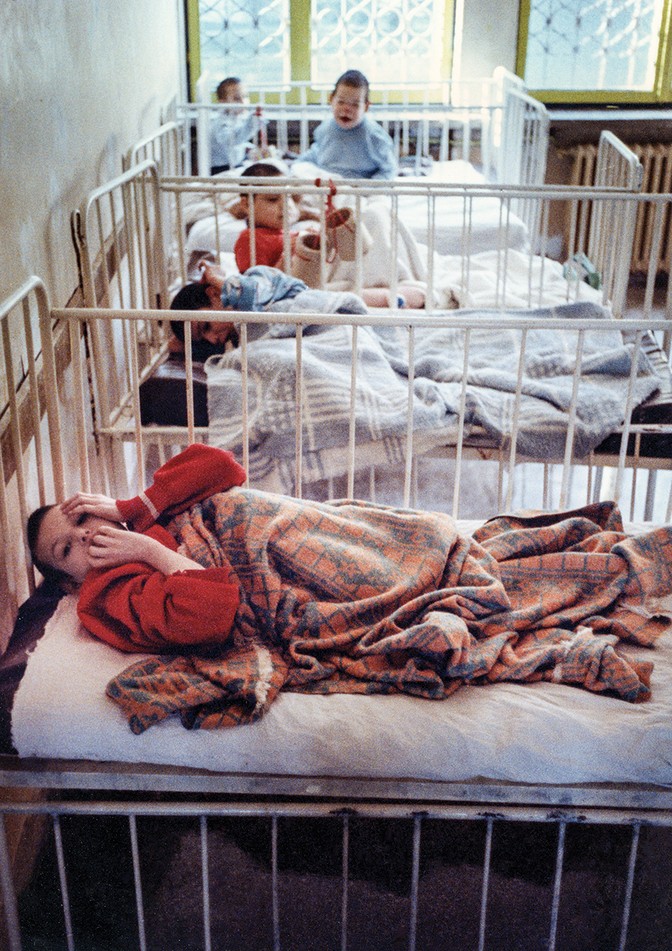
Children at the Home Hospital for Irrecoverable Children in Sighetu Marmaţiei, Romania, in September 1992

But no sooner to I come across that, I came across this: 30 Years Ago, Romania Deprived Thousands of Babies of Human Contact. And there, in the midst of the story there was this:

Neuroscientists tended to view “attachment theory” as suggestive and thought-provoking work within the “soft science” of psychology. It largely relied on case studies or correlational evidence or animal research. In the psychologist Harry Harlow’s infamous “maternal deprivation” experiments, he caged baby rhesus monkeys alone, offering them only maternal facsimiles made of wire and wood, or foam and terry cloth.

Why use monkeys when you can use real children.

By design, 68 of the children would continue to receive “care as usual,” while the other 68 would be placed with foster families recruited and trained by BEIP. (Romania didn’t have a tradition of foster care; officials believed orphanages were safer for children.) Local kids whose parents volunteered to participate made up a third group. The BEIP study would become the first-ever randomized controlled trial to measure the impact of early institutionalization on brain and behavioral development and to examine high-quality foster care as an alternative.

And then they were assessed and then re-assessed again.

When the children were reassessed in a “strange situation” playroom at age 3.5, the portion who displayed secure attachments climbed from the baseline of 3 percent to nearly 50 percent among the foster-care kids, but to only 18 percent among those who remained institutionalized—and, again, the children moved before their second birthday did best. “Timing is critical,” the researchers wrote. Brain plasticity wasn’t “unlimited,” they warned. “Earlier is better.”

The benefits for children who’d achieved secure attachments accrued as time went on. At age 4.5, they had significantly lower rates of depression and anxiety and fewer “callous unemotional traits” (limited empathy, lack of guilt, shallow affect) than their peers still in institutions. About 40 percent of teenagers in the study who’d ever been in orphanages, in fact, were eventually diagnosed with a major psychiatric condition. Their growth was stunted, and their motor skills and language development stalled. MRI studies revealed that the brain volume of the still-institutionalized children was below that of the never institutionalized, and EEGs showed profoundly less brain activity. “If you think of the brain as a light bulb,” Charles Nelson has said, “it’s as though there was a dimmer that had reduced them from a 100-watt bulb to 30 watts.”

And then later in the article we come to this.

As early as 2003, it was evident to the BEIP scientists and their Romanian research partners that the foster-care children were making progress. Glimmering through the data was a sensitive period of 24 months during which it was crucial for a child to establish an attachment relationship with a caregiver, Zeanah says. Children taken out of orphanages before their second birthday were benefiting from being with families far more than those who stayed longer. “When you’re doing a trial and your preliminary evidence is that the intervention is effective, you have to ask, ‘Do we stop now and make the drug available to everyone?’ ” he told me. “For us, the ‘effective drug’ happened to be foster care, and we weren’t capable of creating a national foster-care system.” Instead, the researchers announced their results publicly, and the next year, the Romanian government banned the institutionalization of children under the age of 2. Since then, it has raised the minimum age to 7, and government-sponsored foster care has expanded dramatically.

But in the end, both sets of children ended up damaged. This is a passage towards the end of the article.

The neuropsychologist Ron Federici was another of the first wave of child-development experts to visit the institutions for the “unsalvageables,” and he has become one of the world’s top specialists caring for post-institutionalized children adopted into Western homes. “In the early years, everybody had starry eyes,” Federici says. “They thought loving, caring families could heal these kids. I warned them: These kids are going to push you to the breaking point. Get trained to work with special-needs children. Keep their bedrooms spare and simple. Instead of ‘I love you,’ just tell them, ‘You are safe.’ ” But most new or prospective parents couldn’t bear to hear it, and the adoption agencies that set up shop overnight in Romania weren’t in the business of delivering such dire messages. “I got a lot of hate mail,” says Federici, who is fast-talking and blunt, with a long face and a thatch of shiny black hair. “ ‘You’re cold! They need love! They’ve got to be hugged.’ ” But the former marine, once widely accused of being too pessimistic about the kids’ futures, is now considered prescient.

Federici and his wife adopted eight children from brutal institutions themselves: three from Russia and five from Romania, including a trio of brothers, ages 8, 10, and 12. The two oldest weighed 30 pounds each and were dying from untreated hemophilia and hepatitis C when he carried them out the front door of their orphanage; it took the couple two years to locate the boys’ younger brother in another institution. Since then, in his clinical practice in Northern Virginia, Federici has seen 9,000 young people, close to a third of them from Romania. Tracking his patients across the decades, he has found that 25 percent require round-the-clock care, another 55 percent have “significant” challenges that can be managed with adult-support services, and about 20 percent are able to live independently.

Harry Harlow was not just right, he was more right than he would ever know. It is common sense and indeed obvious; it is very hard to provide warmth outside a family relationship.

People have been dying for a long time for a lot of reasons

The page above is taken from The Perpetual Almanack of Folklore for February 17 which shows, if you can read the print:

During the week which ended on this day in 1719, the following diseases and conditions proved fatal to the inhabitants of London.

Not all of them died, of course, but only some. And none of them died of Covid-19, unless it was Covid-1719. Meanwhile, back in the real world of modern life as we live it today, we have this: The cult of Dan — coming soon to a garbage bag on you.

A person from Melbourne’s CBD wears a garbage bag during their transfer to the Pullman Hotel in Albert Park. Picture: NCA NewsWire / Ian Currie

This is where we have progressed to today. I will end with a quote from John Stuart Mill which seems especially apposite:

“The only freedom which deserves the name is that of pursuing our own good in our own way, so long as we do not attempt to deprive others of theirs, or impede their efforts to obtain it. Each is the proper guardian of [their] own health, whether bodily, or mental or spiritual. Mankind are greater gainers by suffering each other to live as seems good to themselves, than by compelling each to live as seems good to the rest.”

We do not deserve the freedom we have been bequeathed and will soon lose it if we do not mend our ways assuming it has not been lost already.

I hope the death of Rush Limbaugh today is not a metaphor for much else that is going on.

AND NOW TO ADD TO EVERYTHING ELSE THERE IS THIS: From Tony Thomas: Daniel Andrews’ Bad Case of China Envy. Read it through and see if our freedoms are not actually on the line. The accompanying picture really does say something worth thinking about.