
Behind the shock machine

I had actually studied the Milgram experiment before I was randomly chosen to participate in just such an experiment while an arts student at the University of Toronto. And I have always wanted to know how others had reacted to having been part of this experiment so now I will be able to find out. It is one of the main reasons ethics approval is now required and I can tell you that anyone who conducted these experiments ought to be hunted down and their licence to practise psychology withdrawn. This is the text of an article titled, How many people really went through with the Milgram Experiment? by Esther Inglis-Arkell:

We’ve all heard of the infamous Milgram Experiment, in which subjects, with a little pressure from an authority figure, participated in a process that they believed shocked someone to death. But did far fewer people than reported actually go through with it?

The Milgram Experiment is arguably the most famous psychology experiment in the world – probably because bad news travels fast, and it has some very bad news regarding all of humanity. It seems that sixty-five percent of us would torture a human being to death if an authority figure asked us to. For those who don’t know, the Milgram experiment involved subjects coming in and hearing that they would be participating in a memory-improving experiment. A person in the next room – connected via intercom – would be tested on their memory, and the subjects would be in charge of giving them ever-increasing shocks when they screwed up. The person was actually an actor, and not hooked up to anything, but would scream in pain as the shocks got worse. If the actual experimental subject objected to shocking the person, the experimenter would give them more and more menacing orders to continue with the experiment. At last the “line” would go quiet, making the subjects believe that they’d murdered someone.

Although some people considered the experiment a positive experience, and one subject corresponded with Milgram for years and credited the experiment for making him a conscientious objector, others were traumatized. One woman was prodded into participating by her roommate, who turned out to be the one being “killed” in the other room. One hopes that, after the experiment, either the murderer or the psychologist moved out. The Milgram experiment prompted psychologists to call for more exacting standards regarding human experimentation.

The results overshadowed the ethical standards. It appeared that sixty-five percent of people would torture someone to death, if pressured to do so. The results made their way into both psychology and cocktail party conversation. But were they correct? At least one woman doesn’t think so. Gina Perry, for her book, Behind the Shock Machine, traced as many participants in the Milgram experiment as she could, and re-examined the notes of the experiment. Milgram claimed that seventy-five percent of the participants believed in the reality of the experiment, but Perry puts the number at about half. The change makes a big difference in the results. The people who didn’t buy that they were actually shocking people were far more willing to increase the intensity of the shocks. They wanted to know how far the experimenters would go in the ruse, while the experimenters were wondering the same thing about them. Those that believed that they were shocking people were much more likely to keep the shocks down low. While Perry still thinks about a third of the people would crank up the shocks even if they believed, that’s a big drop in overall percentage. While no one can deny that people can do some terrible things, perhaps, overall, people are neither as evil or gullible as we imagine.
Should one teach Marx as part of HET?

David Henderson had the following blog post today at Economic Liberty

On a short blog post today, Daniel Kuehn, preparing to teach an undergraduate course in the history of economic thought, writes:

I wish I could completely skip Marx… does that make me a bad person? I suppose I shouldn’t. A few in the department would probably be miffed too if they found out.

First, Daniel, it doesn’t make you a bad person. Indeed, my respect for you just rose from what was already a reasonably high level.

Second, that reminds me of a true story. My friend Chris Jehn, while a Ph.D. student in the University of Chicago’s economics program in the late 1960s or early 1970s, took a course in the history of economic thought from the late George Stigler. Many people might have forgotten this, or perhaps never knew it because George was known mainly for his work in industrial organization and regulation, but the history of thought was one of George’s passions and it was an area in which published a lot in the 1940s and 1950s.

Back to the story. The first day of class, Stigler handed out a pretty comprehensive syllabus and started going over it in class. A student with a foreign voice raised his hand. ‘Yes,’ said Stigler (and if I could do the voice in this blog, you would hear a reasonable imitation of Stigler’s distinctive voice.)

‘Professor Stigler, I see that there is nothing on the syllabus by Karl Marx. Why is that?’

Stigler paused and then answered: ‘Marx was a lousy economist.’

So this was my comment on whether or not Marx should be taught as part of an HET course:

My Defending the History of Economic Thought is about to be published next month by Edward Elgar. In it I devote a chapter to discussing how I think the history of economic thought should be taught with one of the main points I make being that Marxist economics should not be. HET in my view is either about how the economics we find in our texts evolved through time into what we see. Or is it about how the mainstream of the profession answered particular economic questions during different periods of time in the past. In neither case would I think that the inclusion of Marxist economic theory would be relevant.

It’s not whether Marxist theory is good or bad economics but whether it fits into the point of an HET course which is to understand the evolution of mainstream economic theory.

Bang, bang you’re dead

Watching the US from a distance (and I have consciously not described this as a safe distance) you sometimes forget that it is all really happening. The quiet pace at which the left in the US has been snaking its way through every institution of power makes it seem as if it ought to be stoppable but somehow is not. There was therefore what I think of as a very subtle piece of work on what has been taking place that I have discussed in a piece at Quadrant on Line.

The author at the American Thinker, Daren Janescu, describes the experience of living in the United States as like living on the inside of a Kafka novel. But his approach is to begin from the people persecuting five year olds for making guns out of pop tarts and then saying “bang, bang”.

No one ever mistook a half-eaten Pop Tart for a weapon. And that is precisely why you are forbidden from saying ‘bang, bang’ while wielding a half-eaten Pop Tart. If this still makes no sense to you, that is because you are not crazy. But try, for a moment, to put yourself into the twisted psyche of a progressive authoritarian, and ask yourself this question: What is the message being sent through such rules, and the lesson being taught through their enforcement?

Jonescu, of course, notices these people are insane but he also makes the larger point that there is a method in their madness. Their larger if unconscious aim is to make us uncertain of our own instincts, in this way to surround us with rules of what’s impermissible for actions that were once commonplace as a form of social control.

A fine-tuned universe without a fine tuner

Physicists are no better than their biologist cousins. The universe has parameters that are just exactly right. If they were even slightly different, nothing would hang together and human life could never exist. So rather than thinking that the universe may have had something like us in mind, some kind of end project of which we are one part, the alternative now beckons. In this multiverse, everything is random chance but with an almost infinite number of universes one of them was bound to have parameters that would allow human life to emerge. Just chance, not purpose.

So that is the story found in the latest Scientific American. In an article titled, “New Physics Complications Lend Support to Multiverse Hypothesis” here we find the problem set out:

With the discovery of only one particle, the LHC experiments deepened a profound problem in physics that had been brewing for decades. Modern equations seem to capture reality with breathtaking accuracy, correctly predicting the values of many constants of nature and the existence of particles like the Higgs. Yet a few constants — including the mass of the Higgs boson — are exponentially different from what these trusted laws indicate they should be, in ways that would rule out any chance of life, unless the universe is shaped by inexplicable fine-tunings and cancellations.

Yes, inexplicable and just so to the ten-thousandth decimal point and there are many of them just like that. What to do, what to do? How can this be explained without an outside agency?

Physicists reason that if the universe is unnatural, with extremely unlikely fundamental constants that make life possible, then an enormous number of universes must exist for our improbable case to have been realized. Otherwise, why should we be so lucky? Unnaturalness would give a huge lift to the multiverse hypothesis, which holds that our universe is one bubble in an infinite and inaccessible foam. According to a popular but polarizing framework called string theory, the number of possible types of universes that can bubble up in a multiverse is around 10^500. In a few of them, chance cancellations would produce the strange constants we observe.

That’s it. There must be 10^500 universes all different but each on its own so that one or two might have just exactly the right physical constants for life to exist. That is so much more plausible. And I especially like this:

The energy built into the vacuum of space (known as vacuum energy, dark energy or the cosmological constant) is a baffling trillion trillion trillion trillion trillion trillion trillion trillion trillion trillion times smaller than what is calculated to be its natural, albeit self-destructive, value. No theory exists about what could naturally fix this gargantuan disparity. But it’s clear that the cosmological constant has to be enormously fine-tuned to prevent the universe from rapidly exploding or collapsing to a point. It has to be fine-tuned in order for life to have a chance.

A fine-tuned universe without a fine tuner. Our existence is therefore a probability of one in 10^500, obviously much more likely than the existence of some entity to set it all in place.

As you start your way into life . . .

A commencement address from my generation to this generation. How different the world is for idealistic youth as they try to figure out how to patch it all back up after the social attitudes they have taken four years to assimilate. A sample but worth reading the lot:

Your life has been a nonstop ride of work, study and fun. Now, though, you’re about to walk out of those iron gates and … what? You’re headed into the most challenging labor market of the last 80 years.

Because you’re driven and have been told over and over in speeches like this one to follow your passion, you’re going to write eye-catching job query letters and send them with bulging resumes to the heads of Greenpeace, the Aspen Music Festival, ESPN, the Clinton Global Initiative, “The Colbert Report” and Tesla Motors TSLA -5.29% .

That will take three days. Then you’re going to have months and possibly years of free time ahead of you. Free time that you won’t know how to fill, because you’ve never really had any before.

Grim and not so funny.

Kafka and thought control

This is such a subtle article that fills me with endless admiration. By Daren Jonescu and titled Kindergarten and the Kafkaesque the point is that when the leftist loons go after five year olds for pointing fingers at someone and saying, “bang, bang” there is a real intent behind it that actually ends up shaping society in the intended way. And it is more than just about guns. As he writes:

No one ever mistook a half-eaten Pop Tart for a weapon. And that is precisely why you are forbidden from saying ‘bang, bang’ while wielding a half-eaten Pop Tart. If this still makes no sense to you, that is because you are not crazy. But try, for a moment, to put yourself into the twisted psyche of a progressive authoritarian, and ask yourself this question: What is the message being sent through such rules, and the lesson being taught through their enforcement?

These are all of a piece with the way we enforce speech codes by making certain expressions of our beliefs beyond the pale in acceptable society. Eventually everyone will understand that it is against the rules of “civilised” society to have a positive view about guns and gun culture but it goes beyond just guns. It is everything the left doesn’t like that they turn into the equivalent of swearing in public. Everybody learns to behave themselves because there is an ever present danger that they will be hauled before the PC courts of public opinion.

The ultimate goal is not to punish such thoughts; punishment is merely the means. The real goal is to break the young soul to self-censorship and self-accusation regarding all thoughts related to personal efficacy, individual power, independence, and self-defense. A submissive citizen does not ‘cling’ to his weapons. Therefore, future citizens must be taught that such ‘clinging’ is a vice. Submission to the collective is the goal. Seen from that perspective, it is quite logical to try to make children self-conscious about how they eat their Pop Tarts, lest they appear to be ‘threatening’ society. Notice, they are not actually threatening any person; their threat, being imaginary, is abstract. It is a threat to ‘other students’ in the abstract, to the collective. The child is learning to feel guilty if he catches himself in possession of thoughts unacceptable to the state as such; that is, he is learning to submit.

This is, as he notes, a world of insanity but it is designed to shape the future so that these five year olds will know they can do the “bang, bang” routine or their equivalent in other areas of social censorship with trusted friends but never, but never, when out of the house and in mixed company. It will become as great a faux pas to speak positively of such matters as it is to smoke inside a building. You will be shunned and cast out from society. It will be impossible to have such views and travel in the company of our social and political elites. Which is why he brings in Kafka and the future we are creating:

Kafka’s world is our world. The nightmare logic of infinite bureaucratic authority which drives a man into admitting his own guilt without even understanding what he is accused of is the mechanism of public school indoctrination. And like Kafka’s Josef K., we are all, in the compulsory progressive public school, to learn how to self-accuse, to self-incriminate, to self-condemn. And then, at the end of our submissive life of democratic self-enslavement, socialized medicine will treat us to the ignominy of an ending worthy of Josef K. — “‘Like a dog!’ he said; it was as if the shame of it should outlive him.”

It is the way it happens and it is how we are controlled in the modern world. Some things just can no longer be said without risking one’s entire career and social position. Being pro-gun is now becoming one of those ideas in the way that other forms of expression have been leached from elite society. Fascinating to see this in action but also extremely depressing.

Prelinger archive

The Prelinger Archive seems to be a vast storehouse of old footage from ancient days. It has come t light because The Atlantic has put up a video from 1961 on what they have titled, no doubt ironically, The Wonderful World of Capitalism.

The problem is a Keynesian problem. The goods and services can be produced but how are we going to get people to buy the volume of output that can now be produced. The answer is marketing which is to be the saviour.

It is also somewhat noteworthy that the portrayal of this vast outpouring of goods and services was put together at the very end of the Eisenhower administration, at the very moment that Kennedy and Johnson would start the unwinding process of this productive miracle.

It’s marriage that makes you happy – who would have guessed?

Actually, I would have guessed. The ONS is the Office of National Statistics in the UK. This is from an article in the UK’s daily Telegraph:

The ONS has found that being married is 20 times more important to a person’s well-being than their earnings, and 13 times more important than owning a home.

The figures also indicate that having children has almost no impact on a person’s day-to-day happiness, although it does make them feel life is more ‘worthwhile’.

And it’s being married that matters, not just rooming together. And I also found this pretty well matching up with my own life cycle experience.

Overall, personal well-being is the highest for young and older adults, with those in middle age recording lower scores, the ONS found.

So for all you people in the prime of life, at least you have something to look forward to, if you remember to get married along the way.

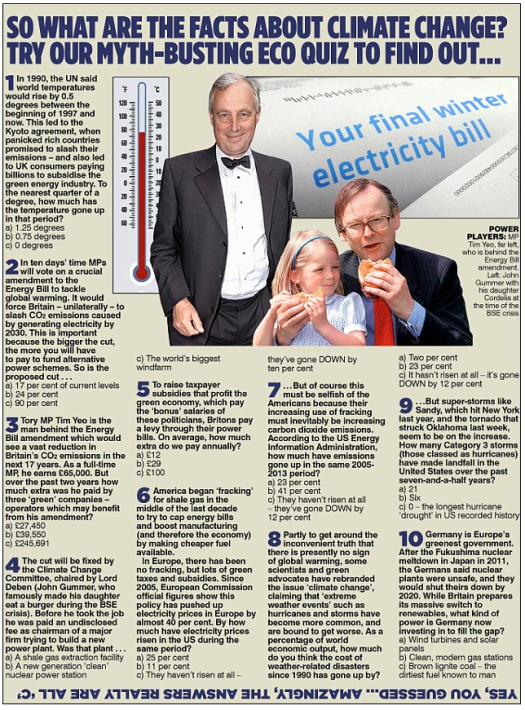
An ecological quiz from the Daily Mail

global warming myths

This is picked up from Andrew Bolt under the heading, Global Warming, The Quiz. How much ignorance must go into the belief in AGW is one of the most bizarre experiences, even more incredible than the belief in socialism or Keynesian economics which not so oddly affects almost exactly the same people. The quiz is originally from The UK’s Daily Mail, one of the few sane newspapers left in the world.