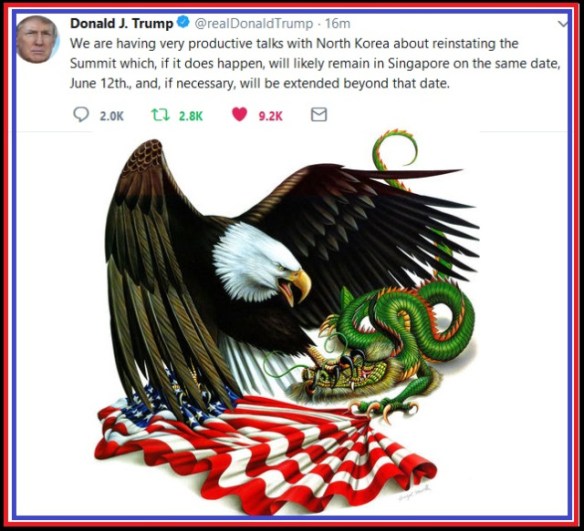
They have Trump surrounded the poor bastards

Read it all, of course, but this is one of the nicer parts. From Secretary Wilbur Ross Heading To China June 2nd through 4th – Likely Authorized To Strip Bamboo Forest…

This helps to understand how significant the economic aspects of the Trump Doctrine are to the geopolitical engagements with North Korea.

Chairman Xi has made a strategic decision in his adversarial approach toward President Trump.  Again, listen to the briefing by Secretary Pompeo – Panda China is telling him they too want to see peace, Korean stability and denuclearization.  However, Dragon China is using the panda mask, and simultaneously leveraging Chairman Kim to aid their trade objectives.

Beijing has made a fatal mistake; they have exposed too much dragon face and did not expect President Trump to call them out on it publicly.

Secretary Ross now heads to China with •Steel and Aluminum tariffs; •auto-sector 232 evaluations; •intellectual property penalties; •over $150 billion in additional trade sanctions/tariffs pending; •and financial sanctions against Chinese banks as economic arrows in his dragon slaying quiver.

Don’t doubt for a minute that based on Chairman Xi’s maneuver with Chairman Kim, Wolverine Ross is not about to fire one -or several- of those arrows directly into the heart of Beijing.

Chairman Xi made a strategic mistake.  Xi genuinely has no idea the level of hurt President Trump is looking for an excuse to deliver.  Things are fixing to get ‘Old-School’.

Hope so. Our way of life is better than anyone’s with the economic benefits only the start of it.

The quiet disaster of modern economic theory

Quite an interesting article with the title The quiet triumph of economics which takes the contrary view to my own view which thinks of economics as have almost entirely sold its soul to the left. So what is the case for?

Economic science has long settled what in his time was the most pressing empirical issue: whether a system of production coordinated and planned from the top could yield better outcomes than the independent actions of individual people guided by the price system.

Today, there is no serious intellectual case for the planned economy. That proponents of more central planning — through, for example, industrial policy — wrap their arguments in vague language about “long-term strategy” and “mission-oriented directionality” is a testament to the lack of economic credibility such views command.

What has actually settled the score has been the irrefutable empirical evidence of the Soviet Union, Maoist China, Cuba and now Venezuela. Not that there aren’t still plenty of economists who will still tell you about the benefits of socialism, and if you think a modern Keynesian model, with its C+I+G, is the very essence of a free market sentiment then have a look at the way our economies are now managed. The only element that still survives are the entrepreneurially managed firms that the dismal record of regulation and taxation have not quite managed to kill off. We live in a crony capitalist state, not that different from the mercantilist system Adam Smith was writing about in 1776.

And if you want a sense of how out to lunch this chap is, hard to beat this for stupidity:

Whereas John Stuart Mill, Karl Marx and John Maynard Keynes championed, when they didn’t themselves lead, such causes as women’s rights, revolution and post-war reconciliation (respectively), today’s economic scribblers largely speak to their own tribe in a language increasingly bewildering to the layperson.

Yet, Mill, Marx and Keynes were much more than practicing economists. They were eminent public intellectuals of their time, so using their trajectory as a benchmark for today’s average economist is like asking any small business owner to measure up to Henry Ford.

Mention of Keynes is bad enough, but Marx! The quiet disaster of modern economic theory goes apace.


Line and staff

Slightly adapted from this article where the reference is to health care:

Let us for a moment consider the land of the sane. In the land of the sane, education is a business, and a business generally has two categories of workers: line and staff. Line workers generate revenue by directly participating in the company’s line of business. Staff workers consume revenue in their roles supporting the line positions. A smart business seeks to balance the two kinds, maximizing the number of line positions while minimizing the number of staff positions.

Where revenue is driven by governments cost control all but disappears.

John Stuart Mill on free speech

Reprinted from Instapundit.

A MUST-READ FOR POTENTIAL SNOWFLAKES: All Minus One, a beautifully illustrated and smartly abridged version of John Stuart Mill’s arguments for free speech in “On Liberty,” is just out at Heterodox Academy, which hopes it will become required reading for students before they enter college. Here’s a conversation about Mill — and why he’s more relevant than ever — with Richard Reeves, the Mills biographer who edited this book together with Jonathan Haidt.

ALL MINUS ONE
John Stuart Mill’s Ideas on Free Speech Illustrated

Heterodox Academy has produced a new book based on John Stuart Mill’s famous essay On Liberty to make it accessible for the 21st century. Here’s what makes our edition special:

1) It’s just the second chapter (out of 5), because that chapter gives the best arguments ever made for the importance of free speech and viewpoint diversity;

2) We have reduced that chapter by 50% to remove repetitions and historical references that would be obscure today, producing a very readable 7000 word essay;

3) Editors Richard Reeves (a biographer of Mill) and Jon Haidt (a social psychologist) have written a brief introduction to link Mill and his time to the issues of our time, and

4) Artist Dave Cicirelli has created 16 gorgeous original illustrations that amplify the power of Mill’s metaphors and arguments.

If you would like to order a copy you can find our where at the link.

And for what it’s worth, John Stuart Mill also wrote the best economics book ever published, and for which there is a modern version as well if these are the kinds of things that interest you.


Public spending lowers economic growth

Another article for all you Keynesians out there: More Government Spending = Weaker Economic Performance. And the article notes this as well:

  • The OECD admitted in one study that “a reduction in the size of the government could increase long-term GDP by about 10%, with much larger effects in some countries.”
  • The OECD admitted in another study that “a cut in the tax-to-GDP ratio by 10 percentage points of GDP (accompanied by a deficit-neutral cut in transfers) may increase annual growth by ½ to 1 percentage points.”
  • The OECD admitted in a different study that “an increase of about one percentage point in the tax pressure (or, equivalently one half of a percentage point in government consumption, taken as a proxy for government size)…could be associated with a direct reduction of about 0.3 per cent in output per capita. If the investment effect is taken into account, the overall reduction would be about 0.6-0.7 per cent.”

Why this might be you will never understand if you start from Y=C+I+G, but that’s all you are going to find in any macro text anywhere in the world.

The ongoing scandal of modern economic theory

Here’s the sub-head: Economists show increased research efforts are yielding decreasing returns. And if they mean negative returns, then I am with them all the way. Economic theory is at a lower level of competence today than in the 1850s. It is such a scandal, but once a subject matter falls into a hole the way economic theory has done, it is near on impossible for it to find its way out. The conclusions drawn from modern theory are literally classical fallacies. An economist raised any time between say 1776 and the 1930s would look at a modern text and disagree with almost every word. There would be almost no overlap between anything found in a modern text and a text written before 1930.

I wrote a paper, published by the skin of its teeth in 2015, on John Stuart Mill’s Fourth Proposition on Capital: “demand for commodities is not demand for labour”. You cannot increase the level of employment by increasing aggregate demand. Everyone once knew this. No one now does. Not one economist in a thousand can any longer understand what was plain as day for a century and a half. We keep growing because we keep inventing things. But the generation that is following behind us will find their living standards falling into a great pit, and the last place anyone will be able to find out why will be from economists.

I have mentioned this already, but perhaps another look might be of interest: What is the difference between Keynesian and classical economics? which is a reply I put up on Quora. Go have a look.

Then there’s this I did not so long ago on marginal analysis which, as presented in a modern text, is as near to empty of content as a theoretical demonstration can be. This is how I look at it which is also classical to its bootstraps.
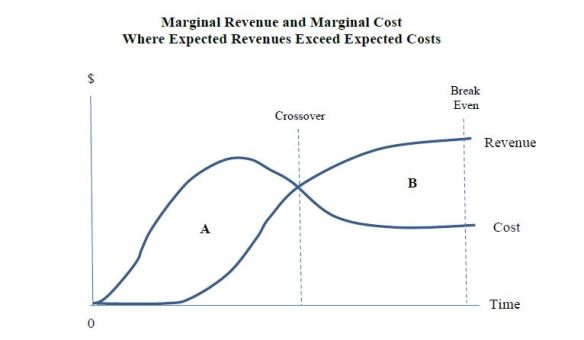
The diagram represents my own version of the marginal revenue and marginal cost diagram. The traditional version has a series of lines many of which can never be realistically drawn (such as the demand curve), with the ultimate point to show the price-quantity configuration for the sale of a single product. The conclusion is that if a firm wishes to maximise profitability on the sale of some good or service, it will price the product just exactly where a lower or higher price would lead to a lower return over cost. Fatuous and useless, with many bits of the real world left out, such as the actual ability to work out the effect on revenue of changing a price. Modern micro truly is as useless as modern macro.

The above diagram – discussed fully in my Free Market Economics – brings in a number of crucial factors:

  • it is about whether some decision should be made rather than deciding on what price to charge
  • it is about trying to make a decision in the face of a future that can never be foretold but is filled with endless uncertainties
  • it recognises that there are costs that almost invariably must be borne before there is a return [Area A]
  • costs continue even after revenues commence and only eventually, in a profitable venture, will revenues exceed costs [when B = A]
  • the point of origin is the present moment when some decision must be made – all of the lines drawn are the expectations of the decision maker
  • reality may turn out to be much different, with losses instead of a net positive return
  • only when total revenue and total costs are equal – that is, when the expected addition to revenues is equal to the expected addition to costs (when MR=MC at the moment the decision is made) does the firm go ahead with the venture

This is the way a business, or anyone else for that matter, makes a decision: in the present with only one’s own conjectures as a guide.

I will lastly mention a very nice note I received the other day:

Steve

Just finished reading your book Free Market Economics and wanted to congratulate you.

I have read plenty of economic texts, but yours is the best by far and helped crystalize a number of things that have been swirling around in my mind.

Great work.

It was truly appreciated. You can get a copy for yourself right here. I didn’t make any of it up myself. It is just a distillation of classical theory, the economics of John Stuart Mill and his contemporaries. It’s never been improved on and I doubt it ever will be. But so what. It is a massive improvement on that junk science we go around teaching today.

Marginal analysis as it ought to be done

This is my own version of the marginal revenue and marginal cost diagram with the traditional version a complete waste of time. The traditional version has a series of lines many of which can never be drawn (such as the demand curve) with the ultimate point to show the price-quantity configuration for the sale of a single product. The conclusion is that if a firm wishes to maximise profitability on the sale of some good or service, it will price the product just exactly where a lower or higher price would lead to a lower return over cost. Fatuous and useless, with various bits of the real world left out, such as the actual ability to work out the effect on revenue of changing a price. Modern micro truly is as useless as modern macro.

The above diagram – discussed fully in my Free Market Economics – brings in a number of crucial factors:

  • it is about whether some decision should be made rather than deciding on what price to charge
  • it is about trying to make a decision in the face of a future that can never be foretold but is filled with endless uncertainties
  • it recognises that there are costs that almost invariably must be borne before there is a return [Area A]
  • costs continue even after revenues commence and only eventually, in a profitable venture, will revenues exceed costs [when B = A]
  • the point of origin is the present moment when some decision must be made – all of the lines drawn are the expectations of the decision maker
  • reality may turn out to be much different, with losses instead of a net positive return
  • only when total revenue and total costs are equal – that is, when the expected addition to revenues is equal to the expected addition to costs (when MR=MC at the moment the decision is made) does the decision become profitable

This is the way a business, or anyone else for that matter, makes a decision: in the present with only one’s own conjectures as a guide.

I will lastly mention a very nice note I received the other day:

Steve

Just finished reading your book Free Market Economics and wanted to congratulate you.

I have read plenty of economic texts, but yours is the best by far and helped crystalize a number of things that have been swirling around in my mind.

Great work.

It was truly appreciated. You can get a copy for yourself here. I didn’t make any of it up myself. It is just a distillation of classical theory, the economics of John Stuart Mill and his contemporaries.

Thieves and the receivers of stolen goods

Not a lot you can do about this in the meantime, but the notion that Paul Ryan ran for VP in 2012 because of his fiscal credential is more bizarre than almost all the rest. The most corrupt political class in the world, but in saying this, I will leave the President out of it.


There is nothing there other than plunder and piracy. The common good is used only as a cover for unconscionable theft, and those on the receiving end, are no better than the receivers of stolen goods, many of which are among the largest businesses in the land. You may still not appreciate what a disgusting con game Keynesian economics is, but one day, hopefully soon, the penny might drop.

The difference between Keynesian and classical economics

Just posted on Quora in answer to the question: What is the difference between Keynesian and classical economics? There are 13 other replies which not much more than prove to me that no one without a truly specialist knowledge of classical theory would have the slightest idea what an economist between the late eighteenth and nineteenth centuries would have understood about anything in relation to the operation of an economy. Their ignorance of what classical economists believed is matched by their ignorance of how an economy actually works. Anyway, this is what I wrote.

The differences between classical and Keynesian economics are so vast that to accept one version of how an economy works means you must reject the other. Classical economic theory is the theory that was developed between let us say 1776 and the 1870s, almost entirely by philosophers and business people who were actually looking at the economy. Modern economic theory has almost entirely been developed within universities by people who have neither a philosophical training nor have ever run a business as their primary mode of earning a living.

Here’s the difference. Classical economic theory begins from the existence of a market economy in which, on one side of the equation, there is a mass of people who would like to buy goods and services, and on the other side there are people who would like to earn their living by producing and selling things to others. The producers continually try to work out what to produce that others will buy, and do it by trying to decide what buyers will pay enough for in total to cover their production costs. These producers hire employees and the combined incomes of producers and wage earners become the purchasing power of the community.

Classical economic theory is thus entirely supply-side driven. And what is particularly interesting about reading the classical literature is that government regulation was an important part of how the economic system worked. The very first Factory Act in Great Britain was introduced in 1802, and there were many others that came after. The notion that classical economics was simply leave everything to the market is 100% wrong. If you look at the greatest economics text of the era, John Stuart Mill’s 1848 Principles of Political Economy, the final 200 pages are devoted to discussing the role of government in ensuring that economic activity was carried out in a morally acceptable way to the benefit of the entire community.

But crucially, classical theory assumes the role of the independent entrepreneur as the linchpin in making an economy work. Try to find a modern economic text that starts from there. Other than my own – Free Market Economics, Third Edition – none of the major mainstream texts starts from the supply side and none – as in zero – feature the role of the entrepreneur.

Keynesian economics assumes economies are driven from the demand side. That is, it is buying goods and services that makes an economy grow and employ, not their production. It is based on the total confusion between the demand for a single product – the greater the demand for shoes the greater the production of shoes will be along with the greater the level of employment for shoemakers. Demand affects individual products; demand in aggregate does not affect the level of output in total. The more that is produced, the higher the level of demand, for the obvious reason that the more that is produced, the more there is that buyers are able to demand. But if you are a Keynesian, you will go on believing that the cause of higher output is higher demand, whereas the reason more can be demanded is that more output is being produced. Public spending may have many benefits, but increasing the level of income and speeding up the rate of economic growth is not one of them. If anything, higher levels of public spending slow things down and lower real incomes below levels that otherwise would have been reached.

Keynesian economics is based on the fallacious belief that buyers will not buy as much as an economy can produce, and therefore demand must be stimulated to ensure everything produced is bought and that everyone who wants to work is employed. A great theory if you are in government and need a justification for taking as much money as you can get away with from income-earning citizens and spending it yourself. But a pernicious theory if you are interested in raising living standards as rapidly as possible.