He just doesn’t understand why.
Even Obama can see the economy is going well
Reply

He just doesn’t understand why.
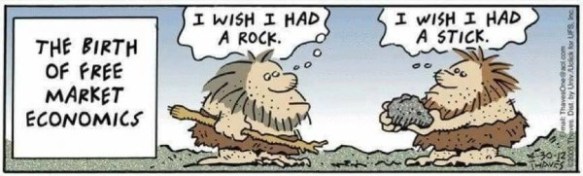
From The Wealth of Nations:
“Nobody ever saw a dog make a fair and deliberate exchange of one bone for another with another dog. Nobody ever saw one animal by its gestures and natural cries signify to another, this is mine, that yours; I am willing to give this for that….But man has almost constant occasion for the help of his brethren, and it is in vain for him to expect it from their benevolence only. He will be more likely to prevail if he can interest their self-love in his favour, and show them that it is for their own advantage to do for him what he requires of them. Whoever offers to another a bargain of any kind, proposes to do this. Give me that which I want, and you shall have this which you want, is the meaning of every such offer; and it is in this manner that we obtain from one another the far greater part of those good offices which we stand in need of.”
On the other hand, it could be the resurrection of an economy recovering from the grip of a socialist experiment, Venezuela say, in about a year or two from now.
Cartoon via Powerline – The Week in Pictures

Sitting on a million dollars of capital and he still thinks the economy is driven by spending.
This is a tweet sent out by Oxford University Press Economics.
“Demand for commodities is not demand for labour.” – John Stuart Mill
<
.
From Oxford University Press with Mill’s fourth proposition on capital – demand for commodities is not demand for labour – just thrown out for comment. So I commented:
The statement is true, much to the shame of modern economics. I have written an article on just this: “Mill’s Fourth Proposition on Capital: a Paradox Explained”, published in the March 2015 JHET. Ever wonder why no stimulus has ever led to recovery? Mill explained it in 1848.
As I wrote to my friend and colleague who had spotted the OUPE tweet and forwarded it to me:
From out of nowhere, really, that OUP should suddenly bring forward that quote of all quotes from Mill. Wondrous that you even saw it and thank you for sending it along. I have now added my own tweet to the rest. The destructiveness of Keynesian economics ought to be perfectly evident everywhere except that it’s not. Sad and yet funny that virtually no one today can even work out what Mill had meant even though it had been the universal view of every economist right up to the publication date of the General Theory. And I don’t mean that people disagree with Mill. I mean that no one can even explain why Mill and all of his contemporaries thought this was true so just end up befuddled but leave it alone.
Need I add that Leslie Stephen thought that Mill’s Fourth Proposition was “the best test of a sound economist”? Well, of course I don’t need to, but I will, and also add that Stephen was right and it is.
LET ME ALSO ADD THIS: From The Oz today, via David Uren:
“Average household incomes have not improved significantly since the global financial crisis in 2008-09.”
We are talking about a decade in which real incomes have not risen and during which the unemployment rate has hardly budged. I wrote this in 2008 (and published Feb 2009).
What is potentially catastrophic would be to try to spend our way to recovery. The recession that will follow will be deep, prolonged and potentially take years to overcome.
Mill’s fourth proposition is pure macro (or theory of the business cycle if you want to think in classical terms). You cannot generate a recovery from the demand side is how you might say it today. In the 82 years since The General Theory was published there has not been a single instance where this has been shown to be untrue.
So the US economy is expanding at a 4.1% annual rate and is experiencing a tightening labour market and possibly even rising real wages. That the American economy under PDT would shed the shackles left by eight years of Obama mismanagement and the inept oversight of GWB was as straightforward as anything I could have imagined although never a certainty given all the unknowns that surround every economy all the time. A supply-side approach, in which the government removes regulations and does not try to spend its way to recovery, is the formula that has worked time and again: see, for example, the spectacular Costello recovery of 1996-98 which was driven by massive cuts to public spending and an entrepreneurial-focused policy framework. No Keynesian at the time had expected it – Treasury begged Costello to reverse his policies! – nor have I ever heard a Keynesian who could explain it. In the midst of the Asian Financial Crisis as well, just to show how difficult it is to find an explanation within modern economic theory for what everyone witnessed but no modern macroeconomist could explain. Which brings me to this.
Steve Hayward, who I usually agree with, has written on Universities: Euthanasia or Suicide in which he discusses how economics is turning itself into a STEM field rather than an area of the humanities, which he thinks of as a good thing. It is already a near useless field of study the way it is presently taught, but economics as physics is its absolute end as a useful empirical science if the aim is to understand how we can best provision ourselves. Nothing will leave economics with less penetration and use than to ship it off to the mathematical side of academic studies. Nothing is more likely to help us find a way to a Venezuelan future. There are numbers in economics, of course, and statistics, but to turn economic theory into nothing but a series of highly abstract mathematical models will ensure that virtually nothing found in an economics journal will provide practical solutions to actual problems related to the world. Once economics dealt with problems, and thought through to solutions, but economics-as-physics is the Death Star for the subject.
Here are a few of the commenters who seem to get it:
Don’ t economics departments want to do this to attract more federal dollars for STEM? Not a good sign. About 30 or so years ago, UVA’s economics department kicked out Buchanan and Coase to go more in the econometrics route. (Paul Craig Roberts wrote about this.) The economics department at my undergraduate university came to be dominated by Marxists. In short, the revolution is corrupting econ departments too.
STEM disciplines are evidence-based. Evidence overwhelmingly shows that Marxism does not work. If an econ department has not ejected all of its Marxists, it should not be allowed to work this dodge.
If Econ is a STEM field, does that mean that Econ Profs can’t point to Venezuela as an example of the success of socialism? Unless they can prove it?
I got a BA in History with a minor in Economics. Although I have had a life long love of history, some of my more enjoyable undergraduate classes were economics. My conversations with recent History and Economic graduates make me wonder if they really got degrees in those fields at all. Their ignorance of even the basics is truly astounding.
Economists almost killed off the history of economic thought and may still do it. For an account of this disastrous venture into academic suicide, see my Defending the History of Economic Thought. Marxists and socialists generally can do maths as well as anyone. But it is a rare temperament who can do economics, and understanding Adam Smith and John Stuart Mill does not require maths and stats. The more mathematical and models-oriented economics becomes the more it will prevent anyone from understanding how an economy actually works.
Economics as physics is the death of economics as a useful empirical science studying how we can best provision ourselves, but it does seem to have some self-preservation qualities as well. Steve Hayward has written on Universities: Euthanasia or Suicide in which he discusses how economics is turning itself into a STEM field rather than an area of the humanities. Nothing will leave economics with less penetration and use than to ship it off to the mathematical side of academic studies. Nothing is more likely to help us find a way to a Venezuelan future, as discussed in my post on Mill and the marginalists. There are numbers in economics, of course, and statistics, but to turn economic theory into highly rigorous models will ensure nothing found in an economics journal will ever provide a solution to an actual problem related to the world. Once economics dealt with problems and thought through to solutions, but economics-as-physics is the Death Star for the subject. In reaching his conclusions, Hayward discusses at the start a lecture he had previously given.
One of the points I made in that lecture is that universities would start to divide into practical subjects like business and economics and STEM sciences, and leave behind the humanities and social sciences:
I think we’re already seeing the beginnings of a de factodivorce of universities, in which the STEM fields and other “practical” disciplines essentially split off from the humanities and social sciences, not to mention the more politicized departments. One early sign—perhaps a canary in the university coal mine—can be seen in the recent announcement of the University of Wisconsin Stevens Point campus that it is shuttering 13 departments in the humanities and social sciences, and laying off tenured faculty, on account of declining enrollment and budget pressures, and reallocating funds to STEM subjects. Another sign are the economics departments that have begun subdividing themselves into “general economics” and an even more-math centric “quantitative econometrics.” Several economics departments are formally reclassifying themselves as STEM departments (there are federal guidelines for this) for a variety of reasons, but among them has to be wishing to disassociate themselves further from other social sciences.
Lo and behold, more economics departments are deciding to become STEM subjects, supposedly for advantages STEM classification provides (especially in attracting and keeping talented foreign students), but I am sure it is in part to disassociate themselves from the rest of the politicized social science disciplines. If nothing else, economics is the one social science field where degree earners have good job prospects, and which doesn’t need propping up.
The Economist reports:
Economics departments appear to be catching on. Yale and Columbia have both changed the code for their economics major in the past few months; five of the eight Ivy League Universities have now done so. Students at Pennsylvania and Cornell are agitating for a switch.
And the American Institute for Economic Research gives five more reasons why economics is better suited as a STEM subject. If you read through these five reasons carefully, it’s what they don’t say that stands out loudly. See what is implied by this passage, for example:
The objective of STEM programs is to create professionally and socially qualified individuals to overcome 21st-century challenges. For that reason, these courses should make students learn how to apply the scientific method to everyday life and acquire useful skills for real-world applications. Economics promotes and develops both of them.
Due to the prevalence of mathematics and pragmatism in economics, positivism is the dominant research method in the field. Therefore, economists examine real-world problems and evaluate feasible solutions through economic positivism, a scientific method.
Further, this degree encourages students to acquire or improve on relevant skills for today’s life, such as critical thinking and problem-solving, entrepreneurship and innovation, resourcefulness and resilience, teamwork and collaboration, and a sense of civic responsibility.
Here are a few of the commenters who seem to get it:
Don’ t economics departments want to do this to attract more federal dollars for STEM? Not a good sign. About 30 or so years ago, UVA’s economics department kicked out Buchanan and Coase to go more in the econometrics route. (Paul Craig Roberts wrote about this.) The economics department at my undergraduate university came to be dominated by Marxists. In short, the revolution is corrupting econ departments too.
STEM disciplines are evidence-based. Evidence overwhelmingly shows that Marxism does not work. If an econ department has not ejected all of its Marxists, it should not be allowed to work this dodge.
If Econ is a STEM field, does that mean that Econ Profs can’t point to Venezuela as an example of the success of socialism? Unless they can prove it?
Economists almost killed off the history of economic thought and may still do it. For an account of this disastrous venture into suicide, see my Defending the History of Economic Thought. Marxists and socialists generally can do maths as well as anyone. But it is a rare temperament who can do economics, and understanding Adam Smith and John Stuart Mill not only does not require maths and stats, will actually prevent you from understanding anything they have to say.
Via Steve Hayward.
To clarify AGAIN for the misreporting journalists & the blue checkmarks demanding an explanation:1) I am not sorry.
2) It’s not coming down.
3) I will make another one.
4) You don’t have to hate Trump to use humor.
5) I don’t have to warn you when I’m about to tell a joke.Allie Beth StuckeyEnlightening & hard-hitting interview with Socialist “it girl” and fellow millennial, Alexandria Ocasio-Cortez [it is a joke]
So let us see what her supporters are like, although the reality is that you cannot parody them since they are such ignorant fodder for a tyranny they have no conception of. It’s only a not very random sample, but there are plenty more like them everywhere.
They are the very definition of drongo. Know-nothings about anything they need to know, whose arrogant stupidity may yet drag us into an abyss out of which even a century from now there will be no coming out of the depths into which our economies might yet descend.
There was a list of papers put up on the History of Economics website this week dealing with the History and Philosophy of Economics, of which the first was this, from which I have also excerpted the relevant bits for what I comment on:
Sraffa’s Silenced Revival of the Classical Economists and of Marx.
Guglielmo Chiodi (Sapienza University of Rome (IT))The standpoint of the old classical economists as well as of Marx “has been submerged and forgotten since the advent of the ‘marginal’ method” – to borrow Sraffa’s own words. The neoclassical (or ‘marginal’) paradigm, in fact, triumphantly dominated over the twentieth century (and is still dominating even now). A serious step towards the rehabilitation of the paradigm of the old classical economists was made by Sraffa (1951) with his remarkable ‘Introduction’ to Ricardo’s Principles, his seminal 1960 book Production of Commodities by Means of Commodities (PCMC) followed a few years later, as a logical completion of his long-standing work.
After long contemplating whether I should stir up this particular hornets’ nest, in a went with my own reply. Here then is what I wrote.
A very interesting list, but I was quite struck by the first of these on Sraffa since I have been attempting the same resurrection, except that I would replace Marx with John Stuart Mill and would write:
The standpoint of the old classical economists as well as of Mill has been submerged and forgotten since the advent of the ‘marginal’ method.
The latter half of the nineteenth century was, in my view, the high point of economic theory, which is why Marx still attracts so many since he constructed his theories on the framework that had been crafted by the classical economists of his time. But much more acute was Mill whose economics may never have been surpassed. The “marginal method” shifted economics from the supply side to the demand side, bad enough in itself since it set up the advent of the Keynesian Revolution, but beyond that, removed the moral and ethical side of economic theory from the way economics was taught and understood and replaced it with a mathematical approach based on an unmeasureable and largely mythical entity called utility. The entrepreneur disappears and everything ends up determined by the relative addition to utility of increased units of particular forms of output. The human, moral and philosophical dimensions of life have vanished. Thus, if the aim is to provide “a genuine alternative perspective and a radically different representation of the economy, compared with that provided by neoclassical theory” you have no need to go to Marx, but can do it in a more sure-footed way by going to Mill.
As an example of what we might find in such a change in direction, let me provide this quote from Volume II of The Growth of English Industry and Commerce in Modern Times by W. Cunningham. Volume II is titled “Laissez-Faire” and at pages 745-46 of my copy (CUP 1912 but written much earlier) we find this:
“The economist of the early part of last century was ready to explain how the greatest amount of material wealth might be produced but not to discuss the uses to which it might be applied; he was prepared to show on what principles it was distributed among the various individuals who formed the nation, and to leave the question of consumption to each personally. But philanthropic sentiment and religious enthusiasm were not content to leave the matter there, and public opinion was gradually roused to demand that practical statesmen and their expert advisers should look farther ahead. Under the influence of these larger views, John Stua
The question really comes down to what questions a modern economist can answer that a classical economist could not, and I cannot think of any at all. As for the questions that a classical economist tried and did answer, there were many that no modern economist is able to answer, at least not within the confines of economic theory as it now is.rt Mill gave a new turn to economic study. He was not satisfied with discussing mere material progress. He could contemplate a stationary state with calmness; he could not but dwell with bitterness on the great misery which accompanied increasing wealth; and he tried to formulate an ideal of human welfare in his chapter On the Probably Futurity of the Working Classes. In this way he succeeded in indicating an end towards which the new material resources might be directed, and thus restored to Economics that practical side, w
hich it had been in danger of losing since the time of Ricardo. It is important that we should have a method of isolating economic phenomena and analysing them as accurately as may be, and this Ricardo has given us; but it is also desirable that we should be able to turn that knowledge to account, – to see some end at which it is worthwhile to aim, and to choose the means which will conduce towards it; this we can do better, not merely intuitively and by haphazard, but on the reasoned grounds, since the attempt was first made by Mill.
The question really comes down to what questions a modern economist can answer that a classical economist could not, and I cannot think of any at all. As for the questions that a classical economist tried and did answer, there were many that no modern economist is able to answer, at least not within the confines of economic theory as it now is.
There are no even-handed accounts. There are only individual perspectives. But all that being so, there are still shared beliefs and political aims that transcend the individuals who hold these aims and beliefs. So here is one more perspective from yet another who sees PDT coming up short: MAGAnomics: a 500 Day Appraisal. Here is a reply via Catallaxy from Bruce of Newcastle.
Very naïve article from Mr Firey.
First: fiscal policy is in the hands of Congress, who presented a bipartisan omnibus porkbarrel bill to Trump on the budget. He signed because there wasn’t much choice against a probable veto-busting majority.
Second: The GOP elites have been underhandedly opposing Trump to try and keep the party out of his control. Thus McConnell has been vacillating in the Senate about the Dems slow walk approval of Trump nominees to key administration positions. That prevents Trump from pushing his agenda through the bureaucracy. In this light it’s amazing how much he’s achieved despite opposition from both parties and the deep staters.
Third: Mr Firey does not comprehend the Art of the Deal strategy which Trump is applying to foreign relations and trade. The tariffs are doubly designed, first to appeal to the blue collar Democrats dumped on the scrapheap by Obama’s embrace of left coast and NYC progressives, and secondly to bring other countries to a deal.
The problem at the moment is both the EU and China are prepared to die in a ditch for ideological reasons rather than deal on trade. The soy tariffs China brought in are a terrible own goal* for Chinese people who rely on cheap soy beans. But Xi is in a Great Game conflict with the US for his own reasons, in which trade is a tool of dominance. EU likewise is in the grip of the Left, and they hate Trump with an irrational fervor.
We’ll see how this goes. Trump is pushing tariffs as a tactic. The tactic may fail, but the aim is a good one: to break down to non-tariff barriers that the EU and China are now getting away with.
(* “There simply aren’t enough soybeans in the world outside of the U.S. to meet China’s needs,” said Mark Williams, chief Asia economist at Capital Economics.)
And it really ought to be emphasised that economics is far from the only reason for supporting PDT, not to mention that the US economy is in the midst of an astonishing revival.


 Law of Markets