Hillary’s remake of The Sting

Thought of this last night but someone has already been there. It is surprising that more has not been made of the possibility that Hillary was in cahoots with the moderator although I can see that this is not the time for a distraction of this kind. The lessons of the first debate have no doubt been absorbed. Remembering The Sting may require you to be of a certain age. A fantastic film if you haven’t seen it with a surprising degree of relevance in the present election.

What’s wrong with other economists?

This is a note I have written to the contributors to What’s Wrong with Keynesian Economic Theory?
______

I hope you have all by now received your own copy of the book.

I have also put a blog post up at the Elgar website which is my own view of the book and how significant I think it is which you can find here

Let me therefore again thank each and every one of you for your articles. As I try to convey in the Introduction, a book such as this is an extreme rarity. This is from a blog post I wrote here in Australia where I tried to explain just how rare the book is.

The following quote is from Henry Hazlitt’s Economics in One Lesson.

When the government comes to repay the debt it has accumulated for public works, it must necessarily tax more heavily than it spends. In this later period, therefore, it must necessarily destroy more jobs than it creates. The extra heavy taxation then required does not merely take away purchasing power; it also lowers or destroys incentives to production, and so reduces the total wealth and income of the country.

The only escape from this conclusion is to assume (as of course the apostles of spending always do) that the politicians in power will spend money only in what would otherwise have been depressed or “deflationary” periods, and will promptly pay the debt off in what would otherwise have been boom or “inflationary” periods. This is a beguiling fiction, but unfortunately the politicians in power have never acted that way. Economic forecasting, moreover, is so precarious, and the political pressures at work are of such a nature, that governments are unlikely ever to act that way. Deficit spending, once embarked upon, creates powerful vested interests which demand its continuance under all conditions.

Hazlitt also published his Critics of Keynesian Economics of which it is said..:

Henry Hazlitt confronted the rise of Keynesianism in his day and put together an intellectual arsenal: the most brilliant economists of the time showing what is wrong with the system, in great detail with great rigor. With excerpts from books and articles published between the 30s and 50s, it remains the most powerful anti-Keynesian collection ever assembled.

And here’s the thing. The book was published in 1960 and other than Mark Skousen’s sadly out-of-print Dissent on Keynes (Praeger 1992) there has not been another attempt to do the same until my own modest What’s Wrong with Keynesian Economic Theory? which was only released last month. It is thus almost twenty-five years since anyone has has brought together a series of critics of Keynesian economics and more than fifty years since the only other. And as scarce as they were even then, critics of Keynes were easier to find, let me tell you, in the 1930s, 40s and 50s [and I might mention that Hazlitt included two nineteenth century articles of sublime excellence by J.-B. Say and J.S Mill]. Such economists are almost completely gone today in spite of there being every reason to think they should be found at every turn.

There are 13 of us in this book. I would doubt there are a hundred economists in the world who are actively anti-Keynesian and see the problem with economic management in Y=C+I+G. Yet even now there is talk of a further stimulus and negative interest rates which are further attempts to deal with our economic problems from the demand side. There was a recent article in The Wall Street Journal by Robert Barro where he said “It wasn’t the severity of the Great Recession that caused the weak recovery, but government policies” which for me is progress.

And he notes the fall off in productivity. But he doesn’t specifically say as I would that the fall in productivity has been because of the diversion of our resource base into various Keynesian stimulus projects, or due to low interest rates misdirecting resources. What I have, however, learned in putting this collection together is that some of those who are anti-Keynesian – and will remain nameless but I can say that Robert Barro was not among them – declined to contribute an article because it would put them offside with their colleagues.

So I thank you again. Hopefully the book will find its way to enough readers to make a difference to how policy is framed from now on in.

Man-made disaster

Here is a presentation I will make sure I get to: Masculinism, global warming and ‘man-made’ disasters: Towards a profeminist environmentalist response. Here is the blurb:

In the wake of disasters and other environmental destruction, recent attempts have been made to develop eco-masculinities, many of which simply encourage men to commune with nature, or seek to minimize feminist critiques by finding redeeming features in traditional masculinity. Against this backdrop of debates, this paper explores what profeminist masculinity studies brings to addressing men’s ecologically destructive practices. While the causal relationship of climate change to natural disasters is contested, people’s vulnerability to “natural” disasters clearly relates to economic, cultural and social relations, including those shaped by gender. Further to that, a variety of eco-feminisms are considered which draw connections between patriarchal social structures and ecological destruction. While some eco-feminist literature is criticized as essentialist, contemporary versions of eco-feminism recognize that the greater responsibility of men for environmental catastrophies is due to the social construction of masculinism, intersected by social divisions between men. Masculinism, and the technological rationality that flows from it, has furthermore become a mindset for environmental management, which does not address the causes of environmental crises. Environmental sustainability may even appear to threaten masculinism and hegemonic masculinity, though environment movements are often seen as a supportive context for non-hegemonic masculinities and progressive practices by men. This theoretical discussion reflects on how different forms of profeminist subjectivities lead to resistance to global warming and environmentally destructive policies, and how men can change their subjectivities and practices to construct a more sustainable world.

And this is the bio of the presenter:

Bob Pease is Professor of Social Work at the University of Tasmania, Australia. He has published extensively on masculinity politics and critical social work practice, including four books as single author and twelve books as co-editor. His most recent books include: Undoing Privilege: Unearned Advantage in a Divided World (Zed 2010), Men and Masculinities Around the World: Transforming Men’s Practices (co-editor, Palgrave 2011), Men, Masculinities and Methodologies (co-editor, Palgrave 2013), The Politics of Recognition and Social Justice: Transforming Subjectivities and New Forms of Resistance (co-editor, Routledge 2014), Men, Masculinities and Disaster (co-editor, Routledge 2016) and Doing Critical Social Work Practice (co-editor, Allen and Unwin 2016).

Where are the critics of Keynesian economics today?

aust unemployment stats

The thing about these Keynesians is that they have no shame. The nonsense that Australia avoided recession after the GFC is one of those self-serving myths that will not stand an ounce of analysis. The data above (from the IPA) are the latest much-revised version of what happened to the unemployment rate during the GFC. A rise in the unemployment rate by two-plus percentage points over the course of a few months is recession enough for me, whether or not we actually had two consecutive quarters of a falling GDP. Ken Henry was Secretary of the Treasury at the time, and his advice was “go hard, go early”. So Rudd and Co went hard and early, with the results before us for all to see.

So now the self-same Ken Henry is on the front page of The Australian today with some advice on how to fix the problem that hard and early have led to: Fix budget before the crunch hits, urges Ken Henry.

National Australia Bank chairman and former Treasury chief Ken Henry warns that Australia faces an unacceptable risk with its budget deficit and fears the nation will wait for a painful economic crunch before confronting true ­financial repair.

In an exclusive interview, Dr Henry issued his most powerful warning about the failure of politicians and the national parliament, saying responsible fiscal policy had become a “pretence”, the economic reform narrative “no longer exists” and politicians are fixated by “appeals to populism”.

Dr Henry said Australia was now running the risk that its AAA sovereign credit rating might be downgraded, coinciding with another global financial disturbance, and in this situation the consequences for Australia “would be truly catastrophic”.

He said this was a “small risk” in relative terms but “the consequences are so large you cannot take the risk”.

Dr Henry said politicians through domestic economic ­policy failures were now exposing the nation to such risks that the entire reason for the reforms of the 1980s and 90s had been ­forgotten.

Unless the momentum was recovered, Australia would find “we are right back with Paul Keating’s banana republic statement”.

Well Ken, what a disaster we have created for ourselves. You must tell us where we went wrong. The following gets to the heart of the matter, which one would have hoped a Treasury Secretary would already have known. The quote is from Henry Hazlitt’s Economics in One Lesson which was brought to our attention by Tel on a previous post.

When the government comes to repay the debt it has accumulated for public works, it must necessarily tax more heavily than it spends. In this later period, therefore, it must necessarily destroy more jobs than it creates. The extra heavy taxation then required does not merely take away purchasing power; it also lowers or destroys incentives to production, and so reduces the total wealth and income of the country.

The only escape from this conclusion is to assume (as of course the apostles of spending always do) that the politicians in power will spend money only in what would otherwise have been depressed or “deflationary” periods, and will promptly pay the debt off in what would otherwise have been boom or “inflationary” periods. This is a beguiling fiction, but unfortunately the politicians in power have never acted that way. Economic forecasting, moreover, is so precarious, and the political pressures at work are of such a nature, that governments are unlikely ever to act that way. Deficit spending, once embarked upon, creates powerful vested interests which demand its continuance under all conditions.

Hazlitt also published his Critics of Keynesian Economics of which it is said:

Henry Hazlitt confronted the rise of Keynesianism in his day and put together an intellectual arsenal: the most brilliant economists of the time showing what is wrong with the system, in great detail with great rigor. With excerpts from books and articles published between the 30s and 50s, it remains the most powerful anti-Keynesian collection ever assembled.

And here’s the thing. The book was published in 1960 and other than Mark Skousen’s sadly out-of-print Dissent on Keynes (Praeger 1992) there has not been another attempt to do the same until my own modest What’s Wrong with Keynesian Economic Theory? which was only released last month. It is thus almost twenty-five years since anyone has has brought together a series of critics of Keynesian economics and more than fifty years since the only other. And as scarce as they were even then, critics of Keynes were easier to find, let me tell you, in the 1930s, 40s and 50s [and I might mention that Hazlitt included two nineteenth century articles of sublime excellence by J.-B. Say and J.S Mill]. Such economists are almost completely gone today in spite of there being every reason to think they should be found at every turn.

Classical economics

It’s been a rather full week for me in the configuration of publications and presentations all surrounding my classical approach to economics.

what's wrong with keynesian economics I received my copy of What’s Wrong with Keynesian Economic Theory?, a collection I have edited of thirteen articles by economists who had previously written critical articles about Keynesian theory. The authors come from every corner of the non-Keynesian world, and therefore you are guaranteed to like some approaches more than others. But at least it is in print, and there is at least this much evidence that the moronic use of public spending and low interest rates to create recovery has its enemies. You would think, given how badly our economies are performing, that there would be more, but such it is. Keynesian theory remains the most easily understood fallacy in economics, thus retaining its savour across the world. Although Keynesian policies never work in practice – other than to enrich our elites at the expense of the rest of us – it continues to be the basis for macroeconomic theory and is universally applied by governments.

The second publication is in our local history of economics journal, The History of Economics Review. It is an article on my second favourite text, Henry Clay’s Economics: an Introduction for the General Reader (Mill’s Principles is my favourite). I subtitled my paper, “The Best Introduction to Economics Ever Written” which it remains, and there is unlikely to be anything better written until the current mania for diagrams and Keynes is finally reversed. You can get a copy of the book at Abebooks for around $10 since it must have sold in the 100,000s given its publication history from 1916 to 1951. The reason for my own article is that 2016 is the hundredth anniversary of its first publication. As a third best alternative to Mill and Clay, I do recommend my own Free Market Economics: an Introduction for the General Reader. No points for working out where I got the title.

The third publication is in this month’s Quadrant which you can pick up at your local news agency for a mere $8.90. It is the best value publication in the country. There you can read a magazine full of interesting and important articles that surround my own. My article tells the story of the trek from using interest rates to allocate resources among competing ends to have become a useless policy tool directed at keeping inflation down by keeping unemployment up. If you’d like a taste of how we classical economists look at things, this would be a very good place to start.

As for the presentations, I have just come back from China where I discussed classical economic theory, under the name supply-side economics, with people who have begun to see the deep errors of following a demand-side approach to policy. They now understand what’s wrong with Keynes. They are now examining the supply-side alternative. You may not think that matters, but just watch what happens if they finally work it out.

In praise of a tasteless, publicity‐seeking, coarse, billionaire, reality TV star

coulter in trump we trust

There has always been one trouble for me with the books Ann Coulter writes. No sooner do I start one than I have reached the last page. No one, and I do mean no one, writes like her. And while there may have been, now and then, something she has written I didn’t quite agree with, nothing of that kind comes to mind at the moment. Her latest is In Trump We Trust: E Pluribus Awesome! from which you can find an excerpt here. This section of the book, I’m afraid, truly made me laugh. Go to the link but I will put up the premise she begins with and then you can see what she does.

If we were in the laboratory, designing the perfect presidential candidate, it’s unlikely we would have produced a tasteless, publicity‐seeking, coarse, billionaire, reality TV star.

Ha! Look at how wrong we were. It turns out, that is exactly what we needed.

Now go and read it all, and if you still want to vote for Hillary after that, then do your worst you sour misbegotten fool. I’ll let you know what I thought of the whole book when I finally have had it in my hands plus the one additional day I will need to read it.

Hillary’s America – it’s closer than you think

At Rotten Tomatoes Hillary’s America is 5% among the critics and 82% among the audience. Here is a link to the only positive review listed. It begins:

Hillary’s America: The Secret History of the Democratic Party is a searing, powerful and persuasive exposé on the Democratic Party and Hillary Clinton. Just like in America: Imagine the World Without Her, director Dinesh D’Souza re-examines American history and highlights the facts that should make you horrified and alarmed if you’re a critically-thinking individual. Yes, you might find yourself in denial at first, but denial is a crucial and natural step in the process of coming to terms with a harsh truth. D’Souza includes some re-enactments and archival footage which help to enliven the film so that it’s not just a bunch of talking heads. The fact that D’Souza remains calm and collected, unlike Michael Moore, throughout the film, is a testament to his strengths as a documentarian and investigator. Did you know that it was actually the Democratic Party was racist the Civil War? Or that the “hood” or “ghettos” are essentially the modern versions of plantations? In other words, the Democratic Party is still just as racist now as it was back in the Civil War, but Democrats, will, of course, deny their racism. Did you know that the KKK originated from the Democratic Party and its members were Democrats themselves? Or how about that Planned Parenthood is mostly found in areas where minorities can be found is a form of eugenics started by Margaret Sanger, the founder of Planned Parenthood? Hillary Clinton just so happens to consider Margaret Sanger to be a role model. D’Souza explains something that you ought to know about Hillary: her mentor was writer Saul Alinksy who began scamming people early on in his college days by ripping off his school’s cafeteria while convincing others to take part in the scams as well. That scam serves as a microcosm of what Hillary Clinton plans to do in our country.

And on it goes. The 95% who hate this film are Democrat Operatives with Bylines, and these are merely film critics. The political commentators are worse. Whether we end up seeing it in Australia, it is worth noting that Box Office: Dinesh D’Souza’s ‘Hillary’s America’ Becomes Top Grossing Doc of 2016. Fighting the left is a continuous ongoing uphill battle.

Clinton Cash – the movie

Breitbart has released the movie so that anyone can now download. Fantastically corrupt and in the open as well. Meanwhile in Philadelphia, the Democrats are in chaos:

gReeTinGS froM pHillY
HIGH HEAT ALERT: DNC DAY 1…
LIVE…
BOOING DURING INVOCATION…
FLOOR BATTLE…
BERNIE TEXTS: PLEASE DON’T PROTEST IN ARENA!
Dems confiscating pro-Sanders signs…
Arrests and heat injuries…
Jeers for Pelosi at California Breakfast…
Wasserman booed off stage, escorted out by security…
LEFT EATS ITSELF…
4 brutal poll numbers greet Clinton at convention…

Yet the media and the American establishment will make her president if they can. You know all of the above only because it cannot be hidden from view. But to those who wish to see her president, none of it matters even the smallest amount. A week from now it will disappear from the news while they go on and on about Melania’s plagiarism.

The first day on the Somme – July 1, 1916

Somme-LaBoisselle_1st_July_1916_Header

FIRST DAY OF THE BATTLE OF THE SOMME

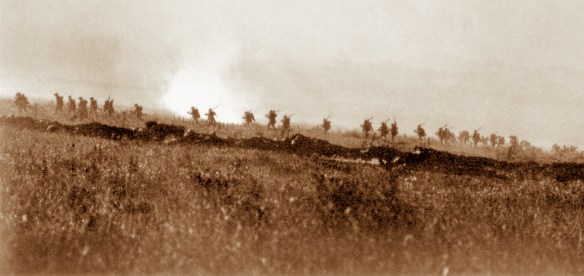
The 1st July 1916 was the opening day of the Anglo-French offensive that became known as the Battle of the Somme. It was the middle day of the middle year of the First World War and is principally remembered as the bloodiest day in the history of the British Army. On the first day of the Somme 57,470 British soldiers became casualties of which 19,240 were either killed or died of their wounds. It has for many come to represent the futility and sacrifice of the First World War, with lines of infantry walking across No-Man’s-Land into the machine guns of the enemy.

The most terrible battle of the most momentous war in European history began a century ago today. As a pure coincidence, I am reading John Buchan’s Greenmantle, published itself in 1916. From Buchan’s biographical details at the start of the edition I have there is this:

During the First World War he worked as a war correspondent for The Times, before joining the British Army Intelligence Corps and writing speeches for Sir Douglas Haig. His experience of war left him vehemently opposed to armed conflict. He wrote many novels, poems, biographies, histories and works of social interest but is most famous for his Richard Hannay novels, The Thirty-Nine Steps and Greenmantle.

In its own way a story that has a modern veneer but you will see why the BBC began and then abandoned a dramatisation of the book in 2007 from this para from the summary of the book on the back cover of my edition of the novel.

The Germans with their Turkish allies are planning to stir up a revolt in the Muslim world that could leave Egypt, India and North Africa in disarray.

The EU was intended to bring such conflicts to an end. History, however, remains open ended as it will and must always be.

UPDATE: The Daily Mail commemorative gallery marking the day in England.Here is how the battle is described:

Synonymous for the slaughter of hundreds of thousands of men, the Battle of the Somme was one of the most controversial conflicts of the First World War.

The battle took place North of the River Somme in France from July 1 to November 13, 1916.

On the first day alone British forces suffered casualties of 40,000 and deaths of 20,000, with 60 per cent of all of those killed being officers.

Designed to relieve pressure on French forces at Verdun, the Battle was the mastermind of General Douglas Haig and involved 750,000 British soldiers across 27 divisions.

By the end of the bloody and brutal battle Allied forces had managed to capture only six miles of land. The British suffered 429,000 casualties, the French suffered 195,000 and the Germans 650,000.

Prior to the battle the British bombarded German lines with 1.6 million shells in an effort to weaken their resolve, but the Germans were heavily fortified and many of the shells did not go off.

Haig, unaware of his bombardment’s failure, was so confident in his tactics that he ordered his men to walk across the battlefield. As a result many were tragically mowed down by machine gun fire as soon as they left their trench.

The general’s tactics remain controversial to this day with military historians, soldiers and biographers conflicted over whether his decisions were necessary or foolhardy.

If ever there was a war to end all wars, this was it. We now know no such war exists. Those who would live in peace must therefore always prepare for war.