Wages based on productivity – there’s a new world dawning

A quite seismic story in The Australian today and one that makes me think that in government the Coalition plans to be there for a long time. The obsession with trying to rid us of our unique industrial relations system may be waning and not before time. Instead, we have evidence that the intention is to use the existing structure in a more creative way. The story is titled, Coalition to police wage claims, and the first two paras say most of what needs to be known:

THE Coalition has vowed to crack down on ‘excessive’ wage claims by forcing ‘lazy’ employers and unions to prove they have engaged in an ‘appropriate discussion and consideration of productivity’ before above-inflation pay rises are approved.

Opposition workplace relations spokesman Eric Abetz said yesterday unions pursuing agreements allowing for annual pay rises of, for instance, 5 per cent should be required to show to the Fair Work Commission that they had ‘genuinely discussed’ productivity with their employer before the deal is approved.

Hard to do, glory be, it will be hard to do. But putting productivity back into the equation where unions are involved in wage negotiations is a major step in the right direction.

Further comment: I am apparently one of those free market economists who actually has an interest in institutional structures. I am also a Burkean conservative in that I think that the “bank and capital of nations” is a standard from which we should only deviate slowly and with caution. And finally, I don’t want Tony Abbott to be the third Prime Minister in our history to lose his seat while his government is voted out because of their policies on industrial relations.

I wrote an article for Quadrant some time back on this, “A Free Market Defence of Industrial Tribunals“, where I point out why the institutional structures we have are a benefit for conservative governments if properly understood and appropriately managed. It’s not the system that’s the problem, it’s the unions and they are a massive problem. For comparison, the industrial relations system of Singapore was based on the system in Western Australia.

It’s union power ruthlessly used, that needs to be dealt with. The idea that we could have what no one has – an industrial relations system free from legislative rules – is a non-option. We have unions and they have power and they will use that power to bludgeon employers for wage increases that threaten our productivity. The madness of the decision yesterday on apprenticeships will, typically, be sheeted home to the Fair Work Commission and not to the current government that sought the change. A government in which half its front bench are union leaders is a government that will cause economic harm.

So what should you do? Get rid of the Fair Work Act, ensure that workplace decisions are determined at the workplace but also make sure that the system put in place is not only fair to all parties but is seen to be fair. If that makes no sense to some people, we will just have to agree to disagree. But if you are interested, read my Quadrant article. We can then continue the conversation after that.

And in this I am mindful of the commotion that this proposal has caused within the Coaltion. Andrew Bolt discusses this under the heading, A good Liberal idea shut down in a day. An election to win. If trying to raise productivity at the workplace by leaning into union power is no longer a vote winner – that is, if the community no longer has any idea how living standards are raised – then this country no longer has any idea on which side their bread is buttered. I don’t believe that but I’m not running the campaign.
Hubble bubble toil and trouble

Really I have no one else to blame for this but it was suggested to me that I reply to an article at The Drum which has now got me looking at the site and reading some of the articles. One has in particular caught my eye, “Our wealth has only grown since the carbon tax”, written by Stephen Koukoulas. Now whatever else might have happened in the world, the notion that introducing a carbon tax has made us a more prosperous community has got to be one of the least plausible possibilities imaginable. But there it is in the title and there it is again in the text. So naturally my curiosity got the better of me and so I looked to see what possible evidence there could be for such a thought, and here it is:

The half a trillion dollar lift in the stock market and house prices reflects a 23 per cent lift in the ASX since 1 July 2012 which had added approximately $275 billion to the value of stocks, while a 5.1 per cent rise in house prices has added approximately $235 billion to the value of housing over the same timeframe.

This is hardly the stuff of an economic wrecking ball or outcomes that are ripping the heart out of businesses and families. On the contrary, it is a stunning boost.

The very ingredients of a bubble economy is being provided as proof that the economy has taken off since the introduction of the carbon tax. Well the Fed is looking for a new Chairman and we will be looking for a new Governor for the RBA in a few months’ time. If quantitative easing and asset inflation are your thing, we have just the name for the shortlist, that is for sure.

The man with no pluses is now PM for the second time

I have no time for either Gillard or Rudd. Both are nasty pieces of work with no serious ideas about how to make Australia a better place. Both think that their own shallow ideas are a match for individuals running their own lives in their own way with governments doing little more than setting the required political structures in place. Welfare and assistance, sure, which every government of every persuasion has done, but never to replace either the individual will or to remove the need for those individuals to act on their own behalf.

Yesterday I came home just in time to catch the 10:30 news and I immediately switched off at the first sighting of Rudd not more than five sentences into whatever he was saying. Gillard was incompetent and clueless. All of her instincts were the deepest red. She had no solutions that did not involve giving power and money to her friends and depriving those she classed as her enemies of the means for their own support. She clearly cannot bear people who run our businesses. And yet I found her resilience admirable. The cover of the Women’s Weekly merely shows that had things been different she could have been Australia’s Margaret Thatcher instead of being a federal version of Joan Kirner.

But Rudd has no pluses. There is no part of him that I would describe as admirable. The phrase low cunning doesn’t work because he has no cunning. He has a personality that shows positive in the media but I think this time we will see through him and very quickly. He has risen in the polls to 49 against Abbott’s 51 but I imagine that will be a high water mark. The Libs will pull him back but he will pull himself back even more.

Democracy does remain the worst form of government except for all the others that are tried from time to time. But Rudd along with Obama reminds you of just how bad democracy can be.

Trading one disaster for another

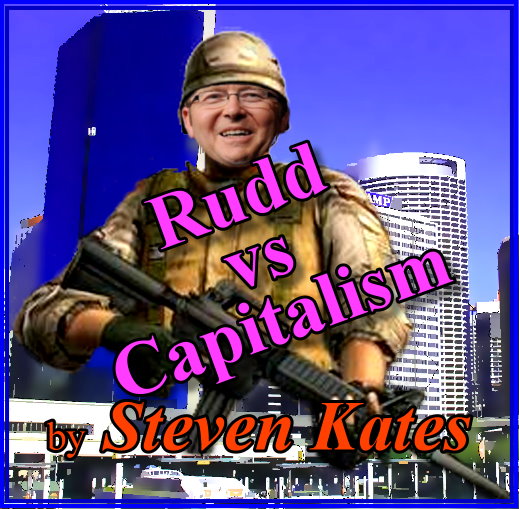
rudd v capitalism

I sometimes think that our economic problems are the least of the troubles we face but they are pretty bad and getting worse. Labor, having wrecked the place, is getting out just in time. No doubt they will have much to criticise from the Opposition benches as the efforts to repair what they have ruined gets into full swing.

The uselessness of the media is never better highlighted than their light touch on leftist governments which are allowed to go well beyond reasonable bounds because criticisms of anyone with a socialist halo is verboten. So what we have is an economy crashing in many directions and from a multitude of directions. Prudence is a great virtue in economic management, a characteristic those with a socialist time perspective never seem to have.

This “QE dries up” from a front page story in the AFR which is part of a headline that also reads “Shares, $A plunge”. This is followed inside with “China credit data fuels doom-mongers’ fears”. We are becoming collectively poorer by the day and our ability to trade our way out of the debt and deficits being left behind is becoming a more gigantic task with each fresh decision by the party with the Parliamentary majority.

Meanwhile, those guys in the media, and that includes the likes of Laura Tingle and etc, you don’t do either the Labor Party or the rest of us any good by not having raked them over the coals for being the Beyond Stupid Party it has become. Unless you personally agree with the range of policies that are ruining us, then it is not just your duty as journalists but your duty as friends to these socialist cretins that you let them understand the nature of the dangers they run. And if you couldn’t see it coming yourselves, then what good are your opinions anyway?

Meanwhile Kevin Rudd is the apparent answer if the only aim is to rid ourselves of Julia Gillard. But as a reminder of how we would be trading one disaster for another, let me dredge up an article I wrote for Quadrant in April 2009 just after Kevin wrote his attack in The Monthly on what he chose to call neo-liberalism. It is titled, “Reflections of a Neo-Liberal“. The PM referred to is of course Kevin Rudd but I suspect it would just as easily apply to his successor. But if you wish to be reminded of the true nature of our once and future PM, these ought to be all the warning you need.

So to the Prime Minister’s article. Here we find a polemic on the evils of the capitalist system as it exists today. It is an imaginary system, bearing little reality to the world in which we actually live.

The article is 7700 words long. No précis can give any more than a taste of how extreme the language is and how misconceived the thoughts. He has invented a villain, the neo-liberal, whose demise is now the mission the Prime Minister intends to hasten. The Prime Minister apparently believes that those on the other side of the political fence, the neo-liberals of his imagination, “fundamentally despise” the state and its role. He apparently believes that in the view of such neo-liberals, “government activity should be … ultimately replaced, by market forces”. He takes it as read that these neo-liberals have “sought, wherever possible, to dismantle all aspects of the social-democratic state”.

To capture as least some of the rhetorical overdrive, I reproduce the two insert quotes displayed in large print across the page. The first:

The great neo-liberal experiment of the past 30 years has failed … the emperor has no clothes. Neo-liberalism, and the free-market fundamentalism it has produced, has been revealed as little more than personal greed dressed up as an economic philosophy.[ellipses in the original]

And then there’s this:

The stakes are high: there are the social costs of long-term unemployment; poverty once again expanding its grim reach across the developing world; and the impact on long-term power structures within the existing international political and strategic order. Success is not optional. Too much now rides on our ability to prevail.

We are here not discussing whether some policy or another might make the economic system work more effectively. This is not about whether there ought to be a stimulus package and if so, how it ought to be structured. This is beyond the technical side of economics and into the realm of good and evil. It is a psycho-drama in which Frodo and his mates take on Gollum in a bid to save the world.

We only elect these people so that they can raid the cookie jar. Well, the cookie jar is now well and truly empty and then some. Back to the people who will hopefully fill it up again although if the only aim is to raid it once again some time in the future it is hard to really see the point.

This is not a distraction

From the AFR of Wednesday the 19th:

Not wanting any distractions between now and the September 14 federal election – the same day the referendum will be held – Mr Abbott some weeks ago committed the Coaltion to back the yes case, but almost every liberal opposes the referendum proposal. [My bolding]

This is not a distraction. It is the most vivid possible reminder that everything that Labor does is poison. How this could lose the Coalition votes is beyond me. A no vote is a no vote for a Labor proposal that would harm our federal structures and undermine the states. If there is to be a disparity in funding for the two sides then all bets should be off and Coalition members free to make their views known to the rest of us before it’s too late.

On wind farms we are less crazy than the rest

James Delingpole, this time on wind farms. You do try to work out which part of elite opinion is the craziest but what a contest. Anyway, we in Australia are recognised as the least crazy, at least so far as wind farms go:

So the anti-wind backlash has begun, of that there’s no doubt. In Australia, where resistance is especially strong, they’re holding a rally in the next few hours in Canberra to protest against an industry described by Alby Schultz MP as “the biggest government sponsored fraud in the history of our country”, so rife with “manipulation, intimidation, lies and cover-up” that there’s enough evidence to justify a royal commission. I wish I could be there at the barricades with my Aussie mates. Sounds like it’s going to be quite an occasion.

Why stop at free education?

This is from Andrew Bolt and on the one hand it is hilarious but on the other it is downright disgusting. We talk about low info voters but the completely skewed ideas these people have is quite a scandal. These kinds of things are the typical province of students but I suspect that the Greens do not go much beyond this in economic sophistication if they go beyond it at all.

The CBC solution to the ABC

journalist bias australia

This is from Andrew Bolt and it is a sensation. How is it that the folks over at the ABC are so completely lacking in self-awareness that they happily answer these questions so that the rest of us can know just how politically naive they are. Who would buy a political opinion from such a bunch as these?

I have over the past few weeks been thinking about a solution to the problem caused by the ABC. And while privatisation might be a nice idea I don’t think it would work out very well. But what would in my view be just as good is for the next Coalition government merely to say to the ABC that within five years, 90% of your funding must be raised through advertising revenue. And having grown up in Canada, there is a precedent. I don’t know what the proportion of its funding must come from its own revenue sources but whatever it might be could be our own target.

I like it because it will still remain “our ABC”. I like it because we can allow the ABC to help the rest of us finance all of the social programs it believes the government ought to finance. And I like it because it should be more commercially oriented so that it is no longer allowed to compete in the market at a zero price.

And I especially like it because this is not the 1930s. We can get cable across the country. There is no one locked out of reception that only the ABC can reach (and if there are such places, the government can provide the subsidy out of the ABC’s new revenue stream).

And then, of course, there is this from Blazing Cat Fur in Toronto who notes how the CBC audience has diminished almost to the vanishing point:

If the share of CBC TV was just over 5% in prime time, it is below 5% on a 24 hour basis; CBC daytime schedules have traditionally performed poorly compared to CBC’s prime time. Making matters worse is that the audience to about half the U.S. TV stations available in Canada are no longer being measured by the ratings company and neither are services such as Netflix or Apple TV, meaning that CBC’s share of all TV viewing is actually lower than the numbers suggest. This is the lowest audience share in CBC’s history and yet there is no hint of the severity of the TV network’s situation in the quarterly report. CBC TV audiences are sold to advertisers and with less audience to sell, 2012-13 revenues, shown in the table above, are almost $40 million less than at the same point the previous year, creating a revenue shortfall that, when added to federal cuts, may be crippling.

There has been some public debate about whether or not CBC is in crisis. The CBC’s latest report confirms that many programs on the main TV service, despite efforts to be more ‘popular,’ have fallen to audience levels not much greater than many specialty channels. Those who deny the crisis fail to realize that Canadians prefer Duck Dynasty to most CBC shows, including the national news. The most important and costly CBC service has an audience crisis and CBC needs to respond to it. Is it time to rethink the role of CBC TV?

Maybe if the ABC were made to think about advertising revenue it might perhaps end up a tad more central to community views than it now is.

Resolved: That Keynesian economics is junk science

This goes back to 2011 but has re-surfaced. Here is the original letter from Ben Eltham dated 28 August 2011:

Dear Steven

As someone who finds myself in consistent disagreement with your opinion writing on economics, I was wondering if you’d be interested in a public debate on some of the issues you’ve advanced in recent times, for instance concerning the effects of Keynesian stimulus.

I think it might be quite a fun event and I’m sure we could ensure a good attendance from interested parties from both the left and right of the political spectrum.

If you’re interested, let me know and I’ll investigate what venues are available. The Wheeler Centre might be interested.

Sincerely,

Ben Eltham

Leaving out the various emails in between, this was my last response dated 12 October 2011.

Dear Ben

When I had not heard back from you before, I just assumed that you had gone cool on the idea so I am pleased that you would still like to have it on. Seems like a potentially very festive occasion.

So please do go ahead and organise something. I am in Melbourne between now and Christmas aside from a week at the end of November. The Wheeler Centre or anything else would be fine. I do not expect either of us will change a lot of minds but for both of us there are serious issues involved in thinking through what needs to be done in the face of the inevitable downturns in the cycle.

I should also apologise for not writing back immediately when you sent your note. I am in what I not-so-whimsically call ‘marking hell’. I gave a test to my 180 students last week, which was the penultimate week of the course, and now I have been buried marking them so that they can have some feedback before they plunge into the final on Hallowe’en. Just finished an hour ago.

But please do organise something. And many thanks again for your willingness to take this on. BTW, we should also meet for a coffee if you are ever around the CBD.

Kind regards

Steve

From that day to this month I had not heard back. But now this dated 15 May 2013:

Hi Steve

We obviously let the idea of the debate get away for a time, but seeing as you seem keen to renew the discussion, perhaps its time to lay down some guidelines and set an appropriate date?

best

Ben

I am unfortunately more busy now than I was then. The claims on my time have reached crisis proportions, but nevertheless, last night I finally replied but only after five days which has been the time I have been doing the mulling:

Dear Ben

I have mulled over your original letter to me and the time just wandered by. I am not particular averse to debating the Keynesian issue. What has stayed my hand in replying is whether you actually understand enough of what I am trying to get at to make it a fair debate. But then again, not many others would either, specially if they have studied Keynes and take aggregate demand as gospel so why should I worry.

We were going to have this debate at the Grattan Institute or somewhere but it was not going to be at RMIT. I will leave that to you. The only stipulation I would make if you are actually interested in this, that this is the resolution we put to the floor:

That Keynesian economics is junk science.

I would then speak to the resolution and you could reply. After that, we could think about what to do next. One-on-one; two-on-two. Anyway, make a concrete proposal and I would be happy to be in it. Might be fun.

Kind regards

Steve

Which is where matters now stand. Will report when there’s more to report.