The future will be nothing like we can imagine it today

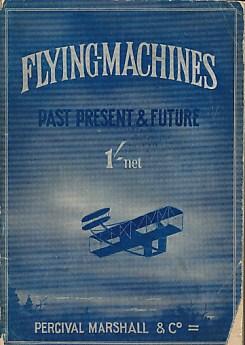
Image result for percival marshall flying machines

I have just picked up a second-hand copy of a third edition of Percival Marshall’s Flying-Machines – Past, Present & Future, as pictured above. Near as I can tell it was published around 1909-1910 and found it utterly fascinating, since every book is written in the present and tells us quite a bit about the time when it was just a newly published text and hardly anything else. What intrigued me most of all was the emphasis given to conjectures about the future. Here are the last three lines of the book:

The experience of the present development of the art of flying, and opinions expressed by aviators, seem to predict that aerial navigation will be the safest of all forms of mechanical transit. Many flights have been made after sunset, practically in the dark. Mr Cody has flown in moonlight, showing that flying machines can be used at night.

In 1909 even flying at night was only a conjecture, a possibility, an aspiration. The author was confident but could hardly be certain. It seems now, just as it was then, that as we try to look ahead, we cannot actually see very far at all. All one can say with certainty is that the future will be nothing like we can imagine it today.

“Obama likes Suleimani, and admires his work”

This is from 2015: Obama Strikes a Deal–With Qassem Suleimani. It’s by Lee Smith from the Hudson Institute.

According to the terms of the Iran deal announced in Vienna on Tuesday, U.N. Security Council sanctions regarding nuclear-related issues will be lifted on a number of entities and individuals—from Iranian banks to Lebanese assassins, like Anis Nacacche. The name that most sticks out is IRGC-Quds Force commander Qassem Suleimani. Administration officials counsel calm, and explain that Suleimani is still on the U.S. terror list and will remain on the terror list. But that’s irrelevant. The reality is that Suleimani is the key to the Joint Comprehensive Plan of Action.

It is all incredible, but this is extraordinary.

Obama likes Suleimani, and admires his work. As the president reportedly told a group of Arab officials in May, the Arabs “need to learn from Iran’s example.”

In fact, they need to take a page out of the playbook of the Qods Force — by which [Obama] meant developing their own local proxies capable of going toe-to-toe with Iran’s agents and defeating them. The president seemed to marvel at the fact that from Hezbollah to the Houthis to the Iraqi militias, Iran has such a deep bench of effective proxies willing to advance its interests. Where, he asked, are their equivalent on the Sunni side? Why, he wanted to know in particular, have the Saudis and their partners not been able to cultivate enough Yemenis to carry the burden of the fight against the Houthis? The Arabs, Obama suggested, badly need to develop a toolbox that goes beyond the brute force of direct intervention. Instead, they need to, be subtler, sneakier, more effective — well, just more like Iran.

Is it stupidity, incompetence or duplicity? Who can tell, but we should be very grateful it is gone for now. With foreign policy such a low-grade issue to at least half the American population, you never know who they will elect for president next. In the meantime, we have to hope they keep the one they now have for the next four years.

But where you will never unravel any of these questions is by reading the daily papers or watching the ABC. This is from the Australian Financial Review today, with this the heading in the paper, but not online: Trump scraps Obama legacy. This is the sub-head in the paper, but again, not the one used online.

“In confronting Iran, the president, driven by a desire to trash his predecessor’s foreign policy record, is determined to prove himself a superior commander-in-chief.”

And in the very middle of the page, the inset quote reads:

“I don’t think it’s too much of a stretch to say the root of much of this is Obama envy.”

It would be nice if these people would stick to foreign policy and lay off the pop-psychology. For what it’s worth, in my view Obama was the worst president in American history, both for domestic and foreign policy. Anyone who cannot at least understand why someone might come to this conclusion should be prevented from commenting on current events.

Progressives and the meaning of progress

https://twitter.com/AlinejadMasih/status/1150105699097161728

Positively incredible. Only “progressives” could believe in the certainty of progress. And of course, for some what exists in 2020 is an improvement on the past. You never know your own future in how the world is built. There are many worse fates than having Donald Trump as president. Many!

And let me draw your attention to a quite good article in The Oz today: Soleimani: For once the virtuous have not been meek. This is how it ends:

For the long term, the challenge for Western governments is how we defend our foreign and domestic interests from these growing networks of state and non-state terrorists. A silent risk is the growing number of people in the West who admire the likes of Soleimani.

As the British geopolitical theorist Halford Mackinder stated: “Democracy refuses to think strategically unless and until compelled to do so for purposes of defence.”

Today that is too slow. We need to wake up to the game being played against our system.

Not just by Iran but Russia and China.

Not to mention all of the “progressives” in our midst.

Cover text comments revised

I am very grateful for the comments on my previous post, ‘Classical Economic Theory and the Modern Economy’ cover text comments, thoughts and suggestions sought with special thanks to Gerry on how to begin the text, which was also the point raised by Tim Neilson. However this is the length they are looking for. This is now my second draft.

‘Classical Economic Theory and the Modern Economy’

If you are interested in how economic theory became the wasteland it has become, this is the book you must read.

It starts with two premises: First, that economic theory reached its deepest level of understanding in the writings of John Stuart Mill and the classical economists of his time, and then, secondly, the author of this book has understood Mill and has accurately explained what the classical school of the late nineteenth century wrote. From these premises, this then follows.

To have any hope of understanding how an economy works, and how modern economic theory became the dead end it has become, this is where you must begin.

The classical economists, and John Stuart Mill in particular, lived through the Industrial Revolution, saw its astonishing economic transformation before their eyes, and explained, so others could understand for themselves, how their prosperity had been created through the emergence of the market economy.

Classical economics was entirely a supply-side theory.

Mill, the greatest utilitarian philosopher of his age, refused to use utility as anything other than a minor element in his theory of value. Mill explicitly and emphatically denied any role for aggregate demand in the creation of employment. In reaching these conclusions, there was no disagreement among the entire mainstream economics community of his time.

First through the Marginal Revolution of the 1870s, and then through the Keynesian Revolution of the 1930s, the entire edifice of classical theory has been obliterated and made virtually incomprehensible to anyone educated in modern economics. From a classical perspective, modern theory is Mercantilist trash.

This book explains why that is and how to understand the classics as they were meant to be understood.

From the comments, I can see that this business about utility among the classical economists is extraordinarily difficult to accept. Of course no one will produce anything that they do not believe they can sell, and no one will buy things that do not satisfy some need or desire.

Perhaps this will provide a clearer understanding which is taken from the text of the book. The heading in bold is my assertion, the quote that follows is by D.P. O’Brien from his 1975 Classical Economics Revisited which was such a tour de force that a second expanded edition was published thirty years later, in 2005. He says throughout his book many of the things I say myself, with only this difference, if it is a difference, that I believe the classics were right about what they wrote where he is only reporting.

The Classical Theory of Value was Not Based on Utility Although Mill was Himself a Utilitarian
“Mill advances a ‘cost of production’ theory of value…. He was not a subjective value theorist…. He treated utility as merely a condition of value.” (p.96)

Both Marginal Utility and Aggregate Demand are demand-side theories that completely divorce an economist from thinking in relation to supply. There is much more to it, but there are no easy points to score against Mill over his cost of production approach to value. He has 17 elements in his overview of the theory of value with this the second:

II. The temporary or Market Value of a thing, depends on the demand and supply; rising as the demand rises, and falling as the supply rises. The demand, however, varies with the value, being generally greater when the thing is cheap than when it is dear; and the value always adjusts itself in such a manner, that the demand is equal to the supply.

This is pretty well all that is taught about supply and demand today and I doubt most economists know much more than that, although we now have diagrams and pages of terminology to explain it all (e.g. “price elasticity of demand” or the distinction between “demand” and “quantity demanded”).

Mill’s first proposition, by the way, is that value is entirely a relative concept. The classics were not trying to explain just the temporary price of the moment, but how the relative price structure across an economy is determined. That is a much much more difficult question and I doubt most economists today have much of a handle on it assuming it is even brought to their attention. It is also a much more important issue than mere price determination of a single product in isolation from the rest of the economy.

For those interested in a classical approach to economic theory, there is the third edition of my Free Market Economics. I think of it as Mill’s Principles for the twenty-first century. It is, unfortunately, absolutely unique.

What would a film critic know about the movies?

As it happens, we went to see the film just last night: ‘Parasite’ Named Best Picture by the National Society of Film Critics. First let me say it was the most watchable film I have seen in a long time. Then let me say it was the most morally incoherent film I have seen in a long time. I will add no spoilers. Will only say it’s worth your time. It was as watchable as the new Starwars is dull beyond imagination. Modern PC has not caught up with Korea while Starwars was so Hollywood that almost from the first second I could tell where the film would end, as it did. You most definitely cannot say that about Parasite. There is even talk that it might win Best Picture at the Academy Awards so others seem to see its moral centre, but that’s Hollywood for you. You’ll have to see the film to know what I mean.

And if you’ve seen Parasite, please include nothing that gives away the story in the comments.

Hysteria in the LA Times

A letter to the editor at the LA Times:

JAN. 4, 2020 3 AM

To the editor: I live in Australia, the country that is now being ravaged by wildfires. As a father and grandfather, I am reaching out in the hope that the lessons of our disaster are not lost on the world.

Our horrific firestorms are the consequence of a long-running drought and the elongation of the fire season, both directly attributable to human-caused climate change. The worst is yet to come, as the costs both economically and environmentally are yet to be accounted, let alone paid.

We have towns that have run out of water and need to bring in drinking water by transport. Major cities have imposed water restrictions. Farmers have no water for crops and livestock.

Currently many of us are suffering under a haze that makes it feel as if we are smoking 80 cigarettes a day. Major sporting events have been canceled. Tourism is suffering as bookings are canceled. Mass evacuations are underway.

We are a nation in great peril and one further imperiled by a leadership enthralled by the lobbying and revenues of mining corporations. We may well become a failed state in time, a once proudly developed nation, the first nation to fall victim to climate change.

Heed our warning. The time to act on climate change is here and it is now. The call is for immediate and urgent action. Please, contact your elected officials and demand action. Make the personal adjustments and sacrifices that climate change demands. Our world is on fire. It is time to act.

Perspectives on the US v Iran

And here’s another perspective!

___________________________Below is the original post
Politics may be the art of the possible, but knowing what’s possible requires calculation and judgement. A bit of the analytics going on in public. The divide over whether the killing of Suleimani should or should not have been done is for the Monday-morning quarterbacks. What is the strategy going forward, and on both sides. Here are some thoughts from others.

From War With Iran?:

Were the United States to place secondary sanctions on all manner of goods, especially food, the effect would be far greater than an invasion by the entire U.S. army. How the Iranian people would deal with the choice between starving and ending their government’s war on America would be their business.

From Iranian Analytics:

Trump’s base accepts that he is backing out of the Middle East firing, not firing to get in…. The current Iranian crisis is complex and dangerous. And by all means retaliation must be designed to prevent more Iranian violence and aggression rather than aimed at a grandiose agenda of regime change or national liberation. But so far the Iranians, not the U.S., are making all the blunders.

From Attack on Qassem Soleimani was deterrence, not escalation:

Iran knows it faces a choice it didn’t think it faced before. It can vow hellish revenge, but now it has had a taste of the hell the United States can rain down in response. And while the mullahs are extreme, they do not appear to be imprudent. Ruthless self-interest might have gotten them going in the first place, and it is what might restrain them in the end. That is how deterrence works. And that is the bet Trump and the United States made by letting the Iranians know we were not going to take their aggression lying down.

From Targeting Soleimani: Trump was justified, legally and strategically:

A congressional authorization of military force would strengthen the president’s hand. It would not require that force be used (or at least used to the full extent of the authorization), but it would show our enemies that our nation is ready to act in our defense. The strategies of Trump’s predecessors were to hope that a committed jihadist enemy would come to its senses; hope that it would realize its purported interest in regional stability; and hope that by bribing it with billions of dollars in sanctions relief, ransom, and an industrial-strength nuclear program, we could de-escalate the conflict. President Trump’s strategy is to remove the enemy’s most effective military asset (who will not be easily replaceable), to demonstrate to the mullahs what can happen when resolve backs our exponentially superior capabilities, and to continue squeezing the regime with punishing economic sanctions — as it is pressured by the increasingly restive Iranian people. Peace through strength is the better plan.

From Trump Calls the Ayatollah’s Bluff:

Deterrence, says Fred Kagan of the American Enterprise Institute, is credibly holding at risk something your adversary holds dear. If the reports out of Iraq are true, President Trump has put at risk the entirety of the Iranian imperial enterprise even as his maximum-pressure campaign strangles the Iranian economy and fosters domestic unrest. That will get the ayatollah’s attention. And now the United States must prepare for his answer. The bombs over Baghdad? That was Trump calling Khamenei’s bluff. The game has changed. But it isn’t over.

From Iranian Revenge Will Be A Dish Best Served Cold:

For many analysts and observers, Iran and the U.S. are on the cusp of a major confrontation. While such an outcome is possible, the reality is that the Iranian policy of asymmetrical response to American aggression that had been put in place by Qassem Suleimani when he was alive is still in place today. While emotions run high in the streets of Iranian cities, with angry crowds demanding action, the Iranian leadership, of which Suleimani was a trusted insider, recognizes that any precipitous action on its part only plays into the hands of the United States. In seeking revenge for the assassination of Qassem Suleimani, Iran will most likely play the long game, putting into action the old maxim that revenge is a dish best served cold….
Trump started this fight by recklessly ordering the assassination of a senior Iranian government official. The Trump administration now seeks to shape events in the region to best support a direct confrontation with Iran. Such an outcome is not in Iran’s best interests. Instead, they will erode Trump’s political base by embarrassing him in Iraq and with ISIS. Iran will respond, that much can be assured. But the time and place will be of their choosing, when the U.S. expects it least.

For myself, I see no point in absorbing punishment to show good will. But that is only a first approximation. We here know virtually nothing of what is known both in Washington and Teheran. This is where we are and this is what these analysts think, but the future remains unknown as it always is. The only certainty is that whatever Trump does the Democrats, and the media, will insist it was the wrong thing to have done.

Plus this: PETRAEUS ON SOLEIMANI:

Two short questions for what’s next, Gen. Petraeus — US remaining in Iraq, and war with Iran. What’s your best guess?

Well, I think one of the questions is, “What will the diplomatic ramifications of this be?” And again, there have been celebrations in some places in Iraq at the loss of Qasem Soleimani. So, again, there’s no tears being shed in certain parts of the country. And one has to ask what happens in the wake of the killing of the individual who had a veto, virtually, over the leadership of Iraq. What transpires now depends on the calculations of all these different elements. And certainly the US, I would assume, is considering diplomatic initiatives as well, reaching out and saying, “Okay. Does that send a sufficient message of our seriousness? Now, would you like to return to the table?” Or does Iran accelerate the nuclear program, which would, of course, precipitate something further from the United States? Very likely. So lots of calculations here. And I think we’re still very early in the deliberations on all the different ramifications of this very significant action.

And this: Lindsey Graham Has a Message for Iran: If They Retaliate, We Will Hit What They Can’t Afford to Lose:

“To the Iranian government: If you want to stay in the oil business leave America and our allies alone and stop being the largest state sponsor of terrorism in the world,” he continued. Boom. If they lose that, they know they will completely collapse and their own people will run over them.

Comments, thoughts and suggestions welcome

You may have noticed my lack of regard for modern economic theory which the following might help you understand more clearly. This is the draft of the cover text for the book I have just completed and sent off to the publisher. Comments, thoughts and suggestions would be welcome. My disdain for Keynesian economics I have discussed on many occasions. My attitude to “marginal” analysis I mention far less often which is why certain passages below are highlighted in bold.

‘Classical Economic Theory and the Modern Economy’

The book starts with two premises: First, that economic theory reached its deepest level of understanding in the writings of John Stuart Mill and the classical economists of his time, and then, secondly, the author of this book has understood Mill and has accurately explained what the classical school of the late nineteenth century wrote. From these premises, this then follows.

If you are to have any hope of understanding how an economy works, and how modern economic theory became the dead end it has become, you will need to read this book.

The classical economists, and John Stuart Mill in particular, lived through the Industrial Revolution, saw its astonishing economic transformation before their eyes, and explained, so others could understand for themselves, how their prosperity had been created through the emergence of the market economy.

Mill, the greatest utilitarian philosopher of his age, refused to use utility as part of his theory of value. Mill explicitly and emphatically denied any role for aggregate demand in the creation of employment. In reaching these conclusions, there was no disagreement among the entire mainstream economics community of his time.

First through the Marginal Revolution of the 1870s, and then through the Keynesian Revolution of the 1930s, the entire edifice of classical theory has been obliterated. From a classical perspective, modern economic theory is Mercantilist trash nonsense. If you are interested in how economic theory became the wasteland it has become, and wish to understand the classical theory no one any longer has the slightest clue about, this is the book you must read.

If you are interested in understanding all this more completely, you will have to read the entire book when it is finally published sometime this year.