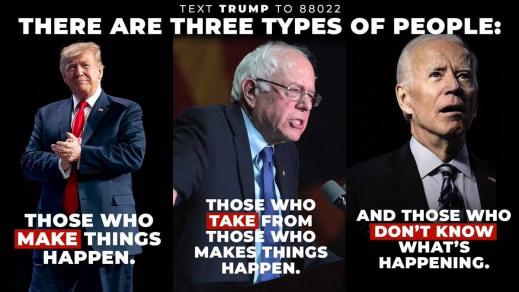
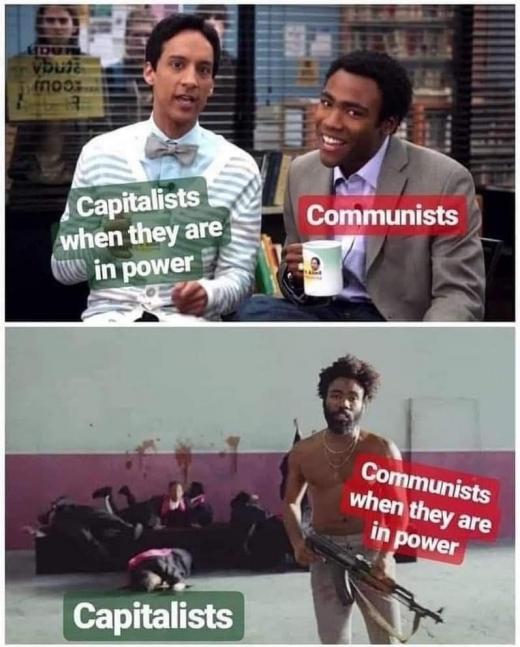
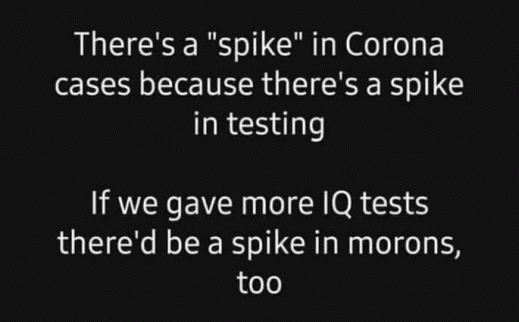
Kristi Noem for president (in 2024)

And Tom Cotton for VP. Watch it through. If you start, you will get to the end, and it is half an hour long.

She gets it in a way almost no one else does, other than Donald Trump. And the “it” that she gets are the principles of both political freedom and economic freedom and how these should be melded into dealing with the Covid-1984, What’s more, with her you get Donald and Melania all in a single package.

Watch the vid and then check out its source: POSTED ON JULY 8, 2020 BY JOHN HINDERAKER IN CONSERVATISM, CORONAVIRUS, REPUBLICANS CHECK OUT ONE OF THE GOP’S BRIGHTEST STARS.

Copy to Scott Morrison, Daniel Andrews and especially Michael O’Brien (who?). O’Brien especially needs to learn the principles necessary to make the case against Dangerous Dan. As for Scott, see CL on Speak for Yourself.

Mostly empty (MMT)

There are a lot of cranks in economics, and it only gets worse all the time. I have been sent a copy of this editorial in The Oz yesterday which is a reminder of just how off the rails economists are: The promise and pitfalls of Modern Monetary Theory. The final para:

MMT certainly has theoretical appeal, even for rational, hard-nosed economists. It’s axiomatic there is no budget constraint in such a model. But we live in a complex, even messy world. Imagine telling a populist National, a clueless Green or a Labor class warrior there is no spending limit. How can you hope to manage the economy? … As an analytical tool the theory has merit. But with printing money in the real world, there is a day of reckoning or just a long stagnation. Our income can never be guaranteed, so we need to earn and pay our way.

They seem to come down against it, but only just, and hardly in a way that might alert you that any genuine application of MMT will wipe out cash-denominated savings, along with driving our economy into a wasteland of unproductive outlays. Living standards would be guaranteed to crash. Yet with government debt that way it is everywhere, why not just print the stuff up. No political leader lasts for ever. Leave things to the next lot to fix.

Economists once understood what the problem with such an approach actually is, as discussed in my Classical Economic Theory and the Modern Economy. As discussed at length within the book, until 1936 economists always first thought about the real economy and then, but only then, brought in money at the end. Here is the turning point in economic theory. From The General Theory itself where the approach taken by Mill is to examine the issues in relation to commodities and not money.

In J. S. Mill’s Principles of Political Economy the doctrine is expressly set forth:

What constitutes the means of payment for commodities is simply commodities. [That’s Say’s Law, by the way.] Each person’s means of paying for the productions of other people consist of those which he himself possesses. All sellers are inevitably, and by the meaning of the word, buyers. Could we suddenly double the productive powers of the country, we should double the supply of commodities in every market; but we should, by the same stroke, double the purchasing power. Everybody would bring a double demand as well as supply; everybody would be able to buy twice as much, because every one would have twice as much to offer in exchange. [Principles of Political Economy, Book III, Chap. xiv. § 2.]

Contemporary economists, who might hesitate to agree with Mill, do not hesitate to accept conclusions which require Mill’s doctrine as their premise. The conviction, which runs, for example, through almost all Professor Pigou’s work, that money makes no real difference except frictionally and that the theory of production and employment can be worked out (like Mill’s) as being based on ‘real’ exchanges with money introduced perfunctorily in a later chapter, is the modern version of the classical tradition.

I might add that money was hardly introduced “perfunctorily”. Mill even explicitly states the quantity theory of money. Virtually no one today any longer thinks in real terms. In fact, virtually no one, especially economists, even know how to think in real terms – they think they do but they don’t. It’s why they are incapable of understanding even the basics that were once universally taught and understood. That is why our economies are heading straight for the rocks.

Even if you already understood Daniel Andrews is an incompetent fool wait till you read this

Johannes Leak 20200707

I do have to say I am pleased to learn there is still an Opposition party in Victoria. The following is from Tim Smith, the Liberal member for Kew. There is an awful lot there that you normally never hear about that really is sickening. From The Oz, in full because you need to read it all to believe it.

Victorians are officially the pariahs of the nation, with NSW closing the state border. We Victorians are literally banned from the rest of our country. The border closure is a stiff economic penalty for regional communities along the Murray River, which are being punished for the negligence of Daniel Andrews and his ministers to manage hotel quarantine.

We also have 3000 residents of nine public housing estates under house arrest and the rest of our suburbs and an adjoining shire back to stage-three lockdown because Andrews decided to use bouncers who fraternised with returned travellers in quarantine and spread the virus into the northern and western suburbs of Melbourne. The government proposes replacing private security with a mixture of prison officers and laid-off staff from Qantas and Jetstar to manage the mess. You couldn’t make this up.

The commonwealth offered the deployment of the Australian Defence Force, for free, to the states for the task of managing hotel quarantine. Every state that accepted this offer has not had one single transmission of the virus.

For ideological reasons Andrews’s gang-of-eight COVID cabinet refused the commonwealth offer, instead hiring private security. This turned into a fiasco with national implications and the three ministers responsible — Martin Pakula, Jenny Mikakos and Lisa Neville — should all have lost their jobs. It goes without saying that the Premier should resign.

In any case, why was Pakula, the Jobs Minister, and his department put in charge of co-ordinating hotel quarantine? Here’s a clue: many of the untrained and ill-equipped private security guards are members of Pakula’s union, the NUW/United Voice.

Equally odd was a sequence of events from June 25 when a panicked request was sent by the Victorian government to the ADF for immediate assistance with hotel quarantine. The next day Defence Minister Linda Reynolds told Melbourne radio: “Last night we received a request from the Victorian government … we’re looking to rapidly mobilise 1000 ADF personnel to be on the job from tomorrow in support of Victoria.”

By the following day, that request had been rescinded. A ludicrous turf war had erupted between the Police Minister and the Health Minister, and finally Andrews caved in. Yet on July 1, when Neville fronted Neil Mitchell’s 3AW radio program, he asked if “at any stage early, was it ever discussed, the possibility of bringing in the Australian Defence Forces to run quarantine, as happened in NSW?”. She said “no”. Surely she knew this was not correct, and if she has misled voters she should resign or be sacked.

Senior Department of Health bureaucrats, including Chief Health Officer Brett Sutton, were warned of problems with hotel quarantine as far back as April but Sutton distanced himself from it.

“It (the decision) wasn’t mine, I haven’t been involved in the governance and operation,” he has been quoted as saying. “But it was jointly oversighted by emergency management within the Department of Health and Hum­an Services, Emergency Management Victoria and Department of Jobs Precinct and Regions.”

Health Minister Mikakos and Pakula — jointly responsible for this fiasco — should resign, but no one in the Andrews government is willing to take responsibility for this recklessness. There is an inquiry being undertaken by a former judge — a political tactic to deflect questioning, and the findings won’t be known for months.

The Jeff Kennett-led Liberal Party won the 1992 state election with the slogan the “Guilty Party”. Back then Labor had bankrupted the state and trashed its reputation. Fast-forward 28 years and this state Labor government has done it again. It is guilty of this second wave of COVID-19 and Labor’s negligence will set our economy back years.

And as hard as it is to believe, the Daniel Andrews lot is even worse than the last lot. And the damage will be even greater this time than last time.

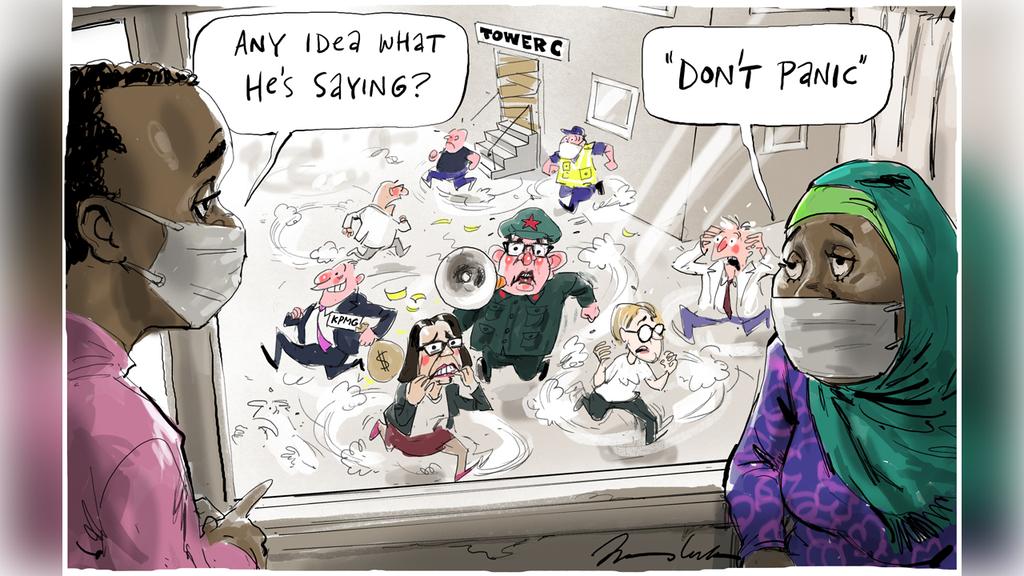
The dumbest kid in his class

I’ve just started writing a children’s book whose first line reads:

“Daniel was the dumbest kid in his class.”

From there it just seems to roll along. My aim is to immortalise incompetence. Victoria may be one of the few jurisdictions in the world that has had to ramp up its restrictions. Certainly no one else in Australia has had to. What an unbelievable buffoon! And so far as I can tell, he accepts no responsibility for any of it. He should at least say something along the lines of how sorry he is. No chance of that!

But what remains worst of all, most people seem grateful.

LATEST NEWS: Victoria lockdown may cost $1bn a week! How do such people get elected?

You do know that an increase in the GST from 10% to 12.5% would mean a 25% increase in tax revenue

At the moment the GST is 10%. On $1000 there is therefore a tax of $100. If the tax is raised to 12.5%, on $1000 the tax would be $125. $125 is 25% higher than $100. The increase is not 2.5%. It is 25%. We would be mad to allow this to happen. Which brings me to this in today’s paper: Lifting GST rate is critical for meaningful tax reform, economists say.

Reforming the GST, including lifting the rate to 12.5 per cent, is critical to boosting economic and productivity growth and could raise between $14bn and $40bn a year, consulting firm PwC says.

This is the same kind of expertise that forecast thousands of deaths from the coronavirus. Do not go anywhere near allowing anyone, State or Federal, to raise our taxes. Let me quote Judy Sloan, also in The Oz today: Don’t waste time on tax: It’s spending that matters. Here Judy is referring to the advice from “former department head Jane Halton”:

Unless the GST or other taxes are increased [Ms Halton says] we won’t be able to afford the public services we apparently all desire. We are approaching a cliff, according to her, and unless something is done, devastation awaits. This is a common refrain from the Canberra bubble.

Judy concludes:

The real pity is that there haven’t been many (any?) reports about expenditure reform. The billions of dollars of government spending that are just wasted and the broader failure to achieve the stated objectives of programs — now those are issues worth considering.

Do not let anyone raise our taxes. We would be mad to let them do anything that allows governments to waste even more money than they already do.

It’s either a wage-based economy or slavery

It must be one or the other. There is no third way.

There are only two ways you can get other people to work for you.

You either hire people and pay them a wage.

Or someone owns their labour and commands them to do what they do.

The first form is called the market system. The second is referred to as slavery although in the modern world there are various forms of disguise. But if things need to be donem you must have one or the other.

It is only where we have a market economy that freedom is even possible. The loons of the left wish to replace the market economy with socialism, which for all practical purposes means a return to a slave-based economy.

Every socialist economy must ultimately resort to some form of forced labour with fake versions of market economy. Socialist economies are those in which workers are allocated to the jobs they do in a society with a virtual absence of personal freedom. There are also no private employers so that everyone works for the government. And since there is no private enterprise, all production is decided by the government. And since there is no market economy for the purchase and sale of anything, all production decisions are made by central planners. And since there is no price system, no one can work out which is the least wasteful form of production.

So not only does socialism mean a return to poverty at levels not seen for hundreds of years, it also means all forms of work are forms of slave labour.

It is inevitable and cannot be avoided.

“Time for a class action by the people of Australia against Daniel Andrews”

This may be the longest letter to the editor I have ever seen at the Oz. And it’s right on the money.

History may be repeating itself. According to the National Museum of Australia, the 1918-19 flu pandemic started in Australia in Melbourne, in January 1919, and then spread to the rest of the country after the Victorian health authorities were slow to react.

Why have things gone wrong this time? It is hard to go past the conclusion that, encouraged by their Government, people in Victoria Health have not been paying attention to what should be their core duties.

If we start with Brett Sutton, the Chief Health Officer, we find that he was the main author of a paper in the Medical Journal of Australia published in May. Did this, for example, deal with ways of shortening long waiting lists or preventing people with psychiatric illness becoming homeless? Not at all. Instead, the hospital system was seen, not as a place to look after the sick, but a big polluter: “In 2018–19 every occupied bed-day in a Victorian public hospital generated on average 120kg of carbon dioxide equivalents and 3.65kg of waste, and used 630L of water.”

And it’s not just Australia’s sick contaminating the planet: “If the global health sector were a country, it would be the fifth‐largest greenhouse gas emitter on the planet.” And the plan to improve the hospital system? “It requires all public hospitals and health services to have an environmental management plan and report publicly on their environmental performance.”

Then we have Dr Annaliese van Diemen, Deputy Chief Health Officer (Communicable Disease), sending a tweet in the midst of the pandemic to the effect that James Cook was “an invader from another land, decimating populations, creating terror”.

It may be said that people in Victoria Health are intelligent people who can do two things at once, but the evidence does not support this. How do we prevent this happening again? Make people do their job and not grandstand. If the virus does now take hold, it might also be time for a class action by the people of Australia against Daniel Andrews and the Victorian Health Department, run by Maurice Blackburn, of course.

Paddy Grattan-Smith, Matraville, NSW

Andrews is the most incompetent political leader I have ever witnessed in all the years since I arrived in Australia. He has ruined Victoria’s economy, and with his role in “the National Cabinet” he has done much to wreck much else as well. What do we know about his agreements with the Chinese? What is the actual off-the-books level of debt in still uncompleted road and rail constructions? He can talk the talk, but is so far out of his depths in everything he deals with that had he set out to deliberately ruin the place he could not have done a better job.

My missing reply to Roy Grieve

Getting an anti-Keynesian article published is very difficult. The following is an interesting parable of our times. There are lots of additional details left out here, but this captures the essence of the story. This short note will be published in the forthcoming issue of the History of Economics Review along with the article by Roy Grieve which I had been asked to reply to.

A Note on My Missing Reply to Roy Grieve
Steve Kates

It is quite a shame the article I had written in reply to Roy Grieve’s will not be published along with his. When his paper was submitted in 2018, I was asked by the editor to write a reply which I quite happily did. Thereafter, I heard nothing for two years until I was told what I had written was not suitable, would not be published, and was offered a truncated version of my paper that I could include instead.

The problem with my paper I was told was that I did not address the core issue Roy had raised which was the wages fund. Since Roy was replying to a paper I had written, the probability that I might have a better idea of what the issues are ought to be seen as extremely high. The editor nevertheless continues to believe the central issue is the wages fund. Since the paper Roy was replying to is titled, ‘Mill’s Fourth Fundamental Proposition on Capital: A Paradox Explained’ (Kates 2015), that ought to be recognized as the issue we were debating. In my reply to the editor, I made it clear the wages fund had nothing to do with Mill’s argument, nor did I wish to contribute further. Mill’s proposition by the way, if true, completely undermines Keynesian economics and modern macro. In Mill’s words, ‘demand for commodities is not demand for labour’ – increases in aggregate demand do not lead to increases in employment.

Roy understood that leaving out my paper diminished the impact that having his paper and my reply together would have had. He therefore wrote to the editor to suggest I add something on the wages fund. And I agreed. I wrote to the editor and said that I was prepared to write an article along these lines:

1. The wages fund has nothing of significance to do with Mill’s Fourth Proposition on Capital.
2. The ‘wages fund’, if understood properly, makes perfect sense.
3. The wages fund, if understood properly, is even an integral part of modern economic theory.
4. Much of the difficulty in understanding the classical view on the wages fund is due to the shifts in terminology since the middle of the nineteenth century.

The final point is the theme of my latest book, Classical Economic Theory and the Modern Economy (Kates 2020a), where all this is discussed more generally. In the end, I have been offered these 600 words. You cannot therefore see within the pages of the journal either my response to Roy or my explanation of the wages fund in modern terms.

Let me therefore add this. I admire Roy’s paper which does something almost never seen. He explains my argument in defending Mill, not only understanding exactly what I had written but also understanding Mill’s argument to near perfection. He nevertheless argues in his paper Mill’s Fourth Proposition depended on the wages fund, so that when Mill abandoned the wages fund in 1869, he had pulled the rug out from under his own Fourth Proposition. If you read my reply to Roy, you will see that I do not agree.

You can read my original reply to Roy at SSRN (Kates 2020b). My explanation of why the wages fund is even to this day embodied within modern economic theory will have to remain a mystery.

Steve Kates
steve.kates@gmail.com
Submitted 11 June 2020

References

Kates, S. 2015. ‘Mill’s Fourth Fundamental Proposition on Capital: A Paradox Explained.’ Journal of the History of Economic Thought 37 (1): 39–56.

Kates, S. 2020a. Classical Economic Theory and the Modern Economy. Cheltenham, UK: Edward Elgar.

Kates, S. 2020b. ‘The Single Most Important Issue in Economics Today: A Reply to Roy Grieve on Mill’s Fourth Proposition on Capital’. SSRN.