Molotov cocktails should neither be shaken nor stirred but thrown

spelling0nt.png

The interesting part is not that whoever did this screen shot had never heart of a molotov cocktail but that in trying to conjure up the correct term, headed towards an anti-semitic meme. To help our journalists who officially know nothing.

The name “Molotov cocktail” was coined by the Finns during the Winter War,[1] called in Finnishpolttopullo or Molotovin koktaili. The name was a pejorative reference to Soviet foreign minister Vyacheslav Molotov, who was one of the architects of the Molotov–Ribbentrop Pact signed in late August 1939. The pact with Nazi Germany, which established that Germany would not intervene in the war, was widely mocked by the Finns.

The name’s origin came from the propaganda Molotov produced during the Winter War, mainly his declaration on Soviet state radio that bombing missions over Finland were actually airborne humanitarian food deliveries for their starving neighbours.[2] As a result, the Finns sarcastically dubbed the Soviet cluster bombs “Molotov bread baskets” in reference to Molotov’s propaganda broadcasts.[3] When the hand-held bottle firebomb was developed to attack Soviet tanks, the Finns called it the “Molotov cocktail”, as “a drink to go with his food parcels”.[4]

Alternatives are petrol bomb or in the United States, gasoline bomb. The irony is lost, but at least there would be some precision in what is being referred to.

Demanding justice

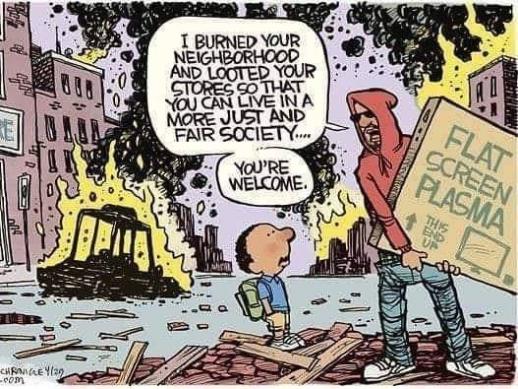
To demand “justice” is demanding an abstraction with no concrete specifics. Let me turn to this from The Atlantic, another American lunatic left-side publication: America Is Giving Up on the Pandemic. Turns out that the Corona V was a bust as a certain means to defeat Donald Trump so the American left is off on another tangent:

After months of deserted public spaces and empty roads, Americans have returned to the streets. But they have come not for a joyous reopening to celebrate the country’s victory over the coronavirus. Instead, tens of thousands of people have ventured out to protest the killing of George Floyd by police.

Demonstrators have closely gathered all over the country, and in blocks-long crowds in large cities, singing and chanting and demanding justice. Police officers have dealt with them roughly, crowding protesters together, blasting them with lung and eye irritants, and cramming them into paddy wagons and jails.

So what’s the next step on the road to Justice? After all, some kind of practical suggestion is required to bring us closer to nirvana. Here we go:

Majority of Minneapolis City Council signs pledge to disband police department.

NRCC turns up heat on vulnerable Democrats over [Ilhan] Omar’s call to abolish police. 

NYC Mayor de Blasio plans to defund the police.

The only symptoms of disease I see are symptoms of insanity. Alas, there is no cure other than a dose of reality but by then it will be too late.


The Corona Virus Syndrome Q&A

What is the Corona Virus Syndrome
Feelings of trust or affection felt in many cases by those who have been forced into a lockdown by these victim towards those who have enforced the lockdown

Corona Virus syndrome is a psychological response which occurs when individuals who are forced into lockdown situations bond with those who have enforced self-isolation and quarantine. This psychological connection develops over the course of the days, weeks, months, or even years of being locked down and being deprived of freedom and rights.

Corona Virus Syndrome is a coping strategy which individuals who are put into lockdown may develop. Fear or terror of developing some disease that is empirically almost certain not to harm them might be most common in these situations, but some individuals begin to develop positive feelings toward those have introduced and have been enforcing the lockdown.

Is the Corona Virus Syndrome a form of brainwashing?
The idea of brainwashing not being a new concept does have many similarities. The reactions of those in lockdown may be described as the result of being brainwashed by their captors.

Is ‘political trauma bonding’ the same as the Corona Virus Syndrome?
The term ‘political trauma bond’ is one of the major forms of the Corona Virus Syndrome. It describes a deep bond which forms between the victims of a lockdown and their political abusers. Victims of such abuse often develop a strong sense of loyalty towards their political abuser, despite the fact that the bond is damaging to themselves emotionally and economically.

What does political trauma bonding mean?
A simple and more encompassing definition is that political traumatic bonding is: “a strong emotional attachment between an abused person in a lockdown situation and his or her political abuser.”

What does political trauma bonding feel like?
‘Political trauma bonding’ refers to a state of being emotionally attached not to a kind friend or family member, but to a political leader who puts individuals into lockdown by asserting that such a lockdown will provide longer-term benefits in spite of the short-term harm to their lives.

Can Corona Virus Syndrome be cured?
Since a person may have experienced mental, emotional and physical abuse during the period of a lockdown, it may take years for the victim to see improvement.

How do you break the cycle of political trauma bonding?

     10 Ways to break ‘political traumatic bonding’:

  1. Recognise that political leaders have agendas of their own that have nothing to do with your welfare.
  2. Stop being terrified about politicised issues whose dangers seem highly exaggerated.
  3. Start reality training both about such politicised issues and about the political leaders who promote them.
  4. Ask good questions and make certain the answers are consistent with the actions being taken. Remember the first priority for political leaders is personal power not your welfare.
  5. Do some personal research, and especially among those authorities who take a different position from the positions being taken by political leaders.
  6. Do everything you can to end lockdowns as soon as possible.
  7. Get out of the house, discuss what is being done with others and start socialising.
  8. Put your focus on common sense.
  9. Learn to read and interpret statistics.
  10. Identify political hypocrisy wherever you find it.

Are there any other similar syndromes?
There are a number of other such syndromes. These include the Global Warming Syndrome and the Socialist Central Planning Syndrome.

George Floyd cause of death

From Just Like That, Gun Control Support and COVID-19 Died This Week, focusing on the least significant element in the politics of Black Lives Matter and the death of George Floyd.

The Purported Trigger: The Death of George Floyd

George Floyd was arrested in Minneapolis for passing a counterfeit bill. He was a big man with a record of assaults and drug use. A video of his arrest shows he was handcuffed and seems to have resisted being placed in the squad car. We see him being pinned down on the ground by Officer Chauvin’s knee. He seems to be wrestling about on the ground and talking. Soon after he stops moving an emergency medical van appears and he is removed from the scene. He was reportedly dead by the time they arrived. At least one report says the officers called for medical assistance early in the arrest when Floyd said he couldn’t breathe. Is the video the best evidence of what occurred? No. The best evidence is the footage taken from the body cams worn by the four officers on the scene; evidence Minneapolis authorities have failed to disclose. If your impression from the video or Dr. Biden’s interview (the examiner hired by the Floyd family) is that Floyd was asphyxiated, the only forensic evidence shows that he was not. The medical examiner, who was the only person to have conducted an autopsy, indicates Floyd was not asphyxiated. Here are the key findings in his report.

He had

1. Arteriosclerotic heart disease, multifocal, severe

2. Cardiomegaly (540 g) with mild biventricular dilatation

3. Clinical history of hypertension

There were

“No injuries of anterior muscles of neck or laryngeal structures” and “No facial, oral, mucosal, or conjunctival petechiae” (These are tiny red marks that are important signs of asphyxia caused by airway obstruction. If there had been any, it might indicate death by strangulation, hanging or smothering. )

He also tested positive for COVID-19.

Even more striking are the autopsy toxicology findings. In his system they found:

1.Fentanyl 11 ng/mL.

2.Norfentanyl 5.6 ng/mL

3.4-ANPP 0.65 ng/mL

4. Methamphetamine 19 ng/mL

5. 11-Hydroxy Delta-9 THC 1.2 ng/ml

6. Cotinine positive

7. Caffeine positive

In sum, he was high on drugs at the time of his death. The fentanyl itself was four times the level known to cause fatalities, reports Paul Sperry, and on top of that he had speed and marijuana in his system. The arresting officer said he was foaming at the mouth and a close look at the video indicates this was so. Interestingly, none of the charges against any of the officers claim Floyd’s death was intentionally inflicted.

Interesting, of course, but politically irrelevant. Here’s just a bit more:

Given the huge drug load in Floyd’s system, we might also look at what is called “excited delirium” about which Officer Chauvin expressed concern when he restrained Floyd. Mark Wauck explains:

The Western Journal of Emergency Medicine says that
“Excited delirium is characterized by agitation, aggression, acute distress and sudden death, often in the pre-hospital care setting. It is typically associated with the use of drugs. Subjects typically die from a heart attack and the majority of the patients die before hospital arrival.”

“All accounts describe almost the exact same sequence of events: delirium with agitation (fear, panic, shouting, violence and hyperactivity), sudden cessation of struggle, respiratory arrest and death.”

Once again, the body camera footage showing the initial encounter, discussions among officers and the call to paramedics about the issue of excited delirium will be a major factor in this case.

I don’t relate these things for you to judge what happened. That’s why we have trials and why we don’t, like ancient Romans, condemn men based on their performance in the coliseum (now replaced by the media circuses). That’s the very point of our legal system. People demanding instant retribution are simply modern-day advocates for lynching. Pundits right and left calling his death “murder” might take some time to look at the autopsy report and wait for the body cam footage. These things will certainly be evidence at trial, a long time after the perfervid reporting and the response to it.

And what difference does any of this make to anyone? But now go to the link and read it all.

Led by credulous morons

Coronavirus crisis projected to add $620bn to Australia’s net debt, PBO says.

Australia’s legacy of the COVID-19 crisis will be additional net debt of up to $620bn by the end of this decade, while the budget deficit will peak at nearly $200bn in the next financial year and will remain in deficit through to 2030, according to new Parliamentary Budget Office projections.

And if nothing else was proven today, everyone now knows with certainty that the lockdown past the first few weeks had nothing to do with public health and safety. Every political leader still enforcing the lockdown is only doing it to save them from the humiliation of being recognised as such credulous nitwits.

Candace Owens and George Floyd

Which might be coupled with this: Report: Full autopsy of Mr. Floyd: 4x amount of fentanyl needed to kill, also meth and pot. Serious side effects of fentanyl include:

  • Serious breathing problems. Symptoms can include:
    • very shallow breathing (little chest movement with breathing)
    • fainting, dizziness, or confusion
  • Severely low blood pressure. Symptoms can include:
    • dizziness or lightheadedness, especially if you stand up too quickly

Classical economics and the unemployment rate in the United States

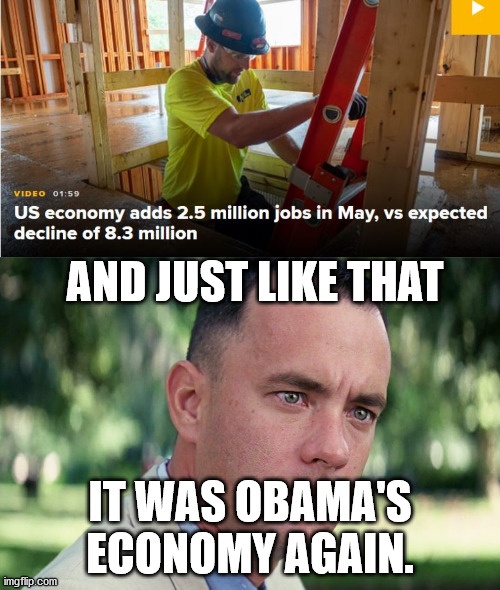
As anyone who understands classical economic theory would understand – which might include around half a dozen people across the world today – “demand for commodities is not demand for labour”. That is John Stuart Mill’s Fourth Fundamental Proposition on Capital. The number of jobs in an economy is unrelated to the level of aggregate demand. This, I need hardly tell you, is in direct contradiction of the whole of modern macroeconomic theory. Which brings us to the latest jobs report in the United States. U.S. Economy Adds Record 2.5 Million Jobs in May, Unemployment Rate Falls to 13.3%.

The U.S. Bureau of Labor Statistics (BLS) reported the U.S. economy added 2.5 million jobs, the largest gain ever recorded and the unemployment rate fell to 13.3 in May.

Well economic good news of such a colossal dimension cannot be allowed to stand on its own so this is what the media reported on instead: Fake News: Media Rush to Decry Trump Quote on George Floyd During Jobs Report Presser – Except He Didn’t Say It

President Trump held a press conference/signing ceremony today at the Rose Garden where he talked about the good news revealed by the BLS’s report before signing a bill that will “give recipients of government small business loans during the coronavirus more flexibility in how they spend the money.”

During the speech he gave before signing the bill, Trump also talked about a number of issues including racial equality in the context of the death of George Floyd last Monday, which happened after Minneapolis police officer Derek Chauvin had his knee on Floyd’s neck for nearly 9 minutes.

CBS News is one of the few news outlets that actually reported Trump’s comments accurately while providing some context:

But black unemployment rose slightly from 16.7% in April to 16.8% in May, in a month the president declared a “tribute to equality” as the nation protests racial discrimination and police brutality. Mr. Trump also seemed to declare success after a week of protests that swept the nation.

“Equal justice under the law must mean that every American receives equal treatment in every encounter with law enforcement, regardless of race, color, gender or creed, they have to receive fair treatment from law enforcement,” the president said. “They have to receive it. We all saw what happened last week. We can’t let that happen. Hopefully, George is looking down right now and saying this is a great thing that’s happening for our country. This is a great day for him, it’s a great day for everybody. This is a great day for everybody. This is a great, great day in terms of equality.”

See for yourself.

Wouldn’t have mentioned it except this media lie was the first thing said to me by my wife this morning.

For added pleasure, you might also wish to read this as well: Paul Krugman Caught in Hilarious Self-Own After Furiously Spinning Conspiracy Theories About Good Jobs Report.

Disbanding the police is all the rage

Impossible you say. Start here: Going All-In: Minneapolis City Council Considers Disbanding Entire Police Force…. Insane, right?

This “community policing” process is already taking place in many European communities the results create what are known as “no go zones.” Neighborhoods, and entire parts of cities, where local Sharia compliance enforcement officers have replaced the police force; and the rules, regulations and enforcement are detached from the larger social compact. Considering that Minneapolis has a large concentration of Somali Muslims within the local population, it makes sense this approach is now discussed for their city.

Minneapolis – […] Now the council members are listening to a city that is wounded, angry, fed up with decades of violence disproportionately visited upon black and brown residents. Various private and public bodies – from First Avenue to Minneapolis Public Schools – have essentially cut ties with the police department. Council members are trying to figure out what their next move is.

Their discussion is starting to sound a little more like what groups like Reclaim the Block and the Black Visions Collective have been saying for years. On Tuesday, Fletcher published a lengthy Twitter thread saying the police department was “irredeemably beyond reform,” and a “protection racket” that slows down responses as political payback.

“Several of us on the council are working on finding out what it would take to disband the Minneapolis Police Department and start fresh with a community-oriented, nonviolent public safety and outreach capacity,” he wrote. (read more)

Minnesota Attorney General Keith Ellison, the man now in charge of the prosecution of Derek Chauvin and the Minneapolis police officers involved in George Floyd’s death, is a very well known Muslim activist and supporter of the sharia doctrine.

And then this: Australia: Muslim leader says riots an “opportunity” for Muslims to seize global leadership and impose Sharia.

Australia: Muslim leader says riots an “opportunity” for Muslims to seize global leadership and impose Sharia

Meanwhile, non-Muslim leaders in the West demand that we all accept that no Muslims, no, not one, want to impose Sharia in Western countries, and declare that anyone who thinks otherwise is a greasy Islamophobe, a “fearmonger.”

“‘We will take over’: Australian leader of extremist Islamic group says US riots are an ‘opportunity’ for Muslims to seize global leadership and impose Sharia law,” by Stephen Johnson, Daily Mail Australia, June 3, 2020:

A controversial Muslim preacher is predicting Islam will replace the United States as the world’s dominant geopolitical force.

Ismail al-Wahwah, the Australian spiritual leader of hardline Islamist group Hizb ut-Tahrir, has suggested riots across the US would bring down the global superpower.

‘Who will take over if America fall?,’ he said a video on Wednesday night.

‘Someone can say Europe, someone can say China, speak about Russia some, but for me the message is, the one who have more values, true values, and that’s us Muslims.

‘I would be hypocrite if I say I’m not happy for what’s happening in America today.’

Mr al-Wahwah described the violent mass demonstrations across the US as an opportunity for Muslims to exploit – following the alleged murder of black man George Floyd in Minneapolis by a white police officer.

‘It’s time to use this opportunity to stand up, and to come back and to take the leadership again,’ Mr al-Wahwah said.

‘We as a Muslim, we should take this opportunity to take the leadership again, I know it’s not easy job.

‘I know it will cost us much, but I know 100 per cent that we are able, we can do it.’

Hizb ut-Tahrir is global Islamist political party, active in 50 countries, that wants Islam imposed as a political system.

It has a goal of replacing world governments with a caliphate based on the rule of Sharia law.

The Islamist group’s ‘Draft Constitution of the Khilafa State’, a blueprint for how its caliphate would govern, advocates the killing of ex-Muslims, known as ‘apostates’.

Despite its fundamentalist Islamic ideology that endorses slavery and only allows Muslim men to rule, Hizb ut-Tahrir is claiming to be the party of civil rights and is convinced riots against police brutality would hasten the downfall of the US.

Ismail al-Wahwah, the Australian spiritual leader of Islamist group Hizb ut-Tahrir, has suggested riots across the US would bring down the global superpower

‘Do you think what’s happening in America will be the end of the Americans’ time? Yes,’ Mr al-Wahwah said….

You just wander around with your head in the clouds but there are lots of people out there with lots of plans that do not sound so impossible if you see what they are up to. Human rights. Free speech. Freedom of religion. All so last century.

Hayes on Keynes worksheet

This is a review of another book on Keynesian economics just published. It is found on the SHOE list. The review is below, and below it are some idiocies that really are modern beliefs about Keynes that are fore square wrong however common they may be. The bits in bold are my own highlights.

M. G. Hayes, John Maynard Keynes. Cambridge, UK: Polity Press, 2020. xv + 195 pp. $25 (paperback), ISBN: 978-1-5095-2825-7.

Reviewed for EH.Net by A. Reeves Johnson, Department of Economics, Maryville College.


Mark Gerard Hayes, formerly of Robinson College, Cambridge, was a post-Keynesian economist who committed his academic life to the study of John Maynard Keynes. In his preface to John Maynard Keynes, Hayes reminisces that his over forty-year study of Keynes eclipses the time Keynes spent in his own scholastic pursuits.

Having invested an effective lifetime to become one of the trusted expositors of Keynes’s economics, it’s hard to imagine someone better suited than Hayes to distilling the economics of Keynes to less than 170 pages (graphs and tables included, no less). Even so, as an analytical biography written for undergraduates with or without formal training in economics, Keynes is an ambitious project. Its primary object is not solely to introduce readers to Keynes, but, specifically, to reiterate Keynes’s critique of classical economics in accessible language. But, Hayes is a veritable authority on Keynes, and his many years of devotion to the subject materialize in a refusal to take shortcuts. It should come as no surprise, then, that the exposition is rigorous, and, for many undergraduates, unsparing.

I note here that reviewing this work through the lens of an academic and an instructor on Keynes offers too little scope. The value of Keynes is understood by its ability to inform its intended audience. Therefore, to fairly assess this book, I offer the following review with its target readership in mind.

Keynes sets out with a brief statement of purpose and summary of the book’s trajectory in the opening chapter. Hayes then delves into classical thought in the form of a corn model in Chapter 2. The core argument is familiar, although its representation may not be. Marginal products determine the respective rates of utilization and of remuneration of labor and capital as profit-maximizing farmers organize production under conditions of diminishing returns. Hayes then delves into classical thought in the form of a corn model , echoing the dubious “continuity thesis” implicit in The General Theory. In any case, this chapter will be tough going for students unacquainted with mainstream economics, but provides a necessary transition to Keynes’s mature thinking.

Chapter 3 naturally turns to The General Theory and offers a concise and careful exposition of the principle of effective demand. Keynes’s non-standard concept of demand as income expected from production is first defined in order to underscore two fundamental features absent in the classical model: the role of future expectations shaping present behavior and the monetary nature of economic activity.

Hayes’s unique approach to the principle of effective demand is well-suited for undergraduates due to his manner of making concrete what Keynes left as abstract. Two instances stand out. For one, Hayes takes Keynes literally by designating the short term as one day. This firmly places the argument in historical time, while also promoting greater conceptual clarity than conventional definitions of the short term admit.

What’s most instructive about Hayes’s approach, though, is his tripartite classification of business into employers, investors and dealers. Keynes’s aggregate demand-supply framework is a constant source of confusion due, in no small part, to its anti-Marshallian rendering of supply and demand in which business appears on both sides of the aggregate market. But Hayes’s expository device disentangles aggregate supply from aggregate demand by mapping employers onto the supply curve, and dealers and investors onto the demand curve. Further, dealers play the critical role in finding, or not, the point of effective demand. In a skillful delineation of the multiplier, dealers adjust their daily inventories by selling spot to meet the increasing consumer demand while buying forward to replenish inventories. Whether the point of effective demand is reached ultimately depends on the fulfillment of dealers’ medium-term expectations, which, as Hayes notes, is unlikely given the uncertainty of consumer demand.

Chapter 4 extends further into The General Theory by fixating on Say’s Law and hence the theory of interest. As in the preceding chapter, Hayes sets out again by fixing ideas. Saving is income not consumed; income is the money value of net output; and, in aggregate, saving takes the form of physical goods. As the rate of interest is the rate on loans of money, an assumption shared by both loanable-funds theorists and Keynes, and saving represents a physical quantity of goods, the rate of interest is a matter of the supply and demand of money.

Hayes addresses liquidity preference after an interlude into Keynes’s investment theory. Because of the interest-centric perspective adhered to, a result of an analytical narrative that puts Say’s Law into the foreground, investment serves as a mere backdrop to discuss liquidity preference. Hayes does briefly address fundamental uncertainty and its relation to investment decisions, but there’s no mention of the marginal efficiency of capital nor its relation to the rate of interest.

Perhaps more troublesome, though, and bearing in mind the intended audience, is that Hayes repeats Keynes’s inconsistent usage of “investor” in The General Theory to mean both buyer of newly produced capital assets and holder of money, debts and shares. This inconsistency engendered confusion among Keynes’s readers; to reproduce it in an introductory text comes off as negligent. It’s all the more unfortunate to find it in a chapter intended to reveal the confusion between money and saving.

Chapters 5 and 6 take as their theme Keynes’s “long struggle to escape from habitual modes of thought and expression,” and especially as this escape concerns monetary theory. Hayes moves swiftly through technical aspects from A Tract on Monetary Reform and A Treatise on Money. Allusions to recent financial events enliven the prose and interrupt the brisk pace of Hayes’s analytical exposition to give the reader an appreciated respite. Still, these chapters, and especially Chapter 5, beset the reader with a kind of textual vertigo. Hayes juxtaposes Keynes’s early work against The General Theory, while enduring ideas (e.g., on the nature of money as debt) are interspersed between the two. These deficiencies don’t detract from Hayes’s extension of the principle of effective demand into the international sphere in Chapter 6, which deserves praise.

The book’s final two chapters assess Keynes’s legacy. Free from the burdens of crafting an analytical narrative, these final chapters establish an organic flow. Chapter 7 begins with a statistical comparison of the “Keynesian Era,” roughly the years 1951-1973, against other historical periods. Despite Hayes’s penchant for statistical inference on the basis of descriptive statistics, his broad-brush comparisons nicely segue to a consideration of how Keynesian was Keynes. Keynes’s policy positions, as borne out by the textual evidence, are then compared to his subsequent followers. Would Keynes be an advocate of Modern Money Theory and support a job guarantee program for developed countries? Almost certainly not. Keynes agrees with post-Keynesians that monetary policy is a rather ineffective instrument to manage the economy, right? No. Keynes’s primary policy proposal was to keep long-term rates low to encourage private and public investment. Linking Keynes’s thoughts on policy to current debates will no doubt interest those navigating today’s landscape.

Chapter 8 continues to dispel popularly-held beliefs on Keynes’s thinking. Hayes deflates the most pervasive myth of Keynes as the figurehead of lavish, even reckless, government spending programs. The unappreciated nuance concerns the ends to which government borrows. While increased borrowing for consumption is likely inevitable during recession, these deficits should be recovered over the course of the upswing. For Keynes, there is no permanent role for government consumption, in contrast to government investment.

The shortcomings I’ve cited relate almost exclusively to the disparity between the book’s elevated content and its targeted readership. Though easily digestible at times, I fear this book is beyond the grasp of undergraduates without training in economics. It will draw interest from dedicated neophytes, advanced students and academics looking for a concise and honest appraisal of Keynes’s work. Indeed, unlike other treatments that reveal more about their authors than the subject (Hyman Minsky’s John Maynard Keynes comes to mind), Hayes’s faithfulness to Keynes’s economics may well irritate some post-Keynesians for its, at times, conservative tone; while intriguing New Keynesians and others to notice that their concerns and positions on critical policy matters share a likeness with Keynes’s.

With his final work, Hayes confronted the onerous task of consolidating an encyclopedia of knowledge. But his passion for the subject cannot be abridged. While Hayes’s Keynes marks an end to a life of dedicated scholarship, in turn, it may mark the beginning for its readers.


These are specifics that I have highlighted.

Hayes then delves into classical thought in the form of a corn model. 

Perhaps more troublesome, though, and bearing in mind the intended audience, is that Hayes repeats Keynes’s inconsistent usage of “investor” in The General Theory to mean both buyer of newly produced capital assets and holder of money, debts and shares. This inconsistency engendered confusion among Keynes’s readers; to reproduce it in an introductory text comes off as negligent. It’s all the more unfortunate to find it in a chapter intended to reveal the confusion between money and saving.

Chapter 4 extends further into The General Theory by fixating on Say’s Law and hence the theory of interest.

Saving is income not consumed; income is the money value of net output; and, in aggregate, saving takes the form of physical goods.

Saving represents a physical quantity of goods, the rate of interest is a matter of the supply and demand of money.

Keynes’s primary policy proposal was to keep long-term rates low to encourage private and public investment.

Hayes deflates the most pervasive myth of Keynes as the figurehead of lavish, even reckless, government spending programs.

For Keynes, there is no permanent role for government consumption, in contrast to government investment.


The highlighted bits are from the review and below in unbolded type are my own comments.

Hayes then delves into classical thought in the form of a corn model.

Does anyone seriously believe that when Keynes was writing The General Theory that the economists he was dealing with were framing their arguments about anything at all on a corn model of growth and distribution?


Chapter 4 extends further into The General Theory by fixating on Say’s Law and hence the theory of interest.

If one is specifically intending never to understand the slightest thing about Say’s Law, focusing on the theory on interest is about as good a way to do it as one might find.


Keynes’s non-standard concept of demand as income expected from production is first defined in order to underscore two fundamental features absent in the classical model: the role of future expectations shaping present behavior and the monetary nature of economic activity.

Both of those supposed absences are not absent at all. Of course, if he never goes past Ricardo, then he would not know it. Is it possible to believe that classical economists saw no role for future expectations in shaping present behavior or that economic activity was affected by monetary factors. If you believe that, you are as ignorant as it is possible to be about the history of economic theory.


Saving is income not consumed; income is the money value of net output; and, in aggregate, saving takes the form of physical goods. As the rate of interest is the rate on loans of money, an assumption shared by both loanable-funds theorists and Keynes, and saving represents a physical quantity of goods, the rate of interest is a matter of the supply and demand of money.

That “saving represents “a physical quantity of goods” is absolutely correct since it is a definition. It is also the only sound way to conceive of saving since an economy is a process that allocates all of the productive resources in existence within an economy to their highest valued uses. By recognising at the same time that the rate of interest is a matter of the supply and demand for money is precisely the way in which all classical economists looked at the process of saving and investment. This is Wicksell and not Keynes (1936), although it is Keynes (1930).


Keynes’s primary policy proposal was to keep long-term rates low to encourage private and public investment.

In saving Keynes’s reputation he has to abandon what Keynes himself wrote. Nothing to do with public spending or short-term deficits. Over the side goes Can Lloyd George Do It? (1930).


Hayes deflates the most pervasive myth of Keynes as the figurehead of lavish, even reckless, government spending programs. The unappreciated nuance concerns the ends to which government borrows.

It was Keynes who wrote how fortunate the Egyptians had been in having pyramids to build or for the mediaeval economies to have been blessed with the construction of cathedrals. It was Keynes who suggested burying bank notes and then have them excavated to create jobs. Certainly not permanent spending on waste, but while the recession was on and while it was deep, Keynes certainly advocated all of that.


For Keynes, there is no permanent role for government consumption, in contrast to government investment.

There was no role for permanent government investment either. When at full employment, as Keynes wrote, classical principles would prevail.