Genius comes in many forms. Plus a bit more.

Genius comes in many forms. Plus a bit more.
These in order from top to bottom are the first thirty comments under the heading Most Liked for Branston’s self declared Non-Rant on Donald Trump. The video is from April 2016. Reading deranged kinds of comments such as Bramston’s four years later reminds me just how much danger we remain in even now. Just think, people like him would vote for a corrupt, senile far-left Democrat rather than Donald Trump. Seriously, there is nothing at all one can learn from these people except how mad the world really is. For some hope for the future, you should read these comments. Not one among the first thirty was left out, but I did leave out the friends of Troy who commented on these comments.
Troy, perhaps you could spend a little more of your rant on the endless persecution Trump has suffered right from initial campaigns to spy on his campaign by the Obama administration which used the entire force and might of the presidency, FBI, CIA, media and the Washington swamp to destroy him and get their darling, Hillary, her rightful place. I bet you’re disappointed General Flynn’s charges have been dropped and that devastating charges will follow for many in the highest levels of Obama’s swamp. Give us an article on Flynn please. What he’s suffered would have destroyed lesser men. He’s entitled to his exentricities after that. He’s exactly what his nation needs, not in any cookie cutter mould but a disrupter who has saved the US from Hillary and the swamp. I’m with him, not you.
I’m sorry, it’s Trumps departure from managerialist sensibility and decorum, so valued by journalists and others in the political class, that has made him so successful as a President. From his entry in public life it’s clear he enjoys a fight at the negotiating table, see ‘Art of the Deal’. He’s put that to work for the American people by re-negotiating dud trade agreements, kickstarting the economy, enforcing immigration laws, bringing the ‘endless wars’ to an end and standing up to China. His whole Presidency can be characterised as an attempt to win a better deal for the American middle-class. Before COVID, not only was the economy booming but middle class wages were rising, something no President since Nixon had achieved. Give me a fighter like Trump over an empty suit beholden to his/her donors any day.
The test, Troy, as to whether anyone is “unfit for purpose” is the ballot box, not the soap box.
“This is not an anti-Trump rant.” AND “Trump is an utterly grotesque figure: a bully, a narcissist, a serial liar and a fool who is devoid of empathy. He is reckless and dangerous. “Not a rant? Quite. I am reminded of the stoning scene from Life of Brian: Are there any women here? ‘No, no no no…” declare a dozen shrill voices…
I think this piece might be described, validly, as a “red meat” article. Fine with me. Look, Trump is exactly the rough, tough, man of much cunning and no couth that is required now as US president. That’s the times. And leaders must be equipped to deal with what the times present. Big unravellings coming in the next several years, all over the world. China, Russia, The Middle-East, the EU -all teetering on their various precipices. No time for lovey-dovey vegans at the top of the USA.
Excuse me. This is nothing but rant. One thing all of these presidents never had to deal with is a hostile 24 hour MSM and corruptible social media. Other than Fox, Obama had a very easy ride and did little with it. People seem to forget that every Republican President from Nixon to Bush has been derided and dismissed as mad, unworthy, stupid. You might have forgotten how the lovies and press dismissed Reagan as a dangerous war mongering dopey failed actor. Now he’s considered one of the best presidents no Democrat would dare to criticise. See how history gives another perspective. I’m not excusing Trump’s flaws and excesses but he’s had some successes too and any reasonable piece would acknowledge them and not exaggerate what has already been wilfully exaggerated. Please stop misrepresenting the disinfectant thing. He clearly meant something like disinfectant. He’s inarticulate and has no filter. That’s why ordinary folk trust what he says rather than being talked at with “sincere” long winded, patronising platitudes where you know you’re being scammed just in a more eloquent way.
Of course it is an anti Trump rant. The venom in the words of this article shocks me. Perhaps the writer could tell us what he would have done if he were president in handling the circumstances where he thinks Trump has failed. That would be enlightening.
Yes he is all of those things Troy. But we have seen the worst version of Trump because of the ultratoxic environment the Democrats and leftist media created. He fought fire with fire. They have lied, distorted and exaggerated any semblance of truth. The Mueller probe, the deranged biased media ridicule, deep state resistance and the constant leaks have been more than any President has endured before. It started before he even came to office. We have therefore seen a constantly wounded bull of a President, floundering gracelessly in a swamp of hatred, lashing out and without the clear air to establish any dignity in office. So if you rewrite this piece, perhaps include those aspects to qualify some of the critique. You have missed an entire dimension of the story by omitting them. They helped create Bad Donald but he really got that economy hopping like few before him and he cut through in many areas of the culture wars and international affairs where few could have. At the end of the day I will be cheering for him because he stood up to the bullies, liars, virtue signalling elites and arrogant swamp dwellers who think they control our world. Look up the word “folk hero” and report back with an edited piece.
Indeed he is egotistical and he says some inappropriate things, but what you have observed is the deep state pushing back. No other president has suffered the treasonist behaviour of the press, the security agencies or the public service. The extreme hypocrisy of the Democrats, the press and social elite far exceeds anything that Trump may have done. He is not a Politician and that is a good thing, because the previous President was a show pony, Bush was forgettable, Clinton got caught out, Kennedy was a Philanderer that dragged the US into the Vietnam war, Nixon was discredited and Carter was unremarkable. The Democrats are determined to divide and conquer the nation and that is causing the nation to disintegrate. Conceivably, Trump may end up being the greatest President of all, when history recalls.
Amazing how articles like this ignore Trump being the first in shutting down travel from China, and had to stare down the media, WHO, the Democrats that accused him of being xenophobic, overreacting and a racists. Trump lead the world, but it does no matter what he does never Trumpers will never accept it.
Troy, deaths per million is the only comparison that has meaning. Look at Britain now for evidence of how not to handle this pandemic. Still with open borders and only just with some semblance of quarantine coming in. Disastrous. Donald Trump may be an unattractive individual but he has achieved much of what he promised to do against irrational opposition. How could Hilary Clinton have been any better with her baggage?
That all maybe true – but it also mirrors the failure of those desperate to replace him. Lots of complaining but no alternative.
Seriously. haven’t we had enough of these rants?
Hilarious! Troy chides Trump for lacking self reflection, then goes on to state that ‘this is not an anti Trump rant’! What is it then – comedic satire with writer as subject?
Troy you should start off your articles with in my opinion, in my opinion he is a great leader and has done more for the average American than most open both eyes and you will see so much more.
Troy, compared with Obama and his cohort of rusted on luvvies this president has been a success
Troy. What has been a disgusting fact is that the Democrats have never accepted the legitimacy of President Trumps election. Trump was elected by the American people as their President for 4 years. The DNC never accepted that fact and from election night have conspired to overturn the legitimate decision by “We the People” I like that Trump has put America first, has actively made the international financial passengers of American largess finally pay their way. Similarly the financial gluttony of the unelected “world” bodies such as UN WHO and endless other QANGOs and NFP professional parasites have been called out. I especially like the way Trump has ceased the mindless situation where in the past the MSN tail was permitted to wag the elected dog. The fact that the established aloof political machine of the privileged class has been brought to task is simply huge dollops of icing on the Trump cake. “We the People” will decide again in November who will be President for the next 4 years. Like many I will be surprised if Joe Biden is the next President. Troy. Your contempt for the America Constitution and American Voters is appalling for someone who espouses to be a knowledgeable student of American History. Like many I look forward to many more Swamps being drained by My President.
Mr Bramston falls for the lethal trap of expecting President Donald Trump to be somebody he’s not, somebody he will never be. Donald Trump is not a politician per se, he’s never gone through the traditional political pathways. That said, he’s remained the person he’s always been, manic, no off switch, no filter, thought bubbled, narcissistic, full on, in your face… we have a good grasp he’s not your regular President in outward behaviour, But is he really different from Kevin Rudd and Malcolm Turnbull? Both display all the traits but place the political facade for the people when in office. President Trump has never behaved with that false facade of “better” behaviour. He never will Is that a good thing or not? Regardless of the answer Donald Trump will remain Donald Trump. Whilst he has been uneven during this difficult time, overall America is a different country to Australia. Lots of movement, obsessive about their civil rights, lots of airports and ports. The Governors play a key role and whilst New York has suffered badly their Governor has been praised for his performance. Seems he has because he’s a Democrat and not a Republican like Donald Trump. And there’s the rub. If Donald Trump was a Democrat and President notwithstanding all his behaviours the media would lap him up and say he’s a wonderful breath of fresh air. He is open in his thought bubbles, making everyone think outside the circle The media would say sure he could be a less abrasive type but overall he just gets things done. And they’d laud him for playing with those nasty Republicans’ heads. Unfortunately the chronic partisanship has been a virus in politics. President is far from perfect, he is at times a badly behaved individual, but not every single thing he does is wrong. Far from it But the media have cried wolf so often that today’s complaints of President Trump are largely ignored by those less interested in partisanship.
I can suggest another book for you, Troy. “The worst president in history”. It looks at the legacy of Barack Obama. Not such a saint when you read past the democratic mist.
Trump’s actions in the USA are difficult to uncover as 99% of the media machine spend 100% of their time focusing on any misstep and if there are none they invent them by cherry picking and reporting only what they want the people to hear, the real story is that President Trump has done an incredible job and is positioning America to be great again.
The real disappointment in US politics over the past few years has not been Trump, but the poor behaviour of the Democrats. Instead of an article about that, we get another anti-Trump diatribe supported by a basic claim of extensive study of presidents past. The revelations about the bad treatment of Michael Flynn are just the latest item. The attempt to scotch Kavanaugh, the appalling process of impeachment, the generally dishonest tactics of his opponents are there for even a casual observer to see and write about.
Troy, I very much enjoy your articles. Can you do a similar one on Xi Jinping and his handling of COVID-19?
To compare like nations, one could note that USA Covid-19 deaths per capita are less than Netherlands, Sweden, France, UK, Italy, Spain, and Belgium, but more than Germany, Denmark, Finland, and Norway. Cannot one recall the US media criticizing Trump for his early and correct calls to embargo international arrivals; cannot one recall the Democrats accusing Trump of xenophobia, echoed by their US media allies. And on it goes, a boring, unfortunately now familiar refrain – the Democrats and their media alliance – endlessly critical of Trump. Disappointing, though, to see the refrain repeated near verbatim here by Mr Bramston, though.
Troy raised the “derangement syndrome” in his article. The “derangement syndrome” certainly exists, and it lies with Pelosi, Biden, Schumer, their Congressional supporters, and the Democrats generally given their penchant for nation destroying programs such as the Ocasio-Cortez’s “green new deal”. Trump is the best American President since Eisenhower, and Obama one of the worst.
Troy, talk about throwing the toys out of the cot, how about these facts.
-3.6M people arrived in the US between December and February most of them from China, Spain, Italy and Great Britain.
-Trump was call a racist for closing the borders to China.
-The New York governor opened retirement homes to house Covid-19 patients.
-Trump delivered stronger borders, lower taxes, an end to political correctness, non interventionlist foreign policy and less business regulations.
-He also pulled out of Paris climate agreement, stopped the ban on coal mining and forced china into accepting UN sanctions on North Korea.
How many of your lot have achieved so much in under 4 years, maybe take your mate Rudd’s advice and take a Bex and lie down. Oh and by the way when your mate became PM in 2007 we had $20B in the bank.Disastrous presidency? On what basis? Undoing all the Obama era mistakes? Not having a crease in his trousers? Has he ever said corpsman incorrectly? Please explain. Whenever I ask Trump haters to spell out what he has done wrong they fall back on the personal attributes such as you have done which is to attack the man and not the ball. It shows a complete lack of intellectual vigour.
Time to fess up. Obama was hopeless. Trump has been trying to clean up his mess. The behaviour of the Democrats is front and centre…a swamp
Firstly, I am not a Trump supporter. However the distortion of facts in this article demands a response.
1. To dismiss per capita death comparisons with the UK, Italy, Spain and France is ludicrous. How can you compare the situation of a country with 350 million people with Australia or Denmark.
2. Trump announced a ban on non-American travellers from China around the same time as Morrison. Both were met by claims of racism. In fact Trump extended the ban to Europeans well before Morrison.
3. Containing the virus largely depends on population densities. It is no surprise that New York and LA have the highest number of cases in the States. Yet NY has a pop density 4 times greater than Tokyo and Manhattan 10 times greater.
4. While the media in Australia has largely been supportive of the plan put forward by Morrison, Trump has had to fight against a media which will distort his words at every opportunity.
5. the USA has never been, and never will be, a country of high welfare dependence, Democrat or Republican, rightly or wrongly. Therefore the vast majority of people depend on work to survive, no handouts apart from a $1200 cheque. Trump’s call to return to work puts food on the table of millions of Americans who are doing it much tougher than Australians.This is not an anti Trump rant ? you’re jocking me right ! Trump has faired as well as any leader , America is a different constituted country than the rest of the world , their Governor have constitutional power and like the Premier’s of Australia in the recent bushfires were found wanting!
Can Troy name one occasion – just one – where Trump did not follow the advice of his medical experts?
Can he name one state – just one – that did not get the ventilators and other medical supplies they needed?
Can he name one senior Democrat – just one – that supported Trump when he halted flights from China in late January?
Can he provide any facts at all that support this article that are not based on things Trump said rather than what Trump actually did?
Nope. He can’t.
The video is from April 2016
– Why the early bird gets the worm;
– Life isn’t always fair;
– And maybe it was my fault.Common Sense lived by simple, sound financial policies (don’t spend more than you can earn) and reliable strategies (adults, not children, are in charge).His health began to deteriorate rapidly when well-intentioned but overbearing regulations were set in place. Reports of a 6-year-old boy charged with sexual harassment for kissing a classmate; teens suspended from school for using mouthwash after lunch; and a teacher fired for reprimanding an unruly student, only worsened his condition.Common Sense lost ground when parents attacked teachers for doing the job that they themselves had failed to do in disciplining their unruly children.It declined even further when schools were required to get parental consent to administer sun lotion or an aspirin to a student; but could not inform parents when a student became pregnant and wanted to have an abortion.Common Sense lost the will to live as the churches became businesses; and criminals received better treatment than their victims.Common Sense took a beating when you couldn’t defend yourself from a burglar in your own home and the burglar could sue you for assault.Common Sense finally gave up the will to live, after a woman failed to realize that a steaming cup of coffee was hot . She spilled a little in her lap, and was promptly awarded a huge settlement.Common Sense was preceded in death,
-by his parents, Truth and Trust,
-by his wife, Discretion,
-by his daughter, Responsibility,
-and by his son, Reason.He is survived by his 5 stepchildren;
– I Know My Rights
– I Want It Now
– Someone Else Is To Blame
– I’m A Victim
– Pay me for Doing NothingNot many attended his funeral because so few realized he was gone. If you still remember him, pass this on. If not, join the majority and do nothing.
—
From The Times of London.
As I understand the concept behind the editorial page policy of The Australian, they provide something for everyone, articles for people with sense, and then utter nonsense for those on the left. Which brings me to Troy Bramston’s column today: A LIAR, A FAILURE, A FOOL UNFIT FOR PURPOSE, the headline found in the paper but not online, proving beyond all need for further evidence that journalists may well be the people least fit to comment upon the news. In case you could not tell, his article is about Donald Trump.
My interest is always in reading critiques of beliefs that I hold myself, to see if my beliefs can stand up to what others have to say. Sadly, this was as empty as the worst of the worst anti-Trump rants you may ever read. And just to prove he wasn’t just ranting, he told us so himself, proving just how lacking in self-awareness he is:
This is not an anti-Trump rant.
What I have always sought but never found anywhere is a list of policy mistakes Donald Trump has made. Start with some kind of outcome that we might agree on as desirable, outline the policy adopted by the President, explain why it is wrong, and then outline what ought to be done instead. Alas, you will live a long time before coming across any such thing. Instead, all you will get are intemperate rants by ignorant fools who cannot marshal an argument.
He begins with telling us how he has since childhood had an “obsession” with the American presidency and America’s presidents. Not proof of much other than that you might know their names, and could place Franklin Pierce in an ordered list. You can also see the kinds of people he must hang out with, all just like him:
Today, like most people, I look on with complete horror at Donald Trump’s disastrous presidency, which has diminished the office and damaged the reputation of the US. Trump is an utterly grotesque figure: a bully, a narcissist, a serial liar and a fool who is devoid of empathy. He is reckless and dangerous. He is completely out of his depth in the White House.
Trump has shattered the norms of presidential behaviour. There is not an ounce of dignity or grace within him. He shows no respect to almost everyone, including current and former staff, cabinet members, congressional Republicans and Democrats, governors, presidential predecessors and voters. There is no self-reflection or contrition, and he takes no responsibility for any of his actions or the lack of them.
Wow. That’s the usual inane list we get with people who have no clue whatsoever although somewhat more intemperate than the average. But aside from his rant on Donald Trump’s approach to dealing with the Chinese flu, there are zero specifics. Here is something that is utterly false as he starts rumbling through his charge sheet:
The full extent of Trump’s catastrophic presidency is evident in his response to the coronavirus pandemic. It is surely one of the greatest and gravest presidential failures. Trump ignored warnings about COVID-19, downplayed its impact and delayed acting. His belated response has been flawed. He blamed others. He misled people about the virus’s impact, and about testing and treatment. None of this can be disputed. Yet he calls the US response “a great success story”. He is not the trusted and reassuring leader needed in a crisis.
And then to show how out of it Trump is on dealing with the Chinese flu, he then says this:
After Trump suggested injecting disinfectant or exposing the body to ultraviolet light as cures for coronavirus, and repeatedly promoted hydroxychloroquine as a “game changer” when the Food and Drug Administration warned it could be dangerous, how can anyone defend him? It is beyond reason for anyone to endorse this mad behaviour.
There are two possibilities here in judging the provenance of the article. (A) He knows better but counts on his readers to be unaware that what he has written has already been shown a thousand times over to be untrue. Or (B) He is absolutely stone cold ignorant of the fact that the President never said any such thing. Whichever it is, it would make him unfit to be expressing his opinions in a respectable journal.
And so to his finale.
In Kate Anderson Brower’s forthcoming book, Team of Five: The Presidents Club in the Age of Trump (HarperCollins), Trump shows no empathy for those who served before him. He claims he has been “treated worse” than Lincoln, who had brutal press coverage and was assassinated. The book shows Trump is not only ignorant and incompetent but also plagued by a toxic mix of insecurity, vanity and braggartism.
Trump’s admirers make excuses for his disastrous presidency. They are the same people who admire Eisenhower and Reagan or John Howard and Scott Morrison. Trump’s critics, they say, have “Trump derangement syndrome”. But it is demented to suggest these presidents and prime ministers resemble Trump’s leadership approach. Morrison’s response to COVID-19 was timely and informed by expert advice. He has been cautious, reassuring and consistent in his communication.
The US has often been blessed with leadership that has inspired people around the world. No other country has assembled a greater array of political leaders over 2½ centuries. None of them was perfect. But the greatness in America can be seen in presidents such as George Washington, Lincoln and Franklin Roosevelt. They had integrity, authority and credibility. They knew how to lead and the rest of the world looked to the US. But not any more.
And what you see above are mostly his words since for anyone with common sense and an understanding of the world in which we live, just quoting back his own words with all his tears and the stamping of his fee, is all one needs to discredit his empty and shallow ranting. I will finish with the first of the comments on his article listed as “Most liked”.
Troy, perhaps you could spend a little more of your rant on the endless persecution Trump has suffered right from initial campaigns to spy on his campaign by the Obama administration which used the entire force and might of the presidency, FBI, CIA, media and the Washington swamp to destroy him and get their darling, Hillary, her rightful place. I bet you’re disappointed General Flynn’s charges have been dropped and that devastating charges will follow for many in the highest levels of Obama’s swamp. Give us an article on Flynn please. What he’s suffered would have destroyed lesser men. He’s entitled to his eccentricities after that. He’s exactly what his nation needs, not in any cookie cutter mould but a disrupter who has saved the US from Hillary and the swamp. I’m with him, not you.
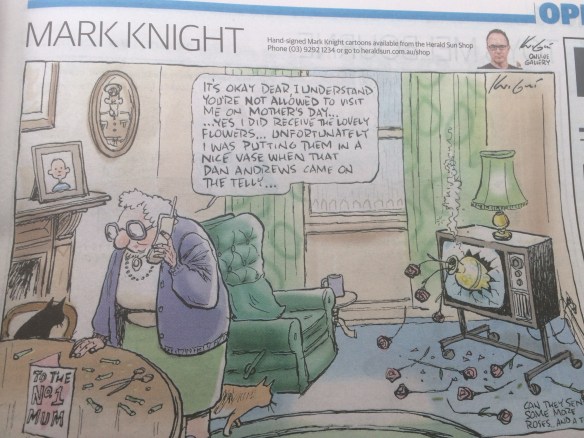
Whatever Daniel Andrews may do for the rest of his life, closing down Mother’s Day one day in advance of allowing social visits of five or more to each others’ homes will be what he is remembered for best.

Andrews has become the very essence of a political buffoon, recognised that way across the entire country, not just in Victoria. I can see he is beginning to understand the ridicule everyone else is offering on his moronic leadership. A complete clown, but the man with the power to enforce all kinds of idiotic outcomes which he did.
I went looking for Daniel Defoe’s A Journal of the Plague Year, which he did not actually live through so it is complete fiction. But in looking it up, found this quote which fits many a leader, and not just Andrews.
Nature has left this tincture in the blood, That all men would be tyrants if they could.
Whether it is “all” or not may be questioned, but it seems to be mostly true for anyone who seeks political leadership. The only people who can be trusted with power are those who do not want it. The next best thing is to put as many barriers in their way as possible.
This was put up at the Societies for the History of Economics discussion thread:
The Wall Street Journal has a review by Ben Steil of Zachary Carter’s upcoming book, The Price of Peace: Money, Democracy, and the Life of John Maynard Keynes:
https://www.wsj.com/articles/the-price-of-peace-review-the-economic-engineer-11588947478
The review is behind a paywall, but I thought many on this list would be interested and would have access to it through a library or other provider.
And behind a paywall it remains, so this is all I could read, but it was quite enough:
“The more troublous the times, the worse does a laissez-faire system work.” Spoken in London in 1923, these words, among the lesser known of the most quotable economist of the 20th century, are perhaps his most important for these, our most troublous of times. For it is now, in the midst of a global pandemic the likes of which we have not seen since 1918, that the importance to life and livelihood of bold, informed and competent government becomes apparent. And no one wrote as originally and forcefully about what such a government does, faced with the prospect of economic collapse, than did John Maynard Keynes.
So let me draw your attention to a pamphlet published in 1926 by that self-same John Maynard Keynes: The End of Laissez-Faire where we find this passage:
From the time of John Stuart Mill, economists of authority have been in strong reaction against all such ideas. ‘Scarcely a single English economist of repute’, as Professor Cannan has expressed it, ‘will join in a frontal attack upon Socialism in general,’ though, as he also adds, ‘nearly every economist, whether of repute or not, is always ready to pick holes in most socialistic proposals’. (Theories of Production and Distribution, p. 494). Economists no longer have any link with the theological or political philosophies out of which the dogma of social harmony was born, and their scientific analysis leads them to no such conclusions.
Cairnes, in the introductory lecture on ‘Political Economy and Laissez-faire’, which he delivered at University College, London, in 1870, was perhaps the first orthodox economist to deliver a frontal attack upon laissez-faire in general. ‘The maxim of laissez-faire’, he declared, ‘has no scientific basis whatever, but is at best a mere handy rule of practice.’
I have noted before that the least understood grouping of economists in history are the later-classical economists from John Stuart Mill through to the end of the nineteenth century, from around 1848 with the publication of Mill’s Principles of Political Economy till around 1890 with the publication of Marshall’s Principles of Economics. I will just mention here that I hope to have at least in part remedied this major deficiency with a book that will be published by Elgar in June, Classical Economic Theory and the Modern Economy [https://www.e-elgar.com/shop/gbp/classical-economic-theory-and-the-modern-economy-9781786433565.html ]. That an economist can still get away with suggesting that economic theory prior to Keynes was rife with notions of laissez-faire shows so little awareness of the history of economics even among historians of economics is a scandal.
Just to focus on Mill, his Principles runs for almost 1000 pages, with the last 200 on the role of government, at the end of which he declares that the role is so extensive and the circumstances of the world so diverse, that even after those 200 pages he could not cover everything a government might find itself in need of doing so that no definitive limitations can be introduced. The only addition to the scope of economic policy introduced by Keynes was the notion of demand deficiency and with it the utility of public spending during recessions to lower unemployment, a policy universally opposed by classical economists but almost universally endorsed today. The historical record since the publication of The General Theory seems to show that the classics were completely right on that score. I cannot think of a single thing written by Keynes that would provide the slightest insight into how to bring our economies out of the lockdowns we have all experienced across the world.
I will also add that I have read the whole review and I will let you judge the book by this one quote from the review:
Mr. Carter seems to believe that Keynes, were he alive today, would be advising Sen. Bernie Sanders. But if we want to know what Keynes would do, we cannot simply extrapolate from his most radical writings.
If it is not immediately obvious how off the planet such an observation is, then I cannot help you further. Nothing I have ever written on Keynes is as discrediting as those words, since Keynes, if nothing else, was a serious scholar who tried to make sense of how an economy worked from a small-l liberal, that is from a classical liberal perspective. I believe he was wrong in his economic theories, but I would never have placed Keynes on the far left of the political spectrum, not only in his own time, never mind today.
HERE IS THE FULL REVIEW FROM THE WSJ:
The Price of Peace
By Zachary D. Carter
Random House, 628 pages, $35
“The more troublous the times, the worse does a laissez-faire system work.” Spoken in London in 1923, these words, among the lesser known of the most quotable economist of the 20th century, are perhaps his most important for these, our most troublous of times. For it is now, in the midst of a global pandemic the likes of which we have not seen since 1918, that the importance to life and livelihood of bold, informed and competent government becomes apparent. And no one wrote as originally and forcefully about what such a government does, faced with the prospect of economic collapse, than did John Maynard Keynes.
With the U.S. Congress having authorized $3.5 trillion in new spending over the past five weeks, it is tempting simply to conclude that we are all Keynesians now. Yet Keynes was hardly the crude advocate of deficit spending that he is too often made out to be. His writings on how to pay for World War II, and how Britain could avoid financial dependence on the U.S. in its aftermath, for example, reflect the careful workings of a brilliant and subtle mind, with the fullest appreciation for detail and circumstance. Were Keynes alive today, he would have much to say not just about what to spend on what but about how to manage the financial burden efficiently and fairly.
Timing, paradoxically, can be critical to a history book, and “The Price of Peace: Money, Democracy, and the Life of John Maynard Keynes” couldn’t have appeared at a more opportune moment. Journalist Zachary Carter has crafted a timely, lucid and compelling portrait of a man whose enduring relevance is always heightened when crisis strikes. If there is a conspicuous blemish in the book, it is the polemical turn of its last third, which goes well beyond the life of his subject. Still, readers of all political persuasions will, in the biographical material at least, find plenty of insight for our time.
As Mr. Carter makes clear, Keynes’s life mission was to find the keys to sustaining democracy and economic liberty in the face of challenges from authoritarians of the left and the right—and not when times were easy but when they were most troublous. Now, with economies around the world struggling to emerge from a devastating, unprecedented shutdown, we who have been blessed to live in liberty will need to reflect on what will be needed to preserve it once the present crisis passes (assuming we are wise enough to surmount it).
Like it or loathe it, we are not going back to globalization as we knew it—the globalization that emerged with the rise of China and the internet after the end of the Cold War. Five years after the end of World War I and the start of the Spanish flu epidemic, Keynes was similarly aware that Britons were not going back to the glorious globalization of the late 19th century and the heyday of the British Empire. The task as he saw it, then, was to create a less glorious but more durable regime.
Born in Cambridge in 1883, Keynes had followed in the footsteps of his academic parents, securing, at age 26, a prestigious life fellowship at Cambridge’s King’s College. There he was regarded with awe by some of the greatest minds of the early 20th century. “Keynes’s intellect was the sharpest and clearest that I have ever known,” wrote Bertrand Russell. “When I argued with him, I felt I took my life in my hands.”
Keynes did not, however, make his name as a scholar until relatively late in life. He published his first major economics work (“A Tract on Monetary Reform”) in 1923, at age 40. He initially came to prominence as a British government financial adviser during World War I, accompanying Prime Minister David Lloyd George to the Paris peace talks. His scathing account of those talks (“The Economic Consequences of the Peace”) and his premonitions of political disaster to come, however, instantly transformed him into a major public intellectual. Mr. Carter ably weaves the narrative of Keynes’s personal life—his association with the Bloomsbury set, his male relationships before marrying a Russian ballerina in 1925—into that of his rise to professional fame during these years.
It is as an economic thinker, of course, that we primarily know Keynes today. Yet Keynes, a polymath with an abiding interest in philosophy, art and politics, would have had difficulty even gaining admission into today’s math-obsessed Ph.D. programs. Though an able mathematician himself, he had only disdain for those who sought precise solutions to big, imprecise problems. As an economics major in college, I learned “Keynesian” methods, yet was never asked to read Keynes. Those methods had been formulated by later American disciples and would mostly have been dismissed by the master as misleading and factitious.
It is difficult to overstate the effect that Keynes’s 1936 masterwork, “The General Theory of Employment, Interest and Money,” had on the economics profession, particularly in the U.S. The book—his effort to unearth the deeper causes of, and solutions to, Britain’s stubbornly high unemployment—virtually established macroeconomics as a discipline, both in the academy and in government. But the unusual style of “The General Theory” made it hard for even expert readers to separate out its “true” substance. It is only slightly outlandish to liken this work to the Bible. It is full of memorable, mellifluous passages. It is also, at times, obscure, tedious and tendentious. It is a work of passion driven by intuition, with tenuous logic and observation offered as placeholders until faithful adherents could unearth the proofs.
The central contention of “The General Theory” was revolutionary (at least to economists): that the economy had no natural tendency toward full employment. If governments did not intervene forcefully to boost consumption demand, Keynes argued, high unemployment could persist indefinitely. Cheap money provided by the central bank would not suffice to alter the circumstances decisively. This contention was wholly contrary to classical economics, which held that protracted involuntary unemployment was a result of some interference in the workings of the price mechanism. In classical economics, full employment required flexible wages; Keynes showed why, with different assumptions, falling wages could actually worsen unemployment. These different assumptions were related to the nature of money, to human psychology and to the conventions of contemporary society. Each of these on its own would do to support Keynes’s argument, and he was not that particular about which he credited at any time.
There is also much contradiction in Keynes’s thought, and between his thought and his behavior—contradiction that provides endless opportunity for fans to claim him as their own, or for detractors to dismiss him entirely. He was “too mercurial and impulsive a counsellor for a great emergency,” groused Lloyd George. “He dashed at conclusions with acrobatic ease [and] rushed into opposite conclusions with the same agility.” He eagerly speculated in securities, for himself and his college, particularly abroad, while calling for a policy to limit speculating in securities, particularly abroad. He further expressed biting disdain for those who supported both the orthodoxies and the heresies he himself had espoused in earlier times.
Yet it was not fickleness but a keen sensitivity to political contexts that typically drove Keynes’s shifts in economic thought. “When the facts change,” he famously told a critic of his volatile views on monetary policy, “I change my mind. What do you do, sir?” Unusually for an economist, he took the shifting mores of society seriously when prescribing policy and didn’t seek to mold humanity to his models or preferences. He was also more an internationalist Englishman than an English internationalist, so that the trajectory of his thinking tracked the trials and tribulations of his country as it struggled, from 1914 to his death in 1946, with war, inflation, deflation, unemployment, indebtedness and the growing demands of the masses for greater voice and security.
As a government adviser and diplomat, he was perspicacious and farsighted, yet rarely converted an intellectual adversary. In Washington, where he represented the U.K. during both world wars, he was all too often “dogmatic and disobliging,” making “a terrible impression for his rudeness”—and this according to his own British colleague. At the 44-nation Bretton Woods conference in 1944, which established the International Monetary Fund, the World Bank and the dollar-based global monetary system, he became the first celebrity economist, captivating the American press—yet infuriating the U.S. Treasury, which sidelined and outmaneuvered him. It is a testament to the influence of Keynes’s ideas, however, that so many policy thinkers around the world still want to create a legitimate supranational currency, modeled after his “bancor” proposal at Bretton Woods, to supplant the international role of the dollar.
Robert Skidelsky’s renowned biography of Keynes ran to three volumes, the last of which was published in 2001. As Mr. Carter notes in his acknowledgments, “all modern Keynes scholars begin their journey” from this foundational work. But wholly apart from his auspicious timing, Mr. Carter has, with this fresh reappraisal, made an outstanding authorial debut. The financial and economic questions with which Keynes wrestled, both as scholar and adviser, were complex, and it is tempting for an author writing for a wide audience to gloss superficially over the more difficult ones. But whether the subject is war reparations or interest-rate policy, Mr. Carter leaves no reader behind, and he writes with wit and clarity. Capturing in a single sentence why Keynes persisted with abstruse theoretical writing long after becoming a major public intellectual, Mr. Carter explains that “if Keynes wanted to reach the sovereigns, he would first have to convert the priesthood.” Keynes had set out to change the very foundations of economic policy-making. And to do that he had to change economists themselves. By any reasonable measure, he succeeded.
This book covers considerably more than the life and labors of his subject, however. Keynes expires on page 368, but his legacy, or Mr. Carter’s version of it, carries on for a further 166 pages. For this reader, at least, the later material constitutes a mixed blessing. Mr. Carter nicely narrates the story of the bitter and consequential split between the “left” Keynesians, led by Joan Robinson in Britain and John Kenneth Galbraith in the U.S., and the “right” Keynesians, led by Paul Samuelson and his fellow mathematical economists. But Keynes and Keynesianism disappear for long stretches of text, as the discussion devolves into an ever-angrier assault on “neoliberal” trade and market-liberalization policies, which Mr. Carter blames for growing inequality. The author reserves his harshest treatment for Democrats, with Bill Clinton bearing the brunt of his wrath for championing the North American Free Trade Agreement, the World Trade Organization and greater economic ties with China.
Mr. Carter seems to believe that Keynes, were he alive today, would be advising Sen. Bernie Sanders. But if we want to know what Keynes would do, we cannot simply extrapolate from his most radical writings. Keynes as diplomat—at Bretton Woods and in Washington the year following, begging for a loan—didn’t choose splendid isolation. Instead, he adapted his policy positions to the reality of America’s rise to economic dominance, however repugnant he found it. He would, today, surely not spit into the winds gusting from a rising China. He would get his country the best deal he could, understanding that China was going to reshape the world, peacefully or otherwise, with or without his cooperation. Mr. Carter himself, in the end, believes that Washington should engage in “cooperative economic diplomacy.” But what was China’s WTO accession if not “cooperative economic diplomacy”?
Mr. Carter is also too dismissive of contributions to economic policy thinking from the center and the right, particularly from Nobel Prize winners Friedrich Hayek and Milton Friedman—both of whom he paints, in his more charitable moments, as tools of reactionary and moneyed interests. During the present economic crisis—as during the financial crisis a decade ago—unprecedentedly bold monetary interventions have been more important in preventing economic collapse than fiscal ones. And it was Friedman’s analysis, not Keynes’s, that stimulated this reaction from the Fed and other central banks. It was Friedman to whom Ben Bernanke, the former Fed chair (and Great Depression scholar) paid homage for his seminal analysis of the monetary causes of the Depression and to Friedman’s work that Bernanke turned for guidance when faced with the challenge of preventing another one. Current Fed Chairman Jay Powell is following the same script, but with even more gusto.
In the end, readers who admire the anti-“market fundamentalism” of Nobel economist Joseph Stiglitz, whom Mr. Carter quotes approvingly, will delight in this book’s extended epilogue; those who don’t, won’t. In any case, Mr. Carter might have been wiser to write two books, letting his fine and eloquent analysis of Keynes’s life and thought stand alone as the best single-volume biography of this intellectual giant.
—Mr. Steil is director of international economics at the Council on Foreign Relations and the author of “The Battle of Bretton Woods: John Maynard Keynes, Harry Dexter White, and the Making of a New World Order.”
Which for some reason calls to mind Max Weber:
‘Every state is founded on force,’ said Trotsky at Brest-Litovsk. That is indeed right. If no social institutions existed which knew the use of violence, then the concept of ‘state’ would be eliminated, and a condition would emerge that could be designated as ‘anarchy,’ in the specific sense of this word. Of course, force is certainly not the normal or the only means of the state – nobody says that – but force is a means specific to the state.
Today the relation between the state and violence is an especially intimate one. In the past, the most varied institutions have known the use of physical force as quite normal. Today, however, we have to say that a state is a human community that (successfully) claims the monopoly of the legitimate use of physical force within a given territory.
Note that ‘territory’ is one of the characteristics of the state. Specifically, at the present time, the right to use physical force is ascribed to other institutions or to individuals only to the extent to which the state permits it. The state is considered the sole source of the ‘right’ to use violence.
And just today: Anti-lockdown protesters clash with police in Melbourne. Here are some pictures.
And “related” as they say in the story: Premier Daniel Andrews labeled “incredibly cruel”.
And this from Cold Hands on an earlier thread. Unbelievable.
And then there’s that woman in New South Wales.
Which for some reason calls to mind Max Weber:
‘Every state is founded on force,’ said Trotsky at Brest-Litovsk. That is indeed right. If no social institutions existed which knew the use of violence, then the concept of ‘state’ would be eliminated, and a condition would emerge that could be designated as ‘anarchy,’ in the specific sense of this word. Of course, force is certainly not the normal or the only means of the state – nobody says that – but force is a means specific to the state.
Today the relation between the state and violence is an especially intimate one. In the past, the most varied institutions have known the use of physical force as quite normal. Today, however, we have to say that a state is a human community that (successfully) claims the monopoly of the legitimate use of physical force within a given territory.
Note that ‘territory’ is one of the characteristics of the state. Specifically, at the present time, the right to use physical force is ascribed to other institutions or to individuals only to the extent to which the state permits it. The state is considered the sole source of the ‘right’ to use violence.
From The DesMoines Register – How this ‘crying liberal’ Iowan became a worldwide meme for those gloating over Trump’s win. Turns out she now lives in Sydney. Here’s the story.
I’ve seen the face of the loser.
I’ve seen the face of dejected Hillary Clinton supporters everywhere.
I’ve seen the look of utter horror at the prospect of living at least four years under the presidency of Donald Trump.
That face has a name: Janna DeVylder.
Yes, DeVylder, 42, who grew up in Council Bluffs and now lives and works on the other side of the globe in Sydney, Australia, has become the international symbol of the inconsolable popular-vote winners of our presidential election. (Online she was zinged as the “poster child for the mentally insane Hillary snowflakes.”)
In other words, she has spent the last two months as one of the world’s most popular political memes.
She’s the face of blue-Democrat America that saw what seemed like a sure claim to the White House slip away in the deep-red rural counties and the Electoral College.
DeVylder has lived a surreal, virtual double life as her meme of infinite varieties has spread far and wide across the internet.
I tried to get Reuters, the photo’s owner, to let us publish the photo in print, to no avail. But just Google “crying liberals” and you’ll see it. DeVylder’s face pops up probably as the very first image: She’s wearing cobalt blue eyeglasses, pearl earrings and a matching necklace and a homemade Hillary pin. She even purchased a secondhand gray pinstripe pantsuit just for the occasion. Oh, and you can’t miss her festive red, white and blue top hat.
But the first thing you notice is her convulsed posture and anguished expression. Her shoulders droop forward, while her head is flung back. Her eyes are scrunched shut. Her mouth hangs open in a frown, and you can’t help but imagine hearing her pitiful moan.
The photo was snapped on Nov., 8, Election Day (although because of the time difference technically it already was the next day in Australia). DeVylder, as if you couldn’t tell from her getup, had voted absentee for Clinton. She holds dual citizenship.
She and some friends attended an election viewing party at the University of Sydney. DeVylder was so excited that she took the day off work — made easier by the fact that she’s her own boss. She and her husband run their own design firm with a third business partner.
DeVylder expected a low-key event. What she got was a teeming throng of hundreds of American expats and curious Aussies packed into a room with a giant video screen, CNN sponsorship and Trump supporters chanting, “Lock her up!” So she did the only sensible thing: She grabbed the free plastic hat offered at the door and dove headlong into the fray.
DeVylder’s pantsuit and general look made her a magnet for multiple TV and radio interviews. But initially she didn’t notice all the photographers who had staked out the crowd, including Jason Reed of Reuters.
His was the perceptive eye that captured DeVylder’s reaction — not to the final result but merely to Trump’s win of an early state. And like a dutiful news photographer, he quickly filed it for his editors.
Not more than 90 minutes later, as DeVylder still sat in the very same seat in Sydney, she received a message from her friend Matt back in Davenport, Ia.: I think I just saw your face come up on Yahoo News, he told her.
In a relative eye blink she had been zapped around the globe. And little did she know that that was only the beginning.
To be fair, Reed’s original caption was rather innocuous, and didn’t include DeVylder’s name: “Supporters of U.S Democratic Presidential candidate Hillary Clinton react as a state is called in favour of her opponent, Republican candidate Donald Trump, during a watch party for the U.S. Presidential election, at the University of Sydney in Australia, November 9, 2016.”
Reed himself has shot photos in Iowa, but never has he had a photo reach so far, so fast.
“I was surprised to see the amount of interest in this image considering the sheer number of similar pictures being taken across the United States on that day,” he wrote to me in an email.
When the photo seeped into social media and the political blogosphere, it took on a life of its own. It seemed to reduce Trump’s surprise victory to a single frame and face perfect for attracting schadenfreude.
Her “conservative friends in the Midwest,” DeVylder said, “who visit different websites than I do, kept seeing it come up.”
Some of the captions and headlines paired with DeVylder’s face:
“When everyone gets a trophy … you don’t know how to lose.”
“Best pics of distraught Hillary voters from last night as they sob and lay in fetal positions. Run to your safe spaces!!! Trump is president!”
“Classes canceled to allow college students to ‘cope’ with shock of Trump’s win” (DeVylder, a mom to two sons and two stepdaughters, is happy to pass for an undergrad.)
Conservative radio talk show host Laura Ingraham tweeted DeVylder’s photo with the quip, “To think we had 18 year olds taking Omaha Beach, at Battle of Chosin, Ardennes ….”
DeVylder, who was lured to Australia by a job and made a life there, may even end up on T-shirts and coffee mugs in Texas.
This is made all the funnier because she wasn’t crying in the photo. As she put it, she was just “a bit expressive.”
But that doesn’t matter because the image managed to unwittingly capture DeVylder’s general feelings about the election. And she likes it. She told Reed as much via email.
DeVylder probably was one of the perfect people to fall victim to this meme: She’s a practical, thoughtful and somewhat bemused Iowan with a psychology degree from the University of Iowa who finds all this utterly fascinating.
Not only has she taken it in stride, she has blogged about it.
She considers it a teachable moment.
“You realize how easy it is to take your eye off the ball,” she said of how complacent she had gotten about her politics, “and you expect that other people are doing things that will keep the status quo that you appreciate, and that the progressive cause is a cause that will just keep going.”
In retrospect DeVylder said that she attended the party feeling a little cocky, expecting to toast a win.
“Even when you think things are good from your point of view that doesn’t mean you can stop working at it,” she said. “That’s a life lesson, right?”
Instead of getting mad, she retaliated by posting her own versions of her meme:
“I’m not crying because we lost. I’m not crying because there’s no trophy. I’m crying because we are losing our collective humanity.”
“Crying, for the lessons of history have yet to be learned.”
“Realizing that this election has brought out the worst in us.”
“The moment she realized we don’t even try to understand each other anymore.”
Just when DeVylder thought her face had been plastered in every corner of the web, it erupted again when Sean Hannity shared it on Facebook at the end of the year, with the timely message: “The Electoral College electing Trump is unfair … says the party that used ‘super delegates’ to elect Hillary.”
Here again, DeVylder tends to get analytical, not defensive. Her meme life has left her feeling that conservatives and liberals alike can be hypocrites. Everybody has confirmation bias. We all love to feel smug in victory.
“We fight in some instances for inclusion and open arms,” she said of her half of the political spectrum, “and yet we draw lines when it comes to people who may be conservative.”
But even for the nicest of Iowans, at some point introspection becomes annoyance. DeVylder would like to think that her digital doppelganger has expired, but she expects to endure at least one more round.
“I’m anticipating that it will be used again for the inauguration,” she sighed. “You just know it will.”
That’s a safe bet for Jan. 20. At the very least, DeVylder seems to have rekindled her political fire. In blogging about the incident, she publicly committed herself to a laundry list of next steps, including:
- “I will not find joy and boast in other people’s sorrows.”
- “I will model for my children the way I would hope they would conduct themselves.”
- “I will not fight hate with hate.”
- “I will work to ensure more young people engage and vote.”
- And she ended with a question: “What will you do?”
Who said no good could come from a mean-spirited meme?
I hope we can continue to gloat come November. Otherwise they will have to exchange my face for hers.


 Law of Markets