The media is more dishonest than anyone can imagine

I received this note which really is astonishing:

Regarding SOTU: Did you notice at about the 1 hour 21 minute mark of USA Today’s SOTU broadcast they edited out the word “never” when Trump put down Socialism? USA Today used their 2 second delay privilege in “live” broadcasting to black out “never” so it sounded like Trump said “the US will … be a Socialist state”.

Watch, it’s just like he says – start at around 1:19:

It’s not a glitch. They really cannot bear the thought that the United States may not become a socialist country. They are not just dishonest, but evil.

I had put this version up since it was the first one available at Youtube. But they added afterwards the various so-called “fact checks” that attempt to counter the points the President made. They are the most vile liars imaginable, worse than the Soviet press who lied because of the threat of the gulag. These people do it because they are dishonest, and clearly wish to actually see the US, and the rest of us, become socialist tyrannies.

State of the Union one day later

Remember when the Democrats were going to stop Trump from delivering his State of the Union. Funny how he seems to get his way in the end. The Wall is next.

As for the politics, Trump’s State of the Union is an almost perfect dye-marker for your own political beliefs. You won’t see a more perfectly designed and written defence of conservative values in the modern world. And I agree with this from Instapundit.

ONE OF THE INTERESTING THINGS ABOUT TRUMP’S SPEECH LAST NIGHT is how it seemed calculated to demolish all the standard anti-Trump tropes from the media and from the left and to do so with compelling imagery. Consider:

Trump’s a Nazi: Praise for Holocaust survivors, and a touching rendition of “Happy Birthday.” (With Trump waving his fingers like a conductor).

Trump hates minorities: Brags about record low black, Hispanic, and Asian unemployment — while white-clad Democratic women, overwhelmingly white themselves, sat prune-faced.

Trump’s a Russian tool: Withdrawing from the INF Treaty.

Trump’s a warmonger: Without me, Trump says, we’d be at war on the Korean peninsula. Also, I’m looking at pulling out of Afghanistan.

Trump hates women: Except he got even the prune-faced white-clad Democratic women up dancing (and chanting “USA! USA!”) when he talked about record female employment in and out of Congress.

And his rebuke to socialism was designed to strip the glamour that the media have tried to imbue it with by tying it to the abject misery of Venezuela.

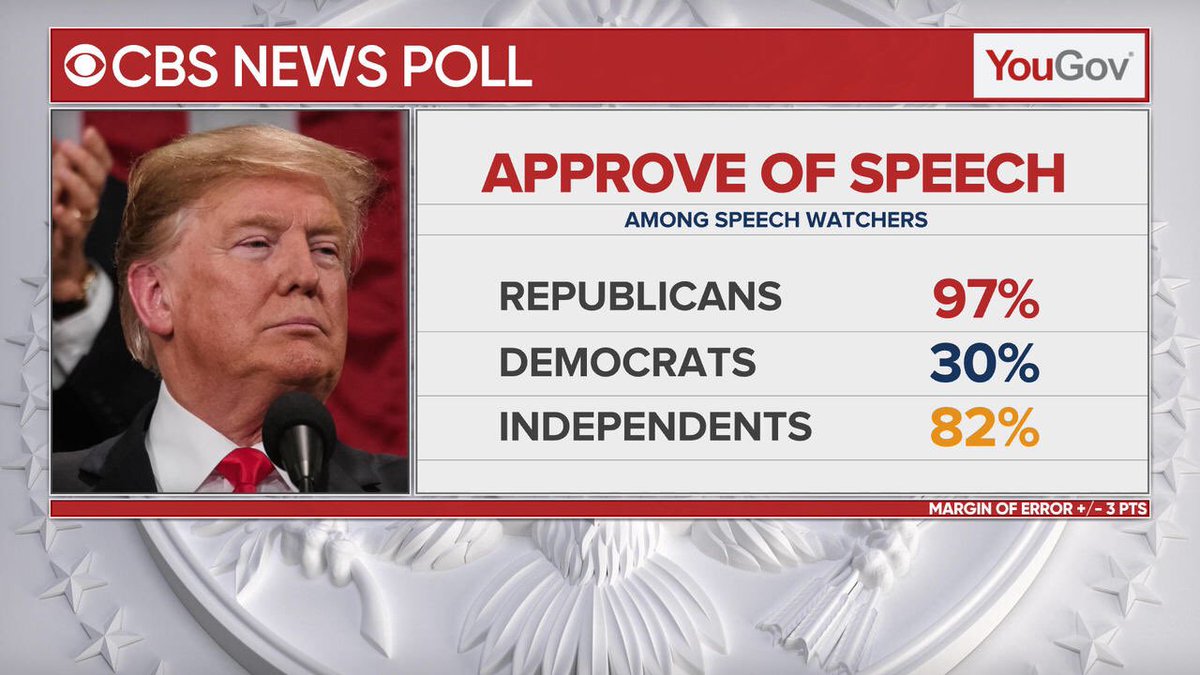
The 70% of those who did not like the speech from the mean-spirited, Marxist-Progressive Democrats remains the problem. They really do want to turn the US into Venezuela. Ignorant fools they may be, but they still get to vote.

AND NOW THIS: The State of the Union set to music.

More at the link.

How to explain why socialism leads to poverty

It is a common mis-perception on the right side of the political divide that they understand and can explain why socialism leads to poverty. The reality is that virtually no one can do this. I had made it part of many conversations over the years, especially after the Venezuelan economy had collapsed, to ask what exactly the problem with socialism is, but it is a much more difficult question than most people seem to understand. There is no doubt that every attempt to introduce socialism anywhere has led to economic ruin. It is as plain as day that socialism rapidly leads to a major reduction in living standards. Absolutely inevitable, but why? There is a relatively small but important literature on this question, but it is complex and is mostly for specialists who have a deeper understanding of the nature and operation of a market economy. You won’t get it unless you have studied economics already, or are prepared to put in the time. You are more than welcome to enter into the intricacies of the Socialist Calculation Debate which explains why without a free market an economy cannot determine either what to produce, and more importantly so far as the certain failure of a socialist economy is concerned, how to produce. Which is why every such economy must fall into an abyss from which they cannot even begin to emerge until their socialist institutions are removed.

I have therefore written an article, that I hope will be accessible to anyone, on why all socialist economies are doomed. I have based it on an earlier classic article published in 1958, I, Pencil which is why I have titled my own version, I, Mechanical Pencil. This is how I, Mechanical Pencil begins, which will explain what I wrote, and the connection with its earlier predecessor.

Many years ago, one of my early ancestors wrote his own life story in a wonderful autobiographical tale titled I, Pencil. He told the story of how he came to be, how he had been the result of thousands of many independent decisions made all over the world by many tens of thousands of individuals. Their collective actions explained how he came to be the pencil he was.

His aim was to explain why socialism doesn’t work. Whatever name you associate the idea of ‘socialism’ – whether it is ‘democratic’, ‘scientific’, ‘utopian’ or something else – socialism inevitably brings poverty and privation to the vast majority who are robbed of their political freedom as well. His aim had been to explain how our free market economic system brings us both freedom and prosperity; how a market economy is indispensable if we are to live our lives as we wish and in our own way, while also becoming more prosperous with each passing year.

Yet I fear his message has been lost in the modern world; in part because we live in different times with different kinds of problems, but also because many fail to separate out the political side of socialism from the economic. Socialist economies are always run from the centre and inevitably become a dictatorship with democratic constraints on the government crushed by those who take control. That is the certainty of it. Political freedom disappears when a socialist government takes over. The loss of freedom is straightforward and unmistakeable. There are no exceptions.

But hidden away beneath the political dimension are the reasons behind the economic catastrophe that follows the introduction of a socialist regime. These outcomes are visible at every turn. There is no disguising the massive reductions in income and personal wealth that are inflicted upon virtually everyone in a socialist economy, other than, of course, those who run the country. Everyone sees it, but virtually no one understands why so many things go so wrong everywhere within the economy and almost all at once.

I have therefore set out to explain why this happens, because we take the prosperity we have so much for granted. We now live in far and away the richest communities that have ever existed. Even the poor are only relatively poor, and live better than all but the royalty of earlier ages – in fact, probably even better than royalty then did as well. I won’t say things are perfect or could not be improved. But I will say that any solution to our problems that tries to make things better by introducing a socialist program of some kind is not only doomed to failure but is absolutely certain to make conditions far worse. Of this, there should be no doubt whatsoever.

I commend the article to you and feel free to pass it along as far and wide as you like.

PDT on anti-semitism

In his State of the Union, the President focused on anti-semitism which is again a force for evil in the world today when one would have hoped it had disappeared into the past. This has been highlighted by Scott Johnson at Powerline in a post on The State of the Union is Good. These are the relevant parts of his post.

I want to highlight one especially important theme. President Trump has taken a lot of unjustified grief for alleged anti-Semitism. What a farce.

Last night the president recognized individual Holocaust survivors among his special guests, but he went beyond gestures. He expressed support of the Jewish people and opposition to anti-Semitism (see, e.g., the case of Iran). He mentioned his support of Israel as well. The Jewish theme made for a powerful motif. Here he knit together Trump foreign policy with recognition of a law enforcement hero:

My Administration has acted decisively to confront the world’s leading state sponsor of terror: the radical regime in Iran.

To ensure this corrupt dictatorship never acquires nuclear weapons, I withdrew the United States from the disastrous Iran nuclear deal. And last fall, we put in place the toughest sanctions ever imposed on a country.

We will not avert our eyes from a regime that chants death to America and threatens genocide against the Jewish people. We must never ignore the vile poison of anti-Semitism, or those who spread its venomous creed. With one voice, we must confront this hatred anywhere and everywhere it occurs.

Just months ago, 11 Jewish-Americans were viciously murdered in an anti-semitic attack on the Tree of Life Synagogue in Pittsburgh. SWAT Officer Timothy Matson raced into the gunfire and was shot seven times chasing down the killer. Timothy has just had his 12th surgery — but he made the trip to be here with us tonight. Officer Matson: we are forever grateful for your courage in the face of evil.

He wasn’t done:

Tonight, we are also joined by Pittsburgh survivor Judah Samet. He arrived at the synagogue as the massacre began. But not only did Judah narrowly escape death last fall — more than seven decades ago, he narrowly survived the Nazi concentration camps. Today is Judah’s 81st birthday. Judah says he can still remember the exact moment, nearly 75 years ago, after 10 months in a concentration camp, when he and his family were put on a train, and told they were going to another camp. Suddenly the train screeched to a halt. A soldier appeared. Judah’s family braced for the worst. Then, his father cried out with joy: “It’s the Americans.”

A second Holocaust survivor who is here tonight, Joshua Kaufman, was a prisoner at Dachau Concentration Camp. He remembers watching through a hole in the wall of a cattle car as American soldiers rolled in with tanks. “To me,” Joshua recalls, “the American soldiers were proof that God exists, and they came down from the sky.”

I began this evening by honoring three soldiers who fought on D-Day in the Second World War. One of them was Herman Zeitchik. But there is more to Herman’s story. A year after he stormed the beaches of Normandy, Herman was one of those American soldiers who helped liberate Dachau. He was one of the Americans who helped rescue Joshua from that hell on earth. Almost 75 years later, Herman and Joshua are both together in the gallery tonight — seated side-by-side, here in the home of American freedom. Herman and Joshua: your presence this evening honors and uplifts our entire Nation.

All in all, an excellent speech with many highlights.

Quotable quote: “Here, in the United States, we are alarmed by new calls to adopt socialism in our country. America was founded on liberty and independence –- not government coercion, domination, and control. We are born free, and we will stay free. Tonight, we renew our resolve that America will never be a socialist country.”

There has never been a moment in all the years since he entered public life, which for me is now four years ago, that I have ever doubted the sincerity of a word he has said. He is the most remarkable man I have ever seen hold high office and we are blessed to have him where he is.

George Polites RIP

One of the greatest political geniuses of Australian history has just today gone to God, aged 100. He was the representative of employers across Australia from the 1950s through until the 1980s, with his great achievement the formation of the Confederation of Australian Industry in 1977. The CAI was intended to be the employer equivalent of the ACTU, providing a forum in which employer organisations from across the spectrum of industries and sectors could come together to discuss strategy and tactics in the face of the tremendous anti-business attitudes that typically prevail among those who believe our wealth and prosperity is a free gift of nature.

It was my good fortune to be hired as the economist for the industrial relations division in 1980 and eventually became the Chief Economist of what is now the Australian Chamber of Commerce and Industry where I remained for 24 years. But among all of those whom I had the privilege of working with, there was no one who had George’s ability and vision. It was from him I learned most of what I understand about politics and the political process. I am always astonished by those who abandon some political leader because they fail to achieve 100% of what they want. From George I learned the patient art of politicking and the need to think about what is possible and how to achieve ends across large spaces of time.

He was the equal of Bob Hawke in his ability to sit down and negotiate an outcome, but sought none of the limelight and was content to work in the background working the room so to speak to get the things he wanted. He always thought of me as far too much of the economist, too devoted to the market, but I have to say that in many ways I carry within me his own vision of the kind of world I would like to live in, and his desire to ensure we create an industrial environment that is both productive, and dare I say it, fair to both employers and employees.

Having written the above I have had a look at The Oz and The Age to see if there is any mention of George but there is none. The only photo on the net is the one above, taken when he was already a very old man. He left CAI back in 1982 so it is not all that surprising that the world no longer remembers. But I remember, and I am sure Bob Hawke remembers, just as all of us veterans of the ancient world of industrial relations. The ACTU blathers on about fairness and justice, but it was people like George Polites who made such outcomes as near as possible in the real world of sharks and wolves that we inhabit and always will.

Socialist calculation debate

From Wikipedia: Criticism of socialism.

Distorted or absent price signals[edit]

The economic calculation problem is a criticism of central economic planning. It was first proposed in 1854 by the Prussian economist Hermann Heinrich Gossen.[8] It was subsequently expounded in 1902 by the Dutch economist Nicolaas Pierson, in 1920 by Ludwig von Mises, and later by Friedrich Hayek.[9][4][10] The problem referred to is that of how to distribute resources rationally in an economy. The free market relies on the price mechanism, wherein people individually have the ability to decide how resources should be distributed based on their willingness to give money for specific goods or services. The price conveys embedded information about the abundance of resources as well as their desirability which in turn allows—on the basis of individual consensual decisions—corrections that prevent shortages and surpluses. Mises and Hayek argued that this is the only possible solution and without the information provided by market prices socialism lacks a method to rationally allocate resources. Those who agree with this criticism argue it is a refutation of socialism and that it shows that a socialist planned economy could never work. The debate raged in the 1920s and 1930s and that specific period of the debate has come to be known by economic historians as “the Socialist Calculation Debate”.[11]

Ludwig von Mises argued in a famous 1930 [actually 1920] article “Economic Calculation in the Socialist Commonwealth” that the pricing systems in socialist economies were necessarily deficient because if government owned the means of production, then no prices could be obtained for capital goods as they were merely internal transfers of goods in a socialist system and not “objects of exchange”, unlike final goods, therefore they were unpriced and hence the system would be necessarily inefficient since the central planners would not know how to allocate the available resources efficiently.[11] This led him to declare “that rational economic activity is impossible in a socialist commonwealth“.[4] Mises developed his critique of socialism more completely in his 1922 book Socialism, an Economic and Sociological Analysis.

Friedrich Hayek argued in 1977 that “prices are an instrument of communication and guidance which embody more information than we directly have” and therefore “the whole idea that you can bring about the same order based on the division of labor by simple direction falls to the ground”. He further argued that “if you need prices, including the prices of labor, to direct people to go where they are needed, you cannot have another distribution except the one from the market principle”.[12]

Ludwig von Mises argued that a socialist system based upon a planned economy would not be able to allocate resources effectively due to the lack of price signals. Because the means of production would be controlled by a single entity, approximating prices for capital goods in a planned economy would be impossible. His argument was that socialism must fail economically because of the economic calculation problem—the impossibility of a socialist government being able to make the economic calculations required to organize a complex economy. Mises projected that without a market economy there would be no functional price system, which he held essential for achieving rational and efficient allocation of capital goods to their most productive uses. According to Mises, socialism would fail as demand cannot be known without prices.

The socialist planner, therefore, is left trying to steer the collectivist economy blindfolded. He cannot know what products to produce, the relative quantities to produce, and the most economically appropriate way to produce them with the resources and labor at his central command. This leads to “planned chaos” or to the “planned anarchy” to which Pravda referred…. Even if we ignore the fact that the rulers of socialist countries have cared very little for the welfare of their own subjects; even if we discount the lack of personal incentives in socialist economies; and even if we disregard the total lack of concern for the consumer under socialism; the basic problem remains the same: the most well-intentioned socialist planner just does not know what to do.

The heart of Mises’ argument against socialism is that central planning by the government destroys the essential tool – competitively formed market prices – by which people in a society make rational economic decisions.[13]

These arguments were elaborated by subsequent Austrian economists such as Friedrich Hayek[14] and students such as Hans Sennholz.

The anarcho-capitalist economist Hans-Hermann Hoppe argues that in the absence of prices for the means of production, there is no cost-accounting which would direct labor and resources to the most valuable uses.[15] Hungarian economist Janos Kornai has written that “the attempt to realize market socialism […] produces an incoherent system, in which there are elements that repel each other: the dominance of public ownership and the operation of the market are not compatible”.[16]

Proponents of laissez-faire capitalism argue that although private monopolies do not have any actual competition, there are many potential competitors watching them and if they were delivering inadequate service, or charging an excessive amount for a good or service, investors would start a competing enterprise.[17][18]

In her book How We Survived Communism and Even Laughed,[19] Slavenka Drakulić claims that a major contributor to the fall of socialist planned economies in the former Soviet bloc was the failure to produce the basic consumer goods that its people desired. She argues that because of the makeup of the leadership of these regimes, the concerns of women got particularly short shrift. She illustrates this in particular by the system’s failure to produce washing machines. If a state-owned industry is able to keep operating with losses, it may continue operating indefinitely producing things that are not in high consumer demand. If consumer demand is too low to sustain the industry with voluntary payments by consumers, then it is tax-subsidized. This prevents resources (capital and labor) from being applied to satisfying more urgent consumer demands. According to economist Milton Friedman: “The loss part is just as important as the profit part. What distinguishes the private system from a government socialist system is the loss part. If an entrepreneur’s project doesn’t work, he closes it down. If it had been a government project, it would have been expanded, because there is not the discipline of the profit and loss element”.[20]

Proponents of chaos theory argue that it is impossible to make accurate long-term predictions for highly complex systems such as an economy.[21]

Pierre-Joseph Proudhon raises similar calculational issues in his General Idea of the Revolution in the 19th Century, but also proposes certain voluntary arrangements, which would also require economic calculation.[22]

Leon Trotsky, a fierce proponent of decentralized economic planning, argued that centralized economic planning would be “insoluble without the daily experience of millions, without their critical review of their own collective experience, without their expression of their needs and demands and could not be carried out within the confines of the official sanctums” and “[e]ven if the Politburo consisted of seven universal geniuses, of seven Marxes, or seven Lenins, it will still be unable, all on its own, with all its creative imagination, to assert command over the economy of 170 million people”.[23]

Mises argued that real-world implementation of free market and socialist principles provided empirical evidence for which economic system leads to greatest success:

The only certain fact about Russian affairs under the Soviet regime with regard to which all people agree is: that the standard of living of the Russian masses is much lower than that of the masses in the country which is universally considered as the paragon of capitalism, the United States of America. If we were to regard the Soviet regime as an experiment, we would have to say that the experiment has clearly demonstrated the superiority of capitalism and the inferiority of socialism.[24]

According to Tibor R. Machan: “Without a market in which allocations can be made in obedience to the law of supply and demand, it is difficult or impossible to funnel resources with respect to actual human preferences and goals”.[25]

Perfectly logical


This is perfectly logical: A Jewish Republican accused a Muslim Democrat of anti-Semitism, she accused him of Islamophobia.

If your religion states that Jews are evil and someone accuses you of being anti-semitic, then they are criticising your religion since your religion specifically mandates that its adherents must hate Jews. What could be clearer than that?

Tolerance has nothing to do with it. That is a Judeo-Christian concept and unique to the West.