Donald Trump, conservatism and free trade

I realise we live in a world of economic solipsism, where virtually nothing of the past endures while the most superficial gloss passes for deep profundity. The reason I bring it up is that occasionally I am accused of misunderstanding conservative principles because I fail to condemn Donald Trump’s attempt to protect American workers from the open borders vandalism of others. Here I have an excerpt on free trade from a website called “The Imaginative Conservative” titled, The Economics of Prudence: Roepke, Ricardo, and Free Trade. That virtually no one today would have the slightest idea who Wilhelm Roëpke was is just how it happens to be. But he was in his time as important as Hayek, an important part of the conservative tradition from the 1930s through to the 1960s. The post is, however, by Ralph Ancil who is described as “the President and Economist for the Roepke Institute.” You are welcome to read his entire post, which was written in 2010, thus well before Donald Trump was even on the horizon. He is discussing free trade with this his central point:

Mainstream economic theory has traditionally relied on the principle first articulated by David Ricardo in the early 19th century England. Ricardo’s famous example to illustrate this was trade between two countries: Portugal producing wine and England producing linen. The free trade argument concludes that nations jointly maximize their levels of consumption to their mutual benefit when firms within the nations are allowed to engage in trade unhindered by arbitrary interventions by government especially those intended to shield some industries from foreign competition. Hindering such trade through the imposition of tariffs or quotas is called protectionism. His principle and approach have been the basis for subsequent expansion and development of the free trade idea, and are still taught in principles textbooks.

However, in the hands of politicians or economists with a certain axe to grind the discussion loses sight of the major prerequisite for the benefits of free trade to hold: it is assumed that capital and labor stay within each country. They are reallocated within a country, but not between them. That means that outsourcing of, say labor, is not an example illustrating free trade nor are those who object to outsourcing promoting protectionism. In short, maintaining the Ricardian prerequisite is not anti-free trade.

The key concept which drives this conclusion is the distinction between comparative and absolute cost advantages. A country may be able in absolute cost terms to produce something more cheaply than its trading partner (using fewer workers, for example). However, it still may find it advantageous to let its trading partner produce this good, if its own alternative uses of (labor) resources allows it to be still more productive. Subsequent trade between the two countries will be to their mutual benefit. The essence of the free trade principle then is comparative not absolute advantage. Yet when corporations scan the globe for the cheapest labor to move their factories to or hire their services from, they are looking for absolute not comparative advantage–a situation that goes beyond the bounds of the free trade principle. It is not a tenet of free market economics that losing one’s productive assets is beneficial for the nation, however much it may benefit a particular corporation. Current US experience makes the point very clear: the middle class continues to shrink while paupers and billionaires continue to grow. This is not the hallmark of a healthy economy.

Armed with this distinction we are liberated to adjust policy (within limits) without losing our economic integrity to free markets. We can, for instance, admit that there are situations where a complete free trade or laissez-faire approach is unwise. These are situations not considered in the Ricardian analysis but which subsequent work has shown complicate the picture of benefits and costs arising from international trade and which do call for prudent policy interventions.

Trump certainly understands all of this intuitively. Making free trade the touchstone of conservative means one has understood neither the nature of conservative philosophy nor the principles that underlie the operation of free markets. It also means the distinctions between conservative and libertarian perspectives remain completely invisible. And I might mention that the biography of Roepke provided above is by Russell Kirk, possibly the greatest conservative scholar produced by the United States during the whole of the twentieth century.

And let me add this about my collection of blog posts on the American election. The most astonishing part for me in reading them through was to discover how consistently conservative I am in the true sense of the word. If you are interested in what conservative means, you could try reading the book.
This one is for keeps there is no second go

Watching American politics remains as depressing as ever. There are the Democrats who run as Democrats (DD), there are the Democrats who run as Republicans (DR), there are the Republicans (R) and then there’s Donald Trump (T). And running far to the left of all of these is the media (M). The configuration is thus DD+DR+M vs R+T. Maddening. And the DR types may well have preferred Hillary over Trump, and that includes Paul Ryan, the present Speaker of the House, a DR to his very bootstraps. So let us go to the tape. This is Ryan speaking in October, just a month before the election:

“His comments are not anywhere in keeping with our party’s principles and values,” Ryan said. “There are basically two things that I want to make really clear, as for myself as your Speaker. I am not going to defend Donald Trump—not now, not in the future. As you probably heard, I disinvited him from my first congressional district GOP event this weekend—a thing I do every year. And I’m not going to be campaigning with him over the next 30 days.”

In the things Trump can do on his own, he is making progress but it is a shark pool at every turn. But the one area he cannot control are the issues that can only be decided by legislation, which means by Congress, which means they must pass through the hands of Paul Ryan. And this is the core issue of Obamacare, which either can be repealed or it cannot. And if it cannot be repealed, because it requires 60 votes and there are only 52 Republicans, then there may or may not be other ways to do it, which requires some kind of finessing in the way the legislation is crafted. And that is how it is being done, or so Ryan says. But among those who in my view are in the R column is Tom Cotton, Senator from Arkansas, a potential presidential nominee and very astute. Here he is talking to Hugh Hewitt.

HH: So what can be done? I’ve talked to the Speaker, I’ve got to the Leader. I’ve talked to Cathy McMorris Rodgers is on today, Mick Mulvaney, Tom Price. They all say it’s a three-step dance because of the Senate reconciliation rule. So you know those rules. Working within the rules, how can the Senate improve its bill, or how can the House send to the Senate a bill that fits within the guardrails of reconciliation and allows for 51 votes that improves the individual market?

TC: Hugh, there is no three-phase process. There is no three-step plan. That is just political talk. It’s just politicians engaging in spin. This is why. Step one is a bill that can pass with 51 votes in the Senate. That’s what we’re working on right now. Step two, as yet unwritten regulations by Tom Price, which is going to be subject to court challenge, and therefore, perhaps the whims of the most liberal judge in America. But step three, some mythical legislation in the future that is going to garner Democratic support and help us get over 60 votes in the Senate. If we had those Democratic votes, we wouldn’t need three steps. We would just be doing that right now on this legislation altogether. That’s why it’s so important that we get this legislation right, because there is no step three. And step two is not completely under our control.

Meanwhile the drumbeat of left opposition continues with anything and everything that can be thrown into the vat included, however preposterous it may be. To which is added the often sensible but still negative criticisms from those who support Trump in general but disagree on various particulars. Three years and nine months till the next election, but those years do go by quickly.

What continues to amaze me is how little assistance the right side of the political divide offer to Trump. I don’t say that there should be blind allegiance, but I do say there should be at least some awareness of how hard it is to push a conservative agenda in this day and age. There is endless opposition from almost 50% of the population who are socialists of one kind or another, either through personal conviction or because it raises their personal incomes to much higher levels than they would otherwise reach. And in that latter group, there are the oceans of welfare recipients on one side and the crony capitalists on the other. They present a formidable phalanx and are almost immovably difficult to deal with. Trump has both the mentality and the will to overcome much of this but he cannot do it by himself on his own. The #NeverTrump is now more than supplemented by the #WishyWashyTrump, who are ready to criticise from the very moment an issue comes up. The benefit of the doubt is never towards seeing what Trump is trying to do with the limited resources available in the midst of a public service that is largely and implacably opposed to his agenda. I need hardly add that not everything can be done at once and many things that Trump may wish to do might in the fullness of time turn out to be impossible to carry out. But that he is trying to achieve my agenda is never in doubt, and that he miraculously prevented a Hillary administration will always mean we were given at least this one last chance before the deluge.

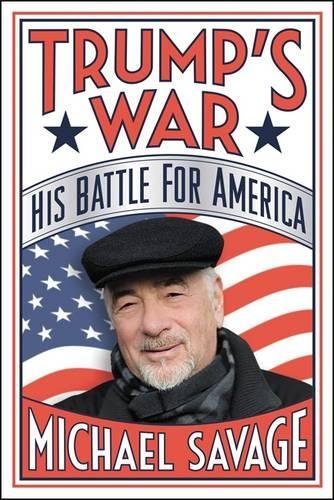
Michael Savage, along with Rush Limbaugh, are two who do get it. Savage has just published a book – Trump’s War: His Battle for America – that spells out the dangers of a fairmindedness that borders on the inane.

This is a battle that is for keeps. If we lose it, we don’t get to come back next season and have another go.


The Art of the Impossible

The Art of the Impossible -- Steven Kates

The Art of the Impossible is now out in the world and can be bought on line either here in Australia or anywhere at all here at Amazon. I thought originally that the aim should be to have the book available for Christmas but for a variety of reasons, including that nothing was settled until the Electoral College met in December, it has taken until now. But at the time, I had not even read the book myself, had only brought the posts together. Now I have read the book – four times or perhaps even five – and I no longer think of it as a book that will have only immediate interest. This is truly a book for the long haul. These are some of its features.

First, it is almost entirely about Donald Trump. The first post is from July 2015 which was a long time before anything had settled, but even before I had seen or heard a word from him or about him, I was absolutely on the same page. That very first post – Politics is what you can get away with – is about the disastrous presidency of Barack Obama, the corruption of the American political system and the destructive impulses of the American media. Nothing Trump would say during the entire election period was not something I had not already said myself, whether about border protection, migration or economic mismanagement. Everything Trump has said is what I have said. You will therefore find here the most sympathetic account of his rise to the presidency available from any source. No one, and I do mean no one, has been as onside and from so early on as I have been. I won’t say there weren’t nerves to settle and issues to bed down, but no one was as primed to see the policies put forward by Trump as I was. And as it happened, I was there on the day his trajectory changed with his July 11 presentation in Las Vegas which I live blogged at the time, and then discussed in some detail the following day.

Second, it is what I call a “blog history” and I think it’s the first of its kind. The entire book is made up of the blog posts I had written contemporary with all of the events described. In its own way, it is a new kind of history, in the way that the Anglo Saxon Chronicle may have been a new kind of history in its own time. Things would happen, and as is fitting with a blog, I would partly report on what I had read about or seen and partly give my own reaction and write up my own perspectives. The book is therefore entirely an historical account that describes events as they happened. But its more than just a series of events. Each of these events comes with a series of comments that puts these events into the perspective of someone who understands things in a way almost identically with the way they would have been seen by Trump himself. When I did the survey on “Who Should I Vote For?” my overlap with Trump was 94%.

Third, my own education and then my entire career has been inside of a political economic framework, with a large part of my area of study, both then and now, in political philosophy. I am a classical conservative and I knew another one when I saw him. I instantly recognised Donald Trump as a kindred spirit. I was never in the slightest doubt that he was and is a conservative in the proper meaning of the word. He seeks to conserve what is best but accepts the need for change but only after careful assessment. I had also worked as the Chief Economist for Australia’s largest and most representative business association and knew the crucial importance of leaving things to the market and limiting as much as possible the role of government, both in relation to regulation and expenditure.

Fourth, the events as they happened are all there. The book takes you back to each of the major moments during the campaign. Even better is that each of these moments is described without the benefit of hindsight. Each moment is looked at right then so there is a sense even now of following everything along. It therefore has the feel of a documentary rather than the views of someone who already knows what’s going to happen. You are there. You are right in the midst of things. Small events become larger events and important markers along the way – remember Michelle Fields, for example? You are right back in the midst of the campaign where these things are again happening right before your eyes just as they happened then.

Finally, I think this is an historical record that could only have been written at the time and can never be re-produced again. I think this is part of what gives it a feeling of contemporary relevance since you can no longer go back to the moment to remember how things felt and the uncertainties that were in the air. This record however take you back to the very moment when these events were first being experienced, when they were the present and not, as they now are in the past. It is the only book I have written that I feel might still be worth looking at in a hundred years, and not only right now, which I also think. If you would like to relive the American election almost day by day there is no better way to do it.

And on top of everything else, it will help you understand why Donald Trump won the election and how fortunate we are that he did.

“Supply-side” ignorance

A supply-side approach means to leave it to the market to sort things out. Supply-side does not mean telling suppliers the wages they must pay their workers. Here is a piece of academic literature that only emphasises to me that we are never going to get our economies working again: Supply-Side Policies in the Depression: Evidence from France. This is the abstract with some bits in bold:

The effects of supply-side policies in depressed economies are controversial. This Working Paper sheds light on this debate using evidence from France in the 1930s. In 1936, France departed from the gold standard and implemented mandatory wage increases and hours restrictions. Deflation ended but output stagnated. The authors present time-series and cross-sectional evidence that these supply-side policies, in particular the 40-hour law, contributed to French stagflation. These results are inconsistent both with the standard one-sector new Keynesian model and with a medium-scale, multi-sector model calibrated to match the authors’ cross-sectional estimates. They conclude that the new Keynesian model is a poor guide to the effects of supply-side shocks in depressed economies.

Did they not see what would follow? I just hope that policy is somewhat better today, but you can’t be sure.

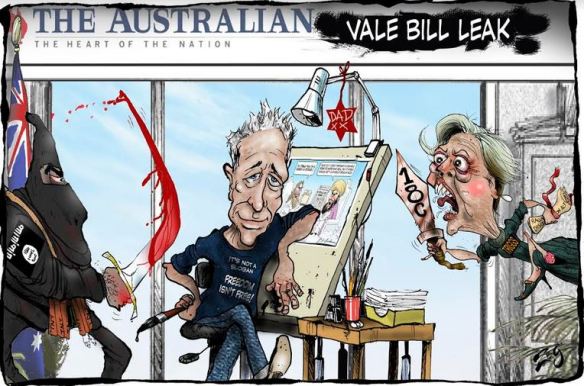
A stunning tribute to Bill Leak from another cartoonist

This is Zeg at Quadrant on Line. Beautifully drawn and very much to the point. Here is the text:

Bill Leak was forced to move his home and family to a secret location after being marked for death by Islamic fascists — real fascists, mind you, not the sort the sniveling Left perceives at every word of disagreement. He should have been able to count on the full weight and support of every government agency and bureaucrat. Instead, while the Prime Minister declined to utter four short words, ‘Je suis Bill Leak’, he was abandoned to the torments of the shameless Gillian Triggs and her posse of tax-funded thugs. What’s the difference between ISIS and the HRC? The former is open and honest in its vindictive contempt for all who will not toe the line.

The Prime Minister is missing in action in every encounter and not just here. Since no one else has mentioned it in a post today, the loss in WA is where the Feds are heading under its ineffectual low-energy non-leader. If the Coalition go to the election in the present configuration, they really are beneath contempt since they are destined to lose unless they finally work out a plan to reinvigorate themselves.

Winston Churchill defends the Balfour Declaration in 1921

This is what doesn’t exist today along with the kinds of politicians who can speak clearly and from deep principle. At the link is a discussion of Winston Churchill’s Defense of the Balfour Declaration which he made in 1921 while actually in the Middle East and while talking with the Arab leaders. Donald Trump is the closest equivalent today. The lesson we have learned since then is that a people with hatred in their souls cannot make peace because they will not make peace. That peace was possible was the hope he expressed then. What has the Arab population done in all that time to bring about a lasting peace between two peoples who would live together side by side in that fragment of the former Ottoman Empire? One can say there is fault on all sides, etc etc, but only the Israelis want mutual accommodation. Who would speak like this today? Who would not think such thoughts are pointless and mere air that can have no effect?

If a National Home for the Jews is to be established in Palestine, as we hope to see it established, it can only be by a process which at every stage wins its way on its merits and carries with it increasing benefits and prosperity and happiness to the people of the country as a whole. And why should this not be so? Why should this not be possible? You can see with your own eyes in many parts of this country the work which has already been done by Jewish colonies; how sandy wastes have been reclaimed and thriving farms and orangeries planted in their stead. It is quite true that they have been helped by money from outside, whereas your people have not had a similar advantage, but surely these funds of money largely coming from outside and being devoted to the increase of the general prosperity of Palestine is one of the very reasons which should lead you to take a wise and tolerant view of the Zionist movement.

The paper which you have just read painted a golden picture of the delightful state of affairs in Palestine under the Turkish rule. Every man did everything he pleased; taxation was light; justice was prompt and impartial; trade, commerce, education, the arts all flourished. It was a wonderful picture. But it had no relation whatever to the truth, for otherwise why did the Arab race rebel against this heavenly condition? Obviously the picture has been overdrawn. And what is the truth?

This country has been very much neglected in the past and starved and even mutilated by Turkish misgovernment. There is no reason why Palestine should not support a larger number of people than it does at present, and all of those in a higher condition of prosperity.

No reason at all, as it does today. But still no peace. A long article, but every word is worth your attention.

How fortunate we are to have The Australian

I would just like to put in a word for The Australian in the midst of our mourning the passing of Bill Leak. He was the bravest cartoonist in the world but he could only have reached his audience because we are fortunate in having the bravest newspaper in the world here in Australia.

There are parts of its editorial line I may not agree with but I am a subscriber because it is only in The Australian that we can even hope to hear our side put into the public space.

They will not find another cartoonist like Bill Leak, and that is our eternal loss. But we still have the paper who was brave enough to run those editorial page cartoons, and for this we are truly blessed.

The modern rules of free speech

The modern rules of free speech are pretty clear and enforced everywhere.

The political and social views of anyone on the right are always open to the most extensive criticisms while criticisms of anyone on the left are strictly forbidden.

You can be as negative as you like about white males while nothing critical can ever be said of any person who is not a white male.

You can criticise Christianity and Judaism as much as you please while the practices of every other religion must never be criticised.

You are compelled to praise every form of human relationships other than a non-adulterous relationship between a man and a woman.

Paedophilia is forbidden except where it’s not (such as with child brides).

The ordering here is also important. The higher issues dominate anything below them. For example, if a woman says something positive about some conservative belief, she is no longer protected even under the “white male” rule.

Which one is the fake?

Anything can be faked in this day and age, but this is at least has it funny side. It’s from Barack’s half brother Malik: Malik Obama shares photo of brother Barack’s Kenya ‘certificate of birth’. Of course, to quote Hillary Clinton, what difference at this stage does it make?

Meanwhile, the Hawaiian version has had its critics as discussed here. Nevertheless, fake or not, this is what has been published.

Now perhaps we can clear up the questions surrounding Obama’s Connecticut social security number, a state in which he never lived. And while we are at it, we could look into why no fellow student remembers ever seeing him at Columbia although he was supposedly there for two years!