Viva Che, accountant

IMG_2049

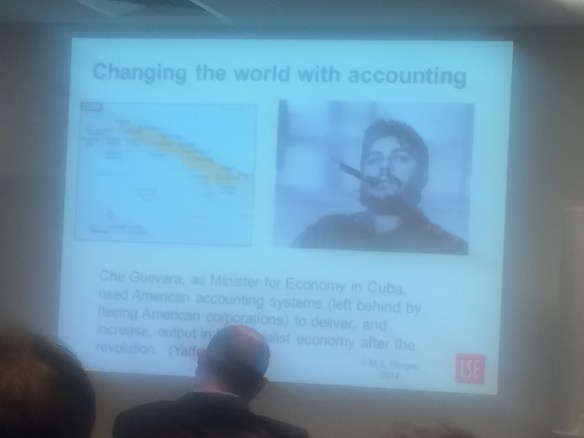
I went to an Economic Society presentation last night about the role of statistical measurement in creating economic reality given by one of the stellar scholars of our time. That was the first slide of the night. This is the text below the picture:

Che Guevara, as Minister for Economy in Cuba, used American accounting systems (left behind by fleeing American corporations) to deliver, and increase, output in a socialist economy after the revolution.

You would think the presenter would be embarrassed to say any such thing, or if one cared to give the benefit of the doubt, is perhaps oblivious to the offence that might be caused or has no idea how this might be judged given how badly the Cuban economy has been managed. None of it. Understood it all and dared anyone to say a word. No one, of course, did.

Lasched to the massed

The article starts with the obligatory anti-Trump statement but once you get past the opening the text is not anti-Trump at all. Christopher Lasch is one of my favourite writers of all time and the article is Donald Trump and the Ghost of Christopher Lasch. So get past the opening with its “Trump would be the end of the world as we know it” to read this:

In The Revolt of the Elites Lasch foresaw the disconnect between the nation’s political classes and the governed, as UCLA law professor Stephen Bainbridge has recently observed. America’s elites have devoted so much energy to building their collective moral system that they expect ideological obedience. When Trumpists say strong families in the 1950s were a positive, the cognoscenti respond: “So what. It was a terrible time for minorities and gays.”

Trump’s armies feel the sting of comfortable, upscale, post-industrial winners who can barely conceal their contempt for those they dismiss as Wal-Mart people. The disdain for yeoman America—which is overwhelmingly white—is visceral, longstanding, and profound.

“Middle Americans, as they appear to the makers of educated opinion, are hopelessly shabby, unfashionable, and provincial, ill informed about changes in taste or intellectual trends, addicted to trashy novels of romance and adventure, and stupefied by prolonged exposure to television,” Lasch wrote in 1995, not yesterday. “They are at once absurd and vaguely menacing.”

And why does this matter?

As Lasch anticipated, the nation’s ruling classes style themselves to be citizens of the world, living in “a global bazaar” to be savored indiscriminately, “with no questions asked and no commitments required.” From Pacific Palisades to Cambridge, far from the madding crowd, well-heeled transnational citizens of the world may hold assets in Singapore or the Cayman Islands. Their identities are post-national. Amid the affluence, obsequious Third World helpers work at minimum wage or off the books, doing the scut work and producing an exotic, multicultural vibe as a bonus.

Abandoning the left’s original intent to protect the common man, Lasch observed, progressives chose instead to pursue diversity, secularism, and cultural revolution. Families, schools, and churches were left behind. For thought leaders, family values, mindless patriotism, religious fundamentalism, white racism, homophobia, and retrograde views of women stood in the way of progress.

Progress should, of course, be written as “progress”. And so how do those elites think, and remember this is Lasch who was writing this two decades ago:

For progressive elites, delicate moral confections and debatable ethical positions became acts of faith. “It is no longer necessary to argue with opponents on intellectual grounds or to enter into their point of view,” Lasch pointed out. “It is enough to dismiss them as Eurocentric, racist, sexist, homophobic – in other words, as politically suspect.” When these novel moral systems are challenged, Lasch added, progressives react with “venomous hatred,” the toxic ill feeling that seems abundant in the 2016 election year.

Go to the link and read it all right through to the end, which is not an attempt to dissuade anyone from voting for Trump.

A Trump victory of course is “impossible.” It would require a massive, almost unimaginable white, yeoman flight from the Democratic Party. It is quite likely that we are even now experiencing Peak Trump. But “impossible” now stands in quotes.

And my congratulations to the author, Gilbert Sewall, for putting this together in just such a way that it has been featured at Instapundit, by Ed Driscoll who would have understood it perfectly, but also at Powerline which perhaps was uploaded by Steve Hayward, but I doubt any of the others. Our elites are ruining the world and the only thing that might save them and us is this revolt from below.

A great day for Western civilisation, was it?

I realise if you are part of the Murdoch press, these independent columnists, these frank speakers of truth to power, are ever so often under instruction to take a particular line. So who do you suppose Greg Sheridan was speaking of when he wrote this:

The best day for Western ­civilisation since the beginning of the primary season.

Was it Hillary Clinton’s loss? Was it Bernie Sander’s win? Don’t be silly. No, it was the defeat in a non-Romney-winning state primary of Donald Trump by Ted Cruz. What a great day that was! More to the point though, is why doesn’t this really make him worry and worry a lot more?

Insurgent Vermont senator Bernie Sanders, who describes himself as a democratic socialist, won his sixth straight primary, beating former secretary of state Hillary Clinton 56 per cent to 43 per cent.

Is Sanders really less of a worry than Trump? Is the American equivalent of Hugo Chavez not something that really really worries him? What a pitiful joke. And speaking of pitiful jokes, we also have another of the Murdoch shills, this time Niki Savva, lamenting the fact that people who preferred Abbott to Turnbull continue to say so. Well, there is at least this concession:

Turnbull has made his mistakes in the job — and which prime minister has not, certainly in the early stages.

Pathetic, just pathetic. It’s not just that he’s made mistakes, it is that he has not achieved a single thing. Here, on the other hand, is a list put together by someone pointing out Tony’s contrasting record:

His government stopped a ruthless people smuggling trade that had resulted in more than 1000 people perishing in the seas between Indonesia and Australia. They got rid of the carbon and mining taxes. They pushed through three FTAs. He, personally, pushed to stop government subsidies to the car industry, he said no to taxpayer funding for Qantas and IXL. He called a Royal Commission into Trade Union corruption. He reduced subsidies to the renewable energy sector. He tried to push through a one-stop shop on environmental approvals for new mining projects.

And all this with the Leader of the Opposition a member of his own cabinet.

I can certainly live with a Ted Cruz as president, better than either of the Democrats. But not to understand the virtues that Donald Trump would bring with him to the White House along with his negatives makes everything his critics at The Australian say just empty rhetoric demanded of them by their boss, in exactly the same way they had all ganged up on Tony.

Were the Classical Economists Right After All?

This is the first draft of an abstract I have put together which relates to my previous post on production versus consumption. I would be interested in any thoughts you might have.

Political Economy in Crisis:

Were the Classical Economists Right After All?

There are, generally speaking, five streams of macroeconomic thought that compete for allegiance in the modern world.

Keynesian which comes in many varieties all of which argue recessions are due to failure of aggregate demand and which deny the validity of Say’s Law

New Classical based on rational expectations but with no embedded theory of recession

Austrian which typically ignores aggregations, where activity is driven by marginal utility and which builds a theory of recession based on structural imbalances caused by financial dislocation

Marxist and other forms of socialist theory whose aim is to centralise economic decisions and whose main focus of analysis are exploitation of the working class and concern with inequality

Classical which emphasises the supply-side of the economy, focuses on the role of the entrepreneur and sees recessions as due to structural imbalances which may come from a variety of causes.

The aim of the paper is to argue that economic theory reached its deepest and most profound level in the writings of the late classical economists which flourished over the period from the publication of John Stuart Mill’s Principles in 1848 through until the publication of John Maynard Keynes’s General Theory in 1936. The paper will discuss the classical framework and contrast this approach with the alternatives that today compete for the allegiance of economists.

Fields of dreams and hallucinations

It’s like all those folk back then who looked through their telescopes and saw the canals on Mars. In this case, it is the battery inflicted on Michelle Fields by Donald Trump’s campaign manager. Here is a description from the formerly reliable Jeff Jacoby in an anti-Trump article titled, Authoritarian in Chief:

Authoritarian abuse of power in a Trump administration isn’t just a theoretical possibility. Should the New York businessman win the presidency, it’s a certainty. Trump’s campaign, with its torrent of insults, threats of revenge, and undercurrent of political violence, is the first in American history to raise the prospect of a ruthless strongman in the White House, unencumbered by constitutional norms and democratic civilities.

When Trump’s campaign manager, Corey Lewandowski, was arrested last week on misdemeanor charges of battery against reporter Michelle Fields, the candidate’s reaction was typical. Though Fields’s account was never in doubt — it was corroborated at once by an eyewitness (Washington Post reporter Ben Terris), by an audio recording, and then by security-camera video footage — Trump offered no apology and didn’t rebuke his staffer. Instead he went on the attack: He claimed that Fields had “made the story up,” he went out of his way to praise Lewandowski, and he gleefully trashed the journalists covering him as “disgusting” and “horrible people.” Trump even hinted that he might sue Fields.

A campaign manager is not the candidate himself, and even the most abusive principal will fire subordinates if they cause trouble. But Trump did not and in fact told Lewandowski that under no circumstances was he to apologise or concede anything at all. So let me bring Gavin McInnes to put the other side of the case in an article he titles, Michelle Fields Is Not Black and Blue.

There is plenty of photographic and video evidence of the exchange, but it doesn’t seem to affect people’s perception of what happened. Once again, the more we are confronted with evidence that contradicts our beliefs, the more steadfast we are in those beliefs. The initial videos show a close-up of Fields touching Trump, and an aerial view was released by police this week that shows more details. What is irrefutable is that on March 8, after a press conference in Jupiter, Fla., Breitbart reporter Michelle Fields approached Donald Trump and was moved out of the way by Trump’s campaign manager, Corey Lewandowski. There is audio of Fields acting like it was a big deal to The Washington Post’s Ben Terris, but I was happy to get on with my day a few seconds after seeing the first video.

So here is the story on video.

You have to be hallucinating to see an assault in any of this, or perhaps just hoping with all your might for any old lie to get the job done. Here it is one more time.

Are people really telling the truth when they say they saw an assault in that picture? There is no insanity quite like it.

AND JUST A BIT MORE: I thought I would look up the distinction between “assault” and “battery” Here is what I found on the net:

Any reasonable threat to a person is assault while battery is defined as use of force against another with intent of causing physical harm without his consent. In other words, assault is the attempt to commit battery.

Unless there was an intention to cause physical harm, there is no case to answer. You can look at the legal definitions here.

“What a country wants to make it richer, is never consumption, but production”

I have an aversion to virtually every form of modern economic theory. Whether it is based on aggregate demand or marginal utility, they all seem to think economies are driven from the demand side. And no level of failure built on such policies ever gets the profession to recognise that an economy is driven by value adding production and nothing else. If you want to understand how things work, you must return to classical economic theory. It is what drove Reagan’s revolution which was described as supply-side economics but was explicitly based on a return to classical economic theory and Say’s Law. Which brings me to this, an article Mill Power, which has as its sub-head, “‘Trumponomics’ from a classical perspective”. This is by Stephen MacLean writing in the Quarterly Review of Canada’s Disraeli-Macdonald Institute.

Foregoing the legitimate question about the efficacy of U.S. fiscal dictates that induce home industries to take advantage of tax structures in foreign lands — and penalise them when they try to patriate capital — what policy should a possible Trump administration advocate for congressional legislation?

The answer lies in entrepreneurship and innovation. As Mill explained, ‘What a country wants to make it richer, is never consumption, but production.’

What can you find in all of your modern texts that makes as much sense as that? And oddly, just today, this showed up: What has Trump Wrought by Pat Buchanan. And there, right in the middle, we find exactly the same argument:

Economists who swoon over figures on consumption forget what America’s 19th-century meteoric rise to self-sufficiency teaches, and what all four presidents on Mount Rushmore understood.

Production comes before consumption. Who owns the orchard is more essential than who eats the apples. We have exported the economic independence Hamilton taught was indispensable to our political independence. We have forgotten what made us great.

In dwelling on all this, you might contemplate which side of this issue those crony capitalists are lining up on, the ones who would find their massive lashings of government money shorn away as a more economically literate business-like administration took over.

And just in case you are wondering where you can find a modern version of Mill’s Principles, might I suggest this, now in its second edition.

Hillary Clinton and the rights of the unborn

Can you see why everyone was upset with this from Hillary Clinton? More particularly, why did it upset so many of those on the left?

Democratic primary front-runner Hillary Clinton ran afoul of both the pro-life and pro-choice sides of the abortion debate Sunday when she said constitutional rights do not apply to an “unborn person” or “child.” . . .

Mrs. Clinton also said “there is room for reasonable kinds of restrictions” on abortion during the third trimester of pregnancy.

Here’s the reason they were upset.

Describing the fetus as a “person” or “child” has long been anathema to the pro-choice movement, which argues the terms misleadingly imply a sense of humanity.

In addition, the specific term “person” is a legal concept that includes rights and statuses that the law protects, including protection of a person’s life under the laws against homicide. Pro-choice intellectuals have long said that even if an unborn child is a “life,” it is not yet a “person.”

See the distinction?  You may think this is sick and depraved, but what do you know? You have to be a constitutional scholar or an intellectual to understand these things.

Even an old pro like Hillary can’t get it right even after all these years, although you may be sure this is nothing but a passing moment on her way to the White House. I only mention it as a reminder of the extent to which the media makes everything into a sensation when it want to get you. But with those it supports you hardly hear a sound. I point this out just so you know which side you are on when you buy into American politics. Because if these eight months old “fetuses” are actually persons with constitutional rights – you know, actual real people – then perhaps some of you were just a tad harsh the other day in your judgements of what nameless others had been saying on this very issue. Not that he was necessarily right, but only that you are picking up your cues from George Soros and The New York Times.

I always see a movie when I have popcorn

If they didn’t blend as well as they did, this near-century relationship between popcorn and the movies would not have endured. It is obviously not just a fad. The main point of this fascinating video is that movies only became part of our way of life in the way they did because of the popcorn concessions in each cinema. Since I never see a film without a box of popcorn and a Diet Coke, I am the last person alive to think this is untrue. But it would be amazing if it is true.

Suffering conditions worthy of Anglo-Saxon countries

Is this the very letter of what it means to be living in a bubble, Labour law revolt across France humiliates President Hollande.

A day of chaos left Mr ­Hollande under pressure to ­perform another humiliating U-turn, after his climb-down over new anti-terrorism laws on Wednesday.

So what has got him into such hot water after he found it impossible to introduce new laws restricting the rights of terrorists?

The labour legislation, ­promoted by Prime Minister Manuel Valls, was touted by spin doctors as a brave bid to improve the stuttering economy by lengthening France’s notoriously short working week, while making it easier for companies to lay off staff.

The economy is without doubt stuttering, and the 35-hour week has been a major handicap since it was introduced in the 1980s. It has also been impossible for a firm to reduce employee numbers whether or not those employees were actually needed by the business. So you don’t really have to look all that far to see what the economic problems are. But this is the bit I liked the best:

The under-25s are now prominent in a protest movement whipped up by student unions claiming that the workers of the future will suffer conditions worthy of Anglo-Saxon countries.

Well given how things are going, they won’t have to worry about economic conditions being like ours in a few years, or about other conditions as well.

The writers and critics who prophesize with their pens

The fantastic amount of anti-Trump material pouring out across the media and throughout the whole of the left means they perfectly well understand the threat Trump poses to them. If they thought he was not a the most serious threat to the Democrats among the Republicans, they would stay silent and let nature take its course. They are not silent and are doing all they can to stop him. At the beginning they thought of him as the easiest one to beat and brought him forward out of the pack. Now they have seen the error of their ways and are pushing as hard as they can in the other direction.

I have just gone through Lucianne and the headlines there. It was near on a quarter of the stories were anti-Trump from every media source you could name. They mean it – the writerly class, they understand that he needs to be stopped, and of course this writerly class consist of almost as many Republicans as Democrats.