Why economic theory is not self-correcting

This is about the hard sciences mostly, but fits into my astonishment that Keynesian economics seems to survive every failure: Why Science Is Not Necessarily Self-Correcting.

In the absence of replication efforts, one is left with unconfirmed (genuine) discoveries and unchallenged fallacies. In several fields of investigation, including many areas of psychological science, perpetuated and unchallenged fallacies may comprise the majority of the circulating evidence.

Of course, with economics we are not even dealing with replicatable experiments but simply the received theory that is built into the models that are used to test them. It does seem to me that economists only look at models and never at what’s going on outside their windows in the actual economy. And although few economists even know this, the datasets they use – such as GDP, the CPI and the unemployment rate – are almost entirely designed to deceive rather than enlighten.

The 2016 UK HET Conference in Shanghai

ukhet-group-photo

The UK History of Economic Thought Conference this year was held in Shanghai because, as I understand it, the Chinese are interested in pursuing HET and want to see how it is done. They get it, that HET brings an extra and extremely important dimension to the study of economics, something it is hard to convince economists in the West about.

The UK meeting is always extremely good, and this one was no exception, in large part because they only have a handful of presentations and they are always plenary sessions so that for presenters, you really are guaranteed the benefit of listening to comments from quite knowledgable people. And on this occasion because all of the fees and expenses were paid (but not the air fares), and partly because it was in Shanghai, it did seem to attract an astonishing array of high quality papers. It was very pleasing to be included. The group photo is above.

Cheating at the debate

There are issues large and small that do make you wonder. This is among the small, but is neither irrelevant or insignificant: Presidential Debate Commission Admits Trump’s Mic Was Messed Up. Trump said it on the day but now it is confirmed.

But then there is the larger ones the most extraordinary one being the removal of Hillary’s notes from her podium by someone who then immediately crosses paths with the moderator after exchanging knowing looks. At Google, it is practically gone, although there were a few versions of this available a few days ago in a more extended form. I only found the one below which followed on from a much more brief version. It shows the man with grey hair and glasses taking something from Hillary’s podium and then looking over at the moderator before they briefly cross paths in the middle of the stage, but then goes on with much much more.

Why would you doubt for a second that if they could cheat they would cheat? And why would you doubt that the media would be in on it to the hilt?

Not even near peak stupid

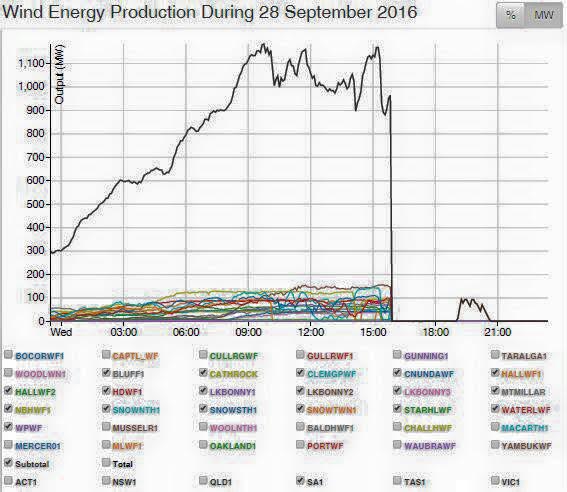
wind-production

The text that came with the chart is unsourced but quite interesting:

The blackout of the entirety of South Australia is a poignant lesson as to why wind power is nonsense.

You will hear from a whole heap of truth deniers trying to protect the eco-crucifix industry by saying that the blackout had nothing to do with the fact that Labor has made South Australia completely reliant on renewable energy for its power.

But the cold hard fact is that the knockout of a transmission tower would not have stopped power being generated by a decent network with reliable coal-fired baseload power. What knocked out the power was the fact that every wind turbine powering South Australia ceased to operate as soon as wind speeds reached a critical level. They cannot produce power when there isn’t enough wind and they can’t produce power when then there’s too much wind. The proof: this graph showing wind power energy production in South Australia yesterday.

Thank God we aren’t reliant on those useless, bird-chopping wind turbine monstrosities here in Queensland.

I have now seen this South Australian story told round the world but in a way that suggests that this is just one of those really idiotic things that happened one time in some out of the way place in Australia. Really only mentioned for a laugh. Yet the people who did this are everywhere and wherever you find them they really are incapable of seeing and understanding cause and effect, but are filled with emotion about some remote possibility 50 to a 100 years from now. Unfortunately there is worse to come before it is better.

Just how unique is Australia!

aussie-mussies

For those who need translation: this is a cover story from The Australian Spectator on the Australian Muslim community. Nowhere else in the world would such a cover be possible. Australia must save itself. It really is the best country in the world in so many ways, but there is a lot of downside potential if we are not very very careful. The rest of the world seems to be a case study in lack of care.

What would a journalist know about anything?

A journalist generally has about as much education and worldly knowledge as a Grade IV teacher. Which is why we have this from today’s Cut & Paste:

But at The Sydney Morning Herald, veteran Canberra hand Tony Wright suggested The Donald had enjoyed some familiarity with lines of Peruvian marching powder:

Donald Trump made a fool of himself so many times it wasn’t worth counting. He told half-truths and plucked lies out of the air (“I opposed the ­invasion of Iraq”). He blurted streams of incomprehensible free association. He raved, interrupted and sniffled like a coke addict.

As it happens, I didn’t then and don’t now oppose the war in Iraq. It has turned out disastrous, but who could have expected an incompetent foreign policy dunce like Obama would become the American President (who, for the record, is equally incompetent on domestic policy).

Trump did oppose the War in Iraq, but not the War in Afghanistan, which means he took the same position as Obama but I would not expect any “journalist” to know this since few of them seem to want to know facts that are contrary to what they prefer to believe. My guess, though, is that if Trump had been president since 2008 he would not have done everything he could to undermine the stability in the Middle East that had finally been created. ISIS belongs to Obama and Hillary. Hillary is the last person in the world anyone should ask to fix up the mess she is largely responsible for.

What’s wrong with other economists?

This is a note I have written to the contributors to What’s Wrong with Keynesian Economic Theory?
______

I hope you have all by now received your own copy of the book.

I have also put a blog post up at the Elgar website which is my own view of the book and how significant I think it is which you can find here

Let me therefore again thank each and every one of you for your articles. As I try to convey in the Introduction, a book such as this is an extreme rarity. This is from a blog post I wrote here in Australia where I tried to explain just how rare the book is.

The following quote is from Henry Hazlitt’s Economics in One Lesson.

When the government comes to repay the debt it has accumulated for public works, it must necessarily tax more heavily than it spends. In this later period, therefore, it must necessarily destroy more jobs than it creates. The extra heavy taxation then required does not merely take away purchasing power; it also lowers or destroys incentives to production, and so reduces the total wealth and income of the country.

The only escape from this conclusion is to assume (as of course the apostles of spending always do) that the politicians in power will spend money only in what would otherwise have been depressed or “deflationary” periods, and will promptly pay the debt off in what would otherwise have been boom or “inflationary” periods. This is a beguiling fiction, but unfortunately the politicians in power have never acted that way. Economic forecasting, moreover, is so precarious, and the political pressures at work are of such a nature, that governments are unlikely ever to act that way. Deficit spending, once embarked upon, creates powerful vested interests which demand its continuance under all conditions.

Hazlitt also published his Critics of Keynesian Economics of which it is said..:

Henry Hazlitt confronted the rise of Keynesianism in his day and put together an intellectual arsenal: the most brilliant economists of the time showing what is wrong with the system, in great detail with great rigor. With excerpts from books and articles published between the 30s and 50s, it remains the most powerful anti-Keynesian collection ever assembled.

And here’s the thing. The book was published in 1960 and other than Mark Skousen’s sadly out-of-print Dissent on Keynes (Praeger 1992) there has not been another attempt to do the same until my own modest What’s Wrong with Keynesian Economic Theory? which was only released last month. It is thus almost twenty-five years since anyone has has brought together a series of critics of Keynesian economics and more than fifty years since the only other. And as scarce as they were even then, critics of Keynes were easier to find, let me tell you, in the 1930s, 40s and 50s [and I might mention that Hazlitt included two nineteenth century articles of sublime excellence by J.-B. Say and J.S Mill]. Such economists are almost completely gone today in spite of there being every reason to think they should be found at every turn.

There are 13 of us in this book. I would doubt there are a hundred economists in the world who are actively anti-Keynesian and see the problem with economic management in Y=C+I+G. Yet even now there is talk of a further stimulus and negative interest rates which are further attempts to deal with our economic problems from the demand side. There was a recent article in The Wall Street Journal by Robert Barro where he said “It wasn’t the severity of the Great Recession that caused the weak recovery, but government policies” which for me is progress.

And he notes the fall off in productivity. But he doesn’t specifically say as I would that the fall in productivity has been because of the diversion of our resource base into various Keynesian stimulus projects, or due to low interest rates misdirecting resources. What I have, however, learned in putting this collection together is that some of those who are anti-Keynesian – and will remain nameless but I can say that Robert Barro was not among them – declined to contribute an article because it would put them offside with their colleagues.

So I thank you again. Hopefully the book will find its way to enough readers to make a difference to how policy is framed from now on in.

This is ‘Irreversible’

Below the radar isn’t the half of it.

USA INTERNET SURRENDER DAYS AWAY…
Obama’s Reckless Plan Threatens U.S. Oversight of Internet
FCC Commissioner on Internet Oversight Switch: ‘If You Cherish Free Expression,’ ‘You Should Be Worried,’ This Is ‘Irreversible’

The same people who run the UN will now run the single most important communications network in the world.

And it’s not as if the US Senate is not there and available to knock this off. The main story at Drudge at this moment is Congress Votes to Override Obama Veto on 9/11 Victims Bill. The Senate is in session and it could take action.

It’s like the lights in South Australia. There is a belief that things will just go on the way they were, but they never do and in this case they really won’t.

You also have to wonder who is calling the shots here because the lack of action itself speaks volumes.

The drums of war

I can’t hear them, but Victor Davis Hanson can. His title is A Hard Rain Is Going to Fall but his meaning is that we are on the edge of a war we are not preparing for and will be unable to fight.

Russia has been massing troops on its border with Ukraine. Russian President Vladimir Putin apparently believes that Europe is in utter disarray and assumes that President Obama remains most interested in apologizing to foreigners for the past evils of the United States. Putin is wagering that no tired Western power could or would stop his reabsorption of Ukraine — or the Baltic states next. Who in hip Amsterdam cares what happens to faraway Kiev?

Iran swapped American hostages for cash. An Iranian missile narrowly missed a U.S. aircraft carrier not long ago. Iranians hijacked an American boat and buzzed our warships in the Persian Gulf. There are frequent promises from Tehran to destroy either Israel, America or both. So much for the peace dividend of the “Iran deal.”

North Korea is more than just delusional. Recent nuclear tests and missile launches toward Japan suggest that North Korean strongman Kim Jong-un actually believes that he could win a war — and thereby gain even larger concessions from the West and from his Asian neighbors.

Radical Islamists likewise seem emboldened to try more attacks on the premise that Western nations will hardly respond with overwhelming power. The past weekend brought pipe bombings in Manhattan and New Jersey as well as a mass stabbing in a Minnesota mall — and American frustration.

Europe and the United States have been bewildered by huge numbers of largely young male migrants from the war-torn Middle East. Political correctness has paralyzed Western leaders from even articulating the threat, much less replying to it.

Instead, the American government appears more concerned with shutting down the detention center at Guantanamo Bay, ensuring that no administration official utters the words “Islamic terror,” and issuing warnings to Americans not to lash out due to their supposedly innate prejudices.

The last para of the article: “War clouds are gathering. A hard rain is soon going to fall.” If he’s right, we won’t have long to wait to find out.

Man-made disaster

Here is a presentation I will make sure I get to: Masculinism, global warming and ‘man-made’ disasters: Towards a profeminist environmentalist response. Here is the blurb:

In the wake of disasters and other environmental destruction, recent attempts have been made to develop eco-masculinities, many of which simply encourage men to commune with nature, or seek to minimize feminist critiques by finding redeeming features in traditional masculinity. Against this backdrop of debates, this paper explores what profeminist masculinity studies brings to addressing men’s ecologically destructive practices. While the causal relationship of climate change to natural disasters is contested, people’s vulnerability to “natural” disasters clearly relates to economic, cultural and social relations, including those shaped by gender. Further to that, a variety of eco-feminisms are considered which draw connections between patriarchal social structures and ecological destruction. While some eco-feminist literature is criticized as essentialist, contemporary versions of eco-feminism recognize that the greater responsibility of men for environmental catastrophies is due to the social construction of masculinism, intersected by social divisions between men. Masculinism, and the technological rationality that flows from it, has furthermore become a mindset for environmental management, which does not address the causes of environmental crises. Environmental sustainability may even appear to threaten masculinism and hegemonic masculinity, though environment movements are often seen as a supportive context for non-hegemonic masculinities and progressive practices by men. This theoretical discussion reflects on how different forms of profeminist subjectivities lead to resistance to global warming and environmentally destructive policies, and how men can change their subjectivities and practices to construct a more sustainable world.

And this is the bio of the presenter:

Bob Pease is Professor of Social Work at the University of Tasmania, Australia. He has published extensively on masculinity politics and critical social work practice, including four books as single author and twelve books as co-editor. His most recent books include: Undoing Privilege: Unearned Advantage in a Divided World (Zed 2010), Men and Masculinities Around the World: Transforming Men’s Practices (co-editor, Palgrave 2011), Men, Masculinities and Methodologies (co-editor, Palgrave 2013), The Politics of Recognition and Social Justice: Transforming Subjectivities and New Forms of Resistance (co-editor, Routledge 2014), Men, Masculinities and Disaster (co-editor, Routledge 2016) and Doing Critical Social Work Practice (co-editor, Allen and Unwin 2016).