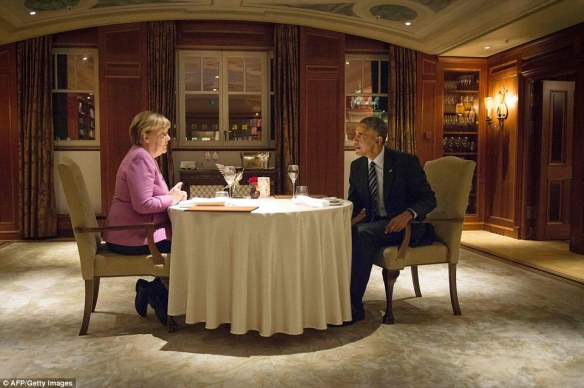
The two greatest political fools of our lifetime
Image
Reply

From Drudge, right now:
Trump Says Ford Called to Say It’s Keeping SUV Plant in Kentucky
Dollar Sees Record Winning Run Versus Euro on Trump Policy View
In Trump Era, Israel Sees Opportunity to Shift Iran Approach
Trump fears push nations at Morocco talks to call climate action an ‘urgent duty’
Kanye West: I would have voted for Donald Trump, if I had voted Chaos and projectile shoes at concert as rapper gives hour-long pro-Trump speech
MAGA!
We have heard that the Malcolm Turnbull has had a conversation with Donald Trump, just as Trump has noted that he spoke to Malcolm as one of the 29 world leaders he had talked with. What was said and the tone of the conversation was not, however, mentioned. This is from David Archibald, in an article he titles News from the Cone of Silence to emphasise what we do not know about what was said.
Our own langorous leader decided to join the good and the great in having a telephone conversation with someone they so recently despised in public. To do so he reprised Maxwell Smart in going to the cone of silence to make the call. In this case it was the ASD crypto-centre in Canberra to make the secure call to the private number of Trump, which had been provided by Joe Hockey, Australia’s ambassador to the United States.
Turnbull had the call on speaker. On good report, everyone in the room was surprised when Greg Norman answered the mobile number. Mr Norman patched the call through to President-elect Trump who was not rude but made it plain in telling Turnbull what the new rules were and that Trump would be using Greg Norman as a filter as he would be very busy.
It is important and very interesting that President-elect Trump is said to have said, “Let’s start by you getting your navy up here to take part in Freedom of Navigation patrols, then we can talk about our relationship.”
Apparently Turnbull was somewhat nonplussed and said, “Well, we need to discuss climate change and the TPP…” Trump peremptorily dismissed both issues with “Not a priority, but talk to Greg. He is a great Aussie who has been part of my team for 30-years and he is the advisor I trust.” It was a shock to Turnbull to engage with someone who didn’t want to hear his waffle, as most in this country do far too politely.
The other interesting conclusion is that Hockey is out of the loop with respect to the Trump administration, as someone who is useless and stupid. It is also evident that Trump is aware of the enormous task ahead of him and is not wasting a moment.
Trump is clearly a man who has his eye on the ball, knows what he wants and is not prepared to pussyfoot around with idiots. What a change is in store for us all.
The Australian Prime Minister’s Chief Economic Advisor gave a speech yesterday. It was, in effect, a warning about the economic dangers of President Trump’s policy proposals. It is discussed here, but let me especially bring to the surface one of the comments from the post: Martin Parkinson misses the point (again).
John Comnenus
#2211865, posted on November 18, 2016 at 12:34 pm (Edit)
I was at this speech and reported on it in an earlier thread.The Parkinson speech was, in my view, an ill timed full throated plea for Trump to reverse policy. It was clearly the Government’s position and I suspect Parkinson fully supports it.
The question and answer session is not captured in the link. The first asked why Parkinson thinks this populism thing is happening Brexit – Trump etc?
Parkinson called the response ‘inchoate’ and he didn’t understand why it was happening, but he certainly recognised it was going on. But really it isnt that hard to understand if you look at what Parkinson said in his speech.
During the speech Parkinson noted the following as a key benefit to Americans of US trade and economic diplomacy:
“To give some context, US residents’ ownership of private foreign assets has risen from 6.5 percent of US annual GDP in 1950 to more than 140 percent of annual US GDP, or $25 trillion today. In other words, openness to trade and to investment abroad has directly contributed to a massive increase in the wealth of individual Americans.”
US economic and trade diplomacy created a truckload of wealth.
In the answer to why the revolution question, Parkinson noted that 60% of US workers real wages are equivalent to what they were 30 years ago.
Now I’m not Einstein, but even I can see the obvious connection between those two data points and popular anger.
The last question totally dumbfounded Parkinson, it was from a CEO who asked what impact Parkinson thought the Trump tax plan would have by going from the highest corporate tax rate in the G20 to the lowest.
Parkinson was stuck in a very long pregnant pause whilst trying to work out how to respond. Clearly the answer is obvious, but how does it fit with the narrative that Trump will wreck the world economy? In the end Parkinson conceded it is likely to create strong jobs and wealth growth and that Treasury modelling suggests that half the benefit of those corporate tax cuts will go to the workers.
At the end of the lunch I thought how ridiculous is Parkinson? He tells us on one hand that he doesn’t know why people are voting Trump and Brexit noting that lots of wealth has been created. Later he acknowledges that wage earner has seen none of this wealth, in fact they are going backwards fast, and then finally that Trump’s tax plans will create more jobs and better pay.
Now I don’t have a PhD in economics from Princeton but even I can connect those three dots.
Parkinson’s speech unintentioanlly proved that the massive wealth accumulation from US trade policy has gone to very few people, that most workers have seen none of it and that Trump’s tax plan will help spread that benefit to a lot more workers. It really suggests, unlike Parkinson, that the average Trump voter understood what is going on, what Trump was offering and voted for their best economic interest. That is the average Trump voter voted the smartest way they could given the choice.
If I were Turnbull I would be very circumspect about taking too much advice from Parkinson who assembled and looked at all the evidence only to miss the most obvious conclusion.
A little later down the comments he added the following:
Parkinson’s further remarks to the tax cuts question defy belief and indicate a complete lack of self awareness.
Parkinson advised, in his most serious tone, that the deficits that result from tax cuts are ok if the money is invested in long term productivity improving infrastructure, but bad if they are spent on recurrent expenditure.
There are three things wrong with Parkinson’s statement:
1. what a damning statement about Australia’s idiotic and wasteful fiscal policy over the last decade or so. No contemporary Australian is in a position to tell any other government anything about wasting deficits on recurrent expenditure.
2. Parkinson doesn’t get that company tax cuts are going to companies and not the government. You don’t get to direct private consumption (yet).
3. The company owners will decide what to spend the additional profit on. I bet they get better and more relevant productivity improving development through private sector investment than any massive infrastructure waste government would deliver, say like the NBN.
This whole speech, in hindsight, was just embarrasing and appropriate indicator of the Govenrment’s complete inability to come to grips with Trump’s private sector driven economic growth approach.
And then he immediately added this in the very next comment:
Everyone, including Parkinson, assured us those jobs aint coming back.
Why what was that I read yesterday? Ford is moving a truck plant from Mexico to Ohio and Apple is looking at producing iphones in America.
Trump is on a roll and he isn’t even in office yet.
Is it too early to call: BEST PRESIDENT EVA!
And then finally he added this.
I felt like standing up and telling Martin that in the private sector wages have been flat compared to the public sector where wages are on average higher and they keep growing regardless of performance and that is before you add the outrageous level of superannuation and the obscene recent pay increases the politicians and top ‘public servants’ gave themseleves as if they have been doing a good job running the country.
The only thing saving Parkinson from a Trumpageddon event is the fact that the US Trumpageddon event is about to create a massive private sector led economic recovery in the USA and some of that will flow to Australia.
These morons will never learn that you can’t tax your way to growth which means you can’t government spend your way to growth either.
If he says anything else, I will add those in later.
The two best, most reliably accurate writers on the politics of our time, with columns on the election just published, with a bit from each. First Ann:
In the modern Democratic Party, out-of-work coal miners are constantly denounced for their “privilege” by half-black girls at Yale — who wouldn’t have gotten in without the black half — and who will be paid a quarter-million dollars as the “diversity coordinator” at some Fortune 500 corporation.
Apparently the new method of developing opinions is to figure out what’s trendy and allowing celebrities and comedians to act as your personal shoppers.
And then Mark:
To be honest, I’d be mildly impressed were any of the #NotMyPresident types to hold up a sign accusing Trump of “Pecksniffian disingenuousness” and “shabby bluff”, but it doesn’t seem to be Miley or Katy’s bag, and Pecksniffian uses up too many Twitter characters for a viable hashtag. That said, Donald Trump is pachydermatous on a nuclear scale and clearly relishes l’honneur d’être une cible (look it up, snowflakes). So you’re gonna need something new. Like maybe try refuting Trump’s positions rather than labeling the millions of voters who support them. Oh, and while we’re at at it, you might politely suggest to Messrs Oliver, Colbert and Noah that there’s never been a better time to embark on a mid-life career change and move into comedy. If the object is to win the next election, sneering is not a substitute for argument, or entertainment.
These are but samples. Go to the entire columns. We can at least have a good time for now before having to endure the deranged opposition to what the majority of Americans appear to want.
The video is from Powerline. From reports, Hillary outdid Hitler on her own election-night rant.
Getting a recovery from here, from within the mess that Obama has left behind, will be a task of such Herculean difficulty that only because Trump is president do I think it is even possible. And one of the most important virtues he may have is not listening to economists such as this one discussed in the article at the link: The brilliant economist who designed the failed 2009 stimulus plan tells us that Donald Trump’s economic plans are going to fail. Here we are dealing with Harvard economist, i.e. Keynesian economist, Lawrence Summers, about whom the article states:
At this point, we have to note that the esteemed Dr Summers was the architect of President Obama’s 2009 stimulus program, the American Recovery and Reinvestment Act of 2009, an $831 billion boondoggle which was promised to hold unemployment to a maximum of 8%; it reached 10.0% in October of 2009, and stood at 9.2% in June of 2011, when it was projected to be below 7%. There are many economists who still justify the stimulus bill by saying that while the effects of the recession were worse than estimated, they’d have been worse yet without the ARRA. That, of course, is unprovable, but when the designer of such a huge, failed program tells me that someone else’s economic plans won’t work, I have to look at his statements with a jaundiced eye.
Trump has spending plans of his own that aside from The Wall, which if it significantly reduces the size of the American welfare bill may pay for itself many times over, will also add to the burdens on the economy. But he also intends to cut energy costs, improve decaying infrastructure, free up the regulatory framework that suppresses industry, renegotiate trade deals that are intended to work for American industry, and lower government outlays generally. He will also remove Obamacare, which has raised the cost of full-time employees, while lowering the cost of health insurance. Interest rates will also start to rise which should assist in the shifting of resources into more productive areas of the economy, and will also add to the willingness of many to save.
I definitely do not say it’s easy, and no one can guarantee things will turn round rapidly enough to show results soon enough to work politically, specially in the midst of the hostile media circus Trump will have to deal with. But at least I feel the for the most part the changes that will be introduced will generally shift things in the right direction. Here is the alternative Summers has in mind:
I have long been a strong advocate of debt-financed public investment in the context of low interest rates and a decaying U.S. infrastructure, so I was glad to see Trump emphasize it. Unfortunately, the plan presented by his advisers, Peter Navarro and Wilbur Ross, suggests an approach based on tax credits for equity investment and total private-sector participation that will not cover the most important projects, not reach many of the most important investors and involve substantial mis-targeting of public resources.
There is no learning from history other than that economists never learn from history. You also know that Congress is will fight like cats to maintain expenditure since that is almost entirely what they have to maintain their support. Whether there is a constituency for re-building the private sector is still to be discovered, but at least with Trump you know he will want to try.
And if you are curious about the significance of the title to the post, you need to recall Obama’s declarations of a “recovery summer” that never arrived even after eight successive summers of trying.
The two best, most reliably accurate writers on the politics of our time, with columns out today with a bit from each. First Ann:
In the modern Democratic Party, out-of-work coal miners are constantly denounced for their “privilege” by half-black girls at Yale — who wouldn’t have gotten in without the black half — and who will be paid a quarter-million dollars as the “diversity coordinator” at some Fortune 500 corporation.
Apparently the new method of developing opinions is to figure out what’s trendy and allowing celebrities and comedians to act as your personal shoppers.
And then Mark:
To be honest, I’d be mildly impressed were any of the #NotMyPresident types to hold up a sign accusing Trump of “Pecksniffian disingenuousness” and “shabby bluff”, but it doesn’t seem to be Miley or Katy’s bag, and Pecksniffian uses up too many Twitter characters for a viable hashtag. That said, Donald Trump is pachydermatous on a nuclear scale and clearly relishes l’honneur d’être une cible (look it up, snowflakes). So you’re gonna need something new. Like maybe try refuting Trump’s positions rather than labeling the millions of voters who support them. Oh, and while we’re at at it, you might politely suggest to Messrs Oliver, Colbert and Noah that there’s never been a better time to embark on a mid-life career change and move into comedy. If the object is to win the next election, sneering is not a substitute for argument, or entertainment.
These are but samples. Go to the entire columns. We can at least have a good time for now before having to endure the deranged opposition to what the majority of Americans appear to want.
The most certain certainty that following the election rates would go up, and if Trump won, they would go up sooner and faster. From the oh so non-political Fed:
While there’s growing confidence in a rate hike in December, Yellen may not be able to give the bicameral Joint Economic Committee in Washington many additional details on the more distant path for monetary policy. The future is loaded with more than the usual amount of hypotheticals that could alter the central bank’s economic forecasts and rate-hiking speed.
Federal funds futures markets indicate a 94 percent chance that the Fed will increase rates by 25 basis points at its December meeting. On Tuesday, Fed Governor Daniel Tarullo — who historically has supported maintaining easy policy to help pull workers back into the labor market — said there’s now a stronger case for talking about hiking to avoid overheating, adding his to the chorus of voices signaling that an increase has become more imminent.
But it’s a good thing in the end. Low rates are a killer, but don’t expect most economists to be able to tell you why.
Before we invented Keynesian aggregates economists had a reasonable understanding of how economies work. Seriously, what can you make of this story in today’s Oz: Weak wages knock economy pick-up hopes?
Wage growth has dropped to a record low with average increases barely matching the depressed inflation rate and casting a shadow over both Reserve Bank and Treasury hopes that household spending will fire the economy over the next year.
The fall in wage growth from 2.3 per cent a year ago to 1.9 per cent in the year to September surprised economists and the Reserve Bank, which had argued wage growth had stabilised at a little above 2 per cent and that a gradual pick-up in inflation was likely. . . .
Both the Reserve Bank and Treasury are counting on household consumption to support economic growth over the year ahead, compensating for weak business investment.
The Reserve Bank’s quarterly economic review last week said that would require households to be sufficiently confident about their income growth to cut back on savings.
A couple of points. First, falling real wages are part of the adjustment process that keeps people in jobs and allows businesses to remain viable. It’s a good thing in such difficult times. You wish it were otherwise, but wages adjusting to productivity is what helps keep an economy on course.
Second, the growth in public spending as a proportion of total output means that we cannot grow as fast as we previously had. My favourite example, since it is bi-partisan and therefore shows neither political party gets it, is the NBN. We are ploughing billions into a project that soaks up resources that do not produce a net return. And then there are all the green subsidies and the thousands of other projects that governments subsidise because they cannot earn their keep on their own.
And speaking of green subsidies, since our moron class of politicians think it is wise public policy to close down carbon-based forms of energy, the fact that it is harder for industry to move forward ought to be understood as the direct consequence of such forms of vandalism. If you replace cheap energy with more expensive energy, the economy slows. If they don’t even understand that, how do they think things work?
Laughably, the pressure is now on to lower interest rates to kindle more inflation. This is right out of standard economic theory so why should anyone think it makes sense? You might have hoped that someone would have noticed that lowering rates is not working, not here nor anywhere else. Economic theory is junk science, I’m afraid. But the cutest part of the story is this:
The public sector is doing better than the private sector, with wages up 0.6 per cent in the quarter and 2.3 per cent over the year, compared with the private sector increases of 0.4 per cent in the quarter and an annual 1.9 per cent.
And here we see the diversion of massive amounts of our productivity to the most useless parts of our economic apparatus. I’ve even heard it said that Gillian Triggs takes home $400,000 a year. Public waste is chronic.
UPDATE: Satire can no longer keep up with real life. This is from the comments:
john constantine
#2210724, posted on November 17, 2016 at 12:54 pm (Edit)
Zero interest rates not working only proves that cash needs to be disposed of and all money made electronic, then negative interest rates can be effectively introduced and clinging obsolete savers can be charged rates on the unspent money in their accounts.If that doesn’t work, then they can charge rates on the unborrowed and unspent balance on your credit card.
And this is from real life just now from Zero Hedge:
Less than a week after India’s surprise move to scrap its highest denomination cash notes, another front in the War on Cash has intensified down under in Australia.
Yesterday, banking giant UBS proposed that eliminating Australia’s $100 and $50 bills would be “good for the economy and good for the banks.”
(How convenient that a bank would propose something that’s good for banks!)
This isn’t the first time that the financial establishment has pushed for a cashless society in Australia (or anywhere else).

 Law of Markets