The drumbeat is getting louder

You know, if I were over at the ABC, I would be hearing the drumbeat getting louder. This is from an article in today’s Australian with the ominous title – ominous if you think you are an untouchable media organisation even though funded by a government you do everything you can to undermine – Tony Abbott says ABC ‘takes everyone’s side but our own’.

TONY Abbott says he is concerned the ABC takes an anti-Australian stance in its reporting and wants the broadcaster to stick to straight news-gathering.

The Prime Minister said the broadcaster was, like all media organisations, entitled to report “credible evidence”.

But “you shouldn’t leap to be critical of your own country”, he said, referring to reports of alleged mistreatment of asylum-seekers by naval personnel.

“It dismays Australians when the national broadcaster appears to take everyone’s side but our own and I think it is a problem,” Mr Abbott told radio station 2GB

“You would like the national broadcaster to have a rigorous commitment to truth and at least some basic affection for the home team, so to speak.”

He said the broadcaster should have given the navy and its personnel “the benefit of the doubt” in its reporting of the matter,

“I want the ABC to be a straight news-gathering and news-reporting organisation, and a lot of people feel at the moment that the ABC instinctively takes everybody’s side but Australia’s,” Mr Abbott said.

He said he was also concerned at the ABC’s reporting of leaks by the “traitor” Edward Snowden, saying it “seemed to delight” in broadcasting his allegations.

“And of course, the ABC didn’t just report what he said, they took the lead in advertising what he said. That was a deep concern.”

ABC spokesman Michael Millett said the public broadcaster would not be commenting on Mr Abbott’s statements.

This no longer feels like our ABC.

Pete Seeger

I own only two instruments, one is a banjo and the other a concertina. The reason I own them is because when I was very young, in the mid-1950s, I was sent to a summer camp for the children of comrades in the movement. And because of the blacklist, there were limited opportunities for people with a communist history, so two musicians came up to this southern Ontario campsite to entertain the children, one who played the concertina whose name I no longer remember; the other was Pete Seeger. Not many definitive moments in a child’s life that are remembered more than half a century later, but that concert was one. And so, very badly, I play the banjo, and it was from Pete Seeger’s instructional manual I learned.

I had one other Pete Seeger moment. I was staying with my aunt in Fishkill, NY, sometime during the 1960s, and she mentioned that Pete Seeger was in their local phone book, living in a place called Dutch’s Junction. So I phoned over to invite him to tea and goodness gracious, he answered the phone himself and it was Pete Seeger who has the most distinctive voice in all of folk music on the other end. He thanked me for the offer but didn’t come round but an indelible memory.

Growing up, every single one of my parents’ friends was in the movement. All were Stalinists, my parents included, which is hard to reconcile about people I loved as much as I did. And they taught me a lot, gave me my interest in politics but, as I see it, fortunately taught me enough to break with every political tradition they held dear.

Life is complex. Pete Seeger has died at 94 and I mourn his passing into the great beyond.

A joke, right?

This was picked up from Tim Blair but what gets to me is that since this looks like a joke, and no one even at the ABC would ever put up such a request so it must be a joke, I still think, even then, who knows?

abc - we need your help

But it is a clever parody since the butter-wouldn’t-melt-in-my-mouth tone is so perfectly done, and the disclaimer, that of course it isn’t true and my boss doesn’t think it’s true, but come and talk to us anyway and we can sort this out.

Because if this ad were not a joke and were the real thing, it would mean there’s a cancer at the ABC that needs urgent and immediate treatment before it spreads.

More weed than grass

It’s not going to be stopped. It’s only going to spread. The President is a well known former user and so are more than half the elites of American assuming they are not current users. But s the article says, grass is not good for your health:

Today’s marijuana has many times the potency (as the dealers and retailers tout regularly) of the weed that Obama and his contemporaries smoked in the 1970s. This contributes to the danger of addiction, but also increases other serious risks reported by researchers over the last 10 to 15 years. These include worsening or even triggering serious mental illness (including depression and psychosis) and permanent loss of up to eight IQ points. In addition, there are the well-known risks of short-term memory loss, inhibited concentration, and impaired motor function. These are the known dangers facing the low estimate of 18.9 million users. And the best available figures show that marijuana users have jumped almost 24 percent under President Obama—from 15.3 million in 2008 to 18.9 million in 2012.

So here is the first of the arguments made by Obama:

Obama makes two moral arguments that get to the heart of the distortion in today’s attitudes about illegal drugs. First, Remnick says,

What clearly does trouble him is the radically disproportionate arrests and incarcerations for marijuana among minorities. “Middle-class kids don’t get locked up for smoking pot, and poor kids do,” he said. “And African-American kids and Latino kids are more likely to be poor and less likely to have the resources and the support to avoid unduly harsh penalties.”

The charge is ludicrous. No one gets “locked up for smoking pot”—federal mandatory minimums don’t even kick in below 220 pounds, and only 9 percent of federal marijuana convictions involve African Americans. No part of law enforcement in America targets pot-smoking kids or simple users of any age. No one is being frisked on the streets for the purpose of finding marijuana users.

Just keep your head low and remain amongst the elites at the top of the tree. The scummed down neighbourhoods will be for lives that are solitary, poor, nasty, brutish and short.

Entitlement and the decline of America

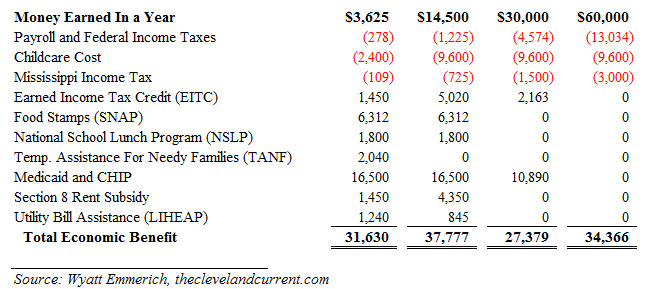
Money Earned

The self-inflicted death of America is not a pretty sight. Given how admirable the US was until not all that long ago, the descent into the dust is astonishing. Whatever principles of a free republic that were there then, they are being buried in front of our eyes. What you are looking at is a set of data that, according to the article Entitlement America shows this:

“A one-parent family of three making $14,500 a year (minimum wage) has more disposable income than a family making $60,000 a year.”

About which is added this comment:

It is not only the richest and most audacious thieves that prosper – it is also the penny scammers at the very bottom of the economic ladder that rip off the middle class each and every day, courtesy of the world’s most generous entitlement system.

Why d’Souza is being prosecuted

Here is the premise of the modern critique of America, that “America is based on theft”. It is not just in America, of course, that this critique is found but is found everywhere and certainly no modern prosperous nation state is free of the ignorant fools who argue these views. It is to deal with this critique that the film has been put together. As d’Souza says in this trailer:

I want to take this progressive leftist critique head on. I want it to be articulated by its best spokesmen. And I want to effectively answer it and debunk it. That is the central ideological question answered in the film, ‘America’.

D’Souza has now been railroaded into the court system by the most corrupt, lawless government in American history, a travesty of honesty and fair play. The video heralds the release of a film on the fourth of July that is in part an attempt avant la lettre to explain why he is being prosecuted.

A slapp shot from the point

It’s only a minor thing in the face of all of the other repressive activities in the US, but Mark Steyn’s travails within the court system, after having been sued by Michael Mann over his hockey stick, is quite significant in its own way, possibly more so because Mark is one of the few who is willing and able to fight back. In an article he brilliantly titles Slappstick Farce – and you will have to read the article to understand how clever it is – Steyn discusses how difficult it has been within the American system to deal with Mann’s lawsuit. One more example of how someone on the right finds dealing within the system so difficult.

I don’t think much about the First Amendment these days. As a practical matter, it’s simply not feasible in a global media market to tailor one’s freedom of expression to the varying local bylaws. So I take the view that I’m entitled to say the same thing in Seattle as I would in Sydney or Stockholm, Sofia or Suva. But, were Dr. Mann to prevail, it would nevertheless be the case that his peculiarly thin skin and insecurities would enjoy greater protection under U.S. law than they do in Britain, Canada, Australia, and other jurisdictions. It would thus be a major setback for the First Amendment.

That’s worth making a noise about. Up north, following a similar SLAPP suit from the Canadian Islamic Congress, my publisher Maclean’s, who are far less ideologically simpatico to me than NR, nevertheless understood the stakes — and helped get a disgusting law with a 100 percent conviction rate first stayed by a hitherto jelly-spined jurist and ultimately repealed by the Parliament of Canada. This too is a free-speech case. Free speech is about the right to thrash out ideas — on climate change, gay marriage, or anything else — in the public square, in bright sunlight. And you win a free-speech case by shining that sunlight on it, relentlessly. As we embark on our second year in the hell of the D.C. court system, that’s what I intend to do.I don’t think much about the First Amendment these days. As a practical matter, it’s simply not feasible in a global media market to tailor one’s freedom of expression to the varying local bylaws. So I take the view that I’m entitled to say the same thing in Seattle as I would in Sydney or Stockholm, Sofia or Suva. But, were Dr. Mann to prevail, it would nevertheless be the case that his peculiarly thin skin and insecurities would enjoy greater protection under U.S. law than they do in Britain, Canada, Australia, and other jurisdictions. It would thus be a major setback for the First Amendment.

The comparison is with Macleans, which is something like The Bulletin once was, and National Review, which is supposed to be the stalwart beacon of freedom on the right, is part of Steyn’s continuing disenchantment with the magazine in which he writes. Hardly anyone is standing up for freedom in the US any longer, with the dangers to wealth and reputation so large that the risks of being anything but a leftist jerk are just getting too high.

The Obama Doctrine

This is from Victor Davis Hanson in what he calls, Obama’s Recessional. There’s nothing about this I find exceptional other than no one seems to care. It ought to frighten the daylights out of Australians sitting out here in the South Pacific but life does seem to go on. This is Hanson summing up Obama’s foreign policy strategy.

The Obama Doctrine is a gradual retreat of the American presence worldwide — on the theory that our absence will lead to a vacuum better occupied by regional powers that know how to manage their neighborhood’s affairs and have greater legitimacy in their own spheres of influence. Any damage that might occur with the loss of the American omnipresence does not approximate the harm already done by American intrusiveness. The current global maladies — Islamist terrorism, Middle Eastern tensions, Chinese muscle-flexing, Russian obstructionism, resurgence of Communist autocracy in Latin America — will fade once the United States lowers its profile and keeps out of other nations’ business.

There is always a balance of forces that asserts itself. It’s basically, you’re on your own except that with Obama, his foreign policy is essentially to support America’s former ideological enemies and abandon its friends. Where, then, do you suppose that leaves Australia? But Hanson also transfers the Obama Doctrine to domestic policy as well.

For Obama, America abroad is analogous to the 1 percent at home. We need not squabble over the reasons why the wealthiest Americans enjoy unequal access to the things money can buy, or why America, of all nations, finds itself with unmatched global clout and influence. The concern is only that such privilege exists; that it is unfair; that it has led to injustice for the majority; and that it must be changed.

Obama, of course, cannot issue a global tax aimed at the United States. He cannot easily expand U.S. foreign aid as a sort of reparations. And he cannot craft the international equivalent of Obamacare. But he does seek the same sort of redistributive readjustment to America’s presence abroad that he does to some Americans at home — in the interests of fairness, equality, and social justice.

Just as the United States would be a lot better place if a few million were not so rich, so too the world would be better off if the United States — and to a lesser extent Europe — were not so powerful and interventionist.

Obama is a man of shallow thoughts and great hatreds. Describing anything that Obama does as a “doctrine” gives it more credit than it deserves. But there are no doubt instinctual attitudes and reactions to specific events and they are more than evident, and if you want to call them a doctrine, be my guest. But whatever you call the structure of America’s foreign and economic policies, they are re-shaping the world. Time moves more rapidly than you think. In this century 911 and the Global Financial Crises are the two most momentous events. In their wake, the world is different now and if we are thinking either who will be the most powerful nation on the planet or where will wealth creation be at its most rapid twenty years from now, what’s your guess? That things will be as they are today is nowhere near even a fifty per cent chance.

Krugman and his continuing ignorance of Say’s Law

Following my post on Hollande and Say’s Law, there has so far been just one response, which merely carried an article by Paul Krugman, Scandal in France. The scandal, as seen by Krugman, has nothing to do with

I haven’t paid much attention to François Hollande, the president of France, since it became clear that he wasn’t going to break with Europe’s destructive, austerity-minded policy orthodoxy. But now he has done something truly scandalous.

I am not, of course, talking about his alleged affair with an actress, which, even if true, is neither surprising (hey, it’s France) nor disturbing. No, what’s shocking is his embrace of discredited right-wing economic doctrines.

You would think that the way he writes that the recovery that followed the American stimulus has been a light unto the nations and that the US and Keynes have much to teach us about economic management.

Mr. Hollande, in announcing his intention to reduce taxes on businesses while cutting (unspecified) spending to offset the cost, declared, “It is upon supply that we need to act,” and he further declared that “supply actually creates demand.”

Oh, boy. That echoes, almost verbatim, the long-debunked fallacy known as Say’s Law — the claim that overall shortfalls in demand can’t happen, because people have to spend their income on something. This just isn’t true, and it’s very much not true as a practical matter at the beginning of 2014. All the evidence says that France is awash in productive resources, both labor and capital, that are sitting idle because demand is inadequate. For proof, one need only look at inflation, which is sliding fast. Indeed, both France and Europe as a whole are getting dangerously close to Japan-style deflation.

That Krugman is as innocent as the day is long of the actual meaning of Say’s Law is merely evidence that he is like 99% of the profession who have been mis-educated on a principle that was at the centre of the classical theory of the cycle. He wouldn’t know that either. It is actually shocking to see someone so ignorant of the things about which he so confidently speaks. Well the fact of the matter is that Krugman is an ignoramus who is continually pushing economic advice that is keeping the American economy low and is impoverishing millions of his fellow citizens.

The European economies, and Australia as well, emerged from the Great Depression faster than we have today because they used classical theory and policy to work things out. The UK famously balanced its budget in 1933 at the very trough of the Great Depression. We cut spending here in 1931 and was the first economy to come out of the Great Depression with the Australian trough being reached in 1931 from which time things continually improved.

Only the American economy, with its Keynesian-Roosevelt road to recovery remained in the Great Depression right up until the US entered the war at the end of 1941.

There’s more to the world economy than the US, and even if that is all Krugman knows, even that should make him just a bit more cautious, perhaps a whole lot more cautious in speaking about things he knows nothing about.