Panic in the capitals of Europe

It’s not as if Obama’s intentions from the start were difficult to read. He’s a hard left ideologue whose greatest hatreds are for the civilisation of the West and in particular the country of which he is president. That there are revelations upon revelations as one by one, but ever so slowly, the truth begins to dawn on those fools who elected him, or the international mobs who supported him, is something like a revelation to me. Just how self-deluded can these people really have been. This is from Richard Fernandez:

The capitals of Europe have gone from complacency to a near panic in the last 72 hours, not simply over the crisis in the Ukraine but in the growing awareness that for at least the last half decade they’ve been standing on a trapdoor.

Are they really that clueless? Could they really not see that Obama is their greatest enemy? We are living in a sea of troubles, which are building not going away, and the American defence budget is about to be slashed. Could these people really not see it coming? Whatever the panic that may suddenly have overtaken them, did they really have no inking of the kind of person Obama is, what his beliefs are and the end points he has been aiming at. Listen to Fernandez himself, who still writes as if Obama wants to do the right thing by America and the West:

To see it coming would have invalidated the fundamental premise of Obama’s foreign policy: that the train line was unobstructed; that he could talk to people he now knows he can’t talk to. For a while the deal making seemed too almost too good to be true and Obama marketed his “opportunities” and “investments” with almost evangelical zeal. Even now Obama plans to tell Benjamin Netanyahu that time is running out for Israel to make a deal with the Palestinians. One of those magic deals Kerry’s negotiated, like the one with Syria. He is figuring to tell the Israeli prime minister he had better buy now while supplies last or miss the deal of the century, the deal of a lifetime! Maybe he even plans to exhibit all the notices he’s received from his “partners for peace” about how close he is to grabbing the Big Brass Ring.

“The fundamental premises of Obama’s foreign policy”! It really is pathetic. The principle of Obama’s foreign policy is to encourage our enemies, and the greatest possible triumph in Obama’s mind would be the destruction of Israel. More from Drudge:

Obama warns of ‘fallout’ for Israel if peace effort fails…

‘Time Is Running Out’…

USA pushing Israel to stop assassinating Iranian nuclear scientists…

Basically, it’s the USA pushing Israel to stop defending itself. That he will never get them to do, but he might get the US to stop providing help. That’s the aim. And as for us out here in the South Pacific the message is equally grim. No immediate threats at the moment but with America withdrawn from active engagement and too broke to really do anything, and more so as time goes by, where does our safety lie, thinking say a decade or two ahead?

The kind of empty thought processes that seem to animate political decisions is a never ending frustration for me, but the mere 6% of Australians who supported Romney at the last American election has left me with the profound belief that the world map a century hence will look nothing like the one we see today. Some people will be on top – who I do not know – and a lot more will be on the bottom, and the possibilities of peace, freedom and prosperity will have withered. But it is the present delusion that Obama is a fit and proper president, that he intends to do the right thing and is trying to make the world a better place for the likes of us, still does not go away. We will reap the whirlwind and never know why that was.

UPDATE: From The Diplomad, Climbing Out of the Obama Foreign Policy Hole:

The Obama foreign policy team is peopled by the “well-educated,” i.e., they have college degrees, and as befits the “well educated” in today’s America, they are stunningly ignorant and arrogant leftists, but mostly just idiots. They do not make plans; they tend to fly by the seat of their pants using a deeply ingrained anti-US default setting for navigation. They react to the Beltway crowd of NGOs, “activists” of various stripes, NPR, the Washington Post and the New York Times. Relying on what they “know,” they ensure the US does not appear as a bully, or an interventionist when it comes to our enemies: after all, we did something to make them not like us. Long-term US allies they view as anti-poor, anti-Third World, and retrograde Cold Warriors. Why else would somebody befriend the US? Obama’s NSC and State are staffed with people who do not know the history of the United States, and, simply, do not understand or appreciate the importance of the United States in and to the world. They are embarrassed by and, above all, do not like the United States. They look down on the average American, and have no problem with anti-American regimes and personages because overwhelmingly they are anti-American themselves.

His conclusion is what I was trying to say:

Above all, we need men and women in the highest reaches of our government who know, understand, and love the greatness that is Western civilization, especially that variant of it handed us by our great English forefathers, and the role the USA should and must play in ensuring its survival. We do not have that now; freedom-loving people around the world pay the price for that hideous fact, and that must change. That is the only way out of this hole dug by the Obamistas and their “progressive” groupies.

I just make the further point that it is now unimaginable to me that the United States could elect such a government which is what makes me pessimistic about our future. And while all this goes on, the headline at Drudge is, RUSSIACHINA UNITE!.
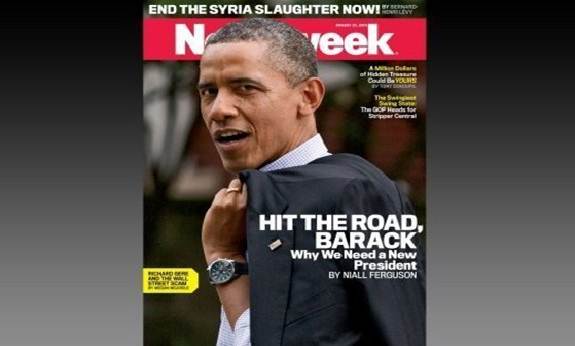

Newsweek’s deathbed recantation

obama - hit the road newsweek cover

And this is the text:

I Too Have Become Disillusioned

By Matt Patterson (Newsweek Columnist – Opinion Writer)

Years from now, historians may regard the 2008 election of Barack Obama as an inscrutable and disturbing phenomenon, the result of a baffling breed of mass hysteria akin perhaps to the witch craze of the Middle Ages. How, they will wonder, did a man so devoid of professional accomplishment beguile so many into thinking he could manage the world’s largest economy, direct the world’s most powerful military, execute the world’s most consequential job?

Imagine a future historian examining Obama’s pre-presidential life: ushered into and through the Ivy League, despite unremarkable grades and test scores along the way; a cushy non-job as a “community organizer;” a brief career as a state legislator devoid of legislative achievement (and in fact nearly devoid of his attention, less often did he vote “present”); and finally an unaccomplished single term in the United States Senate, the entirety of which was devoted to his presidential ambitions.

He left no academic legacy in academia, authored no signature legislation as a legislator. And then there is the matter of his troubling associations: the white-hating, America-loathing preacher who for decades served as Obama’s “spiritual mentor;” a real-life, actual terrorist who served as Obama’scolleague and political sponsor. It is easy to imagine a future historian looking at it all and asking: how on Earth was such a man elected president?

Not content to wait for history, the incomparable NormanPodhoretz addressed the question recently in the Wall Street Journal: To be sure, no white candidate who had close associations with an outspoken hater of America like Jeremiah Wright and an unrepentant terrorist like Bill Ayers, would have lasted a single day. But because Mr. Obama was black, and therefore entitled in the eyes of liberal Dom to have hung out with protesters against various American injustices, even if they were ‘a bit’ extreme, he was given a pass. Let that sink in:Obama was given a pass – held to a lower standard because of the color of his skin.

Podhoretz continues: And in any case, what did such ancient history matter when he was also so articulate and elegant and (as he himself had said) “non-threatening,” all of which gave him a fighting chance to become the first black president and thereby to lay the curse of racism to rest?

Podhoretz puts his finger, I think, on the animating pulse of theObama phenomenon – affirmative action. Not in the legal sense, of course. But certainly in the motivating sentiment behind all affirmative action laws and regulations, which are designed primarily to make white people, and especially white liberals, feel good about themselves.

Unfortunately, minorities often suffer so that whites can pat themselves on the back. Liberals routinely admit minorities to schools for which they are not qualified, yet take no responsibility for the inevitable poor performance and high drop-out rates which follow. Liberals don’t care if these minority students fail; liberals aren’t around to witness the emotional devastation and deflated self-esteem resulting from the racist policy that is affirmative action. Yes, racist. Holding someone to a separate standard merely because of the color of his skin – that’s affirmative action in a nutshell, and if that isn’t racism, then nothing is.

And that is what America did to Obama. True, Obama himself was never troubled by his lack of achievements, but why would he be? As many have noted, Obama was told he was good enough for Columbia despite undistinguished grades at Occidental; he was told he was good enough for the US Senate despite a mediocre record in Illinois; he was told he was good enough to be president despite no record at all in the Senate. All his life, every step of the way, Obama was told he was good enough for the next step, in spite of ample evidence to the contrary.

What could this breed if not the sort of empty narcissism on display every time Obama speaks? In 2008, many who agreed that he lacked executive qualifications nonetheless raved about Obama’s oratory skills, intellect, and cool character. Those people – conservatives included – ought now to be deeply embarrassed.

The man thinks and speaks in the hoariest of clichés, and that’s when he has his Teleprompters in front of him; when the prompter is absent he can barely think or speak at all. Not one original idea has ever issued from his mouth – it’s all warmed-over Marxism of the kind that has failed over and over again for 100 years. (An example is his 2012 campaign speeches which are almost word for word his 2008 speeches)

And what about his character? Obama is constantly blaming anything and everything else for his troubles. Bush did it; it was bad luck; I inherited this mess. Remember, he wanted the job, campaigned for the task. It is embarrassing to see a president so willing to advertise his own powerless-ness, so comfortable with his own incompetence. (The other day he actually came out and said no one could have done anything to get our economy and country back on track). But really, what were we to expect? The man has never been responsible for anything, so how do we expect him to act responsibly?

In short: our president is a small-minded man, with neither the temperament nor the intellect to handle his job. When you understand that, and only when you understand that, will the current erosion of liberty and prosperity make sense. It could not have gone otherwise with such an impostor in the Oval Office.

Of course the Nazis were socialists

It is only on the say so of Joseph Stalin that Hitler and the Nazis have not been identified as socialists. The modern left naturally wants to be spared the connection. Anyway, this issue has come up in a debate in the UK that has been discussed by Jonah Goldberg in an article titled, Nazis: Still Socialists. This is how Goldberg sums up:

Conservatives, libertarians, and other champions of free-market economics must constantly put pressure on politicians to fend off the natural human tendency to fight innovation as a threat to the status quo and the powers that be. Across the West there’s a tendency among bureaucrats, politicians, academics, and other members of the New Class to convince the people to hand over the major decisions of their lives to the “experts.” These experts aren’t all in the government, but they all collude with government to convince people that the experts have all the answers and that the people need to hand the reins over to them. They will tell us what to eat, what to drive, what to think. It’s an approach that puts politics before economics. Because it is an attempt to politicize peoples’ lives. Or as Hitler put it, “Why need we trouble to socialize banks and factories? We socialize human beings.”

Personally I prefer the Otto Strasser version, a leading Nazi and therefore in a position to know, also quoted in the article:

We are socialists. We are enemies, deadly enemies, of today’s capitalist economic system with its exploitation of the economically weak, its unfair wage system, its immoral way of judging the worth of human beings in terms of their wealth and their money, instead of their responsibility and their performance, and we are determined to destroy this system whatever happens!

That’s the Greens. That’s the left. That is a quite accurate summary of socialism going all the way back to its first origins, just as it will continue to be as far forward as the eye can see. Tactics may differ but the rhetoric will always remain the same.

In this debate on the affirmative was Daniel Hannan who has himself written an article, Leftists become incandescent when reminded of the socialist roots of Nazism. All the more important, therefore, to continuously remind them of it. From his article:

Goebbels never doubted that he was a socialist. He understood Nazism to be a better and more plausible form of socialism than that propagated by Lenin. Instead of spreading itself across different nations, it would operate within the unit of the Volk.

So total is the cultural victory of the modern Left that the merely to recount this fact is jarring. But few at the time would have found it especially contentious. As George Watson put it in The Lost Literature of Socialism:

It is now clear beyond all reasonable doubt that Hitler and his associates believed they were socialists, and that others, including democratic socialists, thought so too.

The clue is in the name. Subsequent generations of Leftists have tried to explain away the awkward nomenclature of the National Socialist German Workers’ Party as either a cynical PR stunt or an embarrassing coincidence. In fact, the name meant what it said.

Hannan for some reason wishes to absolve the modern left from Nazi tendencies. I am more willing to leave it an open question. But what he writes is how to seriously get under the skin of the modern left:

Marx’s error, Hitler believed, had been to foster class war instead of national unity – to set workers against industrialists instead of conscripting both groups into a corporatist order.

His aim, he told his economic adviser, Otto Wagener, was to “convert the German Volk to socialism without simply killing off the old individualists” – by which he meant the bankers and factory owners who could, he thought, serve socialism better by generating revenue for the state. “What Marxism, Leninism and Stalinism failed to accomplish,” he told Wagener, “we shall be in a position to achieve.”

Leftist readers may by now be seething. Whenever I touch on this subject, it elicits an almost berserk reaction from people who think of themselves as progressives and see anti-fascism as part of their ideology.

And when before has Hannan touched on this. Here, in this article from February 16, 2013 titled, So total is the Left’s cultural ascendancy that no one likes to mention the socialist roots of fascism. It has certainly touched a nerve given it had 1357 comments at the Daily Telegraph in London.

President Pussy Kitten threatens Russia

More red lines? More empty gestures? Who is this cypher to go arounds pretending strength and resolve? From the Associated Press:

President Barack Obama is warning Russia “there will be costs” for any military maneuvers it launches in Ukraine, a move U.S. and Ukrainian officials say they believe to be already underway.

So what are these costs?

Officials say Obama may retaliate by canceling a trip to Russia this summer for an international summit and could also cut off trade discussions with Moscow.

Or as Charles Krauthammer has said:

The Ukrainians, and I think everybody, is shocked by the weakness of Obama’s statement. I find it rather staggering.

Anyway, if the lights are going out all over Europe and the West, it will be because of our war on fossil fuels. If there’s another kind of war coming it will be because of American weakness, not because of its strength. Meanwhile, Russia’s invasion of the Ukraine appears to have begun. But what needs to be treasured is this:

In 2008, when she was the GOP vice presidential nominee, Palin questioned in a speech whether then-Sen. Barack Obama would have the foreign policy credentials to handle a scenario in which Russian President Vladimir Putin invaded Ukraine. . . .

The former Alaska governor was happy to highlight her prediction on Friday and scold those who criticized her 2008 comments.

“Yes, I could see this one from Alaska,” she said on Facebook. That remark was a reference to a 2008 interview in which Palin argued that Alaska’s proximity to Russia helped boost her foreign policy experience.
“I’m usually not one to Told-Ya-So, but I did, despite my accurate prediction being derided as ‘an extremely far-fetched scenario’ by the ‘high-brow’ Foreign Policy magazine.”

In October 2008, Foreign Policy labeled Palin’s prediction as “strange.”

Does the left ever get anything of importance right?

UPDATE: To which must be added this:

Oh they are shaking in their boots [with laughter] in Moscow tonight. Can’t somebody show up to work at the White House and tell this Jello-spined juggalo that his warning and threats just aren’t making it? I mean really. This tough guy spiel is just an embarrassment:

“The Obama administration is evaluating whether President Barack Obama will go forward with plans to attend an international summit in Russia this summer amid reports of Russian intervention in Ukraine. A senior administration official says it’s hard to see how Obama and European leaders would attend the G-8 summit in Sochi, which is scheduled for June.”

So let me get this straight. The “penalty” for Russia if it keeps its hold on the Ukraine is that it doesn’t get to waste precious summer days in June in the presence of this cowardly little narcissist and his entourage of fluffers and fellators? Well, yes, that would certainly make any leader of Russia give up the security of his fleet’s access to the Crimea, the Black Sea, and from there into the Mediterranean. Let’s not forget that Russia lost the Crimean War in the middle of the 19th Century [not that long ago in the Russian mind] which took about half a million lives on all sides. In that war, most of the fighting took place for control of the Black Sea, with land battles on the Crimean peninsula in southern Russia. Deja vu all over again? Why not? That’s the history of Russia writ large.

Simply put, if Russia cannot maintain control of the Crimea and Sevastopol it cannot maintain the Black Sea Fleet.

The Black Sea Fleet is considered to have been founded by Prince Potemkin on May 13, 1783, together with its principal base, the city of Sevastopol. Formerly commanded by such legendary admirals as Dmitriy Senyavin and Pavel Nakhimov, it is a fleet of enormous historical and political importance for Russia.

The Black Sea Fleet enables Russia to control and dominate its close in “backyard” of Georgia as well as have access to the Mediterranean and, hence, the Middle East and Suez. Without the Crimea and Sevastapol, Russia ceases to be a nation with global reach. This is something Putin will not do. Ever. This is one of those annoying strategic situations in which trying to force Russia to step back can easily become a trigger for thermonuclear war. And Russia is still in the strategic nuke business.

Instead of understanding how history lives in the present and shapes the future, this pig-ignorant “president” doesn’t have a foreign policy, all he has is a series of poses and postures; none of which are all that butch.

Indeed, it would seem that the only group on the planet that are afraid of this putz are D.C. Republicans. And I’m not too sure about them any longer.

More news on the economy

From The Oz today, Tony Abbott eyes $5bn for new road funding:

ROAD funding will surge again in the federal budget in May as the Abbott government casts an “eager eye” on new projects to lift faltering economic growth.

The budget plans include billions of dollars to upgrade old road and rail infrastructure in outer suburbs, on top of the Coalition’s existing $35.5 billion list of public works.

The new spending will come with tough conditions on the states to hasten construction after a federal audit revealed $3bn in cash sitting idle in state coffers.

I guess with the state of economic theory being what it is, the worst that the ALP can say is this:

The Coalition agenda is being criticised by Labor infrastructure spokesman Anthony Albanese on the ground it ignores public transport projects such as urban rail.

Meanwhile:

Investment spending will dive from $167bn this year to $125bn next year, according to figures released on Thursday by the Australian Bureau of Statistics, adding to the case within the government for outlays on public works.

If these are projects that can show a net positive return, then there is a case to be made. Otherwise it’s just more waste.

Ted Nugent on Obama

This is for some reason a big deal in the US. In attacking Ted Nugent, who I have never heard of before, “human mongrel” and “chimpanzee” are the issue to the media. How’s this for something to have said about the US President and his cronies, that they are “bad people who are destroying our neighbourhoods.” Maybe that ought to be the focus.

Kishinev 1903

Why have I never heard of this? This is the review of a book published on the 100th anniversary of this pogrom.

Kishinev 1903: The Birth of a Century. Reconsidering the 49 Deaths That Galvanized a Generation and Changed Jewish History.
by: J.J. Goldberg
The Forward, April 4, 2003

One hundred years ago, on April 6, 1903, the Jewish community of Kishinev in what was then czarist Russia suffered two days of mob violence that shocked the world and changed the course of Jewish history.

Provoked by a medieval blood libel, flashed around the globe by modern communications, Kishinev was the last pogrom of the Middle Ages and the first atrocity of the 20th century. The event, and the worldwide wave of Jewish outrage that it evoked, laid the foundations of modern Israel, gave birth to contemporary American-Jewish activism and helped bring about the downfall of the czarist regime.

Much of that, curiously, resulted from a misreading of events at the time.

Kishinev, the capital of the czarist province of Bessarabia, today’s Republic of Moldova, was a town of some 125,000 residents, nearly half of them Jewish. Ethnic tensions were running high that spring, thanks to a noisy, months-long campaign of antisemitic incitement by local nationalists.

The rioting began on Easter Sunday, after rumors spread through town that a Christian had been killed by Jews in a ritual murder. Mobs rampaged through Jewish neighborhoods for two days, burning, smashing, raping and killing. When it was over, 49 Jews were dead and 500 wounded, 1,300 homes and businesses were looted and destroyed and 2,000 families were left homeless.

The brutality sent shock waves across Russia and around the world. Leo Tolstoy spoke out. Mass rallies were held in Paris, London and New York. Western governments protested the apparent complicity of the czar’s police, who had refused repeated pleas to intervene. The Forward reported the news with a banner headline: “Rivers of Jewish Blood in Kishinev.”

From nearby Odessa, the great center of Russian Jewish culture, the young Hebrew poet Hayyim Nahman Bialik was sent to Kishinev by the Jewish communal commission to interview survivors and report firsthand on the bloodbath. Before returning home he composed one of his most powerful poems, “On the Slaughter,” with its unforgettable cry that Satan himself could not forgive the death of a child. A year later Bialik would publish his epic masterwork, “The City of Slaughter,” a searing condemnation of Jewish passivity, from which the following is taken.

Descend then, to the cellars of the town,
There where the virginal daughters of thy folk were fouled,
Where seven heathen flung a woman down,
The daughter in the presence of her mother,
The mother in the presence of her daughter,
Before slaughter, during slaughter, and after slaughter!
Touch with thy hand the cushion stained; touch
The pillow incarnadined:
This is the place the wild ones of the wood, the beasts of the field
With bloody axes in their paws compelled thy daughters yield:
Beasted and swined!
Note also, do not fail to note,
In that dark corner, and behind that cask
Crouched husbands, bridegrooms, brothers, peering from the cracks,
Watching the sacred bodies struggling underneath
The bestial breath,
Stifled in filth, and swallowing their blood!
Watching from the darkness and its mesh
The lecherous rabble portioning for booty
Their kindred and their flesh!
Crushed in their shame, they saw it all;
They did not stir nor move;
They did not pluck their eyes out; they
Beat not their brains against the wall!
Perhaps, perhaps each watcher had it in his heart to pray:
A miracle, O Lord ¡ª and spare my skin this day!

Bialik’s poem fell on ready ears. Young Jews across Russia, electrified by the events, took the poem as a call to arms and organized themselves into self-defense units, most led by fledgling socialist or Zionist parties. Thousands threw themselves into revolutionary movements, determined to bring down the murderous czarist regime. Their rage and energy gave new momentum to the revolutionary movement and led directly to the abortive Russian revolution of 1905, which in turn set the stage for the cataclysm of 1917.

Others, despairing of any Jewish future in Russia, began making their way to the land of Israel in a wave of immigration that would come to be known as the Second Aliya. Influenced by socialism, led by young radicals such as David Ben-Gurion and Yitzhak Ben-Zvi, the pioneers set about remaking the Zionist settlement in Palestine on a foundation of Jewish labor and Jewish self-defense. Driven by visions of Kishinev and the shame of Jewish passivity, they created the kibbutzim, the towns and factories, the militias and political parties that were the cornerstone of modern Israel.

In fact, the image of Jewish passivity was largely untrue. Eyewitness accounts of the pogrom tell a very different story. Here is a front-page report from the Forward of April 24:

Armed with knives and machetes, the murderers broke into Jewish homes, where they began stabbing and killing, chopping off heads and stomping frail women and small children. If such a vicious, enraged mob would have attacked a Jewish town somewhere in Volin or Lithuania, thousands of Jews would have been killed in an hour’s time. But Kishinev Jews are tough, healthy, strong as iron and fearless. When the murderous pogromists began their horrible slaughter, Jewish boys and men came running and fought like lions to protect their weaker and older brothers and sisters. Even young girls exhibited amazing heroism. They defended their honor with supernatural strength…. The Jews, however, fought with their bare hands and the murderers, armed with machetes and knives, were primed to annihilate and decimate all the Jewish townspeople.

How did Bialik get it so wrong? Like many young Russian Jews, Bialik was ready to believe in the shame of Jewish passivity even before he got to Kishinev. Zionist essayists had been hammering the theme home for decades, none more powerfully than the Kishçnev-born physician Leon Pinsker, whose 1882 essay “Autoemancipation” is still regarded widely as the founding manifesto of Russian Zionism.

Pinsker’s essay was on Bialik’s mind when word of the bloodbath reached Odessa on the second day of the rioting, April 7. Bialik appears to have spent the evening at a meeting of the city’s Jewish literary circle, the Beseda (“Conversation”) Club, which included such luminaries as the historian Simon Dubnow, the Hebrew essayist Ahad Ha’am and editor-publisher Yehoshua Ravnitzky. The circle’s April 7 meeting was devoted to a lecture by a little-known journalist named Vladimir Jabotinsky, age 23. His theme for the lecture, his first major public appearance, was “Autoemancipation.”

Here is how the historian Dubnow recalled the evening in his memoirs:

It was the night of April 7, 1903. Because of Russian Easter, the newspapers had not been issued for the previous two days so that we remained without any news from the rest of the world. That night the Jewish audience assembled in the Beseda Club, to listen to the talk of a young Zionist, the Odessa “wunderkind” V. Jabotinsky [….] The young agitator had great success with his audience. In a particularly moving manner, he drew on Pinsker’s parable of the Jew as a shadow wandering through space and developed it further. As for my own impression, this one-sided treatment of our historical problem depressed me: Did he not scarcely stop short of inducing fear in our unstable Jewish youth of their own national shadow?… During the break, while pacing up and down in the neighboring room, I noticed sudden unrest in the audience: the news spread that fugitives had arrived in Odessa from nearby Kishinev and had reported of a bloody pogrom in progress there.

When Bialik set out for Kishinev later in the week his mission was to collect the facts, but it could be that his narrative was formulated in advance, etched in his mind by Jabotinsky.

Most of Russia’s Jews, to be sure, wanted nothing more than to flee the czar’s charnel house. Emigration to America, already a flood tide, more than doubled by the end of the year. In America, Jews scrambled to cope with the human tidal wave, leading to an explosive growth of Jewish philanthropy and social service agencies. When Russia launched its ill-fated war against Japan the next year, America’s leading Jewish philanthropist, investment banker Jacob Schiff, volunteered to underwrite Japan’s war bonds and personally financed Russia’s defeat. Schiff and other prominent Jewish business figures entered a series of negotiations that led three years later to the formation of the American Jewish Committee, arguably the world’s first modern human-rights lobby. President Theodore Roosevelt greeted the committee’s formation by inviting its best known figure, the former diplomat Oscar Straus, to become his secretary of commerce and labor, the first Jew to serve in an American cabinet. And not a word about color-blind meritocracy: “I want to show Russia and some other countries,” Roosevelt wrote to Straus, “what we think of the Jews in this country.”

For all that, the enduring image of Kishinev is Bialik’s.

The historian Rufus Learsi once wrote that the 1903 Kishinev pogrom must be seen as “a dress rehearsal” for the far bloodier wave of antisemitic violence two years later, following the 1905 revolution, which left some 3,000 Jews dead. But that violence was only a rehearsal for the genocidal fury of the 1918 Russian civil war, in which Ukrainian militias under Simon Petlura massacred as many as 200,000 Jews. And that, of course, was just a dress rehearsal for the Holocaust.

Like Kishinev in its time, the Holocaust was taken by survivors and heirs to be an object lesson in the human capacity for evil and the Jewish duty to stand up and fight. But for all the earnest lessons, whether at Kishinev or at Auschwitz, the atrocities of the 20th century seem to be little more than forerunners one for the next, descending not as warnings but as dress rehearsals for new and greater horrors. In Cambodia, Rwanda, Bosnia and now Liberia and Congo, neighbors continue to slaughter neighbors while the world is busy elsewhere. Only the technologies improve. The mold was set in Kishinev.

Proposed cover design – Free Market Economics – 2nd edition

This would be the main motif within a field of brown similar to the first edition of my Free Market Economics but perhaps shading towards the colour of the first cover design of Henry Clay’s 1916 first edition of Economics: an Introduction for the General Reader which is similar to the red in the upper half of the photo. But in the middle of the cover would be this picture, which is a waterwheel fashioned out of clay. This is taken from an ebay ad for the plaque shown which was up for sale and I have now bought and own. The picture credit goes to the original seller who I do not think will ask for very much to use his picture but if he does, I am sure that we can do something else along the same lines, although the photo you see is near perfect for me.

watermill made of clay

The actual cover design would follow along these lines from the cover shown below which is the cover of The Rediscovery of Classical Economics (Elgar 2013). A more red/brown version where this one is white is my idea. But I would like some kind of adaptation of this since the underlying themes are so similar and also because both books are being co-published with the Institute of Economic Affairs (IEA) as it says on this book and will say on mine.

rediscovery of classical economics

Shocked and disgusted and outraged

An illegal migrant was killed during a riot at the detention centre at Manus Island. Why were they rioting? They have found a safe haven from the repression they say they had experienced; in fact, surely they had that safe haven in Indonesia but I don’t know the details. But here is the story as told by the ABC, picked up at Andrew Bolt:

Thousands of people have held candlelight vigils around Australia for slain asylum seeker Reza Berati, who died in violence at the Manus Island detention centre last Monday.

A crowd of 5,000 people gathered in Melbourne’s Federation Square while 4,000 more rallied at Sydney’s town hall, with candles lit for the 23-year-old man.

And why the vigil:

I suppose what this represents is a catalyst or a flash point which has mobilised people all round Australia who are shocked and disgusted and outraged at the events that have led to this.

This seems very political to me since, as Andrew writes, these same people did not seem to worry so much about the at least 1100 people who drowned in trying to reach Australia by boat. And does anyone know what marketable skills Reza brought with him to Australia and whether he could even speak English?