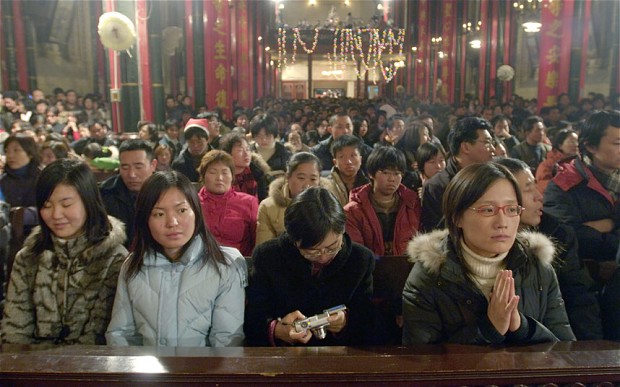
Without God, people can do as they please

china christianity

One of the most enlightening books I have ever come across was The Victory of Reason: How Christianity Led to Freedom, Capitalism, and Western Success by Rodney Stark. And at the very end of this book there is a quote from a Chinese scholar who had been part of an investigation into the causes of Western economic success. This is a direct quote of what this Chinese scholar had said:

One of the things we were asked to look at was the success, in fact, the pre-eminence of the West, all over the world. We studied everything we could from the historical, political, economic and cultural perspective. At first, we thought it was because you had more powerful guns than we had. Then we thought it was because you had the best political system. Next we focused on your economic system. But in the past twenty years we have realised that the heart of your culture is your religion: Christianity. That is why the West is so powerful. The Christian moral foundation of social and cultural life was what made possible the emergence of capitalism and then the successful transition to democratic politics. We don’t have any doubt about this.

I was reminded of this by an article in London’s The Telegraph with the self-explanatory heading, China on course to become ‘world’s most Christian nation’ within 15 years. And while you may be sure the Chinese government has been keeping a watchful eye on where this might go, they have also not been attempting to stamp it out. And there are reasons for this, in keeping with that earlier study:

Some officials argue that religious groups can provide social services the government cannot, while simultaneously helping reverse a growing moral crisis in a land where cash, not Communism, has now become king.

They appear to agree with David Cameron, the British prime minister, who said last week that Christianity could help boost Britain’s “spiritual, physical and moral” state.

Ms Shi, Liushi’s preacher, who is careful to describe her church as “patriotic”, said: “We have two motivations: one is our gospel mission and the other is serving society. Christianity can also play a role in maintaining peace and stability in society. Without God, people can do as they please.”

In place of a moral order we now have political correctness and the pagan religion of Gaia and the environment. China, meanwhile, may become a Christian nation as we in the West depart from what may be the single most important part of the inheritance we have.

The land of missed opportunity

From two articles picked up at Instapundit. First this, the conclusion to an article titled, The United States of Envy:

Voters who will hear the Obama call for envy and redistribution should ask themselves and others: Would you prefer to live in an America where the market is dynamic and opportunity abounds, or in France, where unemployment is high and tax rates are crushing? Don’t you prefer opportunity to envy?

And then this from an article with the title, Growing-ups which is subtitled, “Living with your parents, single and with no clear career. Is this a failure to grow up or a whole new stage of life’?”:

The ‘selfish’ slur also ignores how idealistic and generous-hearted today’s emerging adults are. In the national Clark poll, 86 per cent of 18- to 29-year-olds agreed that: ‘It is important to me to have a career that does some good in the world.’ And it is not just an idealistic aspiration: they are, in fact, more likely to volunteer their time and energy for serving others than their parents did at the same age, according to national surveys by the US Higher Education Research Institute.

As for the claim that they never want to grow up, it’s true that entering the full range of adult responsibilities comes later than it did before, in terms of completing education and entering marriage and parenthood. Many emerging adults are ambivalent about adulthood and in no hurry to get there. In the national Clark poll, 35 per cent of 18- to 29-year-olds agreed with the statement: ‘If I could have my way, I would never become an adult.’

Read both articles but the second shows such a high proportion of bone-headed youths who are not interested in “dead-end” jobs that you really do have to wonder about not just how dynamic the US is and but how much of that opportunity there actually any longer is.

Income distribution, envy and investment

income distribution

Alan Meltzer has written an article he has titled, The United States of Envy about the distribution of income across the past century. Here’s his main point:

Taxing the rich to redistribute did not produce growth. On the contrary, growth reduced the share earned by the highest earners.

Rapid growth comes from investment in new and better productive assets taking place more rapidly than existing assets are eaten away by use and decay. More saving and less consumption is what is required and nothing else will do. But here’s the catch. If investment projects are actually going to create value and raise living standards, they will have to be chosen by individual entrepreneurs – not governments who know only how to squander. Therefore, these individual entrepreneurs, to the extent they are actually successful, become wealthy. There is no way to succeed at some entrepreneurial innovation without becoming wealthy, and there is no means to organise an economy that will encourage entrepreneurial innovation without offering wealth to those who succeed. Hence envy.

But the envy is not just at wealth. No one cares about the wealth of movie stars or sports stars. They are amongst the wealthiest people in every society. But they do things that people admire and wish they could do themselves and tend to be young or at least glamorous. People who run businesses, however, are old and boring, hardworking and stodgy. Numbers people who may hire but will also fire. They focus on costs and sell what they produce at a profit. Their value system, whatever charitable work they may do and philanthropy they may spread, is still essentially Protestant work ethic irrespective of their actual religious beliefs.

But suppose it is drive, intelligence, personal ambition, an eye for detail, a grand vision and other such characteristics that matter and make all the difference. These traits are unevenly distributed across every population and thus not everyone has them to the same extent. Some people are lazy, not very bright, unambitious, slothful and without ideas, any single one of which will keep you from excelling. Well whose fault is that and why should these people be made to suffer for it? Why should the unequal distribution, not of wealth and income but of personal characteristics, determine not just your financial position but actual status in life?

So when we talk about the distribution of income we are really talking about the distribution of personal characteristics, with a tremendous amount of resentment directed towards those who actually do succeed. But what social policy has now done is to finance the lazy, the less intelligent, the unambitious, slothful and those without ideas with just enough of the earth’s worldly goods to keep them alive. But it has also vastly undermined those who might have been more ambitious, more creative, more productive with the result that individuals in great numbers fall into the abyss of non-achievement. And once in such condition, there is almost no means to pull oneself upwards. And so the envy and with it the socialism of the modern day whose greatest enemy is commercial and financial success driven by the resentment of those who can do more than they can and who are far more likely to lead lives of integrity and self-fulfilment.

Just remember, they’re going to get old too

My own moment when I’m teaching about structural employment, I always use as an example the “typing pool” which has zero meaning to every student I teach. Even the words don’t quite fit themselves into a coherent phrase from which they can conjure up an actual productive activity. I actually tried to buy a cassette player not long ago and they are nowhere to be had, not even in an op shop. Time I threw out my cassettes, I guess, but they’ll only go after I first get rid of my records.

Picked up at Hot Air

A failed state to be

Picked up from Small Dead Animals with the following text:

Here’s a review on the HuffPo of the same. There’s little doubt that Jeff Daniels’ rant was written by a Leftist for a Leftist audience. However, if one were to look critically at what has destroyed so much in America – just read SDA for a week! – the blame mostly sits squarely with Leftists, their policies, and the institutions they’ve set up. Clearly they don’t see it that way but their reticence to admit failure – as has been observed recently with Obamacare – should not let them off the proverbial hook one iota.

A leftist trope, all right, with the stupidest line on why liberals don’t win any more when they no longer seem able to lose even as they drive the US into the ditch. I can hardly think of a single thing I admire about the US any more and there is nothing it does that makes me wish we did the same here. It is a failed society and seems to me to be doomed. It will soon be flanked, north AND south by countries which are richer and more at peace with themselves. How the US reclaims itself and returns to what it once so recently was I cannot even begin to imagine.

No guts, no spine, and no conviction

I stopped reading National Review ages ago for reasons I would be hard pressed to explain other than to say that aside from Mark Steyn and one or two others, it no longer represented my core beliefs. But this article, What’s Wrong with the Right, by Pam Geller, gets very close to stating what I think:

National Review Online took another gratuitous shot at me Thursday in an article defending Ayaan Hirsi Ali, saying: “Hirsi Ali is no Pamela Geller. On the contrary, for her whole life, Hirsi Ali has used anger as a catalyst to great good.” Is it necessary to smear me in order to defend Hirsi Ali? And this is not the first time that NRO has allowed insults and defamation against me and other freedom fighters to run unedited. I hardly know why. But I do know that NRO has no guts, no spine, and no conviction.

And while every word she writes is dead on the mark, this is particularly accurate and important:

Once again, the establishment right takes its marching orders from what the destroyers on the left dictate. The right consistently allows the left to destroy our most effective voices – Sarah Palin is a major example. Unequivocal voices like Palin’s are tarred and smeared, while the right instead offers up weak and meandering fools like John McCain – and stands by him even when he poses with al-Qaida leaders in Syria and insists that they’re “moderates” . . .

This is how the establishment right makes it bones: on the bones of the principled right. This is how the establishment right gets legitimacy: by pandering to the left and selling out the clear, uncompromised voices on the right. Instead of destroying our philosophical enemies in the war of individualism vs. statism, the establishment right trims its message, then trims it some more, desperately hoping to appease leftists and their media lapdogs.

Is it any wonder that we can’t win elections? McCain? Romney? We can’t win until we find our spine. NRO best represents the abject failure on the right.

I’m not with her about Mitt Romney but am with her about all of the rest. And she could not be more right about what she says. If you take a stand on the left you have comrades at every side. If you take a stand on the right, there are cowards who flee the field before even the first shot is fired.

The leadership on the right does not understand its own philosophy. They do not understand free markets, capitalism and individual rights. If they did, they would be more ferocious, fiercer and more courageous in the fight for freedom and equality of rights before the law against the second-handers, moochers, and looters on the left.

I am not into symbolism and suicidal grandstanding so I don’t always say what I wish I could. There are a few who do, but only a few, who are in positions to take up this fight, most of whom are in established positions associated with the media or have made particular issues their vocation. For anyone outside these kinds of precincts, the vulnerabilities are immense and the rewards non-existent.

Google reads your emails and allows others to read them as well

Let me start with this news item from two days ago, Google admits it’s reading your emails:

GOOGLE HAS UPDATED its privacy terms and conditions, eroding a little more of its users’ privacy.

Google is so far unapologetic about its changes, despite having created some controversy. The bulk of the responses worry that Google is now able to read users’ emails and scan them for its various purposes.

In its terms and conditions the firm said that its users agree that information that they submit and share with its systems is all fair game. Its update, the first since last November, makes the changes very clear.

This I have known myself since last October. This is the report I sent to IT within the University:

I am doing a presentation on Tuesday next week and wrote the following note to the coordinator of the seminar:

This is the paper I will speak to which is an update on my previously published paper. I cannot believe how much things have evolved from then. I will also do a set of overheads which will help me keep track of where I am and might even be of use to those who come to listen.

Attached to it was my paper named nowhere other than in the paper itself:

The Use of Multiple Choice Questions with Explanations for Economic Assessment

This was the same title for a paper I had written in 2008 and put up on an academic website along with an abstract. But for the past five years the paper had simply been a paper that could be accessed but no one had. And then, a few hours after sending my note off to the coordinator of the seminar I received the following email:

Hi Professor Kates,

Hope you are doing well.

I would like to introduce myself as [redacted], one of the fastest growing research acceleration firm. We have been working with academicians from 35 of the top 100 universities across the globe including researchers from Harvard, Wharton, Stanford, MIT, NUS, and INSEAD.

We help researchers with Data Harvesting, Analytics, Visualization and Technology Implementation. As an organization, our primary focus is to increase research productivity, reduce research costs, and enable researchers focus on the most important facets of their research. You can read more about us here .

As we read through the abstract of research paper on The Use of Multiple Choice Questions with Explanations for Economic Assessment, we thought it would be a good idea to set up some time for a short call and explore how we can help you accelerate your research. Let me know a good time and we can schedule a call accordingly. I look foward to hearing from you.

Regards

I do not believe in coincidences, specially not one in a million shots like this would have been. This was, moreover, not just someone who had read my email but had been able to open my attachment, read its title and presumably anything else they chose to read within the contents, and then send me a follow-up email, all on the same day.

It’s not just the NSA and it’s not just our foreign enemies. My google account information is not just being shared but my attachments can be opened by total strangers. And the more I think about it, the more it burns me up.

I then had very helpful assistance from someone in our IT department who was as interested as I was in whether Google really was reading my emails and allowing others to read them as well. After quite a number of emails back and forth to each other, this was the final email sent to me.

Hi Steve,

Apologies for the delay in getting back to you.

I’ve had some ongoing discussions with Google Support and here is the summary. They say that a message that travels only within Google servers can’t be accessed in transit, so could only be seen by a third party if the sending or receiving account is compromised by eg. phishing.

However, they also say that their mailflow algorithms mean that an email sent from one Google account to another, even sent from a Google user to themselves, may leave Google’s mail servers and come back in again. In that case, messages travelling on the internet would be subject to the inherent insecurity of email.

I’ve done a quick search to find a good explanation of why/how email is insecure, and I think this one sums it up pretty well:

http://www.digitaltrends.com/mobile/can-email-ever-be-secure/

As I understand it, hacking of email in transit, by eg. packet sniffing etc, is thought to be pretty rare. But it’s possible. However, there’s no way we or Google can establish whether or not this has happened since it would have occurred out in the wild, on servers or connections to which we have no access.

Not only is it not “out in the wild” or “pretty rare”, it even turns out to be integral to the google mail (gmail) system and no doubt common. The fact of the matter is that you do not know who your emails are being diverted to or who is reading them or the attachments. And now that Google has said so in public, it burns me up even more.

How can an atheist know right from wrong?

The Spectator has a story on The return of God: atheism’s crisis of faith. That the world as we know it cannot possibly be the result of spontaneous creation and Darwinian natural selection is so obvious that I am no longer even embarrassed in the company of atheists who I now think of as intellectually shallow and impossibly obtuse. Atheism cannot be defended other than as a form of wilful ignorance. Even the existence of a morality within human societies, a largely common morality shared across all religious groups – although with large differences in view about whether non-members of the religion are protected by these beliefs – shows a kind of understanding of the difference between right and wrong.

The new atheism has reached the limits of what it can achieve because it is attempting to renew secular humanism in anti-religious terms. This cannot be done. It’s a paltry and dishonest attempt, because it avoids reflecting on the tradition of secular humanism. Such reflection is awkward for it, due to its muddled claim that morality is just natural, and so no special tradition is needed. And yet — felix culpa! The atheists have unwittingly raised the question, which we generally prefer to evade, of what secular humanism is, how it is related to God. By tackling this big issue ineptly, they have at least hauled it onto the table. (Also — a slightly different point — their unattractive polemics have surely helped to push some semi-Christians off the fence, onto the faithful side — seemingly including A.N. Wilson and Diarmaid MacCulloch. And they have nudged some quietly Christian authors into writing about their faith — Francis Spufford stands out.)

Evade it as you like, without God there can be no morality beyond self-interest and what you can get away with.

The new barbarism

There is an article in the latest Standpoint with the interesting title, Are we learning the right lessons from the Holocaust?. This discussion is based on the author’s reflections on an exhibition dedicated to Anne Frank:

Many believe that the holocaust teaches modern societies the need for racial tolerance, to stand up for the persecuted, and so on. The protagonists of this view vary enormously in their politics and prescriptions. They range from those who see, not unreasonably, a mortal threat to Jewry in the paranoid anti-Semitic worldview of a nuclear-armed Iranian leadership, to those who, less reasonably, accuse Israel of perpetrating genocide against the Palestinians.

He describes the basis of this “Anne Frank” exhibition in this way:

The thrust of the exhibition – as indicated by its inclusion of ‘and you’ – is to demonstrate how Anne Frank’s story transcends the specificity of time and place to embrace the cause of all humanity. It does so by reminding us of the number of genocides that have happened since the holocaust, including Briafra, Cambodia, Sudan (on many occasions), Bosnia, Kosovo, among others. It also laments the prevalence of ethnic and cultural prejudice occurring even in advanced western societies. The exhibition features panels on the experiences of black people and homosexuals.

The interesting part of all this he notices is that amongst this homily to tolerance, the fact that Anne Frank was murdered because she was a Jew has tended to be read out of the story. His conclusion:

Sadly, modern anti-Semitism is not a negation of multi-culturalism, but in some respects a result of it.Perhaps the only occasion when the extreme right and extreme left sit down together in harmony is when they combine to descry the power of international Jewry (sometimes thinly disguised as ‘Zionism’). Here, diversity is not the solution, but part of the problem, because an extreme desire to respect it often means tolerating extreme intolerance. The exhibition could easily have ended with a poster containing portraits of the white extreme right-wing politician Jean Marie le Pen, the black comedian Dieudonne M’Bala M’Bala, an Iranian Mullahs, and assorted other extremists, with the question: “Which one of these is an anti-Semite?” Answer: “All of them.”

Hatred of Jews has returned in some parts of the world to a similar intensity as in pre-World War II Central and Eastern Europe and in other parts has become as bad as it has ever been. What to make of this latest turn of events, Jews ‘ordered to register and list property’ in east Ukraine city of Donetsk where pro-Russian militants have taken over government buildings:

Jews have reportedly been told to ‘register’ with pro-Russian forces in the east Ukrainian city of Donetsk.

They were also told they would need to provide a list of property they own as well as being ordered to pay a fee or face the threat of deportation.

U.S. officials in Washington say leaflets bearing the chilling order have recently appeared in the city amid pro and anti-Russian protests as tensions rise in the area.

It comes after Jews leaving a synagogue in the city of Donetsk were reportedly told they had to ‘register’ with Ukranians trying to make the city part of Russia.

Home on the grange

This business with Barry O’Farrell is one more example that the only way to keep government corruption down is by electing governments that journalists, and the media generally, don’t like.

I would venture to say that virtually none of the scandals related to the R-G-R governments has entered common consciousness across the country, not in any deep and enduring way. They are reported to the most minimal extent and explained away at every turn. Labor Members of Parliament and party executives have gone to jail for heaven’s sake, and a former leader is heading for a potential rendezvous with the court system for involvement in a SLUSH FUND, but who has been forced to notice?

Both the MYKI card and the Desal plant down here in Victoria ought to have been worth an ocean of printer’s ink and hours of media time but only we old hands even bother to notice and who within the community even remembers or understands how their living standards are being reduced because of such decisions. The NBN is potentially the most expensive but also potentially provides the lowest return on the dollar of any major infrastructure project in the history of this country. Literally billions have been wasted on projects that were never going to return a positive financial outcome but you won’t read about it in The Age or see it on the ABC, and certainly they won’t tell you the effect on our living standards, assuming they even understand this themselves.

Meanwhile a $3000 bottle of grange will undoubtedly remain headline material until the next election, and not just the election in NSW but federally as well.