Burning down the house

What do they teach them in schools of journalism these days? Reading Andrew Bolt’s posts on the media and Mr Abbott (and here and here and here and here and every day since the election) make it plain there is nothing these people would not do to restore the worst government in our history.

Why that would be is beyond sense. Do they really want these boat arrivals to keep on coming? Do they really want to make Gillard’s prediction come true (or was it Rudd’s?) that trying to stop the boats will lead to war? Do they actually miss the rising debt and the $31 billion NBN? Would they rather have the country bankrupt than see some kind of fiscal balance restored? Are their values so warped and their judgments so impaired that they would rather burn down the house than see this government succeed?

Beyond bizarre. And frightening too.

It’s simulations all the way down

I find everything about this story tantalising. Tests could reveal whether we are part of a giant computer simulation — but the real question is if we want to know…. Basically, if we could do it ourselves, what’s to say others haven’t done it to us?

Making an imperfect copy of the universe that’s just good enough to fool its inhabitants would take far less computational power. In such a makeshift cosmos, the fine details of the microscopic world and the farthest stars might only be filled in by the programmers on the rare occasions that people study them with scientific equipment. As soon as no one was looking, they’d simply vanish.

In theory, we’d never detect these disappearing features, however, because each time the simulators noticed we were observing them again, they’d sketch them back in.

That realization makes creating virtual universes eerily possible, even for us. Today’s supercomputers already crudely model the early universe, simulating how infant galaxies grew and changed. Given the rapid technological advances we’ve witnessed over past decades — your cell phone has more processing power than NASA’s computers had during the moon landings — it’s not a huge leap to imagine that such simulations will eventually encompass intelligent life.

The economics equivalent of Godwin’s Law

This is a correspondence that began on the Societies for the History of Economics (SHOE) website that originally dealt with wages and productivity. But as the thread developed, the issues drifted over towards Keynesian economics, and not I emphasise because of anything I had contributed. So on November 15, there was the following contribution which began with a quote from something that had been written by James Ahiakpor:

It was with much amusement that I read Michael Ambrosi’s comments. Amusement because I remain puzzled as to why some historians of economic thought can’t seem to shed their Keynesian beliefs in the face of analysis clearly contradicting them … I’m getting to the point of accepting that some people just can’t be helped with arguments or clarifications. It’s just a waste of time. Would that I did not encounter them in the academic refereeing process …

Following which the following question was asked:

There are ex-Marxists and ex-Keynesians: where are the ex-Austrians?

So on the very same day, I wrote the following response:

Rob asks an interesting question which I think is worth a thread of its own:

‘There are ex-Marxists and ex-Keynesians: where are the ex-Austrians?’

Austrian economics was one strand of pre-Keynesian classical economic theory but an important strand today since it is the only strand that survived the Keynesian Revolution. I don’t classify myself as an Austrian but as a classical economist which gives me an overlap of around 75% with the Austrian School and about 10% with modern neoclassical macro. And there is almost nothing in Mises and Hayek I ever find myself in serious disagreement with.

There are, no doubt, ex-Austrians but I suspect none of them end up in any of the modern strands of economic theory. I often mention Mill but a more modern and accessible version of the classical school can be found in almost any text pre-1930. My favourite for a variety of reasons is Henry Clay’s 1916 Economics: an Introduction for the General Reader but there are many to choose from. Haberler’s Prosperity and Depression published in 1937 moves you closer to the depth and breadth of the classical theory of the cycle.

I have for many years found Keynesian demand side analysis utterly wrong but where was the evidence? Now we have had a radical experiment in economic policy across the world and if it is not obvious beyond argument that a Keynesian stimulus will not work then I don’t know what conceivable evidence there could ever be that would convince anyone just how poorly structured the underlying Keynesian theory is. Y=C+I+G in my view and the view of many others provides no insights into either the causes of recession nor what to do when they happen.

There are therefore no ‘ex-Austrians’ in the same sense as ex-Marxists or ex-Keynesians because the world continues to behave more or less as we classical/Austrian economists expect it to. Classical theory does explain and it does provide policy answers which we are seeing put in place under the name of austerity as an attempt to restore balance after the Keynesian excesses of the past five and more years. Those who are taking this road are guided by intuition without textbook answers but are doing pretty well what a classical economist would have recommended. That is, they are doing exactly what the UK, Australia and others did to take our economies out of the Great Depression.

A series of responses followed this, some reply to Rob and others to me. But the largest complaint about what I had written was not about Keynesian theory but whether I had gone to far in stating that the failures of the Keynesian stimulus had been “obvious”. That the stimulus has made things worse in every economy it has been tried seems so self evident that I still don’t know how the obviousness of the mess the stimulus has caused can be question. Nevertheless, this is what I wrote in reply on 16 November:

I should not have said ‘if it is not obvious beyond argument that a Keynesian stimulus will not work etc etc’ since it is not obvious. But even here in Australia, where for a variety of reasons we probably experienced the least damaging downturn following the GFC, the general assessment is that the stimulus has left us with massive problems that will require a repair job going over many years. No one goes around talking about how well the stimulus turned out and even as unemployment has now returned to its post-GFC high and still heading north, our new government is attempting to cut spending and bring the budget into balance just as the previous government attempted to do. And on this we are not alone.

So it is not obvious what went wrong, merely a conundrum: this is what it says in the textbooks and this is what we feel we need to do. Why are they different?

Every economist seems to be in some ways eclectic. They put their own worldviews together built around one of the existing frameworks that for individual reasons appeal to themselves. And over time they shift and change as they learn more and observe. But with macro just about everyone starts from AS-AD which has now become a major dividing line. Keynesians versus Austrians is the way it is often portrayed but this is a short form which leaves out much of what is relevant.

But however you would like to describe the nature of this divide, we as economists should in my view be having some kind of in-house review on the relevance of AS-AD to the formation of policy. It’s true that AS-AD is a very seductive concept, not obviously wrong. But still, starting from casual empiricism and then working through the econometric work of Alesina, say, but also others, and with theoretical considerations also then brought into this discussion, alternatives to AS-AD might eventually emerge in our textbooks. In the meantime, ever fewer policy makers are willing go near AS-AD to work out what ought to be done in the real world. That much anyway is obvious. Given that our economic texts ought to be a guide to economic policy, all this should be seen as something of concern to the profession.

The only reply since then has been to say this:

If I may offer just one more quote from some people who care about the evidence. Jordà, Òscar and Alan M. Taylor, 2013:

The Time for Austerity: Estimating the Average Treatment Effect of Fiscal Policy

[W]e have a measure of the multiplier that explicitly accounts for failures of identification due to observable controls. Our estimates … suggest even larger impacts than the IMF study when the state of the economy worsens. … It appears that Keynes was right after all.

As Steve now allows, it is *not* obvious that the fiscal responses to the Great Recession invalidate Keynesian claims about the role of aggregate demand. Not in the least.

To prove using a Keynesian model that Keynesian theory delivers the goods in the face of the massive disasters that ought to be the unarguable evidence that the US economy is sinking, only proves there are some people who cannot see because they will not see.

There really needs to be an equivalent to Godwin’s Law in economic discussion. Whoever is the first to bring empirical results into an argument about economic theory automatically loses.

News from the old country

ford anti ford demo

Why this molehill still seems to receive such rock star news coverage can be summed up in a couple of sentences from this story:

The mayor [the mayor of Toronto, that is], a conservative who touts his efforts to curb public spending and keep taxes low, later made it clear he intends to seek re-election next year. . . .

It has been a stunning decline for mayor who was elected three years ago with overwhelming support from Toronto’s conservative-leaning suburbs, where many voters felt angry about what they considered wasteful spending and elitist politics at City Hall.

But he did smoke that cocaine and he does rave and rant. But then on the other hand he also wants to be careful with other people’s money and cut spending on all those welfare payments that are so helpful to the helping professions, although for the poor not so much.

So will he win? Who knows? Should he win? I live on the other side of the world. Does the Toronto Daily [Red] Star (ie The Age) want him out? What a question!

I’ll just say this. When I was growing up, it was “Toronto the Good”, “The City of Churches”, “Tory Toronto”. It was the home of the United Empire Loyalists, founded in 1793 after the American Revolution by British subjects in the colonies who fled north to preserve their British way of life. And it was because the Americans burned down Toronto, then known as York, in 1813 that the British burned down Washington in 1814. I still think they got the better of the exchange.

And now, I can scarcely believe it, how far the saintly have fallen. The harlot of the Americas, sin city or worse. I can see that I got out just in time.

As for how outraged the citizenry are, the above is a picture from an anti-Ford demo just this morning at City Hall. Around fifty on current estimates. From Blazing Cat Fur.

UPDATE: James Delingpole has bought into this major international issue writing we need more crack-smoking Rob Ford politicians. From his article:

Arlene [a Canadian radio talk show host] wanted to get the overseas perspective on the Mayor of Toronto’s alleged behaviour and sounded worried that it might damage Canada’s international image.

‘No Arlene,’ I said. (Or words to this effect – though I probably put it more politely because I’m fond of Arlene, fond of Canada and Canadians too, come to that). ‘Not even if you throw into the mix the recent revelations about fellow Canadian Justin Bieber is there any danger whatsoever that Canada is about to lose its reputations as one of the least rock-n-roll nations on the planet.’ . . .

Let’s put it another way, in the great scheme of the crimes currently being committed by our political class, the Mayor of Toronto’s (alleged) whoring and crack-taking strikes me as, at worst, a venial slip and at best a badge of honour.

So let me tell you a joke only Canadians understand, but it cracks ’em up every time.

Q: How many Canadians does it take to change a light bulb?

A: One.

It makes me laugh every time I hear it.

Girls and boys going out to play

A fascinating article by Stacey McCain on the moralities of our age. This is how the article ends, edited to limit outraged sensibilities, mostly my own. But a very interesting and sober read from start to finish. This is the finish:

If we are heading toward ‘a culture of complete anarchy,’ why? Because we have rejected ‘a God who makes law,’ so that the law is whatever we want it to be, including a law that compels insurance companies to let you stay on your parents’ policy until you’re 26, including a law that compels pro-life Christians to pay taxes used to fund abortion and contraception for irresponsible women who don’t want to pay for the consequences of their degenerate lifestyle. . . .

The ‘narcissism and entitlement’ celebrated in Lena Dunham’s Girls — is defended by feminists for the same reason ProgressNow Colorado promotes ‘independence . . . based on sexual promiscuity.’ Democrats know who votes for them and why, and they know that “a culture of complete anarchy,” without morality or religion, will yield more votes for Democrats.

Of course, this culture will also destroy America as we know it, but destroying America as we know it is what Democrats are all about.

The Amy Otto article on “millennial” voters adds more to the story which is where Stacey McCain began from. This is what he quotes:

Since the central conceit of feminism (that one is owed a man’s attention) cannot be questioned — yet results in women being quite incapable of sustaining a relationship — we must pretend that obtaining said relationship is no longer important. We wouldn’t want to dispute the tenets of feminism:

He should love you and put up with any behavior you throw at him. Its “quirky” and not deranged that you question him about everything he feels at every moment.

You don’t have to be particularly accomplished or worthy of his time. Being a woman is enough. You go, girl!

You are as beautiful as a supermodel no matter who you are — and men who dare to seek out a woman of similar or slightly higher attractiveness are craven idiots. You deserve a man as handsome as you would like him to be.

If it’s something that females experience, everyone else should pay for it too.

Corporations purposely pursue “sexist” strategies to exclude 50% of the market. Society is so inherently sexist that profit comes after the deliberate exclusion of women.

I have no idea if the mentality described is accurate, but if this is even a close approximation it sounds like a wilderness to me.

Focusing on blame and liability

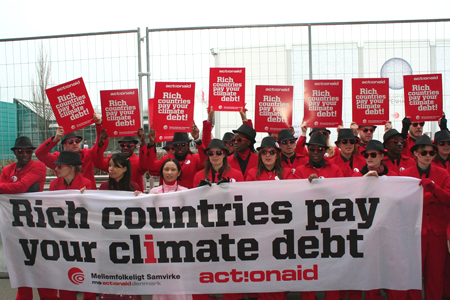
climate debt

There really will be no end to this. From The Guardian of course, this story titled, US fears climate talks will focus on compensation for extreme weather:

US officials fear that international climate change talks will become focused on payouts for damage caused by extreme weather events exacerbated by global warming, such as the category 5 Typhoon Haiyan that hit the Philippines last week killing thousands of people and causing what is expected to be billions of pounds of damage. An official US briefing document obtained by the Guardian reveals that the country is worried the UN negotiations, currently under way in Warsaw, will ‘focus increasingly on blame and liability’ and poor nations will be ‘seeking redress for climate damages from sea level rise, droughts, powerful storms and other adverse impacts’.

You think there won’t be some judge who will buy into this. The potential for mischief making is unlimited, specially with the American left so colossally stupid.

We are not alone

From The Guardian, of all places. This is the headline:

Warsaw climate talks: nearly 3 in 10 countries not sending ministers

Australia is not alone in its failure to send a minister to the UN climate negotiations in Poland, reports RTCC

And while the previous government made a fetish about leading the way, it is actually Tony Abbott who is doing the leading. Again from this same story:

Australia recently attracted attention by its refusal to send either its environment minister Greg Hunt or foreign minister Julie Bishop to the negotiations.

Instead, Australia will send along its climate ambassador Justin Lee as its lead negotiator.

As the world’s top climate officials gather to discuss how to stem emissions and mobilise finance, Hunt will instead be based in the Australian parliament, attempting to fulfill Prime Minister Tony Abbott’s election promise to repeal the country’s carbon tax.

We are setting a precedent and others are taking notice.

This isn’t satire – it’s a real ad!

obamacare ad 131108

I’ve seen it a few times but am finally coming round to see that the ad is not satire but is supposed to help market the Affordable Care Act (a name that is also not supposed to be satirical). Since it part of a series, and this article points out that the ad assumes that the age group this is supposed to appeal to ought to be insulted by being portrayed as such imbeciles, then maybe they really are just as clueless as the people who made these ads think they are.

Galbraith on the India-Pacific

This is a correspondence between Galbraith and Friedman (first names not needed) over whether to travel the India-Pacific from Adelaide to Perth. Via Ric Holt at the SHOE list who put this in as a footnote in relation to an entirely different topic.

Milton Friedman sent Galbraith a note on February 10, 1975 saying that he was going to Australia and thinking of taking a trip “across the Australian continent on the India Pacific Railway.” He heard that Galbraith had taken the trip and wanted his advise whether it would be worth his time and effort.

To Milton Friedman
February 26, 1975
[Gstaad, Switzerland]

Dear Milton:

I think my alert office has already sent you a copy of my description of the journey. It will give you all the information you need for a decision and perhaps more. On balance, I would certainly do it.

The same mail brought a letter from Peking asking if I could arrange to send a copy of Friedman and Schwartz. The prospect for Communism is more devastating than I thought. I am also sending to the press this week a book on MONEY – WHENCE IT CAME AND WHERE IT WENT – which is rich in praise of your scholarship, more reserved on your conclusions.

Yours faithfully,
John Kenneth Galbraith

If I like anything in particular it is the civilised cordial correspondence between economists on opposite ends of the political spectrum.

“A humanitarian disaster as well as an affront to our Australian sovereignty”

Tony Abbott puts it perfectly, from an interview with the 7:30 Report where he is asked why he refuses to discuss what is happening as it is happening:

I’m interested in stopping the boats; I’m not interested in providing sport for journalists, I’m not interested in starting a fight or provoking an argument; I’m interested in stopping the boats. And why I’m interested in stopping the boats is because this is a humanitarian disaster as well as an affront to our Australian sovereignty. And I know that for political purposes and for entertainment purposes and for media purposes people would love every last tidbit of information, but honestly, I think the public expects us to solve the problem, not to engage in sport for commentators.

In mathematics one solves a problem. In politics, there is the need for engagement and explanation as part of the blood sport of commentary. But here Abbott was perfect.

[Found at Andrew Bolt]