PDT reveals his soul

I wrote a while ago about being in need of some urgent advice in regard to a high school friend who I was then about to visit who continually sends me anti-Trump material from CNN etc. He is a two-times-over legal migrant, first from the Hungarian workers’ paradise to Canada in 1956, and then second from the Canadian workers’ paradise to not just the workers’ paradise of California, but to Silicon Valley itself in the early 1970s. There he ran his own business enterprise where he would sack willy nilly any excess staff at the mere hint of a downturn in demand but has been successful enough to end up in a $US5 million dollar home, his and hers Mercedes, a Mercedes van so that he can take his sailboard to the coast, not to mention his Porsche which he didn’t actually register for a number of years so that he could evade speed limits on the highways as he powered his way down the road. That is, he is an average and utterly normal member of the Democratic Party. And now he has sent me this which I will share with you in full with no edits: A Trump meltdown for the ages. From CNN, of course, from which everything below the line is found and with nothing left out.

_____

It was like watching a human Twitter feed.

A combative and unrestrained President Donald Trump opened his authentic political soul, in possibly the most memorable news conference in presidential history, that is certain to become a defining moment of his administration.
It was supposed to be a routine event at Trump Tower in New York to tout the President’s infrastructure plan.
But the session quickly veered off course into one of the most surreal political moments in years as Trump unloaded about the fallout from the weekend’s protests by “alt-right” activists, white supremacists and neo-Nazis in Virginia.
Gesticulating with his right hand, Trump blasted what he called the “alt-left,” protested that he had already condemned neo-Nazis and parroted far-right talking points on the Confederacy.
On the substance, it was a performance that quickly emboldened white nationalist groups and appeared certain to heighten racial tensions and fear in the country.
There’s no chance that Trump’s political team can finesse this one, or walk it back.
But the tone and the spectacle of Trump’s unchained performance was equally stunning.
The unapologetic, stream-of-consciousness style of delivery left no doubt at all: This was the real Trump, not the scripted version who appeared in the White House on Monday and tried to clean up his initial failure to condemn white supremacists after the death of a counter-protester in Charlottesville.
His anger emerged in a torrent, as he obliterated any benefit of the doubt he earned on Monday, thought piling on thought, in a style the nation has become accustomed to from his Twitter feed.
In the most incredible moment, as he stood at a podium bearing the seal of the President of the United States, Trump tore at the nation’s racial fault lines by appearing to offer a pass to a racist and neo-Nazi movement.
“I think there is blame on both sides,” Trump said, returning to his original position about the protest in Charlottesville, saying that an extreme right demonstration in which marchers held torches and Swastikas and chanted racist and anti-Semitic slogans contained some “bad people …. but you also had people that were very fine people, on both sides.”
Trump accused counter-demonstrators of being as violent as the white supremacists.
“What about the fact they came charging — that they came charging with clubs in their hands, swinging clubs? Do they have any problem? I think they do,” he said.
“I think there is blame on both sides,” Trump said.
The President’s fury was first sparked when he was challenged by reporters on his handling of Charlottesville, evidence of how Trump’s extreme sensitivity to personal slights sometimes leads him into politically self-destructive behavior.
It was a display that will renew questions about the suitability of Trump’s temperament for the presidency, and at a time of increasing tensions around the world that will exacerbate fears he will be unable to control his emotions at a time of crisis as commander-in-chief.
Trump also condemned efforts to take down statues in southern states dedicated to heroes of the Civil War Confederacy.
“This week it’s Robert E. Lee. I noticed that Stonewall Jackson’s coming down. I wonder, is it George Washington next week? And is it Thomas Jefferson the week after?”
“You’re changing history. You’re changing culture. And you had people, and I’m not talking about the neo-Nazis and the white nationalists, because they should be condemned totally. But you had many people in that group other than neo-Nazis and white nationalists.”
It did not take long for key figures in the extreme right movement to take comfort in Trump’s remarks, after the news conference appeared to nudge the President closer to an isolated spot on the far right of US politics.
“Thank you President Trump for your honesty & courage to tell the truth about #Charlottesville & condemn the leftist terrorists in BLM/Antifa, wrote David Duke, a former leader of the Ku Klux Klan, on Twitter.
Some of Trump’s fellow Republicans were quick to condemn him.
“If you are showing up to a Klan rally you are probably a racist or a bigot,” Texas Rep Will Hurd said on CNN’s “The Situation Room.” “I think the outrage across the political spectrum about this is maybe the thing that ultimately unites us.”
Florida Sen. Marco Rubio was also quick to rebuke Trump.
“Mr. President,you can’t allow #WhiteSupremacists to share only part of blame. They support idea which cost nation & world so much pain,” Rubio said on Twitter.
“These groups today use SAME symbols & same arguments of #Nazi & #KKK, groups responsible for some of worst crimes against humanity ever.”

The overall impression of Trump’s performance was of a president out of control, who is captive to his whims and instincts and defies any attempt to manage him — including by his new Chief of Staff John Kelly.
“That was all him — this wasn’t our plan,” a senior White House official told CNN’s Jeff Zeleny.
One person who has spent time with Trump over the past 24 hours describes the President as “distracted” and “irritable” in his interactions with top aides. Trump felt pressured into the Monday statement by staff members, the person said. As he went about his day Tuesday, Trump was upset and repeatedly returned to the topic, the person said, culminating in the lobby press conference.
CNN senior political analyst David Axelrod compared Trump to a “runaway truck, there are no brakes, there is no reverse.”
Axelrod also questioned why Kelly and other Trump aides even allowed the President to appear before reporters on Tuesday, given their presumed knowledge of the state of his mood over the Charlottesville coverage.
But ultimately, Tuesday’s stunning appearance will be remembered for the sentiments that passed the lips of a President of the United States.
In the long and tortured history of a nation still trying to work through its complicated story on race, Trump’s meltdown will stand out, as a moment ripped from the darkest pages of history and transposed into the 21st Century.
In the process, he appears to have abdicated any claim to the traditional presidential role as a moral voice for the nation and the world.


THE VIDEO OF THE PRESS CONFERENCE: Prompted by OldOzzie, here is the press conference so you can see it for yourself.

His infrastructure statement is pretty good as well!

The value of free speech

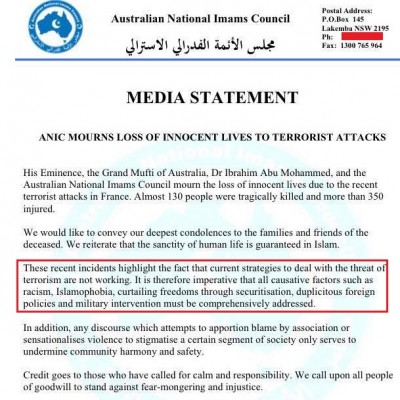
That letting everyone have their say on any matter of public importance is so evident as the best way to manage differences within a community was never better seen than in the last few days. In my view, there are very few really good liars around, with the Clintons and Obama among the best there is (and even they need the help of the even more mendacious media). Mostly, however, people say what they think, even when they are trying to shape their beliefs into a form that others will find acceptable. So with this in mind, I hope I may be permitted to put in a good word for Australia’s Grand Mufti. This is the press release that got him into such hot water.

mufti statement on paris

First, he didn’t write it. Someone else wrote the first draft and then it was gone over by others until they were satisfied that it said what they wanted said. If you can read what it says, you can see which side those who wrote it are on. Why shouldn’t they be on their own side? They mourn the loss of innocent lives rather than actively condemning the attacks. Such is as it is. What is important is for us to understand what they believe. Their plain speaking has set everything straight. Whether the knowledge we have has any practical value is something else again, but at least we know.

Or take Waleed Aly and his own reaction. All you need is love, apparently:

“If you are a member of Parliament or a has-been member of Parliament [who do you suppose he means by this?] preaching hate [and who’s doing that?] at a time when what we actually need is more love — you are helping ISIL. They have told us that. [Who is “they” and when did they tell us?] If you are a Muslim leader telling your community they have no place here [and who has told them that?] or basically them saying the same thing — you are helping ISIL.

It’s our fault and not theirs. We may think the killers in Paris are savages but he thinks they were provoked, and if we condemn their actions, we are playing into ISIS’s hands. I don’t think so but that’s not the point. The value in hearing it is that you start to understand who and what we are up against. They do not condemn these attacks in anything more than a perfunctory way, since they see themselves as more sinned against than sinning. You may not think so, and I may not think so, but many of them do think so, and that’s what letting them say their piece allows us to understand.

Endangering the security of the whole society

Those exertions of natural liberty of a few individuals, which might endanger the security of the whole society, are, and ought to be, restrained by the laws of all governments.

Adam Smith (1776)

I think of myself as a free speech absolutist. There is no point of view that is not open for debate and all perspectives are invited to join. Jews are descended from apes and pigs. Well, that’s one way of looking at things. Jews are murderers of Gazan children and use their blood to make matzohs. Speak the truth as you see it. There was no holocaust but if there were one we would do it right this time round. Interesting, please tell me more.

As you may imagine, I am disgusted and outraged by each of these but the principle is more important than the abuse that some make of the principle. Public discourse is very dangerous, but beliefs that cannot be challenged in public debate is where the greatest dangers lie. Bring them out into the light. Go on, discredit yourself, because if there comes a time when saying such things in public does not make you a social leper, then things have already gone too far. Your rabid, racist, repulsive views are genuinely useful information for the rest of us. It requires judgement to know what can and cannot be said in public without consequence, but there should be nothing to stop you from saying what you want.

But racist rants in public amongst strangers, people abused on the streets by others they do not know, are out of bounds in a civilised community. It is just not on, rightly illegal. In the workplace or amongst those known to each other it becomes trickier but I side, with a heavy heart, on the side that this is just one of those things up with which we must put. But I also understand those who take a different view.

Ordinary people are not political philosophers. They are not social theorists who have read, absorbed and contemplated the arguments of John Stuart Mill. They are not people who are immune to abuse for their religion, skin colour, gender or anything else. Most people are prepared to debate all issues but they are not prepared to have to deal with some idiot shouting abuse at them on the street or where they work.

If the government cannot distinguish between free speech in a civilised community and a racist rant individually one-on-one in a public place, then it should not have gotten into this debate in the first place. And had they made this distinction, they could have presented their aim in terms of doing something positive, that being stopping racists rather than protecting the rights of bigots. What a loser argument that was! Why didn’t the government show they were providing something that will aid comity in the community, not taking something useful away. I fear by not thinking this through, they have damaged the cause of free speech in this country.

Free speech and racist abuse

I think of myself as a free speech absolutist. There is no point of view that is not open for debate and all perspectives are invited to join. Jews are descended from apes and pigs. Well, that’s one way of looking at things. Jews are murderers of Gazan children and use their blood to make matzohs. Speak the truth as you see it. There was no holocaust but if there were one we would do it right this time round. Interesting, please tell me more.

In its way, I am outraged by each of these but the principle is more important than the abuse that some make of the principle. Public discourse is very dangerous, but hidden beliefs are perhaps more dangerous than those made in public. Bring them out into the light. Go on, discredit yourself, because if there comes a time when saying such things in public does not make you a social leper, then things have already gone too far. It is genuinely useful information. It’s good to know what can and cannot be said in public without consequence, but there should be nothing to stop you from saying what you want.

But racist rants in public amongst total strangers, people abused on the streets by others they do not know, are out of bounds in a civilised community. It is just not on, rightly illegal.

Ordinary people are not political philosophers. They are not social theorists who have read, absorbed and contemplated the arguments of John Start Mill. They are not people who are immune to abuse for their religion, skin colour, gender or anything else. Most people are prepared to debate all issues but they are not prepared to have to deal with some idiot shouting abuse at them on the street.

If the government cannot distinguish between free speech in a civilised community and a racist rant individually one-on-one in a public place, then it should not have gotten into this debate in the first place. And had they made this distinction, they could have presented their aim in terms of stopping racists and not protecting the rights of bigots. What a loser argument that was! Why didn’t the government show they were providing something that will aid comity in the community, not taking something useful away. They have damaged the cause of free speech in this country.

Mark Steyn discussing Brendan O’Neill interviewing George Brandis

A bit convoluted, but here goes. Mark Steyn has an article, Medieval Moralists, in which he quotes from an interview with George Brandis conducted by Brendan O’Neill which may be found in a posting with the heading, Free Speech Now. This is the passage Steyn has taken from that Brandis interview with O’Neill:

Brandis says he’s been a fan of free speech for ages. He reminds me that in his maiden speech to the Senate, given 14 years ago when he was first elected as senator for Queensland, he let everyone know that ‘one of my most fundamental objectives would be to protect freedom of thought and expression’. He tells me he has long been agitated by ‘the cultural tyranny of political correctness’. But there were two recent, specific things that made him realise just what a mortal threat freedom of speech faces in the modern era and that he would have to dust down his Mill, reread his Voltaire, and up the ante in his war of words against, as he puts it, the transformation of the state into ‘the arbiter of what might be thought’. The first thing was the climate-change debate; and the second is what is known down here as The Andrew Bolt Case.

He describes the climate-change debate – or non-debate, or anti-debate, to be really pedantic but also accurate – as one of the ‘great catalysing moments’ in his views about the importance of free speech. He isn’t a climate-change denier; he says he was ‘on the side of those who believed in anthropogenic global warming and who believed something ought to be done about it’. But he has nonetheless found himself ‘really shocked by the sheer authoritarianism of those who would have excluded from the debate the point of view of people who were climate-change deniers’. He describes as ‘deplorable’ the way climate change has become a gospel truth that you deny or mock at your peril, ‘where one side [has] the orthodoxy on its side and delegitimises the views of those who disagree, rather than engaging with them intellectually and showing them why they are wrong’.

He describes how Penny Wong, the Labor Party senator for South Australia and minister for climate change in the Julia Gillard government, would ‘stand up in the Senate and say “The science is settled”. In other words, “I am not even going to engage in a debate with you”. It was ignorant, it was medieval, the approach of these true believers in climate change…’

The great irony to this new ‘habit of mind’, he says, is that the eco-correct think of themselves as enlightened and their critics as ‘throwbacks’, when actually ‘they themselves are the throwbacks, because they adopt this almost theological view, this cosmology that eliminates from consideration the possibility of an alternative opinion’. The moral straitjacketing of anyone who raises a critical peep about eco-orthodoxies is part of a growing ‘new secular public morality’, he says, ‘which seeks to impose its views on others, even at the cost of political censorship’.

And as for free speech being free, if you go to the article you can find a bit of first-person experience shared by Steyn in replying to some Canadian nong, Adam Stirling, who finds it a bit tedious to hear Steyn go on about free speech:

The only reason Master Stirling can read me in a Canadian national newspaper is because Maclean’s and I fought a long, hard public battle and won it! And we’ve got seven-figure legal bills to prove it! How funny is that?

And therein lies a tale, which Steyn’s article also discusses.

UPDATE: Here is Mark Steyn again discussing The slow death of free speech. It all needs to be read but here is a bit from the middle:

I’m opposed to the notion of official ideology — not just fascism, Communism and Baathism, but the fluffier ones, too, like ‘multiculturalism’ and ‘climate change’ and ‘marriage equality’. Because the more topics you rule out of discussion — immigration, Islam, ‘gender fluidity’ — the more you delegitimise the political system. As your cynical political consultant sees it, a commitment to abolish Section 18C is more trouble than it’s worth: you’ll just spends weeks getting damned as cobwebbed racists seeking to impose a bigots’ charter when you could be moving the meter with swing voters by announcing a federal programmne of transgendered bathroom construction. But, beyond the shrunken horizons of spinmeisters, the inability to roll back something like 18C says something profound about where we’re headed: a world where real, primal, universal rights — like freedom of expression — come a distant second to the new tribalism of identity-group rights.

Separating political comment from bigotry

What an excellent government we have. Its ability to see clearly and understand the need to protect free speech and political debate while at the same time protecting individuals from vilification in the public sphere is exceptional. I discussed this in a post on Andrew Bolt and Mark Liebler. This is what I concluded then:

Free speech is about allowing the freedom to say whatever one believes in the midst of political discourse. If an acceptance of racist rants is defended as examples of free speech then the very notion of free speech will be discredited by these very claims in the eyes of anyone who wishes to live in a decent society where individuals are protected from the kinds of racist abuse that has no part to play in a civilised community which seeks to promote peace, order and good will.

And it is exactly this distinction that has been made in the coming legislation.

The Government Party Room this morning approved reforms to the Racial Discrimination Act 1975 (the Act), which will strengthen the Act’s protections against racism, while at the same time removing provisions which unreasonably limit freedom of speech.

The legislation will repeal section 18C of the Act, as well as sections 18B, 18D, and 18E.

A new section will be inserted into the Act which will preserve the existing protection against intimidation and create a new protection from racial vilification. This will be the first time that racial vilification is proscribed in Commonwealth legislation sending a clear message that it is unacceptable in the Australian community.

The coming debates in this country over the course of the next few years will be about political views that mascarade as religious or racial views. We now have legislation that will allow such debates to take place in public without spurious claims of racism being allowed to cloud the discussion. An exceptionally well thought out piece of work.

I wonder what this was about

From Andrew Bolt:

People who airily deny that my free speech (and, by extension, yours) hasn’t been taken away in part by our courts should know that I have again been advised by my lawyers not to comment on a recent publication by the Department of Foreign Affairs and Trade, or even to simply republish the DFAT item without comment.

This is far from the first time. Our laws against free speech are a disgrace. The effect is to allow people – in this case DFAT – to promote a certain point of view on a matter of great moral importance without fear of contradiction.

This post, then, is a bookmark to note where an article should have appeared.

A slapp shot from the point

It’s only a minor thing in the face of all of the other repressive activities in the US, but Mark Steyn’s travails within the court system, after having been sued by Michael Mann over his hockey stick, is quite significant in its own way, possibly more so because Mark is one of the few who is willing and able to fight back. In an article he brilliantly titles Slappstick Farce – and you will have to read the article to understand how clever it is – Steyn discusses how difficult it has been within the American system to deal with Mann’s lawsuit. One more example of how someone on the right finds dealing within the system so difficult.

I don’t think much about the First Amendment these days. As a practical matter, it’s simply not feasible in a global media market to tailor one’s freedom of expression to the varying local bylaws. So I take the view that I’m entitled to say the same thing in Seattle as I would in Sydney or Stockholm, Sofia or Suva. But, were Dr. Mann to prevail, it would nevertheless be the case that his peculiarly thin skin and insecurities would enjoy greater protection under U.S. law than they do in Britain, Canada, Australia, and other jurisdictions. It would thus be a major setback for the First Amendment.

That’s worth making a noise about. Up north, following a similar SLAPP suit from the Canadian Islamic Congress, my publisher Maclean’s, who are far less ideologically simpatico to me than NR, nevertheless understood the stakes — and helped get a disgusting law with a 100 percent conviction rate first stayed by a hitherto jelly-spined jurist and ultimately repealed by the Parliament of Canada. This too is a free-speech case. Free speech is about the right to thrash out ideas — on climate change, gay marriage, or anything else — in the public square, in bright sunlight. And you win a free-speech case by shining that sunlight on it, relentlessly. As we embark on our second year in the hell of the D.C. court system, that’s what I intend to do.I don’t think much about the First Amendment these days. As a practical matter, it’s simply not feasible in a global media market to tailor one’s freedom of expression to the varying local bylaws. So I take the view that I’m entitled to say the same thing in Seattle as I would in Sydney or Stockholm, Sofia or Suva. But, were Dr. Mann to prevail, it would nevertheless be the case that his peculiarly thin skin and insecurities would enjoy greater protection under U.S. law than they do in Britain, Canada, Australia, and other jurisdictions. It would thus be a major setback for the First Amendment.

The comparison is with Macleans, which is something like The Bulletin once was, and National Review, which is supposed to be the stalwart beacon of freedom on the right, is part of Steyn’s continuing disenchantment with the magazine in which he writes. Hardly anyone is standing up for freedom in the US any longer, with the dangers to wealth and reputation so large that the risks of being anything but a leftist jerk are just getting too high.

The non-existent principle of free speech on the left

Here is where the controversy over Tim Wilson’s appointment to the HRC overlaps with the controversy in the United States over Duck Dynasty:

Our current social understanding of free speech is this: You can speak your mind freely if you have a large enough army of supporters to pressure a company [and in Australia the Government itself] into resisting pressure from a large army of Speech Police.

This is not free speech. This is free speech as an exceptional thing — only for those with a wide, passionate following — not as a routine thing.

A&E is a cowardly organization. First it puts Robertson on ‘indefinite hiatus’ under pressure from one group of people, then it puts him back on the air because they’ve been pressured by a somewhat larger group of people.

At no point did they trip over anything resembling a general principle of speech free from ‘consequences’ of broad application.