
Writing in code

One of the great philologists used to argue that you could not read the ancient Greek writers without appreciating that it was more than their lives were worth to actually say what they meant. Now we are unlikely to boil you in oil, but still, you might lose your writing gig at National Review if you said what you really meant. Take Victor Davis Hanson, who begins and ends his column on White versus White America, with the standard demand that we be spared a Donald Trump as President, but then says this in the middle:

Trump is not so much appealing to the ethnic prejudices of the white poor and working class, or playing on their perceived resentments of the Other. It’s more that he, a crass member of the elite (“It takes one to know one”), is resonating with their deep dislike of the hypocrisies of the white elite, both Republican and Democratic. Middle-class whites should be outraged at the cruel and gross manner in which Trump insulted John McCain and Megyn Kelly, but they are not. Perhaps, if asked, they would prefer to have the latter pair’s money and power if the price was an occasional little slapdown from Donald Trump. What they see as outrageous is not Trump’s crude “Get out of here” to Spanish-language newscaster Jorge Ramos, but rather the multimillionaire dual-citizen Ramos predicating his con on a perpetual pool of non–English speakers, many of whom have broken federal immigration law in a way a citizen would not dare break the law on his tax return or DMV application. For an angry Arizonan, ridiculing “low energy” Jeb is not as crude as Jeb’s own crude “act of love” description of illegal immigration. An act of love for exactly whom?

What is the perceived white elite? Perhaps a Hillary Clinton raking in $300,000 per half hour at UCLA or shaking down Wall Street for $600,000, even as she pontificates on privilege and the dangers of racism (obviously embraced, in her view, by whites other than those of her class). Or a Chelsea Clinton deprecating the attraction of riches, as her Wall Street internships and marriage perpetuate the Clinton model of pay-for-play enrichment — all to be camouflaged by professions of progressive empathy. Or an elite media that snores when an ex-president of the United States jumps on the private plane of convicted child-assaulter Jeffrey Epstein for a trip to his fantasy island. Or a former anti-government “conservative” congressman who hangs around Washington and mysteriously becomes a multimillionaire leveraging his past government service. Our popular culture is one of Pajama Boy, Mattress Girl, and the whiny, nasal-toned young metrosexual with high-water pants above his ankles and horn-rimmed glasses who “analyzes” on cable news. Is it any wonder that millions sympathized with the heroism of Benghazi’s middle-class defenders rather than with the contortions of the far better-educated, smoother, more sensitive, and wealthier Rhodes scholar Susan Rice, novelist Ben Rhodes, or former First Lady Hillary Clinton?

Whom do these sometimes incoherent Trump supporters likely despise? I would wager anyone who has never been sideswiped in a hit-and-run by an illegal-alien driver but lectures others on why “illegal alien” is a racist term; anyone who has lucrative government employment and whose job description does not exist in the poorer-paying private sector; any politician or his appendage who somehow became quite wealthy on a GS salary in Washington; anyone who makes more than $50 an hour and lectures others on why the country is going broke and must tighten its belt; anyone who sermonizes on free trade and knows few people who ever lost jobs through outsourcing; anyone who freely uses the word “white” in a way and context that he would never use “black” or “Latino”; or anyone who hires someone else to clean his house, watch his kids, and take care of his yard, and then lectures others on their illiberality.

Or to put it this way, whom do these sometimes very coherent Trump supporters likely despise? I’ll leave it to you to work it out.
Stagnant economic thought

This is Paul Kelly writing on Staying smart in dangerous post-GFC world. Doesn’t look all that smart to me, but this is what he writes:

The world suffers from what former US Treasury secretary Larry Summers brands “The Age of Secular Stagnation”, the failure of economies to recover from the 2008-09 global financial crisis, the upshot being weak growth, low or negative interest rates, rising asset prices, more inequality and poor investment.

That is, the failure to recover has been caused by the failure to recover. Hard to argue with, but also not much guidance either. Secular stagnation is the ultra-version of Keynesian economics – as Alvin Hansen said, “secular stagnation is just another name for Keynes’s underemployment equilibrium”. We are all so satisfied with our living standards or something that no one wants to spend on anything any more. So the economy just vegetates. Here’s the Summers’ version:

Secular stagnation may be a reason that US growth is insufficient to reach full employment: “Suppose then that the short term real interest rate that was consistent with full employment . . . had fallen to negative two or negative three percent.”

And then Kelly quotes something else:

The former governor of the Bank of England during the crisis, Mervyn King, in his recent book The End of Alchemy, argues that while the 1930s Depression produced a robust policy response this has not been replicated in the years since the GFC.

“Without reform of the financial system, another crisis is certain and the failure to tackle the disequilibrium in the world economy makes it likely that it will come sooner rather than later,” King says. “Since the end of the immediate banking crisis in 2009 recovery has been anaemic at best. There was a continuing shortfall of demand and output from the pre-crisis trend path of close to 15 per cent.” . . .

There is, moreover, no sign of any substantial recovery, with King warning that “markets do not expect interest rates to return to normal for many years”.

Actually quite scary. More on Summers, and just as scary:

Summers fears a recession, after a weak post-GFC recovery, “would strongly suggest that the current stagnation is secular — that is, indefinite — rather than merely cyclical or temporary”. That is, instead of moving ahead to a period of normalisation the world might be only part way through a slow growth era “shaped by previously unthinkable and far-fetched policies” like negative real interest rates.

The idea is that there is an interest-rate policy that will get us out of this mess is probably the most far-fetched idea of the lot. But what makes this such an interesting column is how Kelly is able to sum up in a single para where we stand and what we urgently need to do.

The core need is for policies that recognise the real problems and priorities, making the 2016 election a plus, not a minus, for the nation and keeping the destructive populists at bay.

The destructive populists are Donald Trump and Jeremy Corbyn. Corbyn wouldn’t know one end of a balance sheet from the other. Trump, however, is the only person running for high office anywhere who has actually run a productive value-adding business for many many years. Why you would trust him to get an economy going when we have Hillary or Bernie Sanders sitting in the wings instead is completely beyond me.

George Soros is more dangerous than Angela Merkel

Naturally in an English paper, this time The Daily Express. You won’t find this mentioned in the US. EU is in ‘mortal danger’ of collapse, warns billionaire global finance guru George Soros unless it spends £24 BILLION EVERY YEAR to tackle the migrant crisis.

Mr Soros said EU leaders needed to agree a surge in funding to deal with the influx of more than a million refugees flooding into Europe.

He suggested that at least €30 billion (£24 billion) a year would be needed and said Europe should be looking to accept between 300,000 and 500,000 a year.

Mr Soros said: “Thirty billion might sound like an enormous sum, but it is not when viewed in proper perspective.

“First, we must recognise that a failure to provide the necessary funds would cost the EU even more.

“There is a real threat that the refugee crisis could cause the collapse of Europe’s Schengen system of open internal borders among 26 European states.

“The asylum seekers are desperate.

“Legitimate refugees must be offered a reasonable chance to reach their destinations in Europe.

“EU leaders need to embrace the idea that effectively addressing the crisis will require “surge” funding, rather than scraping together insufficient funds year after year.

Soros is channelling immense amounts of money to every presidential candidate in the US – Democrat or Republican – except for Donald Trump. This is what he wants and every candidate will give him that except for one.

Voter judgment and Donald Trump

This is a post about political judgment, or more to the point, the lack thereof. And it relates to Donald Trump versus Justin Trudeau. First Canada and its previous PM, Stephen Harper:

The fact that he steered the country safely through the market crash of 2008, signed lucrative international trade deals, kept taxes down, reduced the GST (Goods and Services Tax) and provided the country with a balanced budget plainly counted for nothing. His emendation of citizenship protocols in an effort to check the spread of culturally barbaric practices, chiefly associated with Islam, counted against him. At the end of the day, he was simply unlikeable, he was “Harperman,” and he had to go.

Compared with Harper we have Trudeau:

Trudeau has been in office for half a year, more than enough time to engineer the rapid deterioration of a once-prosperous and relatively secure nation. He has brought in 25,000 “Syrians” and is aiming for many thousands more, all living off the public dole and no doubted salted with aspiring jihadists. He intends to build mosques (which he calls “religious centers”) on military bases and is re-accrediting Muslim terror-affiliated organizations that Harper defunded. He inherited Harper’s balanced budget and in just a few short months was busy at work racking up a $29.4 billion deficit. Not to worry, since Trudeau is on record saying that budgets balance themselves. Magic is afoot.

So the issue is now Trump or not Trump. The summation which is similar to my own:

Would any sane person choose a Trudeau-type figure over a Harper or a Trump to lead their country into a problematic future? The larger issue is whether any reasonable person should predicate his voting preference on personal liking or disliking. Trudeau is intellectually vapid, has the wrong instincts, and is unlearnable. But he is liked. As for Trump, I am not suggesting that he would be a better choice than Cruz may be or Rubio may have been, though I suspect he might. He still has much to learn about the intricacies and priorities of governing and about looking “presidential.” What matters is that a candidate for political office is smart, has the right instincts, and is willing to learn. I believe Trump qualifies in these respects. Disliking him is beside the point.

Writing for The Federalist, Timm Amundson acknowledges that Trump can be rude, arrogant and reckless, and asks: “How can a principled, pragmatic, deliberate conservative be drawn to such a candidate?” And answers: “It is because I believe conservatism doesn’t stand a chance in this country without first delivering a very heavy dose of populism,” that is, “a platform built largely on the principle of economic nationalism…focus[ing] on three primary policy areas: trade, defense, and immigration.” This is Trump’s bailiwick.

So we are into an American election where all of the best educated are siding with candidates that will doom their country because they do not personally like Trump, or prefer a woman irrespective of any other considerations. But the #NeverTrump are the worse buffoons of all, but there you are since they may yet carry the day.

An international socialist conspiracy

I am in the middle of reading Humboldt’s The Limits of State Action who argued the case that giving things to people was bad for those on the receiving end. Reward without effort is debilitating, he wrote. Here in Oz we have ‘More tax, more equitably’ left-wing intellectuals cry in open letter.

Australia’s left-wing intellectual establishment has heaped pressure on politicians to collect “more tax, more equitably” to fund greater health, education and transport spending without cutting welfare entitlements.

An open letter – co-signed by 50 progressive advocates, union leaders and academics – identifies capital gains and superannuation accounts as ripe targets for revenue-raising, and came as opposition treasury spokesman Chris Bowen explicitly ruled out cutting company tax in the May budget.

Meanwhile, in the United States, Hillary Confirms Trillion Dollar Tax Hike Plan.

Daily News: So if I understand you correctly, if you look at your proposals for college costs and for family leave, for infrastructure investments…

Clinton: Well, that’s a little bit different, because infrastructure investment, I’m still looking at how we fund the National Infrastructure Bank. It may be repatriation. That’s one theory, or something else. It’s about $100 billion a year.

Daily News: A hundred billion a year, so that comes out to about a trillion dollars…

Clinton: Over ten.

Daily News: …over ten years.

That’s not the total, that’s the increase. The land of the free has become the land of the free lunch, of which there is no such thing.

Self interest – nothing quite like it for clearing the mind

From Millennials Like Socialism — Until They Get Jobs.

A Reason-Rupe poll found that while millennials still on their parents’ health-insurance policies supported the idea of paying higher premiums to help cover the uninsured (57 percent), support flipped among millennials paying for their own health insurance with 59 percent opposed to higher premiums.

When tax rates are not explicit, millennials say they’d prefer larger government offering more services (54 percent) to smaller government offering fewer services (43 percent). However when larger government offering more services is described as requiring high taxes, support flips and 57 percent of millennials opt for smaller government with fewer services and low taxes, while 41 percent prefer large government.

Charting our Keynesian disaster

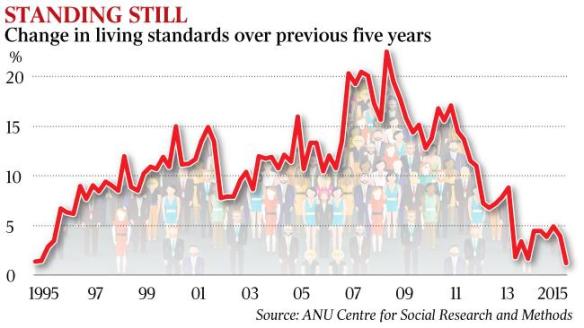
aust living standards fallen

Quite an amazing story, Living standards at a standstill for five years: report. The peak was reached in 2009, at which moment those Keynesian incompetents decided that what was needed was a Keynesian stimulus, and the results are now there for anyone to see. They won’t believe that they caused it, of course. Economists across the world will be united in the belief that things would have been even worse had they not taken the actions they took. Nothing can be proven, but there was, of course, my own forecast from February 2009.

Just as the causes of this downturn cannot be charted through a Keynesian demand-deficiency model, neither can the solution. The world’s economies are not suffering from a lack of demand, and the right policy response is not a demand stimulus. Increased public sector spending will only add to the market confusions that already exist.

What is potentially catastrophic would be to try to spend our way to recovery. The recession that will follow will be deep, prolonged and potentially take years to overcome.

Every classical economist understood this. Now only a handful do. But if you won’t take my word for it, how about listening to Sir Winston Churchill in his budget speech from 1929.

“Churchill pointed to recent government expenditure on public works such as housing, roads, telephones, electricity supply, and agricultural development, and concluded that, although expenditure for these purposes had been justified:

‘For the purposes of curing unemployment the results have certainly been disappointing. They are, in fact, so meagre as to lend considerable colour to the orthodox Treasury doctrine which has been steadfastly held that, whatever might be the political or social advantages, very little additional employment and no permanent additional employment can in fact and as a general rule be created by State borrowing and State expenditure.’”

And I emphasise that this was in 1929 before the Great Depression had even begun. The world is heading towards a disastrous downturn, and in spite of everything, we still only have Keynesian clowns stationed in every major economic post across the globe. Yet I am encouraged by our Treasurer, who gets this exactly right:

Mr Morrison said the key to raising household incomes was to improve productivity and this required business investment.

“You don’t get that from taxing and spending as Labor proposes; you get it from encouraging enterprises to innovate,” he said.

You also don’t get it by building massively loss-making very fast trains, which are really very fast drains on our productive capabilities. It should be no mystery why the Treasurer doesn’t get on with his PM, who still thinks the NBN was a great success.

“Genes are the most important determinant of maths and reading skills among schoolchildren”

Is it really permissible to say this in public? Jennifer Oriel did: Cash can’t beat genetics in class. Here’s the detailed comment:

Speaking on SBS’s Insight program, Brian Byrne of the University of New England revealed findings of soon to be published research with colleagues at the Centre of Excellence for Cognition and its Disorders. It indicates that genes are the most important determinant of maths and reading skills among schoolchildren. Their study of twins’ NAPLAN performance apparently found that maths, reading and spelling skills are up to 75 per cent genetic and writing skills are about 50 per cent genetic. The influence of schools and teachers, the focus of Labor’s policies, accounts for only about 5 per cent of performance.

It wouldn’t worry me one way or the other whether it is genetics or environment, but not since I was very young has it even been possible to side with the genetics without creating a storm of protest. Maybe things are changing, maybe it’s just that this is Australia or maybe I will have to read the papers tomorrow to see the reaction.