You can find me sitting in the front row. And I have to say that for myself, the two speakers opposed to Trump as President provided such empty arguments that it was offensive. The audience was overwhelmingly pro-Trump by the way.

You can find me sitting in the front row. And I have to say that for myself, the two speakers opposed to Trump as President provided such empty arguments that it was offensive. The audience was overwhelmingly pro-Trump by the way.
How could this be even remotely true? U.S. Sent Cash to Iran as Americans Were Freed: Obama administration insists there was no quid pro quo.
The Obama administration secretly organized an airlift of $400 million worth of cash to Iran that coincided with the January release of four Americans detained in Tehran, according to U.S. and European officials and congressional staff briefed on the operation afterward.
Wooden pallets stacked with euros, Swiss francs and other currencies were flown into Iran on an unmarked cargo plane, according to these officials. The U.S. procured the money from the central banks of the Netherlands and Switzerland, they said.
The money represented the first installment of a $1.7 billion settlement the Obama administration reached with Iran to resolve a decades-old dispute over a failed arms deal signed just before the 1979 fall of Iran’s last monarch, Shah Mohammad Reza Pahlavi.
The settlement, which resolved claims before an international tribunal in The Hague, also coincided with the formal implementation that same weekend of the landmark nuclear agreement reached between Tehran, the U.S. and other global powers the summer before.
“With the nuclear deal done, prisoners released, the time was right to resolve this dispute as well,” President Barack Obama said at the White House on Jan. 17—without disclosing the $400 million cash payment.
It’s not just that they lie to you but that the media never says a word of complaint but just swallows it whole and repeats back whatever a Democrat administration chooses to say.
THE DAILY MAIL VERSION: You won’t get it properly reported in the usual media, but there is still the UK’s Daily Mail: US delivered $400m in CASH stashed inside wooden pallets to Iran on same day as American hostages were freed but the Obama administration DENIES it paid a ransom. Of course they deny it; they always lie.
You heard it here first, and since then you have heard it often. The “stimulus” will slow recovery and artificially low interest rates will only make things worse. Since none of this will be explained to you in almost any economics text written anywhere in the past 80 years, it is hard to work out why all this spending and low rates seems to have done nothing of value. But at least there is now some recognition that things are not working out. First this from CBS in the US [!]: Let’s face it — the U.S. economy is going nowhere fast.
They are two of the scariest words in the English language, often heard as the engine room is starting to flood or the parachute fails to deploy: “Don’t panic.” And that was the message among economists trying to make sense of how it is, exactly, that the U.S. could be slowing, when most forecasters had expected it to be speeding up by now.
Time to lower the lifeboats? Not quite. But the economic seas are starting to look ominously rough. Let’s consider why the situation is worrying.
First, it is clear that the economy is much weaker than we thought. As Deutsche Bank economists note, over the past four quarters the non-consumer portion of the economy, notably businesses (you know, the ones that hire people), has grown at a rate of -0.2 percent. That’s recession territory.
A number of economists are now also ratcheting back their forecasts for full-year growth to less than 2 percent, or what many experts think is the economy’s “stall speed.”
Second, history shows that a downturn that starts on the “production” side of the economy [which is where they all start], such as business investment, almost always ends in tears for consumers. Economist Charles Gave of investment advisory firm Gavekal notes that only once since 1958 (in 2012) has the non-consumer part of the economy contracted without that period later being understood to have been part of an official recession.
Meanwhile, here in Australia:
The RBA moved amid worries that there was too much idle capacity in business and the labour market, leading to very low inflation and the weakest wage growth on record.
“Given very subdued growth in labour costs and very low cost pressures elsewhere in the world, this is expected to remain the case for some time,” bank governor Glenn Stevens said after yesterday’s meeting.
Keynesian macro is junk science but if you are in government doling out the spending, nothing could be nicer. I have just finished a paper to be delivered at the start of next month which is a critique of modern macro from a classical economic perspective. It never fails to astonish me how the economics of John Stuart Mill and Henry Clay lay everything open, while the Keynes-Samuelson aggregate demand story has never worked on a single occasion.
A BIT OF ADDED COMMON SENSE: I don’t know how such a sensible article ended up on The Conversation, but there you are. It is Phil Lewis discussing Is the concept of ‘helicopter money’ set for a resurgence? It no doubt is since there is a never-ending supply of bad ideas to try before you actually have to do something hard that works. This is from his article:
The various “stimuluses” have been going on now for eight years with little or no discernible effect on economic growth [At least no discernible positive effect – SK]. This is hardly surprising given that growth entails adding value to inputs to produce goods and services people want at prices they are willing to pay.
Value adding is best done by the private sector and cannot arise from wasteful government expenditure, accumulating debt or printing money. Growth (and jobs) can only arise from value adding activities and government policies which facilitate this such as reducing debt, promoting free trade, reducing restrictions on business and labour market reform.
This is hard to do and far more difficult than easy options such as printing money, which explains why neither side of politics appears to have the stomach for real reform.
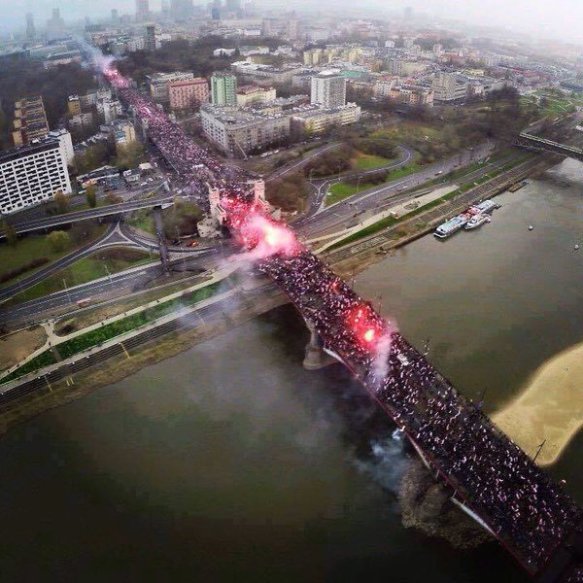
“Polish patriots marched against the Muslim invasion, biggest in the history of Poland. NOT ONE report in the MSM.”
Found here with text.
For the record, the RBA is now as useless as the rest of the central banks of the world. This is from Glenn Steven’s statement today. I have highlighted the best bits, the ones that show how dead in the water the economy is:
In Australia, recent data suggest that overall growth is continuing at a moderate pace, despite a very large decline in business investment. Other areas of domestic demand, as well as exports, have been expanding at a pace at or above trend. Labour market indicators continue to be somewhat mixed, but are consistent with a modest pace of expansion in employment in the near term.
Recent data confirm that inflation remains quite low. Given very subdued growth in labour costs and very low cost pressures elsewhere in the world, this is expected to remain the case for some time.
I will only add that so long as we have a Prime Minister and Treasurer who think the NBN represents good policy and will contribute to growth, we will be living in an economy that is going nowhere.
It’s from a journalist at The Canberra Times (via Andrew Bolt) so you can see why these are listed as positives for a PM:
Good taste in clothes and art, a beautiful speaking voice, a stellar resume, connections everywhere, and politically correct opinions on almost everything made him Abbott’s perfect foil but, so far at least, these qualities have not been enough to make Turnbull a good prime minister.
Only a journalist might think that they would or could. This is how the story starts:
There were three items for the first meeting of the new Turnbull cabinet: the cliff-hanger federal election, the response to Four Corners’ teenage detention revelations, and Kevin Rudd. And so the Coalition government has started as it seems doomed to continue: reacting badly to events and to other people’s agendas.
I cannot say any of this comes as a surprise, specially the cliff-hanger election.
From Tim Blair
How dangerous would Hillary be as president. This dangerous:
“In my first 100 days, we will work with both parties to pass the biggest investment in new, good paying jobs since World War II. Jobs in manufacturing, clean energy, technology and innovation, small business, and infrastructure.”
If this kind of cross between Keynes and Alinsky doesn’t worry you, you don’t know when to be worried. And that is the least of my concerns about what a third Clinton presidency will include.
For another take, you can try Roger Simon on America’s First Major Socialist Party Debuts in Philadelphia. Guess which party that is.
Meanwhile, Trump may have his nose ahead in the polls but he will have to win by a lot to overcome the vote early, vote often approach taken by the residents of local cemeteries.
And having discussed Valerie Jarrett the other day, I find her mentioned at The American Thinker in an article on Valerie Jarrett was our First Female President. I will only add here to what I have already discussed, and begin with this, weakly put though this is:
She arguably has more influence over Obama than anyone with the possible exception of Michelle Obama herself.
This is followed up by the following quote which comes closer:
Her influence is shown by an account in Richard Miniter’s book “Leading From Behind: The Reluctant President and the Advisors Who Decide for Him.”
It relates that at the urging of Jarrett, Obama canceled the operation to kill Osama bin Laden on three occasions before finally approving the May 2, 2011, Navy SEAL mission. Seems she was concerned about the possible political harm to Obama if the mission failed.
Miniter writes that the president canceled the kill mission in January 2011, again in February and a third time in March, in each instance at the urging of Jarrett.
Miniter cites a source within the Joint Special Operations Command who had direct knowledge of the operation and its planning.
Edward Klein, author of the best-selling book about Obama, “The Amateur,” once asked Obama if he ran every decision by Jarrett, and the president responded, “Absolutely.” A former foreign editor of Newsweek and editor of the New York Times Magazine, Klein describes Jarrett as “ground zero in the Obama operation, the first couple’s friend and consigliere.”
Another quote:
Obama has said he consults Jarrett on every major decision, something current and former aides corroborate. “Her role since she has been at the White House is one of the broadest and most expansive roles that I think has ever existed in the West Wing,” says Anita Dunn, Obama’s former communications director. Broader, even, than the role of running the West Wing. This summer, the call to send Attorney General Eric Holder on a risky visit to Ferguson, Missouri, was made by exactly three people: Holder himself, the president, and Jarrett, who were vacationing together on Martha’s Vineyard. When I asked Holder if Denis McDonough, the chief of staff, was part of the conversation, he thought for a moment and said, “He was not there.” (Holder hastened to add that “someone had spoken to him.”
Jarrett holds a key vote on Cabinet picks (she opposed Larry Summers at Treasury and was among the first Obama aides to come around on Hillary Clinton at State) and has an outsize say on ambassadorships and judgeships. She helps determine who gets invited to the First Lady’s Box for the State of the Union, who attends state dinners and bill-signing ceremonies, and who sits where at any of the above. She has placed friends and former employees in important positions across the administration — “you can be my person over there,” is a common refrain.
And Jarrett has been known to enjoy the perks of high office herself. When administration aides plan “bilats,” the term of art for meetings of two countries’ top officials, they realize that whatever size meeting they negotiate — nine by nine, eight by eight, etc. — our side will typically include one less foreign policy hand, because Jarrett has a standing seat at any table that includes the president.
Obama is a cypher of no account other than he can be elected. If you wish to understand what has mattered, following Jarrett and her circle will give you a far better understanding of who the Americans have been governed by and the principles, as such, that have guided what they have done.
It is one thing to recognise that no political vehicle is perfect, it is quite another to reject someone who goes most of the way with you because he doesn’t have everything you want. Donald Trump has no political history, no past set of political judgements to assess him against, and there is no certainty how he will act in any particular set of circumstances. But I don’t worry about renegotiating trade arrangements, I am not worried that he will start some war by accident and it never crosses my mind that me will renege on his stated aim to close the American border and restrict immigration. He is also more likely than anyone to take on the most dangerous issue of our time which is the jihadist rampage across the West.
Meanwhile, we have Niall Ferguson in a particularly vacuous article titled, Paranoid Republidents for Trump. You would think that given his previous concerns about immigration, he might at least lean towards Trump for President. If he believes any of what he has written here, he is instead among the shallowest of our current commentators on Trump’s run for the president who has no idea how to achieve anything he says he wishes to see achieved. He is, by the way, Mr Aayan Hirsi Ali and this is what he has to say:
Trump’s acceptance speech was a ghastly masterclass in what Richard Hofstadter more than 50 years ago called “The paranoid style in American politics.” As Hofstadter summarized it, the paranoid view was that “the old American virtues have already been eaten away by cosmopolitans and intellectuals; the old competitive capitalism has been gradually undermined by socialistic and communistic schemers; [and] the old national security and independence have been destroyed by treasonous plots.”
The paranoid worldview verged on the religious: “The paranoid spokesman sees the fate of conspiracy in apocalyptic terms. . . . He is always manning the barricades of civilization. . . . Like religious millennialists, he expresses the anxiety of those who are living through the last days.” Yet even as he denounces the corrupt, cosmopolitan elite, the political paranoiac is implicitly expressing a kind of attraction. He hates intellectuals, yet he provides extensive footnotes.
This — including the footnotes, 282 of which the Trump campaign supplied on Friday — is about all you need to know about Trump’s acceptance speech. It was all here, beginning with the conspiracy theory. “America is a nation of believers, dreamers, and strivers,” yelled Trump, “that is being led by a group of censors, critics, and cynics. . . . No longer can we rely on those elites in media, and politics, who will say anything to keep a rigged system in place.”
“Big business, elite media, and major donors” were backing Hillary Clinton, Trump declared, “because they have total control over everything she does. She is their puppet, and they pull the strings.” As a result, “corruption has reached a level like never before.”
For me, adjusting for the typical rhetorical flourishes that are the basics of political discourse, there is nothing there that seems exaggerated. But if you cannot see how dangerous a Clinton presidency would be, even if you think of her as the lesser of two evils, then your ability to make sound political judgements is running on empty.
Found at Five Feet of Fury which even has a link to this.
 Law of Markets