Amazing.
Via Tim Blair. And two more from Andrew Bolt.
And then this.
Apparently the work of Huw Parkinson a true genius with his politics just about right (so far anyway). And now this:

Amazing.
Via Tim Blair. And two more from Andrew Bolt.
And then this.
Apparently the work of Huw Parkinson a true genius with his politics just about right (so far anyway). And now this:
A caller to Alan Jones at 2GB yesterday on the “mongrel leftwing scumbags” at the Whitlam funeral. Barb is the perfect name. She’ll be back whoever she (he) is.
Because they are cowards, because they are ideologically red to the core, because they are inveterately dull witted and because they are afraid that their cherished beliefs will be shown to be absurdist lies. And you who watch and listen to the ABC’s biased lies, why do you watch or listen unless your aim is to avoid and evade coming to terms with your own vacuous beliefs which cannot stand up to decent debate. And as for you in the government, why do you put up with it? The ABC is biased in every important respect against everything Australia ought to stand for? Why is it not being downsized and made to raise the funds it needs from those who wish to listen to it or watch its programs.
The news comes thick and fast, Clive Palmer folds, admits key date falsified over China funds:
CLIVE Palmer signed and executed a document that he falsely backdated by 11 months to provide an explanation for his siphoning of $12 million in Chinese funds for his own use.
The document, titled “Port Management Services Agreement’’, has been previously described as a “sham transaction” and a fabrication by the Chinese government-owned companies which accuse the Palmer United Party leader of dishonesty and fraud.
The Weekend Australian can reveal Mr Palmer now admits the key document, which came from his company, was not created on June 1 last year, the date next to his signature on the paperwork.
Mr Palmer admits in his formal legal defence, filed in the Supreme Court in Brisbane, that the document was created 11 months later, in April or May this year. This means the document was produced long after he took the funds, which bankrolled the PUP into the federal election in September last year. . . .
The acknowledgment by Mr Palmer that the document was falsely dated will raise further questions in his Supreme Court civil trial this month about who backdated it and whether the intent was improper. The Citic Pacific-owned companies seek declarations including “that Palmer dishonestly procured or was involved in” a breach of trust, and that he knowingly assisted the company he controlled, Mineralogy, “in its dishonest and fraudulent breach of trust”.
But there are two sides to every story:
Mr Palmer’s defence, which was filed on Thursday, admits the budget made no such provisions, and that he authorised the payments of $2.167m and $10m. Mr Palmer denies he acted fraudulently or dishonestly. His defence insists he “did not know that the funds in the bank account were trust funds — if it be the case, which is denied …”
Politics is such an entertainment I don’t know why anyone bothers with Game of Thrones.
My favourite folksong when I first came to Oz. A great tune which ended up as the theme for the series “Rush”. It’s about mining in Queensland and searching for gold and things like that. It just sort of came to mind for no reason I can think of.
Old Palmer Song
The wind is fair and free, my boys, the wind is fair and free
The steamer’s course is north, my boys, and the Palmer we will see
The Palmer we will see, my boys, and Cooktown’s muddy shore
Where I’ve been told there’s lots of gold, so stay down south no moreChorus
So, blow ye winds, heigho
A-digging we will go
I’ll stay no more down south, my boys
So let the music play
In spite of what I’m told
I’m off in search of gold
I’ll make a push for that new rush
A thousand miles away
I also came across this looking for the above on youtube which is “The Old Maid’s Song” this time sung by someone named Clive Palmer. Have I mentioned that as part of my life on the left, I learned to play the banjo like all good children of comrades and naturally from Pete Seeger’s instructional manual. This is a great tune and well done but by today’s standards very non-PC.
UPDATE: As pointed out in the comments, the theme song from Rush was written by George Dreyfus but there ought to be no doubt that he was taking it from “The Old Palmer Song”. Lots of composers drew on folk song tradition. Here is Dreyfus’s version. And please do note the lovely sounds of the banjo.
FURTHER UPDATE: Again pointed out in the comments that the tune comes from an English sea shanty. But the “Ten Thousand Miles” of the title are about a lad who follows his true love off to Australia after she’s been shipped out as a convict. And if you go into this link on the history of the tune on disk, you can see a number of versions of the lyrics and one more video of the song being played. But if you are in England, the only place Ten Thousand Miles Away is Botany Bay so it may really be ours after all.
ABSOLUTELY FINAL UPDATE: Turns out it is neither a folk song nor a sea shanty but an music hall song from the nineteenth century which even comes with the name of the person who wrote it. I missed this on the discography I linked to before.
Written for the Music Hall by Joseph B. Geoghegan (1816-1889). He was born in Barton upon Irwell, Lancs, and probably wrote his songs while manager of the Star and Museum Music Hall in Bolton. More usually known as Ten Thousand Miles Away, it’s found—though infrequently—all over the English-speaking world, with 47 Roud entries.

This is already an old story, from the SMH on October 11. It’s heading is quite straightforward, Chinese investors are pushing into Melbourne and Sydney. And the text of the article is also pretty clear:
Chinese investors are aggressively lifting their Australian residential and commercial real estate investment.
And then there was this on October 15, Foreign buyers snap up one in six new Aussie homes:
Foreign buyers are flocking to buy Australian property, snapping up one out of every six new homes – and that number is set to get higher.
Foreign demand for new homes surged in the September quarter and is tipped to rise further next year, according to the National Australia Bank’s latest residential property survey.
Overseas buyers accounted for almost 17 percent of total demand for new properties and in Victoria, they accounted for almost 25 percent, or one in four new homes, the report said.
Foreign buyers were also more active in the established property market last quarter, accounting for eight percent of demand.
Again, Victoria led the way, with foreigners accounting for a record high 11.5 percent of established property demand, the report said.
If you are of the opinion that none of this is pushing house prices up and keeping people like my sons out of the market, then you need to brush up a bit on supply and demand. But what has added to my dismay at all of this you may find in this story from The Age on Monday, Corrupt Chinese in AFP sting. Here’s the bit that matters:
The manager of the AFP’s operations in Asia has confirmed Australia has agreed to assist China in the extradition of and seizure of assets of corrupt officials who have fled to Australia with illicit funds running into the hundreds of millions of dollars. . . .
“As time goes on, they start to put [their funds] into legitimate assets such as houses and property”. . . .
The sums of money believed to have been spirited out from China are staggering. The Washing-based Global Financial Integrity Group, which analyses illicit finalcial flows, estimates that $US3 trillion left China illegally between 2005 and 2011.
Some of that money is coming here and it doesn’t take much of a slice of all of that to make an impact on our housing market. It is ridiculous that we haven’t done something ourselves before now, but with the Chinese now seeking to get their money back there may at least be a start.

I was in my first year in Australia and in transition from left to right at the moment Gough was dismissed by the Governor-General. Not long before I had been astonished at my own lack of enthusiasm for the fall of Saigon to the North Vietnamese which was something I thought I had cared about and wished to see. Instead, it left me feeling hollow and uncertain. It was also the year that I came upon Hayek’s Road to Serfdom in the College library at Bendigo and G.L.S. Shackle as well. Nevertheless, I thought Bill Hayden’s budget was very good, being still Keynesian in my outlook. And as a Canadian who had been brought up on the principles of the King-Bing affair, which meant governors-general did not dismiss Prime Ministers, I thought Kerr’s decision was fundamentally wrong, and indeed, in the light of history could never happen again. If a PM has control of the House, the PM remains the PM. But he was nevertheless a bad Prime Minister who has left a bad legacy behind, and it is only the blurring of the years that may have created the impression that Rudd and Gillard were worse. This was put up at Catallaxy by Sinclair and it really does tell a story.
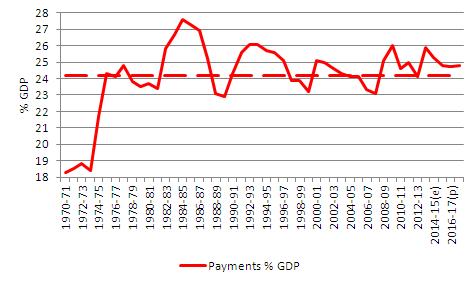
And the only thing that saved Medibank from becoming as disastrous as the English or Canadian systems is that Malcolm Fraser found he couldn’t get rid of it so he merely legislated so that everyone could use their Medibank levy to buy private insurance instead if they preferred. It is why we have the best system in the world because you can be in the public system and get reasonable care or you can pay your own way and get better care, with the dual form of funding attracting more resources into the health care system in total than either on their own would do.
De mortuis nil nisi bonum. OK. I will therefore say he was not worse than Rudd-Gillard which his friends will think of as all right and my friends will know perfectly well what I mean. The cartoon, by the way, is from The Guardian. It apparently is intended to be respectful so I think I can have it here as well. But “to show us what was possible” as an encomium to Gough is about as clueless a line about a failed politician as you are ever likely to see.
Here’s why we should go nowhere near amending the constitution. These are the opening words of a story in The Australian today on constitutional change:
AUSTRALIANS want to address inequality in the Constitution . . .
We are now such a low grade constituency who cannot tell the difference between setting up the rules for governing ourselves and fixing some particular problem that captures our fancy at the moment. I can hardly think of anything that has less place in a constitution than trying to make ours a less unequal society. Merely raising the spectre of such a divisive question as a constitutional matter makes me very nervous about how capable we now are of dealing with such a serious issue in a serious way.
I have just reached home and happy I am to be here but I must say seldom has any trip of mine been so complete. All my interests – economic, political and historical – came together so seamlessly that I only wish life was always like this.
Economically, the meeting on J.-B. Say and the Entrepreneur was an outstanding success. This being the first such meeting, it is of major significance that there is a casting about for some kind of successor paradigm to the fault-ridden neo-classical synthesis so accurately represented by Paul Krugman and Joe Stiglitz. As just a minor point, what became evident is that economists are useless at predicting the future so have substituted GDP estimates for actually knowing anything at all about the economy. If I tell you that Australia over the past twenty years grew by 50% and China by 150%, you would not have any idea about what either was really like, the kinds of economy each is or what is actually going on. Economists have substituted statistics for actual knowledge. It is all pretty useless, but if your aim is to pull wool over people’s eyes about what is taking place, GDP is a great number since it is almost meaningless as a statement about anything of significance.
Politically, it has been amazing to be here for the transition to a more market-oriented socialist Prime Minister. Every country is a hopeless case since the freeloaders have now overrun the productive. But if you are trying to manage the place, even the most dense political leader trying to re-engineer a recovery cannot help noticing that only those who make a net contribution to output actually create more value than they use up. A tremendous amount of capital to run through in our Western economies, but we are managing to do it. Fascinating to see it all in action in a place you would not normally expect it.
Historically, there are two sides to it. In relation to why I am here, I am part of a group that is trying to save Jean-Baptiste Say’s factory in Auchy-les-Hesdins for posterity. There are not many – any – places in the world that are actually historical sites in which economic issues are at the forefront. Auchy is astonishing in that it combines an ancient cotton mill – where the waterfall that ran the mill can still be seen – with the writings of one of the greatest economists of all time. If you are in France in the north-west around Calais or Normandy, and you have any interest in these things at all, you must come visit. The website I am told is coming but you should see it for yourself. The best way to describe the positioning of Auchy is to note that it is half way between Azincourt and Crecy. See all three, but if you have an interest in economics and its history, this place will astonish you. There is nothing like it on the planet and, as with everything related to Say, is only now in the process of being rediscovered.
Lastly there has been my following the trail of historical battles, with the last few days on the WWI battle fronts. Went to Villers-Brettoneaux yesterday which is the Australian Vimy Ridge. Very moving places both of them. Two things I found particularly noteworthy. The first was the direction finder in the tower pointing out various places of significance on the Somme battle grounds. But amongst the 20 miles to this and 30 miles to that was the arrow that pointed to 14,235 miles to Canberra. It was a long way from home for those young Australians who lie buried in the fields of France.
The other was a grave to some young lad who died on this battlefield in 1918. His name was S. Keates. It was quite a strange moment. It is truly the case that there but for the grace of God go we all.
Let me dwell on the first para of this story in the AFR today titled, Abbott’s plan to axe RET:
The federal government is moving towards abolishing the Renewable Energy Target rather than scaling it back in a move that will cost almost $11 billion in proposed investment and which is at odds with the views of its own Environment Minister.
Let’s parse this sentence bit by bit.
Scaling back the RET is described as “a move that will cost almost $11 billion in proposed investment”. “Investment” is one of those hurrah words so that anything that can be described as investment is automatically given a warm reception. What cutting the RET will actually do is cut almost $11 billion dollars of waste. Eleven bil on more windmills and solar panels would not get you back ten cents in the dollar. Stopping such expenditure dead in its tracks will only promote future economic growth, or at least it will if the government doesn’t decide to spend the money itself in some other totally useless way.
The second bit is that this decision “is at odds with the views of its own Environment Minister”. This, alas, is one of the great problems with the Coalition. It really is a coaltion. Labor is too, but it’s a coalition of the left, the far left and the loony left, each branch of which could comfortably fit into the Greens. The Coalition is made up of conservatives, small-l liberals, libertarians, the centre right and the centre left. The centre left as it happens overlaps the Labor left and could also comfortably fit into the Greens. The centre left is a very strong tail that wags the dog.
I, however, and most others who voted for the Coalition did not seek to preserve the Green legacy of economic ignorance, nor for that matter did we seek to maintain the Martin Parkinson/Ken Henry school of Keynesian economic mis-management.
Here is the message: DO NOT SPEND MONEY ON ANY SINGLE INVESTMENT THAT WILL NOT OF ITSELF AND ON ITS OWN PROVIDE A POSITIVE RETURN ON FUNDS EMPLOYED IN A REASONABLE PERIOD OF TIME (LET US SAY THE NEXT THREE YEARS). If you can’t see a return, and prove it in a published cost-benefit study, don’t do it.
I don’t say you shouldn’t provide welfare. By all means provide welfare. Let us look after the sick, the aged and the disabled. But here, since the demands are near infinite, judicious allocations of funds will be required. But while welfare expenditures may be important for those who are unable to work or are too old to work, none of these expenditures will promote economic growth and future prosperity.
We do not have an infinite pool of productive resources. We must prioritise. Removing renewable energy targets is pure profit for the economy, a 100% benefit. So would getting rid of paid parental leave. Get rid of them both at once. I wish the NBN was also up for grabs since getting rid of it would also be a net positive.
And I should finally mention since I am throwing it all into the pot, do not raise taxes on anything in any part of the economy. If the kinds of revenues you are in receipt of are insufficient to pay for everything in the basket, then take some things out of the basket.
The Coalition’s Labor Left is a heavy burden that is weighing down good decision making.
 Law of Markets