Small mercies

No doubt we should be grateful for small mercies. Malcolm is gone, although not gone all that far, and that is something. Scott Morrison is a step up, but lacks either gravitas or the charismatic glow. Perhaps we will be surprised, but I won’t be surprised if we’re not surprised. But he can win the next election and I most assuredly hope he does.

But what has been the most disturbing part of the day’s events were the 40 votes cast against the spill. It is possible the number was made up to save a bit of face for Malcolm. On the other hand, it really may reflect the attitudes within the party room. It would mean near enough half the Liberal Party is made up of Keynesian central planners who think they can spend our money better than we can, and who see themselves at the centre of the economy by dispensing billions towards their favourite projects. These same people wonder why productivity growth has come to a stop. Economic illiterates, but then most economists are as well. No idea how a decentralised economy causes growth almost without effort. They did it themselves under Peter Costello who made the economy hum by savage cuts to public spending and the easing of some of the burdens placed on businesses by governments. You can see the same result in the US right now, but no one here or there sees the cause and effect relationship between freer markets and economic prosperity.

The 40 votes against the spill also suggest that a large part of the party accept that global warming is such a major and pressing problem that it is worth wrecking our economy and our productive base to do what they can to ward off this phantom catastrophe. For myself, anyone who entertains this possibility at this late date is a credulous fool of the highest order, basically a simpleton without a shred of common sense. We sell our coal which gets burned up in a far more polluting way than if we used “clean coal” ourselves. And whether or not we stopped selling coal in an act of suicidal idiocy, the CO2 levels will do whatever they will do with our sacrifice or without. Meanwhile more and more Australians will freeze in the dark as the power bills go up.

The Libs plus the Nats remain better than Labor, and Morrison does at least have form in having stopped the boats and does apparently want to cut back on public spending. And all those folk who think letting Labor have a go while the Libs rejig themselves are the worst fantasists of all.

We must all live in hope, but as they say, hope is not a policy. We shall see.

Tony Abbott for Prime Minister

I just spent the afternoon re-reading Tony Abbott’s outstanding Battlelines, his 2009 tract on political philosophy. It reads better now than when it was first published.

We are about to have a race between three mediocrities to replace a non-entity, with Tony standing on the sidelines. The Libs have a proven vote winner who was sandbagged from his first day in office by an incompetent Minister who wanted the job for himself, and when he had it, drove the party into the ground. Now there will be one more try to get it right.

Abbott understands the major policy issues of our time, and he stands on the right side of history. Not everyone will see this as a positive, but he is our Donald Trump. The left hates him, and rightly, because he sees through everything they have tried to do and wish to do. The left are the party of Venezuela, decay and ruin. Tony Abbott, with a cabinet onside with his fundamental liberal-conservative philosophy, is far and away the best hope we have for renewal, growth, prosperity and freedom.

Tony, please run. And as for the rest of you in the party, restore as your leader the only person in Parliament with the stature, the knowledge and now the deeper understanding of politics to lead.

The purity wing of the political right

Here’s how it is. The only president on our side of the fence is Donald Trump, just as the only Prime Minister on the Liberal side is Malcolm Turnbull. All present alternatives from other political parties are worse, much worse.

With Donald Trump, thus far he has not tried to do anything I disagree with. He gets it on open borders, public spending, climate change, the Middle East, China, our Nato allies, Brexit and just about everything else. I am not even in the slightest concerned with his personal style, and I love his twitter feed which is a wonderful addition to public discourse. The only reservation I have had was that he was concerned about rising interest rates, but this is a technical thing, and about which in my own view higher rates will stimulate growth since it will reduce the proportion of our savings going towards unproductive projects. On this I am not going to make a fuss, and about everything else I am with him 100%. On tariffs, I am generally in favour of free trade, but only among nations in which cheating on their obligations is not the rule but the exception. I am also pleased to see trade issues being used to achieve foreign policy outcomes, such as the pressure being put on North Korea and its allies to get rid of its nuclear weapons.

About Malcolm I have had my doubts in the past but he is the PM and he leads a party who are generally speaking on my side of things, far more than the people anywhere else. I wish him success, and in that I wish even more success to those members of the party holding their cattle prods to induce the PM to do the right thing. His instincts are generally terrible, but he seems pretty sound on stopping the boats, and seems to be getting the message about population growth. He even seems to be seeing the light about coal-driven power stations. I want him to win the next election, and my preference is not marginal but overwhelming. Lots of things I don’t like about Lib-Nat policies at the moment, but while selling the pass in some areas they are still well in front so far as my own agendas are concerned. I just wish they would become more of a entrepreneurial party – cut down their own spending and reduce business regs much much more than they have, but you can’t always get everything you want.

At Freedomfest I met up with many many people with whom I could agree on things almost totally across the board, a very rare experience but an immense pleasure. But the minute I walked out of the conference venue, there I was in the middle of Las Vegas among people for whom none of that would be true. Not that they wouldn’t necessarily agree with me if they thought about things. But that they never think about these things so don’t agree with my views mostly because CNN got to them first and with better production values.

I am not and never have been a member of the purity wing of the right side of the political divide. I worked in policy far too long to even begin to hope to see things done as I would wish most of the time. Democrats and socialists are a lost cause, same again with the #NeverTrump wing of the so-called right. They are political fools and a danger to us all. On our side there are many points of view, even people who think climate change is a genuine issue that needs urgent attention.

But I do have to say that if you do not see the virtues in the miraculous election of Donald Trump as president, you are a political fool of the highest order. Your opinions are dead to me since as far as I am concerned, you are as big a political dimwit as I can possibly imagine.

The wages of waste

Personally, I care not at all about the headline issue: At $528,000 a year, Turnbull’s pay is highest of any leader in OECD. PDT is not taking any salary at all so the price mechanism doesn’t always reflect relative value in any absolute sense. But this is what interests me:

The figures come as the Reserve Bank warns Australians to expect historically low levels of wage growth for some time yet, setting up a policy showdown with Labor before the next election over efforts to tackle the rising cost of living.

Both are trying to ameliorate the impact of torpid wage growth through offering billions of dollars in income tax cuts.

Workers have been starved of pay rises in real terms, with wage growth stuck at the rising cost of living for the past year. Inflation hit 1.9 per cent in March and private sector wages have barely kept up at the same rate but public sector workers have done better, lifting the rate to 2.1 per cent Australia-wide.

The reality is that both parties are deeply into Keynesian idiocies with some kind of belief that public spending makes an economy grow. I am not all that fussed about the deficit as such, but am very much concerned with the level of public spending which is almost invariably wasted. For every dollar spent, you get less than a dollar’s worth of value, often much less. That is why real wages don’t rise, and until that changes, real wages won’t either.

PDT understands that. Does anyone else?

How the Libs can win and where Labor will never follow

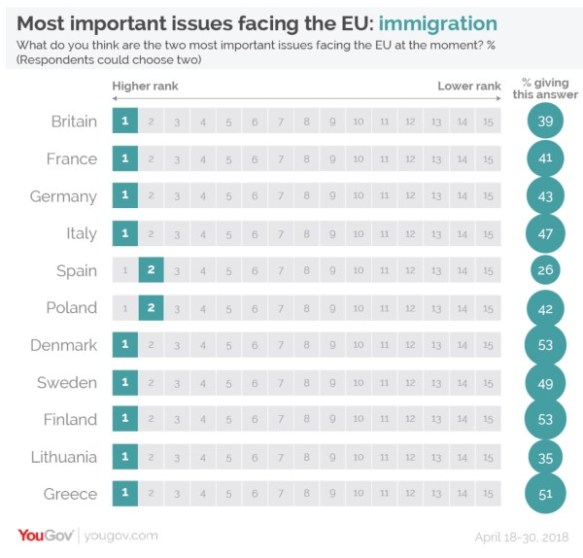
There are certain political observers who would have seen Labor elected in 2016 to teach the Libs a lesson, but I have to say the thought still terrifies me. There are then those in the Coalition who believe that their superior economic management will make all the difference, a notion so absurd I cannot believe that they actually believe they have their finger on the pulse of the nation. So let me draw their attention to the above, which I picked up via Steve Hayward on Powerline, who heads his post: Gee – I wonder if it might be immigration?

This is where their winning break can and will come from, and I am at least comforted that Peter Dutton is such an excellent Minister and is supported by the Prime Minister. And on this Labor will never follow, because their strategy is to bring in an entirely new cohort of citizens on whom Labor will be able to depend.

I can see there’s a consensus building for the next departure from the HRC

Let us begin with Tim Blair in a post he titles, Finest intro ever written:

Daily Telegraph colleague Miranda Devine makes several strong points in her latest terrific column. Let’s take a detailed look, starting from the top:

Race Discrimination Commissioner Tim Soutphommasane’s term expires in August …

Actually, although there are no doubt many strong points, I wasn’t able to read anything beyond that opening line due to tequila shots.

So following from Tim and Miranda, let me take you to Frank Chung: For $340,000 a year, we deserve better than Race Discrimination Commissioner Tim Soutphommasane which has as its subhead:

AUSTRALIA’S race discrimination commissioner has lamented the “dismal” fact that there are too many white people in top positions.

I will leave you with Frank’s last two paras:

There may be many reasons for the lack of one-to-one population representation at the very highest levels of business and politics — but for the Race Discrimination Commissioner, when you’re a hammer, everything looks like a nail.

For someone who is paid $340,000 a year to come up with this dross, it’s not surprising the concept of meritocracy is a foreign one. Or is that being racist?


Coalition sense on IR

I imagine The Australian made this the first thing they told us about the new Deputy Prime Minister as a kind of negative point, but this is something that’s long been missing from the Coalition:

Mr McCormack upheld the importance of unfair dismissal laws to “protect workers”, ­reflecting on his decision to take action against the Riverina Media Group over his departure from The Daily Advertiser in Wagga Wagga — a rural paper that he ­edited for a decade between 1992 and 2002 — ­declaring that he had been “wronged” by his former ­employers.

See the quotes around “protect workers”. There must be some notion that workers being wronged by their employer is so farfetched that it has no place within a government that is pro-market. So let me point out that being shafted by one’s employer is not exactly an unknown phenomenon and it’s a pleasure to see someone back inside the leadership of the Coalition who understands this. I worked for a quarter of a century as the Chief Economist for Australia’s national employer association in the middle of our industrial relations system – even presented the National Wage Case on three occasions – but it never crossed my mind that in arguing on behalf of business that I was acting on behalf of people who were always guaranteed to do what was ethically and morally right. You have no idea what rotten sods there are running businesses, although now that I think about it, I imagine most of you do.

Our unique system of industrial tribunals is in my view a large part of what has made Australia so economically and socially stable. The blind spot in John Howard’s period as PM was his war on our tribunals which in the end led to his introduction of WorkChoices as the core industrial relations legislation. Remember this?

In May 2005, Prime Minister John Howard informed the Australian House of Representatives that the federal government intended to reform Australian industrial relations laws by introducing a unified national system. WorkChoices was ostensibly designed to improve employment levels and national economic performance by dispensing with unfair dismissal laws for companies under a certain size, removing the “no disadvantage test” which had sought to ensure workers were not left disadvantaged by changes in legislation, thereby promoting individual efficiency and requiring workers to submit their certified agreements directly to Workplace Authority rather than going through the Australian Industrial Relations Commission. It also made adjustments to a workforce’s ability to legally go on strike, enabling workers to bargain for conditions without collectivised representation, and significantly restricting trade union activity. . . .

WorkChoices was a major issue in the 2007 federal election, with the Australian Labor Party (ALP) led by Kevin Rudd vowing to abolish it. Labor won government at the 2007 election and repealed the whole of the WorkChoices legislation by the Fair Work Act 2009.

That’s not to say there are no improvements to be made, but a return to WorkChoices is not one of them. Perhaps for a change someone has learned something from history. Good to see Michael McCormack take up his place and good luck to him.

How Turnbull made up with Trump

For the morons who wrote this story to imply that it was PDT who changed his tune and not Malcolm shows what an out-of-touch bunch of clowns they are: How Trump made up with Australia’s prime minister after a ‘most unpleasant call’. This bit is OK, however:

When Turnbull visits the White House today, February 23, it will mark a stark turnabout from his contentious row with Trump last January 28. The Australian leader has now become one of the U.S. president’s closest partners, as they work on issues ranging from the North Korean nuclear threat to infrastructure plans in their respective countries.

This, from the opening paras, is also OK:

On his eighth day in office, President Donald Trump blasted and badgered Australia’s leader over an immigration dispute, telling Prime Minister Malcolm Turnbull, “this is the most unpleasant call,” and then abruptly hanging up on the head of one of America’s staunchest allies.

But what is not OK is to imply that it was PDT who had seen the error of his ways. Here’s the reality.

Turnbull has never had the slightest feel for politics, has no evident ability to assess things from a conservative perspective, assumed from the start that PDT would be a failure and expected those on the right side of the political divide in Australia to support his disdain for the President. Wrong on all counts. What his reation to the election and his initial conversation with the President did instead was reinforce the disdain from everyone Turnbull counted on for support, who never gets anything right. Other than being the nominal figurehead Prime Minister, he has only limited authority over those who the Liberal-National parties are counting on to vote for them. That his own party, plus a twelve-month series of Trump successes, has made him change his tune is proof only that he wishes to be Prime Minister some more.

It is also more evidence of what a success PDT has actually been.