Harriet Taylor as she would be today

harriet taylor up to date

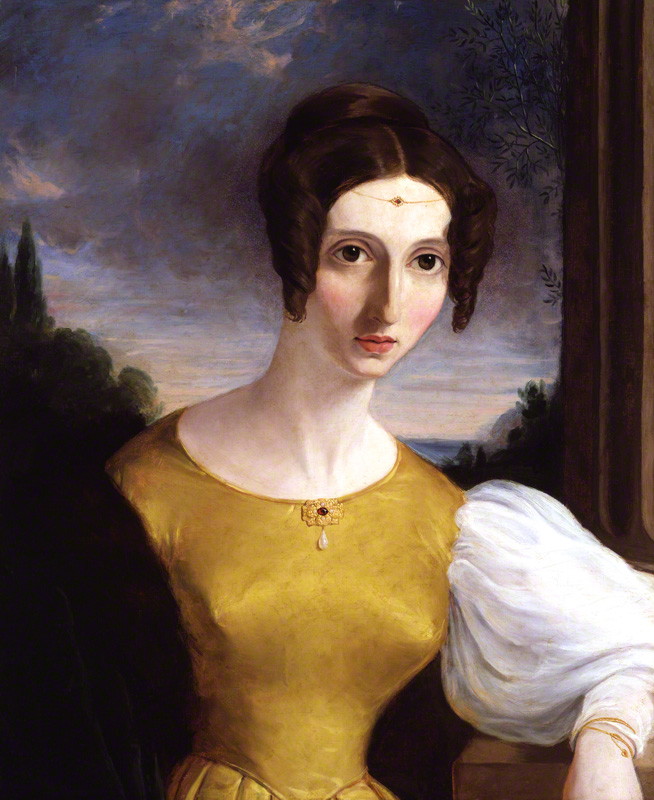
The picture has nothing to do with the story other than it was an ad on the New York Review of Books site where I was reading a review of Hayek on Mill: The Mill-Taylor Friendship and Related Writings (The Collected Works of F. A. Hayek) which has been edited by Sandra Peart and just released. Yet when I looked at the picture, I wasn’t sure that it wasn’t meant to illustrate the story. If Harriet Taylor were alive today, that is what she would be like. Below is what she was really like.

NPG 5489; Harriet Mill by Unknown artist

And while we’re at it:

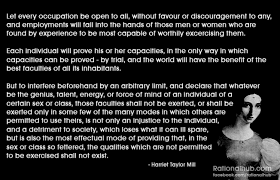
harriet taylor mill on feminism

This is what I think too, and perfectly stated.

Check your privilege

There are some amongst us who, it seems, are able to do better in life because of the advantages that our in-built and inherited characteristics give us. This is a privilege meter that will determine just how privileged you are based on various characteristics.

If I understand the notion, those who have such privileged positions in life should have whatever advantages we have eroded by wealth transfers along with other encumbrances to our enjoying our privilege. If you are pretty, for example, you should perhaps be prevented from wearing make-up.

The meter conveniently puts the various characteristics in order from the most privileged to the least so you can see what they consider are the dregs of society.

The one category left out is to ask whether you think such a scale is “insane” through to whether you believe it to be “absolutely valid in every detail”. If you are able to understand that the people who take these things seriously are bonkers, you obviously have an advantage in life over those lower down the scale.

[From Tim Blair]

Common decency and the Australian Prime Minister

This is part of a story on a murder investigation, but the alleged murderer turns out to have been part of a past incident with our Prime Minister. This is another side to the PM, who is vastly under-appreciated, especially by people who are nothing like him in their common decency.

The man . . . punched Prime Minister Tony Abbott in the face nine years ago.

Mr Abbott was visiting the Thomas Embling [Psychiatric] Hospital on February 22, 2006, in his capacity as Federal Health Minister when he was attacked in the hospital’s acute care unit. . . .

Media reports of the incident say Mr Abbott was hit twice, without warning.

In an interview with an Age journalist . . . Mr Price said that he was the man who hit Mr Abbott, adding that the incident had given him “new respect” for the man who would become Prime Minister.

“I hit him and he stepped back and shaped up like a boxer,” Mr Price said.

“Then he dropped his hands and smiled, and said ‘I’ve been hit harder than that on the football field’.”

Mr Price, who remains in custody, said he had admired Mr Abbott’s self-control, saying not many people would have been able to refrain from hitting him back.

Mr Price’s story has been confirmed by a psychiatric nurse who worked at the Thomas Embling at the time of Mr Abbott’s visit.

“Much to Mr Abbott’s surprise, he realised there was no security operating in the hospital as such,” he said.

Mr Abbott was reported at the time of the attack as joking that “some people probably thought he had a sane moment”.

A spokesman for Mr Abbott said at the time that it was “a matter of complete inconsequence”.

“(The man) did take a swing. He did connect, but to say he punched him is overstating it,” the spokesman said.

[Via Tim Blair]

Open borders idiocy

If you would like some idea of why I will never count myself a libertarian, here is one of the most important. This is a newsletter from the CIS titled, Open the Borders.

March 16 is unofficially ‘Open Borders Day’, drawing attention to the moral and practical case for more movement of people across national borders. It refers to the presumption that people should be able to move freely – the burden of proof lies on those who favour restrictions.

Apart from the ever-present issue of asylum seeker and refugee policies, and stoushes over 457 visas, immigration policy largely flies under the radar. This a positive by-product of a relatively bipartisan consensus on immigration benefits, but also means creative thinking in this area is lacking.

There has been a largely unremarked shift in the government’s rhetoric. Michael Pezzullo, secretary of the Department of Immigration, Customs, and Border Protection, (the delineation of these three functions is indicative) has said mass migration is a mission “long accomplished”, describing the department as a “gateway”, and emphasising the border.

The Howard era approach – where a deterrence narrative for asylum seekers sat comfortably alongside a welcoming attitude to immigrants – appears to be going out of fashion.

Due to the budget pressures outlined in the Intergenerational Report, which can be ameliorated by higher levels of immigration, a substantial restriction in immigration policy is unlikely. But it’s also worth asking why, then, scant attention is being paid to it outside the government’s latest plan to crack down on 457 visas.

Given the government has had much success in negotiating freer movement of goods across borders, it could also be successful in negotiating freer movement of labour, particularly with countries such as the United Kingdom, Canada and United States, in a manner similar to the arrangement with New Zealand. The Mayor of London, Boris Johnson, has expressed interest in the idea.

The Productivity Commission has suggested changes to visa conditions to make it easier for live-in au pairs to stay with a family longer than six months, and another suggestion involves allowing Indonesian women to live and work in Australia as nannies, as a partial solution to the problems plaguing childcare.

These are the kind of innovations that could revitalise discussion around immigration policy. It shouldn’t continue to fly under the radar.

There is, as it happens, not a single good economic reason for opening our borders, with the positively worst one of all some kind of Keynesian demand-side stimulus idiocy. There are no other good non-economic reasons for open borders either. Here we find the CIS lining up with Obama on possibly the single most important issue the US is facing. Immigration should be selective and the immigrant should be assessed very carefully by the country to which application is being made. Showing up on the border and asking to be let in should ensure someone is put at the farthest end of the back of the queue. Immigration may yet sink the West beneath a tide of newly arrived migrants who have no marketable skills and care nothing at all for the value system of the West.

A pragmatic conservatism within a capitalist economy

What we have at the link are Top 12 Most Libertarian Quotes by Barack Obama. It’s put up by Reason magazine which is a libertarian organisation. The quotes are from Obama, lying as usual. But the interesting part for me is that for half of what Obama said, I wouldn’t have agreed with his statements either given the context in which they were placed. Libertarian philosophy is about as far from reality as Marxism but from an anarchist set of presumptions.

We need governments and war will find you. A pragmatic conservatism within a capitalist economy armed to the teeth is all that I can think of as the way forward in this messy world of ours. That is not the values projected by these quotes from Obama, nor are we better off given the way that Obama ended up having lied about what he said.

It’s more than just a matter of words

I wrote this the other day but didn’t push the “publish” button. But with Andrew Bolt having put up a post today on The West attacked: killers to the right, ferals to the left, which begins with the sentence, “Islamists on the Right, anti-capitalists on the Left”, I will just have to buy in. The rest of this was written on Tuesday.

There are no two people in politics I agree with more consistently than Andrew Bolt and Peter Costello, so if I bring up one of Andrew Bolt’s posts in which both feature, it must be understood that I don’t disagree with a single point they make, only with the terms they use. Andrew’s post is titled, The Left now sounds just like the Islamist Right, in which Peter is quoted as saying:

Australia is one of the most successful, open, prosperous, accepting societies that the world has ever known. Being born here is one of the best things that could ever happen in a person’s life. That is worth explaining as part of immunising the young against the false political claims of extremists.

Andrew began the post with this where I will begin myself:

One of the most disturbing developments in public debates has been the Left giving cover to Islamists of the far Right.

There is, I must insist, no such thing as “Islamists of the far Right”. The right-left divide in politics is between those who value individual rights above collective rights and those who do not. The only person who ever correctly thought of Hitler as to his right politically was Joseph Stalin who introduced this notion into our political direction finder. To think of racists and extreme nationalists as part of the right is merely to defame those of us who see ourselves on the right, far or otherwise. It is we members of the right properly understood who almost alone have been willing to take the fight up to Nazis, fascists, communists and Islamists and have been able to do so without missing an ideological beat. To describe Islamists as “far right” wrongly aligns people such as ourselves with people such as themselves, and introduces a confusion of terms since the right-left divide then becomes less clear cut than it ought to be. No one on the right is ever described by those on the left as anything other than “far” right. To be on the right should be seen as a badge of honour.

Same with the word “conservative” who are people, again like ourselves, who find the open and tolerant society in which we live one we would like to see preserved, and therefore are very careful about the nature of change, and are never in any great hurry to see things radically altered. I am at one with Edmund Burke in believing in “the general bank and capital of nations and of ages”* as the great repository of common sense and social morality. It is being worn away as the left has continued its march through the institutions, but it has a powerful hold even still.

And then there is the quote from Peter, where he wrote, “the false political claims of extremists”. The word “extremists” is commonly used about Islamists. But calling Islamists “extremists” makes it seem that these views are well beyond some kind of norm, a thousand miles from the political centre. And so they are, if we restrict the frame of reference for other people’s political morality to our own view of things as found in our own culture, whose traditions travel back in time through to the British Isles and the values that have developed as part of our Judeo-Christian heritage. These are the great bequest we have inherited and we must do everything we can to defend this history from the ignorance of the fanatics in our midst. To call our enemies “extreme” is to misread how they think of themselves. They are perhaps on the more aggressive side of their own value set, but they seem to be far from “extreme” within the communities in which they live. The extremists in such communities are more likely to be the people who agree with us, the ones who would like to share in our own cultural tradition and make common cause with us. Even living here in a Western nation, it is still not easy for them, as the life of Ayaan Hirsi Ali has shown. The proper word to describe Islamists is “barbarians”. If the left chooses to side with them, that is what they are as well.

____________

*”You see, Sir, that in this enlightened age I am bold enough to confess, that we are generally men of untaught feelings; that instead of casting away all our old prejudices, we cherish them to a very considerable degree, and, to take more shame to ourselves, we cherish them because they are prejudices; and the longer they have lasted, and the more generally they have prevailed, the more we cherish them. We are afraid to put men to live and trade each on his own private stock of reason; because we suspect that this stock in each man is small, and that the individuals would do better to avail themselves of the general bank and capital of nations and of ages.” From Edmund Burke, Reflections on the Revolution in France, p 145.


Islamists are not on the “far right” and they are not “extremists”

There are no two people in politics I agree with more consistently than Andrew Bolt and Peter Costello, so if I bring up one of Andrew Bolt’s posts in which both feature, it must be understood that I don’t disagree with a single point they make, only with the terms they use. Andrew’s post is titled, The Left now sounds just like the Islamist Right, in which Peter is quoted as saying:

Australia is one of the most successful, open, prosperous, accepting societies that the world has ever known. Being born here is one of the best things that could ever happen in a person’s life. That is worth explaining as part of immunising the young against the false political claims of extremists.

Andrew began the post with this where I will begin myself:

One of the most disturbing developments in public debates has been the Left giving cover to Islamists of the far Right.

There is, I must insist, no such thing as “Islamists of the far Right”. The right-left divide in politics is between those who value individual rights above collective rights and those who do not. The only person who ever correctly thought of Hitler as to his right politically was Joseph Stalin who introduced this notion into our political direction finder. To think of racists and extreme nationalists as part of the right is merely to defame those of us who see ourselves on the right, far or otherwise. It is we members of the right properly understood who almost alone have been willing to take the fight up to Nazis, fascists, communists and Islamists and have been able to do so without missing an ideological beat. To describe Islamists as “far right” wrongly aligns people such as ourselves with people such as themselves, and introduces a confusion of terms since the right-left divide then becomes less clear cut than it ought to be. No one on the right is ever described by those on the left as anything other than “far” right. To be on the right should be seen as a badge of honour.

Same with the word “conservative” who are people, again like ourselves, who find the open and tolerant society in which we live one we would like to see preserved, and therefore are very careful about the nature of change, and are never in any great hurry to see things radically altered. I am at one with Edmund Burke in believing in “the general bank and capital of nations and of ages”* as the great repository of common sense and social morality. It is being worn away as the left has continued its march through the institutions, but it has a powerful hold even still.

And then there is the quote from Peter, where he wrote, “the false political claims of extremists”. The word “extremists” is commonly used about Islamists. But calling Islamists “extremists” makes it seem that these views are well beyond some kind of norm, a thousand miles from the political centre. And so they are, if we restrict the moral compass we use to judge other people’s political morality to our own view of things as found in our own culture, whose traditions travel back in time through to the British Isles and the values that have developed as part of our Judeo-Christian heritage. These are the great bequest of our cultural traditions and we must do everything we can to defend this history from the ignorance of the fanatics in our midst. To call our enemies “extreme” is to misread how they think of themselves. They are perhaps on the more aggressive side of their own value set, but they seem to be far from “extreme” within the communities in which they live. The extremists in such communities are more likely to be the people who agree with us, the ones who would like to share in our own cultural tradition and make common cause with us. Even living here in a Western nation, it is still not easy for them, as the life of Ayaan Hirsi Ali has shown. The proper word to describe Islamists is “barbarians”. If the left chooses to side with them, that is what they are as well.

____________

*”You see, Sir, that in this enlightened age I am bold enough to confess, that we are generally men of untaught feelings; that instead of casting away all our old prejudices, we cherish them to a very considerable degree, and, to take more shame to ourselves, we cherish them because they are prejudices; and the longer they have lasted, and the more generally they have prevailed, the more we cherish them. We are afraid to put men to live and trade each on his own private stock of reason; because we suspect that this stock in each man is small, and that the individuals would do better to avail themselves of the general bank and capital of nations and of ages.” From Edmund Burke, Reflections on the Revolution in France, p 145.
Yawn: another left-liberal critique of the US government but from an unusual source

Who do you suppose put together this far left liberal critique of the American system of government under the heading, “Fig Leaf: Outrageous Facts About US Congress and Super Pacs”:

This is where the legal absence of institutional checks and balances allows lobby groups, politics and money to come together on a scale that is not imaginable in any other country in the world.

The Senate and Congress are packed with wealthy people that are very rapidly becoming even wealthier. Their collective net worth is now measured in the billions of dollars.

But it is not that easy to get elected to Congress. Candidates have to be heavily connected to lobby groups like Wall Street, National Rifle Association, AIPAC, Military-Industrial Complex and those that are very wealthy. It takes a lot of cash to win campaigns.

The following facts are very difficult to believe but they are actually true. They show that Congress is all about money and lobby politics:

1. The collective net worth of all members is reportedly over 2 billion dollars. But it could be higher, as more than 50 percent are millionaires.

2. This is during a time when the net worth of most American households has declined.

3. The average net worth for a member is $3.8 million and counting.

4. The average cost of winning a seat in Congress is $1.1 million, while in the Senate it is $6.5 million. Spending on political campaigns has gotten way out of control.

5. Insider trading is legal for members, and they refuse to pass a law that would change that.

6. The percentage of millionaires in Congress is 50 times higher than the percentage of millionaires in the country.

There are lots of ways these politicians are raking in the cash. One way is making investments in companies that will go up significantly if legislation that is being considered “goes the right way”. This happens constantly and nobody seems to get into any trouble for it.

For instance, when it comes to the National Rifle Association, climate change deniers, Israel, Big Oil, or Military-Industrial Complex, these “hired guns” waste no time to pass legislation that would support their “friends”. In return, they get all the cash they need for their election campaigns.

This is not new. The emperor is butt naked. Whoever Americans vote for, the money and the lobby groups get in. The law allows unlimited campaign contributions by lobby groups, corporations and unions. The organizations that are taking advantage of this law are known as Super Pacs and they can remain anonymous.

As is, money in American politics is the elephant in the room. In the interim, the White House tenants are asking us to ignore both the sight and the stench. They want us to believe no one is buying the candidates and access to power, and that there is no coordination between the compromised members of Congress and the Super Pac.

In reality, however, this is little more than a fig leaf. Any doubters should go through an unusual open letter from Republican senators, which was made public recently, cautioning Iran against a potential nuclear deal with President Obama. The letter shows us how class interests and the influence of money and lobby groups have visibly corrupted an entire political culture.

In no small part it also explains the depth of cynicism, alienation and mistrust the international community now has for America’s illusion of participatory democracy and sovereign foreign policy.

Why it’s none other than the FNA. And to find out who that is, you need to go here. It’s not just that my enemy’s enemy is my friend. For the left in the US, these are their friends.

[Via John Hinderaker at Powerline]

INTP

Myers-Briggs INTP:

INTPs are quiet, thoughtful, analytical individuals who tend to spend long periods of time on their own, working through problems and forming solutions. They are curious about systems and how things work. Consequently, they are frequently found in careers such as science, philosophy, law, psychology, and architecture. INTPs tend to be less at ease in social situations or in the “caring professions”, although they enjoy the company of those who share their interests. They prize autonomy in themselves and others. They generally balk at attempts by others to convince them to change. They also tend to be impatient with the bureaucracy, rigid hierarchies, and the politics prevalent in many professions. INTPs have little regard for titles and badges, which they often consider to be unnecessary or unjustified. INTPs usually come to distrust authority as hindering the uptake of novel ideas and the search for knowledge. INTPs accept ideas based on merit, rather than tradition or authority. They have little patience for social customs that seem illogical or that obstruct the pursuit of ideas and knowledge. This may place them at odds with people in the SJ (Sensing/Judging) types, since SJs tend to defer to authority, tradition, and what the rest of the group is doing. INTPs prefer to work informally with others as equals.

INTPs organize their understanding of any topic by articulating principles, and they are especially drawn to theoretical constructs. Having articulated these principles for themselves, they can demonstrate remarkable skill in explaining complex ideas to others in very simple terms, especially in writing. On the other hand, their ability to grasp complexity may also lead them to provide overly detailed explanations of simple ideas, and listeners may judge that the INTP makes things more difficult than they need to be. To the INTPs’ mind, they are presenting all the relevant information or trying to crystallize the concept as clearly as possible.

Given their independent nature, INTPs may prefer working alone than leading or following in a group. During interactions with others, if INTPs are focused on gathering information, they may seem oblivious, aloof, or even rebellious—when in fact they are concentrating on listening and understanding. However, INTPs’ intuition often gives them a quick wit, especially with language. They may defuse tension through comical observations and references. They can be charming, even in their quiet reserve, and are sometimes surprised by the high esteem in which their friends and colleagues hold them.

INTPs are driven to understand a discussion from all relevant angles. Their impatience with seemingly indefensible ideas can make them particularly devastating at debate.

INTPs are often haunted by a fear of failure, causing them to rethink solutions many times and second-guess themselves. In their mind, they may have overlooked a bit of crucial data, and there may very well be another equally plausible solution.

It’s just like being a Capricorn, which I am as well.