Leftism and academic ignorance

In which is found:

I started giving quizzes to my juniors and seniors. I gave them a ten-question American history test… just to see where they are. The vast majority of my students – I’m talking nine out of ten, in every single class, for seven consecutive years – they have no idea that slavery existed anywhere in the world before the United States. Moses, Pharaoh, they know none of it. They’re 100% convinced that slavery is a uniquely American invention… How do you give an adequate view of history and culture to kids when that’s what they think of their own country – that America invented slavery? That’s all they know.

How does anyone know what anyone else really believes?

Some facts, perhaps. And then there’s this by Victor Davis Hanson: The Dream Of Muslim Outreach Has Become A Nightmare.

The real problem is that Islamic terrorism feeds off the self-induced failures of the Middle East. Jihadists try to convince the Arab street that returning to religious fundamentalism and exporting jihad will empower Muslims to recapture lost primacy over a decadent and guilty West, just as in the mythical glory days of the caliphate.

In truth, religious intolerance, gender apartheid, illiteracy, autocracy, statism, tribalism and religious fundamentalism all guarantee poverty, economic stagnation and scapegoating. While much of Asia and Latin America progressed through reform, the Middle East blame-gamed its miseries on affluent Western nations and on Israel.

More disturbing, millions of Middle Easterners fled to the safety of Europe and the United States — but on occasion, only to resist assimilation and show ingratitude once they got there.

In short, the dreamy Obama approach to terrorism has proved a nightmare — and it is not over yet.

Not over! It has not yet even really begun.

David Solway on How to Defeat Terrorism

How to Defeat Terrorism, offered not as a practical guide but as a demonstration that it cannot be done:

The measures and policies that would need to be put in place are so obvious that the failure to implement them is nothing but a sign of lethal complacency and moral cowardice. What are these measures? The list is not unduly long and, as I say, entirely obvious.

You can go to the link to find out what needs to be done which consists of a list of actions that will not be done. We no longer have a religion of our own which makes taking such steps all the more unlikely.

What did socialists use before they had candles?

Electricity!

A joke I heard at a wonderful Freedomfest presentation on “The Intellectual Battle for South America”. Here, however, the central question was not about economics but about philosophy. The basis for the talk:

If the evidence of failure is so striking, why keep trying with different forms of socialism?

Their answer: because it’s not about economics but about philosophy and psychology. It’s a moral question, with the almost universal mantra in South America contrary to a market based economy. Two quotes of interest which help sum up the problem. First Eva Peron:

Where there is a need there is a right.

And then from a poster that does seem to help make sense of Venezuela:

If you think greed is bad, wait till you hear about capitalism.

The perfect way to remain very poor but also extremely resentful. I was more than primed for this by my airplane book which I picked up in an op shop just before I left.

Socialism and International Economic Order by Elizabeth Tamedly

I had never come across even its title before, nor the author, but I cannot recommend it highly enough. You see it in South America but unless we are all very careful, what she describes may be coming to a country very near to you very soon.

Suppose you’re on a game show

Off on an airplane and heading to the United States on the way to two conferences. No blogging for a while, and definitely not till I’m on the other side. I therefore thought I’d leave this little puzzle with you before I went.

Suppose you’re on a game show, and you’re given a choice of three doors. Behind one door is a car; behind the other doors, goats. You pick a door – say, No. 1 – and the host, who know what’s behind the doors, opens another door – say, No. 3 – which has a goat. He then says to you, “Do you want to pick door No. 2?” Is it to your advantage to switch your choice?

There was an age thing when I taught this when I first got to Australia those many years ago. Happily I can still see why the right answer is the right one, but I knew already which one was right. Happy to be getting away from local politics for a while and seeing what things are like in the United States.

The consequence of a civilizational commitment to civilizational suicide

These are the same people who think Global Warming is a problem. And after you have watched it through, then you can read how a generation lost its common culture wherein will be found:

Our students’ ignorance is not a failing of the educational system – it is its crowning achievement. Efforts by several generations of philosophers and reformers and public policy experts — whom our students (and most of us) know nothing about — have combined to produce a generation of know-nothings. The pervasive ignorance of our students is not a mere accident or unfortunate but correctible outcome, if only we hire better teachers or tweak the reading lists in high school. It is the consequence of a civilizational commitment to civilizational suicide. The end of history for our students signals the End of History for the West.

What you don’t know can hurt you

These are the questions that come from an article on HOW A GENERATION LOST ITS COMMON CULTURE, but all it really shows is the chasm that separates the generations. No one would know this, but what’s worse, no one among the young would think it matters.

Ask them some basic questions about the civilization they will be inheriting, and be prepared for averted eyes and somewhat panicked looks. Who fought in the Peloponnesian War? Who taught Plato, and whom did Plato teach? How did Socrates die? Raise your hand if you have read both the Iliad and the Odyssey. The Canterbury Tales? Paradise Lost? The Inferno?

Who was Saul of Tarsus? What were the 95 theses, who wrote them, and what was their effect? Why does the Magna Carta matter? How and where did Thomas Becket die? Who was Guy Fawkes, and why is there a day named after him? What did Lincoln say in his Second Inaugural? His first Inaugural? How about his third Inaugural? What are the Federalist Papers?

None of them understand how an economy works, which I think is infinitely worse. They could barely give you a coherent explanation how their bread and milk find their way to the kitchen. But then again, neither could most adults.

They don’t know that their societies have enemies, or even have enough knowledge of what their society is, and how it is different from all others, to know that it needs to be protected, nor would they know how to do it.

It seems bad to me and to the chap who wrote the article, but who knows if it is? But if it does turn out to matter as we think, consequences will follow. Until then, but only until then, we shall just go on as we have.

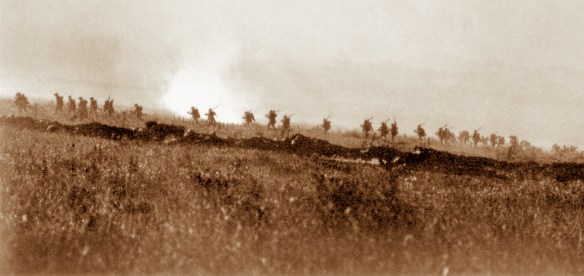
The first day on the Somme – July 1, 1916

Somme-LaBoisselle_1st_July_1916_Header

FIRST DAY OF THE BATTLE OF THE SOMME

The 1st July 1916 was the opening day of the Anglo-French offensive that became known as the Battle of the Somme. It was the middle day of the middle year of the First World War and is principally remembered as the bloodiest day in the history of the British Army. On the first day of the Somme 57,470 British soldiers became casualties of which 19,240 were either killed or died of their wounds. It has for many come to represent the futility and sacrifice of the First World War, with lines of infantry walking across No-Man’s-Land into the machine guns of the enemy.

The most terrible battle of the most momentous war in European history began a century ago today. As a pure coincidence, I am reading John Buchan’s Greenmantle, published itself in 1916. From Buchan’s biographical details at the start of the edition I have there is this:

During the First World War he worked as a war correspondent for The Times, before joining the British Army Intelligence Corps and writing speeches for Sir Douglas Haig. His experience of war left him vehemently opposed to armed conflict. He wrote many novels, poems, biographies, histories and works of social interest but is most famous for his Richard Hannay novels, The Thirty-Nine Steps and Greenmantle.

In its own way a story that has a modern veneer but you will see why the BBC began and then abandoned a dramatisation of the book in 2007 from this para from the summary of the book on the back cover of my edition of the novel.

The Germans with their Turkish allies are planning to stir up a revolt in the Muslim world that could leave Egypt, India and North Africa in disarray.

The EU was intended to bring such conflicts to an end. History, however, remains open ended as it will and must always be.

UPDATE: The Daily Mail commemorative gallery marking the day in England.Here is how the battle is described:

Synonymous for the slaughter of hundreds of thousands of men, the Battle of the Somme was one of the most controversial conflicts of the First World War.

The battle took place North of the River Somme in France from July 1 to November 13, 1916.

On the first day alone British forces suffered casualties of 40,000 and deaths of 20,000, with 60 per cent of all of those killed being officers.

Designed to relieve pressure on French forces at Verdun, the Battle was the mastermind of General Douglas Haig and involved 750,000 British soldiers across 27 divisions.

By the end of the bloody and brutal battle Allied forces had managed to capture only six miles of land. The British suffered 429,000 casualties, the French suffered 195,000 and the Germans 650,000.

Prior to the battle the British bombarded German lines with 1.6 million shells in an effort to weaken their resolve, but the Germans were heavily fortified and many of the shells did not go off.

Haig, unaware of his bombardment’s failure, was so confident in his tactics that he ordered his men to walk across the battlefield. As a result many were tragically mowed down by machine gun fire as soon as they left their trench.

The general’s tactics remain controversial to this day with military historians, soldiers and biographers conflicted over whether his decisions were necessary or foolhardy.

If ever there was a war to end all wars, this was it. We now know no such war exists. Those who would live in peace must therefore always prepare for war.

Who will save us from the experts?

There are two articles paired at Instapundit that really do capture the Brexit moment. The first is It’s Time for the Elites to Rise Up Against the Ignorant Masses which is exactly what the article is about and is offered without the slightest sense of irony or humility. Here is the para that captures it all:

The Republican Party, already rife with science-deniers and economic reality-deniers, has thrown itself into the embrace of a man who fabricates realities that ignorant people like to inhabit.

These are the experts: global warmists and Keynesians! Who would trust such expertise? Reading the comments at Instapundit shows the level of distrust with such people. Here are a couple:

It’s funny how they keep harping on Nigel Farage supposedly lying to the British voters in order to win their votes. The nerve of such people! Why, progressives and neofeudalists would never dare do such a thing!

Ted Kennedy, on the 1965 immigration: “The bill will not flood our cities with immigrants. It will not upset the ethnic mix of our society. It will not relax the standards of admission. It will not cause American workers to lose their jobs.”

Ted Kennedy, on the 1986 amnesty: “This amnesty will give citizenship to only 1.1 to 1.3 million illegal aliens. We will secure the borders henceforth. We will never again bring forward another amnesty bill like this.”

Yet suddenly Leftists are insisting on truth in advertising laws for politicians. If they want to roll back every left-wing lie of the last six decades they can gladly have a redo on Thursday’s vote.

And then there’s this:

Homogeneous societies are happier. They have much higher social trust and a good deal more willingness and less resentment in looking after their have-nots. Multi cultural societies rob people of a true sense of belonging. The lions share of what is good in life has nothing to do with money and economics. A nation is more than just a souless shopping mall packed with culturally atomized individuals. The elites are indifferent to the cultural destruction they have wrought in their blindered pursuit of a few more pieces of silver and a lot more centralized control. Globalization is a disaster of epic proportions. It can only end in tyranny.

All right. One more:

I *do* believe in reason, expertise, and the lessons of history. However, the “elite” are more wedded to their delusions and power than any of the above. Fer crissake, the people who claim to be “believers” in evolution are now pushing the idea that “male” and “female” are entirely learned! Their learning the “lessons of history” is to ignore the lesson of WWII — when lunatics promise to kill you *BELIEVE THEM*!

And expertise? At what? Fraud, extortion, ginning up hatred? Keeping their hands clean of the violence they incite? At laundering money for their elections through an “education” system that leaves those most in need of an education barely literate and trained to hate?

OK. Another, they are so addictive.

“Science deniers”? Which party thinks “male” and “female” are learned traits and surgically alterable? Which clings to a prediction of ever-rising temperatures despite more than a decade of no change? Which clings to a demonization of CO2 when there simply isn’t any more energy CO2 can “trap”?

There is expertise in how to fix a broken sewer pipe. There is similarly expertise in how to take out an appendix. But expert opinion on social, political and economic issues? I’m afraid that wherever self-interest plays a hand in the decisions of experts, their reliability is not to be trusted. Which is why a democratic process, where the rulers must seek the endorsement of the ruled, remains the only way a modern society should be run.

Advice for the lovelorn

This is from Stacy McCain about boy-girl relations.

We understand that not everyone marries their high-school sweetheart, but if you reach age 21 and have never dated anyone longer than “a few months,” you may be headed toward the Darwinian dead end.

The “check engine” light is flashing on your dashboard, OK? Most people start dating in high school and, somewhere between age 16 and 19, form their first “serious” relationship. Maybe this adolescent romance doesn’t become Endless Love — cue the Diana Ross-Lionel Richie duet — but if you’re 21 and have never had a relationship that lasted at least a year, you have a problem, and that problem is you. The most common cause of this particular problem is failure to accurately assess your own attractiveness.

This is a typical problem for loser guys, the kind of dude who is below average, but doesn’t realize it. He’s seen too many Seth Rogen movies, in which Seth Rogen ends up with a hot chick, despite being Seth Rogen.

Hollywood is always making movies where the hapless schlub somehow manages to win the heart of a chick who’s way out of his league. The classic of this genre was When Harry Met Sally — a truly great comedy, but let’s be brutally honest: Guys who look like Billy Crystal do not end up with women who look like Meg Ryan, at least not often enough that you actually expect to see such a pairing in real life.

Nevertheless, clueless losers latch onto the foolish idea that they’ll hit the jackpot and woo a Meg Ryan lookalike and, as a result of this absurdly unrealistic delusion, guys get stuck permanently in Loserville.