In defence of Western Civilisation from our modern vandals

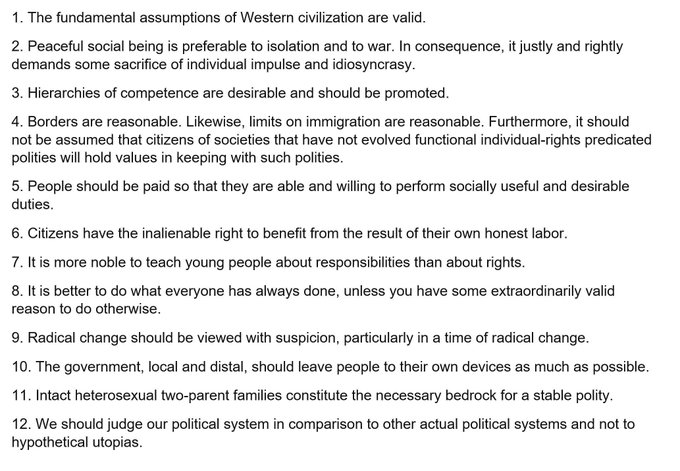
And half of those vandals are internal. Here is a twelve step program from Jordan Peterson. It is hard to believe that such common sense still exists and can be said in public, but here it is.

View image on Twitter

 
And if you are interested in the full text, here is the entire two hours.

This is Peterson’s own background briefing to the presentation:

Conservatism has all-too-often found itself unable to articulate a coherent positive doctrine. By this I mean specifically that the laudable conservative tendency to preserve the best of past has too-often manifested itself in a series of “thou shalt not” statements, instead of laying out a manifesto of fundamental values that might serve to unite people around a set of common ambitions. I am attempting to rectify this problem with this statement of principles, some of which I believe might have the additional virtue of being attractive to young people, looking for mature and forthright purpose and responsibility.

I am not making the claim that the statement is perfect, comprehensive or final.

I will just add that it’s not perfect or final, not least because it is mostly pragmatic but lacks the moral grounding that is essential. The left is filled with people who are evil to their very core but believe they are only doing good. Without a proper moral basis for action, there is no foundation for anything. Socialism is great on paper, and when we have perfected humanity we can bring it on. In the meantime, every such experiment is inevitably disastrous for everyone other than those who are at the very top of the pyramid. We have found a way to bring peace and prosperity which are through the principles laid out, but there is a deeper understanding required which only an Edmund Burke and an Adam Smith can supply.

What seven year old doesn’t need to know this?

View image on Twitter

`

Now, you might be asking yourself why a seven-year-old girl needs to learn about sexual desire at all, let alone homosexual sexual desire; you might be asking yourself why a seven-year-old should be indoctrinated about children being “assigned male or female at birth” when such language is the language of anti-scientific nonsense.

But according to Valenti, you would be the degraded one. After all, school teachers should certainly inform pre-pubescent children about matters of moral and scientific controversy. But, you might answer, young children don’t have the critical thinking skills necessary to ask important questions about this framework.

That, of course, is entirely the point. Children are supposed to be indoctrinated with left-wing views regarding gender and sex — they’re supposed to be told that sex and gender are utterly disconnected, that every sexual activity is equally valid. Children are supposed to be confused about matters of deep philosophical and lifestyle importance, so that later, they feel free to follow whatever feelings they have. We can’t teach children nothing — then their parents might teach them the wrong things. They might teach their children that men were men and women were women, for example, which could create preconceived notions about sex. And if parents were to teach children about the societal value of heterosexual lifestyles, or about the mere biological advantages of heterosexual activity, that could lead to discrimination.

Let me therefore mention a book I have come across by accident that could not be published today but is in print and shows it is still possible to access sanity even in the world the left is creating at every turn: William Kilpatrick’s Why Johnny Can’t Tell Right from Wrong, for which the link will get you to a pdf copy you can download for yourself.

Also available through the net but with certainty will not be found on the shelf in any bookshop anywhere in the world. I wonder if you can find it in a public library.

It was originally published in 1992 where he was warning us about the kind of world that was forming at the time. Only publishable even then because he no doubt looked like an extremest way out on a limb. In fact, the most prescient book I have ever come across. He describes everything you see today, explaining what is wrong, but was then only describing what was to come.

I cannot recommend a book more highly. Probably too late anyway, but worth having a deeper grasp of the horrors surrounding us now with no doubt worse to come in a world now completely out of control.

What does one need to know to be an expert in human rights?

What expertise does someone appointed to the Human Rights Commission need to have? What is an expert in “human rights” and what do such people know that the rest of us might not? They pay these people a third of a million dollars a year, but what are they other than friends of those who make the appointments? Do they know the difference between good and evil? Can they even explain the difference between right and wrong? What exactly are we allowed to do and not allowed to do? Is the law merely made up of their own personal judgement? Are they given the right to plague other people because of their own personal opinions? Who are they and what do they know about anything?

Let us start with this story from Janet Albrechtsen:

Consider the poor barber at the Hunters Hill Barber Shop. Late last year Sam Rahim turned away a woman who wanted him to cut her daughter’s hair. Sam the barber told her he was qualified only to cut boys’ hair, politely directing her to a salon up the road. She took to social media and ran to the Australian Human Rights Commission claiming he breached anti-discrimination laws. He offered an apology. And now he has been served with court papers for a claim that he breached the Sex Discrimination Act.

Sam and his wife, Ronda, have set up a GoFundMe page because, as he told the media, “The legal costs are more than we have ever anticipated.”

Seriously, in what possible way is this a human rights issue? Do these people even have the foggiest idea what human rights are? Because of their oceanic ignorance, they are in the process of discrediting one of the most important concepts at the heart of Western civilisation.

Let me continue with Tim Blair in a post he titles, Finest intro ever written:

Daily Telegraph colleague Miranda Devine makes several strong points in her latest terrific column. Let’s take a detailed look, starting from the top:

Race Discrimination Commissioner Tim Soutphommasane’s term expires in August …

Actually, although there are no doubt many strong points, I wasn’t able to read anything beyond that opening line due to tequila shots.

So following from Tim and Miranda, let me take you to Frank Chung: For $340,000 a year, we deserve better than Race Discrimination Commissioner Tim Soutphommasane which has as its subhead:

AUSTRALIA’S race discrimination commissioner has lamented the “dismal” fact that there are too many white people in top positions.

These are Frank’s last two paras:

There may be many reasons for the lack of one-to-one population representation at the very highest levels of business and politics — but for the Race Discrimination Commissioner, when you’re a hammer, everything looks like a nail.

For someone who is paid $340,000 a year to come up with this dross, it’s not surprising the concept of meritocracy is a foreign one. Or is that being racist?

Forget about good and evil or right and wrong, of which these people appear to have no clear idea at all. How about just something as simple as profit and loss, something else they have no clear idea about at all. If they really think it is a human rights issue for a men’s barber not to cut women’s hair, they need to be sent to a re-education camp as soon as possible and for as long as it takes. And just in case they don’t get it, which is likely, this is just meant as a joke.

A society based upon the opinion of civilians

This is from Winston Churchill, found as the opening words of Daniel Hannan’s wonderful How We Invented Freedom & Why It Matters:

“There are few words which are used more loosely than the word “Civilization.” What does it mean? It means a society based upon the opinion of civilians. It means that violence, the rule of warriors and despotic chiefs, the conditions of camps and warfare, of riot and tyranny, give place to parliaments where laws are made, and independent courts of justice in which over long periods those laws are maintained. That is Civilization—and in its soil grow continually freedom, comfort, and culture. When Civilization reigns, in any country, a wider and less harassed life is afforded to the masses of the people. The traditions of the past are cherished, and the inheritance bequeathed to us by former wise or valiant men becomes a rich estate to be enjoyed and used by all.”

There is no culture like our Western civilisation and if it disappears it will not come back for a thousand years. None of the alternatives looking to be the replacement for our way of life will be anything other than tyranny and slavery for the vast bulk of the population. And if you don’t think our way of life is at risk, you are either completely clueless or think the past is a guarantor of the future. The totalitarian enemy is there at every turn, both outside the citadel and within. Let me just take this from (Lizzie) Beare from a previous thread, because it really is depressing how politically naive so many supposedly intelligent people are.

The ‘right’ circumstances for another ‘purge’ are upon us now; from the left. It is starting under the ‘Antifa’ thugs when ordinary people going about their business are called fascist/and or are subject to physical violence for simply attending a talk by a reputable clinical psychologist or a very clever gay young man making jokes. You see it when a prominent TV conservative is physically attacked on his way into a venue. You see it when the recently deposed Australian Prime Minister is punched in the face by a gay activist. You also see it when a man of J3wish-Yemini background tries to collect signatures at a rally supposedly in support of refugee immigration into Australia and a big loon not just yells but roars ‘Fascist’ at him three times virtually spitting in his face; simply because that J3wish man wearing a J#wish skull-cap is collecting signatures for a petition to recognize that white South African farmers facing a violent racist slow extinction are worthy of consideration as refugees. You see it when people are ‘reported’ and ‘punished’ for disagreement with current thought-police mandated thinking and you see it when the media and other cultural outlets self-censor. It is bred in our schools and our universities, this new fascism, and should be roundly called out for what it is, along with all of the other mind and thought control that political correctness is putting up for our little left Stalins of the day to play lawfare with against those who resist.

Yes, there is ‘scale’ required to see how distant some history may be to the current generation. But that’s why it’s called history. All high school children should study the French Revolution, the Russian Revolution, the Nazi Holocaust, and Revolution of Mao in China with its later abysmal Cultural Revolution, plus the French-influenced Communism in Vietnam that ‘flowered’ in the Year Zero of Pol Pot’s Cambodia. A simple week on each would do it if necessary. And if schools are not doing it, then do it around the dinner table with your children. The lesson of history is that communist and other totalitarian societies always end with economic misery, gulags, secret police, a population turned upon itself, and eventually, piles of bodies.

What on earth is in the history curriculum today now that Marxists control it and teach the teachers?

Socialists are totalitarians. The leaders of socialist movements want what is best for the leaders of socialist movements, and the rest of you be damned. Fools every one.

And for good measure, go see The Death of Stalin, a tragic story told in a lighthearted way. Being miseducated for the most part, most won’t know who Beria was, but the movie gets the politics right. You also need to know something about the doctors’ plot to get some of the jokes. An exceptionally good movie about life in a totalitarian state, which our socialist friends continue to shield their eyes and ears from all knowledge of.

Australian Philosophy Department – Monty Python version


Here are the words:

Immanuel Kant was a real pissant
Who was very rarely stable

Heidegger, Heidegger was a boozy beggar
Who could think you under the table

David Hume could out-consume
Wilhelm Freidrich Hegel

And Wittgenstein was a beery swine
Who was just as schloshed as Schlegel

There’s nothing Nietzsche couldn’t teach ya
’bout the raising of the wrist
Socrates, himself, was permanently pissed

John Stuart Mill, of his own free will
On half a pint of shandy was particularly ill

Plato, they say, could stick it away
Half a crate of whiskey every day

Aristotle, Aristotle was a bugger for the bottle
And Hobbes was fond of his dram

And Rene Descartes was a drunken fart
“I drink, therefore I am.”

John Stuart Mill on free speech

Reprinted from Instapundit.

A MUST-READ FOR POTENTIAL SNOWFLAKES: All Minus One, a beautifully illustrated and smartly abridged version of John Stuart Mill’s arguments for free speech in “On Liberty,” is just out at Heterodox Academy, which hopes it will become required reading for students before they enter college. Here’s a conversation about Mill — and why he’s more relevant than ever — with Richard Reeves, the Mills biographer who edited this book together with Jonathan Haidt.

ALL MINUS ONE
John Stuart Mill’s Ideas on Free Speech Illustrated

Heterodox Academy has produced a new book based on John Stuart Mill’s famous essay On Liberty to make it accessible for the 21st century. Here’s what makes our edition special:

1) It’s just the second chapter (out of 5), because that chapter gives the best arguments ever made for the importance of free speech and viewpoint diversity;

2) We have reduced that chapter by 50% to remove repetitions and historical references that would be obscure today, producing a very readable 7000 word essay;

3) Editors Richard Reeves (a biographer of Mill) and Jon Haidt (a social psychologist) have written a brief introduction to link Mill and his time to the issues of our time, and

4) Artist Dave Cicirelli has created 16 gorgeous original illustrations that amplify the power of Mill’s metaphors and arguments.

If you would like to order a copy you can find our where at the link.

And for what it’s worth, John Stuart Mill also wrote the best economics book ever published, and for which there is a modern version as well if these are the kinds of things that interest you.


Masters of systematic ignorance

HINT: IT DIDN’T JUST HAPPEN BY ACCIDENT. How A Generation Lost Its Common Culture.

My students are know-nothings. They are exceedingly nice, pleasant, trustworthy, mostly honest, well-intentioned, and utterly decent. But their brains are largely empty, devoid of any substantial knowledge that might be the fruits of an education in an inheritance and a gift of a previous generation. They are the culmination of western civilization, a civilization that has forgotten nearly everything about itself, and as a result, has achieved near-perfect indifference to its own culture.

It’s difficult to gain admissions to the schools where I’ve taught – Princeton, Georgetown, and now Notre Dame. Students at these institutions have done what has been demanded of them: they are superb test-takers, they know exactly what is needed to get an A in every class (meaning that they rarely allow themselves to become passionate and invested in any one subject); they build superb resumes. They are respectful and cordial to their elders, though easy-going if crude with their peers. They respect diversity (without having the slightest clue what diversity is) and they are experts in the arts of non-judgmentalism (at least publically). They are the cream of their generation, the masters of the universe, a generation-in-waiting to run America and the world.

But ask them some basic questions about the civilization they will be inheriting, and be prepared for averted eyes and somewhat panicked looks. Who fought in the Peloponnesian War? Who taught Plato, and whom did Plato teach? How did Socrates die? Raise your hand if you have read both the Iliad and the Odyssey. The Canterbury Tales? Paradise Lost? The Inferno?

Who was Saul of Tarsus? What were the 95 theses, who wrote them, and what was their effect? Why does the Magna Carta matter? How and where did Thomas Becket die? Who was Guy Fawkes, and why is there a day named after him? What did Lincoln say in his Second Inaugural? His first Inaugural? How about his third Inaugural? What are the Federalist Papers?

Some students, due most often to serendipitous class choices or a quirky old-fashioned teacher, might know a few of these answers. But most students have not been educated to know them. At best, they possess accidental knowledge, but otherwise are masters of systematic ignorance. It is not their “fault” for pervasive ignorance of western and American history, civilization, politics, art and literature. They have learned exactly what we have asked of them – to be like mayflies, alive by happenstance in a fleeting present.

And not, as I said, by accident.

From Instapundit

Which means they hate you

The rest is from Steve Hayward’s post at Powerline: REMINDER: THE LEFT HATES OUR CIVILIZATION.
 

I know I’ve made the point before, but there is fresh evidence in recent weeks of how much the left today hates western civilization and human excellence in general. Once again the left is determined to flunk what I’ve long called “the Churchill test.”

Once upon a time leading liberals loved Churchill. Think of Isaiah Berlin’s great 1949 Atlantic Monthly essay, “Churchill in 1940,” or how much Arthur Schlesinger loved him, not to mention the total fanboy crush JFK had on Churchill. Remember, too, that in the 1950s some leading American conservatives were not all that enthusiastic about Churchill; William F. Buckley Jr. was downright hostile to him (though he changed his mind), and Pat Buchanan still dislikes Churchill.

But in the aftermath of Darkest Hour and the best actor Academy Award going to Gary Oldman, voices on the left are at it again, calling Churchill a “war criminal” and mass murderer on the same scale as Hitler or Stalin. A popular Indian politician, Shashi Tharoor, wrote in the Washington Post that “In Winston Churchill, Hollywood Rewards a Mass Murderer.” Apparently the Washington Post has decided to reward morons.

Here’s the breathless conclusion of Tharoor’s Post piece:

This week’s Oscar rewards yet another hagiography of this odious man. To the Iraqis whom Churchill advocated gassing, the Greek protesters on the streets of Athens who were mowed down on Churchill’s orders in 1944, sundry Pashtuns and Irish, as well as to Indians like myself, it will always be a mystery why a few bombastic speeches have been enough to wash the bloodstains off Churchill’s racist hands.

Many of us will remember Churchill as a war criminal and an enemy of decency and humanity, a blinkered imperialist untroubled by the oppression of non-white peoples. Ultimately, his great failure — his long darkest hour — was his constant effort to deny us freedom.

Tharoor’s case depends on repeating a number of undying myths about Churchill, or gross distortions of badly tangled affairs. Soren Geiger does a terrific job of unwinding the more egregious claims Tharoor makes in this article in the American Spectator. But Tharoor has lots of company. Shree Paradkar, the “race and gender columnist” of the Toronto Star . . . actually I could pretty much just stop right here, couldn’t it? But no, you need to take in some of her “Winston Churchill, the barbaric monster with the blood of millions on his hands” article to believe it. It includes gems such as:

Oldman might as well have danced on 3 million dead bodies, many of whose loved ones were too weak to cremate or bury them.  Such tributes for a heinous white supremacist who once declared that “Aryan tribes were bound to triumph.” Words as hollow as the tunnel-visioned ideals on which people fashion this man, but they can’t stem the drip, drip of blood from his hands.

Fortunately we have Terry Reardon of Hilldale College’s Churchill Project on the job refuting Paradkar’s paranoia point-by-point, but see also Richard Langworth, who offers up a catalogue of fresh attacks on Churchill from leftist ignoramuses. Richard notes at the end of this bibliography of nihilism:

Nearly forty years ago an equally great Churchill performance, Robert Hardy in The Wilderness Years,  was received with equal acclaim by press and public. There was no chorus of hate, no trumped-up charges, no hint that Churchill’s overall record was in any way debatable. Alas times have changed.

As for the calumny of Churchill’s supposed role in the Bengal famine of World War II, I wonder if any of Churchill’s detractors have ever asked how many would have starved if Japan had succeeded in conquering the Asian subcontinent, which is what surely would have happened if any of them had been in charge?

Times have changed indeed. The left’s fundamental self-loathing of the western inheritance, hostility to human excellence, and childlike grasp of political reality has led to these increasingly candid expressions, for which in a sense we should be grateful—at least the left is being more honest.

Here once again we should repair to the observation of British historian Sir Geoffrey Elton, who wrote: “There are times when I incline to judge all historians by their opinion of Winston Churchill: whether they can see that, no matter how much better the details, often damaging, of man and career become known, he still remains, quite simply, a great man.”

Ah—that “great man” thing: contemporary leftist egalitarians cannot tolerate such distinctions among human beings.

Friedrich Nietzsche, Samuel Laing and Jordan Peterson

All three authors – Friedrich Nietzsche (1844-1900), Samuel Laing (1812-1897) and Jordan Peterson (1962- ) – wrote in response to the same issue: the impossibility of literal acceptance of Christian mythology in the wake of the scientific discoveries of the nineteenth century. Both Nietzsche and Laing found a response in turning to the seventh century BC philosophical writings of Zarathustra – Laing literally with Nietzsche only metaphorically – while Laing and Peterson argue that the moral teachings of our Judeo-Christian ethic can be maintained through the careful reading of Biblical literature. Knotting the yarn a bit more, Nietzsche and Peterson argue that without Christian teaching, Western Civilisation will disintegrate. Nietzsche thinks that would be a good outcome, while Peterson (and Laing) believe it would be bad.

Today, whatever the actual historical circumstances may be, we celebrate the memory of the freeing of the Jewish people from slavery in Egypt. Whether any of the events described in the Bible are literally true is unknowable, but almost no one alive today thinks of almost any of it, from Moses in the bulrushes to the ten plagues of Egypt, as anything but stories. But what is undoubted is that the recorded outcome led to the most important moral event in the history of the world, the receiving into the hands of the Jewish people, the Ten Commandments, whose impress for good on world history has been second to none, or at least as seen by Laing and Peterson, while from the perspective of Nietzsche, the consequence has been an unalloyed moral disaster.

Samuel Laing

Samuel Laing wrote the most astonishing book – Modern Science and Modern Thought – which was first published in 1885. He lived at a time when the scientific discoveries during the nineteenth century made it impossible to believe the literal accuracy of any biblical account. To quote:

There is no more room left for the supernatural in the fiercest tropical thunder-storm than there is in turning the handle of an electrical machine, or sending in a tender to light the streets of London by electric light. And the result is absolutely certain. In the contrast between the natural and the supernatural, the latter has not only been repulsed but annihilated. [Laing 1885: 243]

Morally, then, where are we left? Laing again:

The really religious writers of the present day are those who, thoroughly understanding and recognising the facts of science, boldly throw overboard whatever conflicts with them, abandon all theories of inspiration and miraculous interferences with the order of nature, and appeal, in support of religion, to the essential beauty and truth in Christianity underlying the myths and dogmas which have grown up about it; who above all, appeal to the fact that it exists and is a product of the evolution of the human mind, satisfying, as nothing else can do so well, many of the purest emotions and loftiest aspirations, which are equally a necessary and inevitable product of that evolution. [ibid.: 337-38]

And one more, just to see the point as strongly as it can be made. And he had the advantage of living through an era where the literal truth of Biblical accounts had not yet been shattered by scientific discovery.

Darwin’s “Origin of Species” was only published in 1859, and his views as to evolution, development, natural selection, and the prevalence of universal law, have already annexed nearly the whole world of modern thought and become the foundation of all philosophical speculation and scientific inquiry.

Not only has faith been shaken in the supernatural as a direct and immediate agent in the phenomena of the worlds of matter and of life, but the demonstration of the “struggle for life” and “survival of the fittest” has raised anew, and with vastly augmented force, those questions as to the moral constitution of the universe and the origin of evil, which have so long exercised the highest minds. . . .

To such questions there is no answer. We are obliged to admit that as the material universe is not, as we once fancied, measured by our standards and regulated at every turn by an intelligence resembling ours; so neither is the moral universe to be explained by simply magnifying our own moral ideas, and explaining everything by the action of a Being who does what we should have done in his place. [ibid.: 220-221]

We are therefore potentially morally at sea with no solid foundation on which to build a basis for any moral position whatsoever. This was the great question of the latter half of the nineteenth century for which answers had to be found.

Laing, and I shall suggest Peterson, have taken the side of our traditional morality which they believe has been anchored on an oral and written tradition that have descended to us through time. This is, loosely, the view of the political right. There is then a different tradition, found in the Marxist and Nietzschean traditions, that the only answers are those we make up ourselves and enforce through the will of the strong through the power of the state. Marxist ideology provides a false trail for political and economic construction, but it is from Nietzsche that the moral trail descends.

Nietzsche

Nietzsche’s take starts from the same position as Laing. And it does cross my mind that Laing may be an unknown but still major influence on Nietzsche. It is an odd fact that in none of my various approaches to the world in the past have I ever found interest in Nietzsche’s works, and have been perennially left with the impression that he is someone whose writings are themselves a source of evil. But I may not have, until the last two weeks, opened anything of his in at least two decades, but with Laing’s next book having been The Modern Zoroastrians, which he prefigured in his Modern Science and Modern Thought, I was then immediately drawn to see what is inside Nietzsche’s own examination of this same philosophy. As it happens, there is no overlap at that level, but the parallels are nonetheless quite deep.

I began with the obvious, Thus Spake Zarathustra, and from there I continued with On the Genealogy of Morals. And while Zarathustra discusses “God is Dead”, which is more fully explored in The Gay Science, in the Genealogy of Morals we come face to face with his deepest anti-Christian and let me also note, some of the most shocking anti-Semitic writings you may ever find.

But first let me traverse the potential link to Samuel Laing. Both were living in the immediate post-Darwinian era, with Nietzsche providing the most striking phrase, but both reacting to a moral shift from a literal interpretation of Biblical events. For Laing, the Judean-Christian morality nevertheless remained as the bedrock irrespective of the provenance for the stories themselves. Nietzsche finds deep fault with the morality whatever may be its source, and wishes to see it overthrown. The first essay in the Genealogy of Morals  begins with these words:

Those English psychologists, who up to the present are the only philosophers who are to be thanked for any endeavour to get as far as a history of the origin of morality — these men, I say, offer us in their own personalities no paltry problem; — they even have, if I am to be quite frank about it, in their capacity of living riddles, an advantage over their books — they themselves are interesting! These English psychologists — what do they really mean? (Nietzsche [1887] 2013: 13)

My question here is not what do they mean, but who does he mean? And my suggestion is that Nietzsche is referring to Laing, who not only provided, in full, the opposite position with a complete defence of Western morality, but had himself focused on Zarathustra, using the more conventional name Zoroaster. The editor’s footnote to the above para [ibid.: 148-149] provides more than a dozen individuals to whom Nietzsche might have been referring, but the point is that no one knows. Let me therefore add Samuel Laing to the list of potential points of origin, and one with a lot more to recommend it since it is quite straightforward to see Nietzsche as specifically responding to Laing than to anyone else.

Nietzsche argues that the great moral disaster for the previous two thousand years had been the adaptation in the West of the Judaic moral codes as embedded in Christianity. It is these he wishes to seen thrown over and abandoned. The rule of the strong over the weak had been lost for two millennia, with the introduction of the slave morality with its ethic of pity and help for the poor and downtrodden. And here is a passage found in the Penguin edition that could not be found in any of the online editions, which meant it had to be typed out. But what is interesting is what it says and the phrase he uses. I cannot, of course, vouch for the accuracy of the translation, but you can see why others might have avoided it.

The pathos of nobility and distance, as I have said, the continuing and dominating collective instinct, and feeling of superiority of a higher race, a master race, in comparison to a subservient race – this is the origin of the opposition of ‘Good’ and ‘Bad’. . . . It is by virtue of this origin that the word ‘good’ is far from having any necessary connection with selfless acts, in accordance with the superstitious beliefs of these moral philosophers. [ibid.: 15 – my bolding]

The rule of the strong is the way of every civilisation but our own. Only in the Judeo-Christian world have those on the bottom of the pile ever mattered, and then only some of the time. A democratic political order can have no other origins than through a religious perspective that sees value in every human soul, in which each person is an equal, and in which each life counts for one and no life counts for more than one.

The influence of Nietzsche has been entirely sinister. His philosophy has had the most damaging consequences, for Jews looking at his effects narrowly via his well-known influence on the Nazis, and for the entire world since the nineteenth century.

Jordan Peterson

Jordan Peterson, more than a century after Laing, is trying to say exactly the same thing, and with the very same ancillary message.

The Bible stories, fairy tales, ancient myths and other readings from Western civilisation that we have been telling ourselves for thousands of years are chosen because they are reflections on the lived experiences of our ancestors, and provide us with answers and guidance for living in the world as it is, and at a deeper level that goes well beyond the superficial changes occasioned by our technological advances and the proliferation of modern gadgetry.

As an example of what you will find in Peterson’s book, here’s the opening para that leads off the discussion of Rule 7: “Pursue what is Meaningful (Not What is Expedient)”:

“Life is suffering. That’s clear. There is no more basic, irrefutable truth. It’s basically what God tells Adam and Eve, immediately before he kicks them out of Paradise.

“The simplest, most obvious, and most direct answer? Pursue pleasure. Follow your impulses. Live for the moment. Do what’s expedient.”

The obvious answer, perhaps, but the wrong answer. And what our biblical stories, along with so much of our mythology and philosophical reflection, represent are sets of instructions based on the observed successful life choices made by countless individuals over countless generations. The traditions are entirely based on lived experience as our human ancestors attempted to deal with the challenges they faced:

“Then we started to tell stories. We coded our observations of our own drama in these stories. In this manner, the information that was first only embedded in our behaviour became embedded in our stories.”

These stories delineate the straight and narrow, deviations from which are invitations to disastrous outcomes, not necessarily immediately but over time, and not necessarily for any individual but for societies as a whole. The book is a reminder that there is profound wisdom available to us all that will guide us through life.

And these stories began with the adventures of our own ancestors as they told the story of The Exodus. Whether the events themselves ever actually occurred or not, whether the Children of Israel ever did camp beneath Mt Sinai, the reality is that at some time the Ten Commandments were written down as the basis for the moral law of the Jews. And from the handing down of The Ten Commandments, that were themselves embedded within stories found in the various Biblical accounts describing how these rules might be applied, and which have been told and retold, and their meanings mined for messages about how to behave and how we are to live in moral communities with each other, we have absorbed our morality, even among those who insist they are complete atheists and will have no truck with deities and supernatural beings of any kind.

These powerful stories have given direction and guidance to the lives of hundreds of millions who have used Biblical accounts as a means to orient themselves through the various moral dilemmas served up by life.

The Seder

That is what the Seder is, a retelling of events within a moral setting. Whether God did tell Pharaoh to let his people go, the message that slavery is wrong has been passed through into the cultural DNA of the West. It has passed onto us, the belief that freedom is a paramount value. It has passed on a moral code that we have maintained for 3500 years, adapting it as circumstances have required, but based on the same values we have today.

And because of the spread of Christianity, it is these same values that have become the moral foundation for the richest and freest societies which have ever existed. What Nietzsche calls the “herd mentality” is literally what we think of as freedom. You personally matter. You personally count. Might is not right. The powerful do not have the moral right to do with us, who are less powerful, what they wish.

But these values are always in danger so it is during the Seder each year that we remind ourselves about the moral nature of the world we are in. And it is world we will only continue to inhabit if we listen to the stories of our own past and do what each of us can to defend these personal rights against those who would without any doubt take them from us, as the followers of Marx and Nietzsche would surely do if they could.

And Finally Peterson and Laing on Facing Life

Returning to 12 Rules for Life, the message is mainly for young men, where he instructs young males to get on with life by taking responsibility for those parts of their own lives they can actually make a positive contribution towards. This is a Peterson rant of some deep insight taken from one of his video interviews. As funny though it may be, and even though it is addressed to their teachers and not the young, the point is well directed towards anyone starting out in life, male or female:

“It’s what I tell 18 year olds. Six years ago you were twelve. What the hell do you know? You’re under the care of the family or the state, you haven’t established an independent existence, you haven’t had children, you haven’t started a business, you haven’t taken responsibility for anything, you don’t have a degree, you haven’t finished your course, you don’t know how to read, you can’t think, you don’t know how to present yourself, well Jesus, it’s not right to tell people in that situation that they should go out and change the world.”

Instead, his advice is to find something they can be personally responsible for and then show some responsibility. Grow up. Become mature. Be an adult! As it happens, but it is no coincidence, Laing’s final chapter is titled “Practical Life”. I will repeat the final para of the chapter, which is also the final para of the book, with the parallels and overlap unmistakeable.

And the conclusion I come to is, not that of the Preacher, ‘Vanity of vanities, all is vanity,’ but rather that life, with all its drawbacks, is worth living, and that to have been born in a civilised country in the nineteenth century is a boon for which a man can never be sufficiently thankful. Some may find it otherwise from no fault of their own; more by their own fault; but the majority of men and women may lead useful, honourable, and on the whole fairly happy lives, if they will act on the maxim which I have always endeavoured, however imperfectly, to follow –

FEAR NOTHING; MAKE THE BEST OF EVERYTHING.

And this is just as true in the twenty-first century as well. We will always be fortunate to have been born in a civilised country, and where we are so blessed, we will have a duty placed on our shoulders to ensure that we do what we can to keep the places we inhabit civilised. And the final line was printed just as you see it, in the middle of the page, on its own, and all in caps.