The land of missed opportunity

From two articles picked up at Instapundit. First this, the conclusion to an article titled, The United States of Envy:

Voters who will hear the Obama call for envy and redistribution should ask themselves and others: Would you prefer to live in an America where the market is dynamic and opportunity abounds, or in France, where unemployment is high and tax rates are crushing? Don’t you prefer opportunity to envy?

And then this from an article with the title, Growing-ups which is subtitled, “Living with your parents, single and with no clear career. Is this a failure to grow up or a whole new stage of life’?”:

The ‘selfish’ slur also ignores how idealistic and generous-hearted today’s emerging adults are. In the national Clark poll, 86 per cent of 18- to 29-year-olds agreed that: ‘It is important to me to have a career that does some good in the world.’ And it is not just an idealistic aspiration: they are, in fact, more likely to volunteer their time and energy for serving others than their parents did at the same age, according to national surveys by the US Higher Education Research Institute.

As for the claim that they never want to grow up, it’s true that entering the full range of adult responsibilities comes later than it did before, in terms of completing education and entering marriage and parenthood. Many emerging adults are ambivalent about adulthood and in no hurry to get there. In the national Clark poll, 35 per cent of 18- to 29-year-olds agreed with the statement: ‘If I could have my way, I would never become an adult.’

Read both articles but the second shows such a high proportion of bone-headed youths who are not interested in “dead-end” jobs that you really do have to wonder about not just how dynamic the US is and but how much of that opportunity there actually any longer is.

Income distribution, envy and investment

income distribution

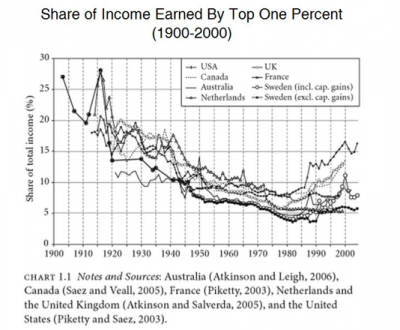
Alan Meltzer has written an article he has titled, The United States of Envy about the distribution of income across the past century. Here’s his main point:

Taxing the rich to redistribute did not produce growth. On the contrary, growth reduced the share earned by the highest earners.

Rapid growth comes from investment in new and better productive assets taking place more rapidly than existing assets are eaten away by use and decay. More saving and less consumption is what is required and nothing else will do. But here’s the catch. If investment projects are actually going to create value and raise living standards, they will have to be chosen by individual entrepreneurs – not governments who know only how to squander. Therefore, these individual entrepreneurs, to the extent they are actually successful, become wealthy. There is no way to succeed at some entrepreneurial innovation without becoming wealthy, and there is no means to organise an economy that will encourage entrepreneurial innovation without offering wealth to those who succeed. Hence envy.

But the envy is not just at wealth. No one cares about the wealth of movie stars or sports stars. They are amongst the wealthiest people in every society. But they do things that people admire and wish they could do themselves and tend to be young or at least glamorous. People who run businesses, however, are old and boring, hardworking and stodgy. Numbers people who may hire but will also fire. They focus on costs and sell what they produce at a profit. Their value system, whatever charitable work they may do and philanthropy they may spread, is still essentially Protestant work ethic irrespective of their actual religious beliefs.

But suppose it is drive, intelligence, personal ambition, an eye for detail, a grand vision and other such characteristics that matter and make all the difference. These traits are unevenly distributed across every population and thus not everyone has them to the same extent. Some people are lazy, not very bright, unambitious, slothful and without ideas, any single one of which will keep you from excelling. Well whose fault is that and why should these people be made to suffer for it? Why should the unequal distribution, not of wealth and income but of personal characteristics, determine not just your financial position but actual status in life?

So when we talk about the distribution of income we are really talking about the distribution of personal characteristics, with a tremendous amount of resentment directed towards those who actually do succeed. But what social policy has now done is to finance the lazy, the less intelligent, the unambitious, slothful and those without ideas with just enough of the earth’s worldly goods to keep them alive. But it has also vastly undermined those who might have been more ambitious, more creative, more productive with the result that individuals in great numbers fall into the abyss of non-achievement. And once in such condition, there is almost no means to pull oneself upwards. And so the envy and with it the socialism of the modern day whose greatest enemy is commercial and financial success driven by the resentment of those who can do more than they can and who are far more likely to lead lives of integrity and self-fulfilment.

No guts, no spine, and no conviction

I stopped reading National Review ages ago for reasons I would be hard pressed to explain other than to say that aside from Mark Steyn and one or two others, it no longer represented my core beliefs. But this article, What’s Wrong with the Right, by Pam Geller, gets very close to stating what I think:

National Review Online took another gratuitous shot at me Thursday in an article defending Ayaan Hirsi Ali, saying: “Hirsi Ali is no Pamela Geller. On the contrary, for her whole life, Hirsi Ali has used anger as a catalyst to great good.” Is it necessary to smear me in order to defend Hirsi Ali? And this is not the first time that NRO has allowed insults and defamation against me and other freedom fighters to run unedited. I hardly know why. But I do know that NRO has no guts, no spine, and no conviction.

And while every word she writes is dead on the mark, this is particularly accurate and important:

Once again, the establishment right takes its marching orders from what the destroyers on the left dictate. The right consistently allows the left to destroy our most effective voices – Sarah Palin is a major example. Unequivocal voices like Palin’s are tarred and smeared, while the right instead offers up weak and meandering fools like John McCain – and stands by him even when he poses with al-Qaida leaders in Syria and insists that they’re “moderates” . . .

This is how the establishment right makes it bones: on the bones of the principled right. This is how the establishment right gets legitimacy: by pandering to the left and selling out the clear, uncompromised voices on the right. Instead of destroying our philosophical enemies in the war of individualism vs. statism, the establishment right trims its message, then trims it some more, desperately hoping to appease leftists and their media lapdogs.

Is it any wonder that we can’t win elections? McCain? Romney? We can’t win until we find our spine. NRO best represents the abject failure on the right.

I’m not with her about Mitt Romney but am with her about all of the rest. And she could not be more right about what she says. If you take a stand on the left you have comrades at every side. If you take a stand on the right, there are cowards who flee the field before even the first shot is fired.

The leadership on the right does not understand its own philosophy. They do not understand free markets, capitalism and individual rights. If they did, they would be more ferocious, fiercer and more courageous in the fight for freedom and equality of rights before the law against the second-handers, moochers, and looters on the left.

I am not into symbolism and suicidal grandstanding so I don’t always say what I wish I could. There are a few who do, but only a few, who are in positions to take up this fight, most of whom are in established positions associated with the media or have made particular issues their vocation. For anyone outside these kinds of precincts, the vulnerabilities are immense and the rewards non-existent.

How can an atheist know right from wrong?

The Spectator has a story on The return of God: atheism’s crisis of faith. That the world as we know it cannot possibly be the result of spontaneous creation and Darwinian natural selection is so obvious that I am no longer even embarrassed in the company of atheists who I now think of as intellectually shallow and impossibly obtuse. Atheism cannot be defended other than as a form of wilful ignorance. Even the existence of a morality within human societies, a largely common morality shared across all religious groups – although with large differences in view about whether non-members of the religion are protected by these beliefs – shows a kind of understanding of the difference between right and wrong.

The new atheism has reached the limits of what it can achieve because it is attempting to renew secular humanism in anti-religious terms. This cannot be done. It’s a paltry and dishonest attempt, because it avoids reflecting on the tradition of secular humanism. Such reflection is awkward for it, due to its muddled claim that morality is just natural, and so no special tradition is needed. And yet — felix culpa! The atheists have unwittingly raised the question, which we generally prefer to evade, of what secular humanism is, how it is related to God. By tackling this big issue ineptly, they have at least hauled it onto the table. (Also — a slightly different point — their unattractive polemics have surely helped to push some semi-Christians off the fence, onto the faithful side — seemingly including A.N. Wilson and Diarmaid MacCulloch. And they have nudged some quietly Christian authors into writing about their faith — Francis Spufford stands out.)

Evade it as you like, without God there can be no morality beyond self-interest and what you can get away with.

The new barbarism

There is an article in the latest Standpoint with the interesting title, Are we learning the right lessons from the Holocaust?. This discussion is based on the author’s reflections on an exhibition dedicated to Anne Frank:

Many believe that the holocaust teaches modern societies the need for racial tolerance, to stand up for the persecuted, and so on. The protagonists of this view vary enormously in their politics and prescriptions. They range from those who see, not unreasonably, a mortal threat to Jewry in the paranoid anti-Semitic worldview of a nuclear-armed Iranian leadership, to those who, less reasonably, accuse Israel of perpetrating genocide against the Palestinians.

He describes the basis of this “Anne Frank” exhibition in this way:

The thrust of the exhibition – as indicated by its inclusion of ‘and you’ – is to demonstrate how Anne Frank’s story transcends the specificity of time and place to embrace the cause of all humanity. It does so by reminding us of the number of genocides that have happened since the holocaust, including Briafra, Cambodia, Sudan (on many occasions), Bosnia, Kosovo, among others. It also laments the prevalence of ethnic and cultural prejudice occurring even in advanced western societies. The exhibition features panels on the experiences of black people and homosexuals.

The interesting part of all this he notices is that amongst this homily to tolerance, the fact that Anne Frank was murdered because she was a Jew has tended to be read out of the story. His conclusion:

Sadly, modern anti-Semitism is not a negation of multi-culturalism, but in some respects a result of it.Perhaps the only occasion when the extreme right and extreme left sit down together in harmony is when they combine to descry the power of international Jewry (sometimes thinly disguised as ‘Zionism’). Here, diversity is not the solution, but part of the problem, because an extreme desire to respect it often means tolerating extreme intolerance. The exhibition could easily have ended with a poster containing portraits of the white extreme right-wing politician Jean Marie le Pen, the black comedian Dieudonne M’Bala M’Bala, an Iranian Mullahs, and assorted other extremists, with the question: “Which one of these is an anti-Semite?” Answer: “All of them.”

Hatred of Jews has returned in some parts of the world to a similar intensity as in pre-World War II Central and Eastern Europe and in other parts has become as bad as it has ever been. What to make of this latest turn of events, Jews ‘ordered to register and list property’ in east Ukraine city of Donetsk where pro-Russian militants have taken over government buildings:

Jews have reportedly been told to ‘register’ with pro-Russian forces in the east Ukrainian city of Donetsk.

They were also told they would need to provide a list of property they own as well as being ordered to pay a fee or face the threat of deportation.

U.S. officials in Washington say leaflets bearing the chilling order have recently appeared in the city amid pro and anti-Russian protests as tensions rise in the area.

It comes after Jews leaving a synagogue in the city of Donetsk were reportedly told they had to ‘register’ with Ukranians trying to make the city part of Russia.

Economists then and now

Not often a blog post begins with a statement that I find profoundly true and important, but there was this the other day:

Economic Illiteracy and Global Economic Worries

An economist used to be a person who was able to explain why the economy works well without interference by the state, and, indeed, better than if such meddling were to be effected. Nowadays, an economist is a person who affirms that the economy can only work properly thanks to interventions by the state.

The economist – versed in knowledge about the invisible hand – has metamorphosed into a staunch proponent of economic policy, the politician’s advisor ambitious to steer the visible hand.

Which then continued as follows which was even more pleasing:

Steve Kates writes in his superb Free Market Economics. An Introduction to the General Reader:

The approach taken to teaching economics has become one in which the market mechanism is … taught only so that there is a basis for explaining why markets … [do] not operate properly. The market mechanism is seldom explained as what it is: the sole means to achieve prosperity and the basis for a continuing improvement in living standards for an entire population [p.284]. … [F]ew are any longer taught that economies have major properties for self-adjustment and are able to recuperate on their own without major government involvement. [p.287]

One of the great dangers of a state monopoly in education is that it provides inordinate leverage for uniform patterns of thought.

The massive distortions in the leading modern economies do seem to be intimately related to the prevalence of the politically both subaltern and ambitious(-for-power-and-status) “economics” of market failure and dirigiste conceit.

Cultural economics and the history of economic thought

I have submitted a paper to a conference on cultural economics and have been asked to explain how a paper on the history of economic thought belongs in a conference on cultural economics. Since the premise of the letter to me was, in the words of the conference organiser, “the more the merrier”, the query was entirely friendly. This is my reply:

I am all for the more the merrier and I must tell you that attending the conference does seem a very copasetic way to spend a few days in Montreal at the start of summer. So I will begin by saying that I have approval to attend your conference since I am already attending the HES conference in the previous week and my confreres will be there already. Nevertheless, I would very much like to help chisel out a bit more territory for cultural economics which is what I am hoping to do with my paper.

The notion that lies behind it came to me in this review of my Defending the History of Economic Thought written by my friend AW whom I am sure you know very well. There he wrote (using the initials IH for Intellectual History):

“More fruitfully, Kates reminds us that HET can be ‘a conversation with economists of the past on contemporary questions.’ Now we are talking IH, the opportunity cost of which needs to be justified. In my opinion, the value of IH to the apprentice economist depends on what kind of economist we are training. There is a large demand, in both the private and public sectors, for skilled technicians in essentially subordinate positions. IH is of no more professional importance to them than Shakespeare or Mozart. But if we are training high-status economists – the Krugmans and Stiglitzes of this world, who play a large part in public affairs and in elite universities – then we must encourage a wide and humane culture: literary, philosophical, historical, artistic and scientific. IH certainly belongs in the mix here. The great Paul Samuelson was a better economist (of this kind) for his ‘conversations’ – often quite disputatious – with Quesnay, Hume, Adam Smith, Thünen and Marx. At his Nobel Prize banquet he listed among the conditions for academic success in economics, fourthly: ‘you must read the works of the great masters.’”

In my book, I did not entirely neglect this side of the issue but I cannot say that I explored it thoroughly either. And while I completely agree with AW in relation to its necessity amongst the elite of the profession, I am not sure that I would wish to stop there since when someone is an undergraduate, or even a graduate student, it is impossible to know who is going to be at the elite of the profession 20-30 years hence. So that is why my abstract is written as it is:

“There is a growing recognition that economists need to study the history of their subject not just because it helps to understand how economies work, but also because it is part of the transmission of cultural traditions. It is not just that knowing the works of the great economists of the past, such as Adam Smith or John Stuart Mill, is valuable for their economic insights, but may be even more valuable for the traditions they represent. This paper looks at the importance of the history of economic thought in terms of the cultural transmission such studies represent. From that premise, it goes on to suggest how the history of economics should be taught so that both the economics of earlier times is understood as well as providing deeper insights into the cultures of both their own times and, by way of contrast, our own.”

Nor should you think that this is a late conversion. As part of the course I teach which is based on the book I wrote, there is a major section on the history of economic thought whose importance I explain not just in relation to helping them understand the theory we teach but also this, which is quoted from my Free Market Economics (Kates 2011: 181):

“It is also important, as a matter of general cultural awareness, to know the great economists of the past who have had an influence on the way in which we think about economic matters. For good or ill, these people have influenced our lives more than any other people in the social sciences because it is based on their theories that our economic structures are organised. This is true irrespective of the kind of economic system one happens to live within.”

I am always struck by how little any of my students know about the historical and intellectual traditions of their own culture. All of the following make at least walk-on appearances although most are treated at length: Adam Smith, J.-B. Say, T.R. Malthus, David Ricardo, James Mill, John Stuart Mill, Karl Marx, Charles Darwin, Stanley Jevons, Karl Menger, Leon Walras, Alfred Marshall, F.A. Hayek, Ludwig von Mises and J.M. Keynes. On more minor members of the economics tradition, I throw in Robert Torrens, Walter Bagehot, Henry Clay, Fred Taylor, Gottfried Haberler, Paul Samuelson, Gary Becker and William Baumol. It will not, of course, surprise you that even in my class of graduate students, the only one that any of them have ever heard of is Marx. To encourage someone to speak up, I always say (as a joke but they can’t be 100% sure) that I will give an automatic “A” to anyone who can tell me a single historical fact about John Stuart Mill. I have had only one taker in the last five years. Their cultural knowledge is pitiful. My course is a tiny experiment in trying to do better. And I might note that as I begin this three hour class on the history of economics, I always say to them that for some this will be the longest three hours of their lives but for others it will be amongst the best experiences they will have in a classroom during their entire university career. And at the break, around half don’t come back but the half that remain feel they have learned something worthwhile which gives them some sense of what they have missed out on had they actually had a genuinely liberal education.

Anyway, I hope you find this interesting as a subject for a paper. I have already written up some of what I intend to give but will leave it in your hands whether space can be found for me to present at the conference. I do, in any case, look forward to being there in June.

With kindest best wishes

Truth even unto its innermost parts

This is the speech Ayaan Hirsi Ali did not give at Brandeis. She is not the bravest woman in the world, she is the bravest person. I wish I had one tenth the courage she has.

One year ago, the city and suburbs of Boston were still in mourning. Families who only weeks earlier had children and siblings to hug were left with only photographs and memories. Still others were hovering over bedsides, watching as young men, women, and children endured painful surgeries and permanent disfiguration. All because two brothers, radicalized by jihadist websites, decided to place homemade bombs in backpacks near the finish line of one of the most prominent events in American sports, the Boston Marathon.

All of you in the Class of 2014 will never forget that day and the days that followed. You will never forget when you heard the news, where you were, or what you were doing. And when you return here, 10, 15 or 25 years from now, you will be reminded of it. The bombs exploded just 10 miles from this campus.

I read an article recently that said many adults don’t remember much from before the age of 8. That means some of your earliest childhood memories may well be of that September morning simply known as “9/11.”

You deserve better memories than 9/11 and the Boston Marathon bombing. And you are not the only ones. In Syria, at least 120,000 people have been killed, not simply in battle, but in wholesale massacres, in a civil war that is increasingly waged across a sectarian divide. Violence is escalating in Iraq, in Lebanon, in Libya, in Egypt. And far more than was the case when you were born, organized violence in the world today is disproportionately concentrated in the Muslim world.

Another striking feature of the countries I have just named, and of the Middle East generally, is that violence against women is also increasing. In Saudi Arabia, there has been a noticeable rise in the practice of female genital mutilation. In Egypt, 99% of women report being sexually harassed and up to 80 sexual assaults occur in a single day.

Especially troubling is the way the status of women as second-class citizens is being cemented in legislation. In Iraq, a law is being proposed that lowers to 9 the legal age at which a girl can be forced into marriage. That same law would give a husband the right to deny his wife permission to leave the house.

Sadly, the list could go on. I hope I speak for many when I say that this is not the world that my generation meant to bequeath yours. When you were born, the West was jubilant, having defeated Soviet communism. An international coalition had forced Saddam Hussein out of Kuwait. The next mission for American armed forces would be famine relief in my homeland of Somalia. There was no Department of Homeland Security, and few Americans talked about terrorism.

Two decades ago, not even the bleakest pessimist would have anticipated all that has gone wrong in the part of world where I grew up. After so many victories for feminism in the West, no one would have predicted that women’s basic human rights would actually be reduced in so many countries as the 20th century gave way to the 21st.

Today, however, I am going to predict a better future, because I believe that the pendulum has swung almost as far as it possibly can in the wrong direction.

When I see millions of women in Afghanistan defying threats from the Taliban and lining up to vote; when I see women in Saudi Arabia defying an absurd ban on female driving; and when I see Tunisian women celebrating the conviction of a group of policemen for a heinous gang rape, I feel more optimistic than I did a few years ago. The misnamed Arab Spring has been a revolution full of disappointments. But I believe it has created an opportunity for traditional forms of authority—including patriarchal authority—to be challenged, and even for the religious justifications for the oppression of women to be questioned.

Yet for that opportunity to be fulfilled, we in the West must provide the right kind of encouragement. Just as the city of Boston was once the cradle of a new ideal of liberty, we need to return to our roots by becoming once again a beacon of free thought and civility for the 21st century. When there is injustice, we need to speak out, not simply with condemnation, but with concrete actions.

One of the best places to do that is in our institutions of higher learning. We need to make our universities temples not of dogmatic orthodoxy, but of truly critical thinking, where all ideas are welcome and where civil debate is encouraged. I’m used to being shouted down on campuses, so I am grateful for the opportunity to address you today. I do not expect all of you to agree with me, but I very much appreciate your willingness to listen.

I stand before you as someone who is fighting for women’s and girls’ basic rights globally. And I stand before you as someone who is not afraid to ask difficult questions about the role of religion in that fight.

The connection between violence, particularly violence against women, and Islam is too clear to be ignored. We do no favors to students, faculty, nonbelievers and people of faith when we shut our eyes to this link, when we excuse rather than reflect.

So I ask: Is the concept of holy war compatible with our ideal of religious toleration? Is it blasphemy—punishable by death—to question the applicability of certain seventh-century doctrines to our own era? Both Christianity and Judaism have had their eras of reform. I would argue that the time has come for a Muslim Reformation.

Is such an argument inadmissible? It surely should not be at a university that was founded in the wake of the Holocaust, at a time when many American universities still imposed quotas on Jews.

The motto of Brandeis University is “Truth even unto its innermost parts.” That is my motto too. For it is only through truth, unsparing truth, that your generation can hope to do better than mine in the struggle for peace, freedom and equality of the sexes.

Ageist, racist, sexist

Having been brooding on this for two weeks now, I feel I have no choice but to refer to the Human Rights Commission an egregious and unacceptable case of ageist, racist and sexist public comment, found on the ABC of all places. As an elderly, Caucasian male, I am disturbed that someone is able to make these kinds of comments in the public space without the Human Rights Commission coming down on them like a tonne of bricks. This is taken from the Q&A transcript dated 31st of March 2014, and as will be seen, Ms Eltahawy is already being prosecuted in the United States for infringing the free speech of others.

MONA ELTAHAWY: Well, you’re talking to someone who got arrested for spray-painting over a racist and bigoted ad in the New York subway and I’m going to stand trial very soon in New York soon for this and I – so I have many thoughts on this. First of all, in the United States, the people who go on the most about freedom of expression and it’s my right to say this and my right to say that are usually old, rich, white men who parade under the term libertarian. And what it ends up basically meaning is: I have the right to be a racist and sexist shit and I’m protected by the first amendment. And it’s utterly ridiculous. Because when you look – if you look at this ad that I sprayed over – now, I’m – I love the first amendment. As a US citizen, because I am Egyptian-American, I love the first amendment. I love that it protects freedom of expression and freedom of belief. But here is the thing: if a racist, bigoted ad is protected as political speech, which it was – the New York subway didn’t want this very racist and bigoted ad but a judge deemed it protected political speech?

TONY JONES: What did it say? Are you allowed to tell us?

MONA ELTAHAWY: I can tell you because it – I mean it’s outrageous. It said: “In the war between the civilised man and the savage, always choose the civilised man. Support Israel. Defeat Jihad.” And I thought: are you fucking kidding me? In my subway? How can you put this up? And the subway – the subway authorities did not want this ad, because they said it was going to incite people and so they took it to the hate group and it’s been classified as a hate group by the – it’s the Southern Law Centre, right, Ken? Is that what they’re called?

KENNETH ROTH: Southern Poverty Law Centre.

MONA ELTAHAWY: That’s it. They have deemed it a hate group. They have deep pockets, these libertarian, you know, old rich white men. And they took it to a judge and the judge deemed it protected political speech. I am fine with protected political speech but surely it should be my right to protest racism and bigotry? I am the one who got arrested. When you have an ad like that, you know, can you imagine, under any circumstances, in the New York subway that you would have an ad like that that either talked about the black community, the Jewish community, the gay community? Absolutely not. The reason that I protested it was because I believe, as a US citizen who has lived in the US for the past – I now live in Egypt but I was in the US for 13 years, Muslims are fair game. So let’s talk about who the subjects or, like, who were the people targeted by this: it’s my right to say and do whatever I want?

Of course, you can vilify and demean old, white males all you like and Gillian Triggs won’t turn a hair. We are not amongst her protected groups. As she said, the law should “retain the impact on the victim’s group as a relevant consideration when assessing whether something is ‘reasonably likely’ to intimidate or vilify.” I suspect nothing that could ever be said to me or about me would lead to a moment’s concern since she has made her judgment and that is that. But also from this same interview, there was this:

Accusing the Coalition of hypocrisy, Professor Triggs said: “One of the disturbing aspects of the freedoms debate … is the inconsistency in approach.

“Those who emphasise individual freedoms have remained curiously silent in the face of the mandatory detention currently of about 4700 asylum seekers in remote detention centres in Australia and Christmas Island.”

Obviously not the sharpest knife in the drawer since she confuses the right to free speech with saying nothing at all. But even worse cannot see that having manadatory detention for illegal migrants is not a human rights issue. You do not have a right to enter another country illegally when you have already landed in an intervening port, i.e. Indonesia. And if they really were in fear of their lives, Manus Island, Indonesia or Cambodia would each work just as well.