The kind of video that makes me think about how I came to be so that I could think about how I came to be

This is an incredible video that came with this story on The Washington Post Is Super Confused About Where Babies Come From. The Washington Post is confused about many things, so why not this too? But the evidence that life begins at conception is unarguable unless there’s another agenda in play.

The world’s most articulate conservative philosopher

Roger Scruton was in Australia this week discussing the nature of politics from a conservative position. Here he is with Andrew Bolt. What I found interesting was his discussion of the nature of the left and its perennial opposition which fills its carriers with an emotional overload that prevents rational thought on their behalf and therefore rational discussion. As the left defines itself by what it hates and not, other than in the vaguest terms, by what it is for, it must work to shut out debate since past the invective, there is nothing concrete it seeks or has to say. I only wish Roger had been given more time.

The sex life of the Australian marsupial

antechinus

Not all Australians, just marsupials. And not all marsupials, just the antechinus, one of our very own you’ve never heard of but should have. This is from a story with the title, This Marsupial Has Marathon Sex Until It Goes Blind and Drops Dead:

For these three weeks of sexual kamikaze, antechinus males are concerned with nothing–absolutely nothing–other than mating with as many females as they possibly can. Ecologist Andrew Baker of Australia’s Queensland University of Technology, who studies these critters’ astonishing habits, has even picked up a copulating pair, who ignored him entirely and went about their business in his hands. “It’s pretty frenzied,” said Baker. “There’s no courtship or anything like that. The males basically just grab the females and go for it.”

The selfish generation

I have just gone through a large section of Simon Newcomb’s Principles of Political Economy published in 1886 just as I was reading The Economist and The Financial Times 2013 book of the year, When the Money Runs Out: The End of Western Affluence. The difference in substance and depth is so profound it leaves me in despair.

But I want to focus on one particular aspect of what really is a book of junk ideas and simplistic formulations. Lots of dross gets published but only one book per annum is rated the best of the year. If this is what economic journalism sees as the finest flowering of contemporary thought, there cannot be all that much economic thought in contemporary journalism.

The author is Stephen D. King who is Chief Economist for a bank, HSBC in particular. He is therefore fixated on the monetary side of economics with the actual productive side having a mere shadowy existence somewhere deep in the background. No evident consideration of value added and production, just shifts in aggregates, most of which are financial.

But let me leave all that to the side along with his smugness and self-satisfaction. No admirer of contemporary economic thought myself, his bizarrely superficial economic recommendations that rest on his support for nominal GDP targeting show him to be about as deep as anyone could be who never thinks in terms of the entrepreneur and value adding activity. That is not, however, why I have bothered to bring his book up.

You see, he blames my poor generation, we baby boomers, for our economic problems today. And while I also think of my generation as the beginning of the rot, I don’t think of things in quite the same sort of way. If anything, where I feel we baby boomers may be most at fault is producing the generations that have come after. So with this in mind, let me take you to what he has to say (all quotes taken from page 243) about our current economic problems in relation to my generation:

“The boomers’ preferences have dominated society’s choices since they first reached adulthood in the 1960s and 1970s. In their twenties and thirties they accepted higher inflation; their mortgages were, in effect, partially written off even as pensioners saw their savings destroyed.”

In 1970, as the Great Inflation was getting under way, even the oldest of the baby boomers was no more than 25 and most were under twenty. We didn’t cause the inflation and I would hardly say we had accepted the acceleration in prices given that we did what we could to end it. If you want causes, you have to go back to the generation before. But if you want solutions, who were our political leaders that we first voted for and put into office? In the US it was Ronald Reagan and in the UK, Margaret Thatcher. Where are your equivalents today? There is not a ghost of a chance that his generation would ever put either of these into office. They were giants compared with the pygmies who have come since. He goes on about my generation, here in a continuation of the above quote:

“Now in their fifties, sixties and seventies, they insist on low inflation, fearing the erosion of their lifetime savings as they head into retirement. The boomers have had their cake and made sure they could eat it.”

You really do have to help me out here, Stephen. We didn’t cause the inflation of the 1970s since we were not in political charge but have worked hard ever since to make sure inflation does not take off again. Was this the wrong call? Should we have had more inflation? Do we need more inflation now? What’s your point? Well here are his thoughts about how to deal with this baby boomer generation for whom he has a name of his own.

“One answer would simply be to wait for the selfish generation to expire. By that stage, however, the damage may have been done: their gains will have been the rest of society’s losses.” [My bolding]

Yes, we could wait for us all to die off, but that’s such a slow process, he thinks. So what to do? In a continuation from the previous sentence and in the same para he therefore suggests this.

“Another would be to recognise the futile nature of the large amounts of medical expenditure for those approaching the final curtain, a use of resources for which the returns are, sadly, lacking [!!!]. It seems unlikely [!!!], however, that society is yet [!!!] willing to embrace voluntary euthanasia – let alone the involuntary kind – any time soon [!!!], or to become indifferent to death, whatever the age.”

This is not written as a joke in “a modest proposal” sort of way. You can quite clearly see that even if he’s not game to say it, his actual real answer is to leave us all to die off as quickly as possible. If we are no longer productive, we should no longer be allowed to absorb resources.

This man is an absolute caricature, a Monty Python version of a merchant banker.

And while he has a chapter he titles, “Dystopia”, these answers are in the following chapter, the one he titles, “Avoiding Dystopia” where he has put all of his suggested remedies. And while Charles Moore in The Daily Telegraph may believe, as it says on the cover of the book, that “it is alarmingly difficult not to disagree with Stephen King”, if he really believes that, I think he might have had the wrong Stephen King in mind.

How is it possible that so many people failed to understand the reality?

Benjamin Netanyahu speaking on Holocaust Remembrance Day:

I have said many times in this place that we must identify an existential threat in time and take action in time. Tonight, on the eve of Holocaust Remembrance Day, I ask myself: why, in the years preceding the Holocaust, did the overwhelming majority of world leaders and Jewish leaders fail to detect the danger in time? In retrospect, all the warning signs were there: the strengthening of the Nazi regime year after year; the horrific anti-Semitic propaganda which grew stronger with each passing month; and the murderous attacks on Jews which began as a trickle and transformed into a huge wave.

In retrospect, there is a direct line connecting the racial laws and the gas chambers.

Very few world leaders understood the enormity of the threat to humanity posed by Nazism. Churchill was one of them. Few among our leaders, primarily Jabotinsky, warned against the imminent destruction facing our nation, but they were widely criticized and their warnings were disregarded, and they were treated as merchants of doom and war mongers.

So I ask: How is it possible that so many people failed to understand the reality? The bitter and tragic truth is this: it is not that they did not see it. They did not want to see it. And why did they choose not to see the truth? Because they did not want to face the consequences of that truth.

During the 1930′s, when the Nazis were gaining momentum, the influence of the trauma of the First World War was still fresh. Twenty years earlier, the people of the West experienced a terrible trench war, a war which claimed the lives of 16 million people. Therefore, the leaders of the West operated on the basis of one axiom: avoid another confrontation at any cost, and thus they laid the foundation for the most terrible war in human history. This axiom of avoiding conflict at any cost, this axiom was adopted not only by the leaders. The people themselves, primarily the educated ones, shared it too.

In 1933, for example, the year Hitler rose to power, there was a meeting of the Oxford University student organization – an institute from which generations of British leaders had emerged. Following a heated debate, the students voted for a resolution stating that they “would under no circumstances fight for their King and Country”. This resolution passed by an overwhelming majority only ten days after Hitler entered the Chancellery of Germany.

And believe me: that message reverberated in Berlin.

This example illustrates the West’s feeble attitude vis-à-vis the rise of Nazism.

Month after month, year after year, more and more information was received in London, Paris and Washington regarding the capabilities and intentions of the Nazi regime. The picture was becoming clear to everybody. However, “they have eyes, but cannot see; they have ears, but cannot hear.”

When you refuse to accept reality as it is, you can deny it. And this is precisely what the leaders of the West did. They dismissed the murderous Nazi rhetoric as internal German politics; they downplayed the seriousness of the danger of the military build-up of the Nazis, claiming that it was the result of the natural will of a proud nation, that it should be taken into consideration, that it should be accepted.

The reality was clear, but it was cloaked in a bubble of illusions. This bubble was burst by the stealth attack by the Nazis on Europe. And the price of the illusion and desire was very heavy because by the time the leaders of the West finally acted, their people paid a terrible price. World War II claimed the lives not of 16 million people, the unimaginable number of victims during World War I, but of 60 million, including one third of our people, who were butchered by the Nazi beast.

Citizens of Israel, my brothers and sisters,

Has the world learned from the mistakes of the past? Today, we are again facing clear facts and a tangible threat.

Iran is calling for our destruction. It is developing nuclear weapons. This is the reason it is building underground bunkers for the enrichment of uranium. This is the reason it is establishing a plutonium-producing heavy water facility. This is the reason it continues to develop inter-continental ballistic missiles that can carry nuclear warheads to threaten the entire world.

Today, just like then, there are those who dismiss Iran’s extreme rhetoric as one that serves domestic purposes. Today, just like then, there are those who view Iran’s nuclear ambitions as the result of the natural will of a proud nation – a will that should be accepted.

And just like then, those who make such claims are deluding themselves. They are making an historic mistake.

We are currently in the midst of fateful talks between Iran and the world powers. This time too, the truth is evident to all: Iran is seeking an agreement that will lift the sanctions and leave it as a nuclear threshold state, in other words, the capability to manufacture nuclear weapons within several months at most.

Iran wants a deal that will eliminate the sanctions and leave their nuclear capabilities intact. Such a deal, which will enable Iran to be a nuclear threshold state, will bring the entire world to the threshold of an abyss.

I hope that the lessons of the past will be learned and that the desire to avoid confrontation at any cost will not lead to a deal that will exact a much heavier price in the future.

I call on the leaders of the world powers to insist on a full dismantling of Iran’s capability to manufacture nuclear weapons, and to persist until this goal is achieved.

In any event, the people of Israel are strong. When faced with an existential threat, the situation of our people today is entirely different than it was during the Holocaust.

Today, we have a sovereign Jewish state. As Prime Minister of Israel, I do not hesitate to speak the truth to the world, even when faced with so many blind eyes and deaf ears. It is not only my right, it is my duty. It is a duty I am mindful of at all times, but particularly on this day, in this place.

On the eve of the Holocaust, there were Jews who avoided crying out to the world’s nations out of fear that the fight against the Nazis would become a Jewish problem. Others believed that if they kept silent, the danger would pass. The kept silent and the disaster struck. Today, we are not afraid to speak the truth to world leaders, as is written in our Bible: “I will speak of your testimonies before kings, and I will not be ashamed…listen, for I will speak noble thoughts; the opening of my lips will reveal right things.”

Unlike our situation during the Holocaust, when we were like leaves on the wind, defenseless, now we have great power to defend ourselves, and it is ready for any mission. This power rests on the courage and ingenuity of the soldiers of the IDF and our security forces. It is this power that enabled us, against all odds, to build the State of Israel.

Look at the remarkable achievements we have made in our 66 years of independence. All of us together – scientists, writers, teachers, doctors, entrepreneurs, employees, artists, farmers – the entire people of Israel, each one in their own field – together we have built a glorious state. The spirit of the people of Israel is supreme, our accomplishments tremendous. Seven decades after the destruction of the Holocaust, the State of Israel is a global wonder.

On this day, on behalf of the Jewish people, I say to all those who sought to destroy us, to all those who still seek to destroy us: you have failed and you will fail.

The State of Israel is stronger than ever. It is a state that seeks peace with all its neighbors – a state with a will of iron to ensure the future of its people.

“The people will arise like a lion cub and raise itself like a lion; it will not lie down until it consumes prey, and drinks the blood of the slain.” (Numbers 23:24; Jeremiah 23:6).

[From Powerline]

Army-McCarthy hearings began sixty years ago today

This largely anti-Joe McCarthy article by Jesse Walker points out that the Army-McCarthy hearings began exactly sixty years ago today. He has put his story under the title, Four Great Myths of the McCarthy Era so let us get into the two most important myths raised. First there’s this:

The great radical myth of the Red Scare is that it was nothing but a scare—that the Americans accused of being Russian agents were virtually all innocent. (It’s hard to maintain that position now that the Venona files have been released and some of the left’s biggest causes célèbres have come crumbling down—at this point even Julius Rosenberg’s children have acknowledged that he was a spy—but some folks still hold onto the dream.)

So with Venona there is no longer any denying that McCarthy was onto something. But these guys never give up. Here is the modern version of the attacks on McCarthy in the voice of a “libertarian” who apparently thinks defending ourselves by identifying communists in positions of influence is somehow against the rules:

The great conservative myth of the period, meanwhile, is that the espionage justified the witch-hunts. People like Ann Coulter and M. Stanton Evans have taken to declaring that McCarthy was right without acknowledging that the bulk of his accusations were false.

So let me look at the evidence that Stanton-Evans and Ann Coulter were wrong and that the bulk of McCarthy’s accusations “were false”. I have divided the core passage from this article cited as evidence by Walker (but which is not itself Walker’s article) into two parts, firstly focusing on the accusation that McCarthy’s approach was over the top and harmful to the anti-Communist cause, and then into a second part where it is conceded McCarthy wasn’t entirely wrong. Note that in the original article the two halves were mixed together but I have here separated the two distinct threads out. Here’s the attack on McCarthy and those who continue to defend him.

McCarthy’s scattershot approach to the facts greatly damaged the cause of anti-communism and greatly emboldened, even legitimized, communism’s apologists. It also raised serious civil liberties questions: Should you lose a government job merely for your political opinions? How far left could you drift and remain employed [in the State Department!]? . . .

But what of those specifically accused by McCarthy of being either security risks or agents of the Kremlin? Here Evans is on shakier ground. . . .

Take his treatment of one of the better-known McCarthy cases. In 1950, the senator denounced the China scholar Owen Lattimore as Russia’s “top spy” in the State Department, an influential “China hand” who deliberately “lost” that country to Mao’s communists by seeking to undermine Washington’s support for Nationalist leader Chiang Kai-shek. McCarthy’s initial accusations, such as his risible claim that Lattimore acted as Alger Hiss’ “boss,” were demonstrably false, something McCarthy himself quickly realized, beating a hasty retreat from his wilder charges. It was a damaging concession, red meat to the growing ranks of McCarthy haters, but one which receives just a single sentence in Evans’ narrative.

Nobody was going to get it 100% right and the ability to backtrack when the evidence could not be fully supported is reasonable since the pressure from every direction was on McCarthy and the evidence was very hard to come by. So from that same passage, I now extract the bits that are a concession to McCarthy’s accuracy. These points were originally interwoven within the passages just quoted:

McCarthy was broadly correct; most of those accused were members of the Communist Party. But what does this add up to? Was the assemblage of New Deal liberals, fellow travelers, and communist agents that McCarthy tossed together “the product of a great conspiracy,” as he famously bellowed on the Senate floor, “a conspiracy on a scale so immense as to dwarf any previous such venture in the history of man”? . . .

Evans’ recapitulation of events begins plausibly enough, with an outline of what readers probably already know: The Soviet Union operated a sophisticated network of agents in the United States, many of whom—including Hiss, Julius Rosenberg, Justice Department employee Judith Coplon, and White House economist Lauchlin Currie—passed secrets to Moscow.

Evans does demonstrate that Lattimore was an “indefatigable shill for Moscow.” There is little new here, though it is still a much needed corrective to the widely held view, successfully advanced by Lattimore himself, that he was in fact a generic New Deal liberal and an anti-communist. McCarthy grilled Lattimore on his previous writings, such as his view that Soviet forced collectivization “represent[ed] a kind of ownership more valuable to them than the old private ownership under which they were unable to own or even hire machines.”

Such touching gullibility even after all these years. With the left media, driven and supported by the communist underground, blowing a trumpet in his ear at every turn, it is a wonder that McCarthy got so much of it right. It matters not whether Marshall was personally a member of the communist party if everything he did was favourable to Soviet interests and harmed the interests of the West. So he wasn’t a paid agent, merely acted like one. Better to have a fool like Marshall in place than an actual agent if you can get him to do exactly what you want. The question “who lost China?” is far from an empty one, and McCarthy’s answers even today seem more plausible than any I have come across from any other source.

Mark Steyn discussing Brendan O’Neill interviewing George Brandis

A bit convoluted, but here goes. Mark Steyn has an article, Medieval Moralists, in which he quotes from an interview with George Brandis conducted by Brendan O’Neill which may be found in a posting with the heading, Free Speech Now. This is the passage Steyn has taken from that Brandis interview with O’Neill:

Brandis says he’s been a fan of free speech for ages. He reminds me that in his maiden speech to the Senate, given 14 years ago when he was first elected as senator for Queensland, he let everyone know that ‘one of my most fundamental objectives would be to protect freedom of thought and expression’. He tells me he has long been agitated by ‘the cultural tyranny of political correctness’. But there were two recent, specific things that made him realise just what a mortal threat freedom of speech faces in the modern era and that he would have to dust down his Mill, reread his Voltaire, and up the ante in his war of words against, as he puts it, the transformation of the state into ‘the arbiter of what might be thought’. The first thing was the climate-change debate; and the second is what is known down here as The Andrew Bolt Case.

He describes the climate-change debate – or non-debate, or anti-debate, to be really pedantic but also accurate – as one of the ‘great catalysing moments’ in his views about the importance of free speech. He isn’t a climate-change denier; he says he was ‘on the side of those who believed in anthropogenic global warming and who believed something ought to be done about it’. But he has nonetheless found himself ‘really shocked by the sheer authoritarianism of those who would have excluded from the debate the point of view of people who were climate-change deniers’. He describes as ‘deplorable’ the way climate change has become a gospel truth that you deny or mock at your peril, ‘where one side [has] the orthodoxy on its side and delegitimises the views of those who disagree, rather than engaging with them intellectually and showing them why they are wrong’.

He describes how Penny Wong, the Labor Party senator for South Australia and minister for climate change in the Julia Gillard government, would ‘stand up in the Senate and say “The science is settled”. In other words, “I am not even going to engage in a debate with you”. It was ignorant, it was medieval, the approach of these true believers in climate change…’

The great irony to this new ‘habit of mind’, he says, is that the eco-correct think of themselves as enlightened and their critics as ‘throwbacks’, when actually ‘they themselves are the throwbacks, because they adopt this almost theological view, this cosmology that eliminates from consideration the possibility of an alternative opinion’. The moral straitjacketing of anyone who raises a critical peep about eco-orthodoxies is part of a growing ‘new secular public morality’, he says, ‘which seeks to impose its views on others, even at the cost of political censorship’.

And as for free speech being free, if you go to the article you can find a bit of first-person experience shared by Steyn in replying to some Canadian nong, Adam Stirling, who finds it a bit tedious to hear Steyn go on about free speech:

The only reason Master Stirling can read me in a Canadian national newspaper is because Maclean’s and I fought a long, hard public battle and won it! And we’ve got seven-figure legal bills to prove it! How funny is that?

And therein lies a tale, which Steyn’s article also discusses.

UPDATE: Here is Mark Steyn again discussing The slow death of free speech. It all needs to be read but here is a bit from the middle:

I’m opposed to the notion of official ideology — not just fascism, Communism and Baathism, but the fluffier ones, too, like ‘multiculturalism’ and ‘climate change’ and ‘marriage equality’. Because the more topics you rule out of discussion — immigration, Islam, ‘gender fluidity’ — the more you delegitimise the political system. As your cynical political consultant sees it, a commitment to abolish Section 18C is more trouble than it’s worth: you’ll just spends weeks getting damned as cobwebbed racists seeking to impose a bigots’ charter when you could be moving the meter with swing voters by announcing a federal programmne of transgendered bathroom construction. But, beyond the shrunken horizons of spinmeisters, the inability to roll back something like 18C says something profound about where we’re headed: a world where real, primal, universal rights — like freedom of expression — come a distant second to the new tribalism of identity-group rights.

The solitary life meets longevity

This is such a depressing story, Hooray for sexual liberation! Now I can die lonely and poor. The central point:

I am a feminist, I really am (I’ve never let a man pay for anything), but feel the current generation of women in their 60s, the first to abandon the way of life of their mothers, which meant they pursued careers, married and had children late, had affairs then got divorced, all in the name of liberation, are now imprisoned in debt, alcohol abuse and loneliness, wishing they could die, and do it soon.

Long life only works if you are in the middle of a village-like family atmosphere. Old age has only terrors for those who must do it on their own.

[From FiveFeetofFury]

Without God, people can do as they please

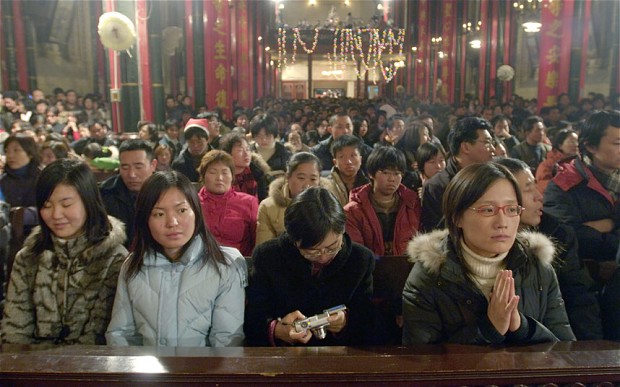
china christianity

One of the most enlightening books I have ever come across was The Victory of Reason: How Christianity Led to Freedom, Capitalism, and Western Success by Rodney Stark. And at the very end of this book there is a quote from a Chinese scholar who had been part of an investigation into the causes of Western economic success. This is a direct quote of what this Chinese scholar had said:

One of the things we were asked to look at was the success, in fact, the pre-eminence of the West, all over the world. We studied everything we could from the historical, political, economic and cultural perspective. At first, we thought it was because you had more powerful guns than we had. Then we thought it was because you had the best political system. Next we focused on your economic system. But in the past twenty years we have realised that the heart of your culture is your religion: Christianity. That is why the West is so powerful. The Christian moral foundation of social and cultural life was what made possible the emergence of capitalism and then the successful transition to democratic politics. We don’t have any doubt about this.

I was reminded of this by an article in London’s The Telegraph with the self-explanatory heading, China on course to become ‘world’s most Christian nation’ within 15 years. And while you may be sure the Chinese government has been keeping a watchful eye on where this might go, they have also not been attempting to stamp it out. And there are reasons for this, in keeping with that earlier study:

Some officials argue that religious groups can provide social services the government cannot, while simultaneously helping reverse a growing moral crisis in a land where cash, not Communism, has now become king.

They appear to agree with David Cameron, the British prime minister, who said last week that Christianity could help boost Britain’s “spiritual, physical and moral” state.

Ms Shi, Liushi’s preacher, who is careful to describe her church as “patriotic”, said: “We have two motivations: one is our gospel mission and the other is serving society. Christianity can also play a role in maintaining peace and stability in society. Without God, people can do as they please.”

In place of a moral order we now have political correctness and the pagan religion of Gaia and the environment. China, meanwhile, may become a Christian nation as we in the West depart from what may be the single most important part of the inheritance we have.