And after all that stimulus spending too

You do know most of our economies are going nowhere, right? So to add to the rest of the tales of woe, there is this from David Uren:

Even assuming that the US overcomes its current budget crisis without wreaking too much damage, businesses in the advanced world may continue to hold back from the investment required to generate jobs and growth. The slowdown in the emerging world, the severity of which has taken the fund by surprise over the past six months, may prove intractable.

The biggest change in the IMF’s outlook in the past six months concerns China. In April, it believed the slowing of China’s growth to just below 8 per cent this year would be a passing pang, with growth returning to 8.5 per cent by 2015 and continuing at that level into the indefinite future.

But it now believes there has been a permanent reduction in China’s potential, and it sees growth slowing to 7.3 per cent next year and to just below 7 per cent beyond 2016. If the pattern of global disappointment continues, China’s long-term growth rate could be below 6 per cent, it says. For the IMF, which traditionally adjusts its forecasts in fractions of a percentage point, this is a huge downgrade.

Public spending beyond some limited amount is a long-term economic disaster. The evidence mounts. But are we learning? We shall see. I will only add that the story presumes that there is a kind of wilfulness in business not investing at the present time. They would if they could so the fact that they don’t tells you something else about how badly our capital base has been mismanaged for the past decade or so in particular.

Only the members of a government and their advisors are apt to believe that members of a government and their advisors are able to direct our resources in a value-adding direction. It is a delusion, but they’re the ones who get to decide. But what a mess their delusions cause!

Keynesian economics is such junk science

It’s not that Greece has forecast a budget surplus that matters but that it has forecast a return to growth and stability going forward. That’s the story in the AFR and although this is all you can see at the link, this is pretty informative as it is:

The government has presented a draft budget for next year forecasting a tenuous return to growth, offering the first real hope that Greece could emerge from a six-year recession.

Well fancy that. They cut spending with a cleaver and the next thing you know they are forecasting a return to economic growth. No riots, no blood in the streets, just a quiet reversal of fortune.

I, of course, mention it because this is such a prime example of how useless Keynesian economic theory is that it is a scandal we haven’t had a mass book burning of all our macro texts. Where besides here are you going to find anyone to explain to you why cutting spending in the midst of recession is good for growth.

Now the story does go on to say that the economy has shrunk by a quarter since 2007. But it’s not the economy that has shrunk but the measured level of GDP. Since most of that shrinkage was in public sector waste, the economy did not shrink at all but actually expanded. With each cut in non-value-adding expenditure the actual effect has been positive. Our macroeconomic data, structured around a Keynesian framework as they are, provide not only zero information about the state of the economy, they may even provide negative information, telling you that things are getting bad when they are in fact on the mend.

The unemployment rate is now going to fall from 27% to 26% which is horrific all round no matter how you look at it. But what they had was unsustainable since most of the jobs lost did not pay for themselves from their own productivity. Now jobs will have to pay their own way. It’s not as pleasant as coasting on the value adding activity of others but it is the only way to create long term growth and stability.

Keynesian economics is such junk science.

Keynesian claptrap

‘We support genuinely liberal policies based on “Austrian economics” in contrast to the Keynesian claptrap routinely espoused,’ Day explains.

This is a quote from Bob Day, Senator Elect from South Australia in today’s Australian.

He thinks of it as Austrian economics but it is much older and broader than that. It is the economics of the entire economics profession during the entire pre-Keynesian era prior to 1936 starting from about 1776. Today’s macro, as I am fond of pointing out, is a classical economic fallacy. Until 1936, the economics of Y=C+I+G was seen as an absurd fallacy, obviously and unmistakeable nonsense. Now it is universally taught at all levels of economics as the fundamental truth.

Here is the issue. Y=C+I+G means total output in the domestic economy is determined by the total of consumption (C), private investment (I) and government spending (G). And thus, so far as this model is concerned, an increase in government spending is absolutely and in every way equivalent to an increase in private investment. If a mining company develops a new mine, according to macro theory, it is identical in every way in its effect on output and employment as increased spending on school halls. This is the economics taught in every mainstream first year macro course in the world. Claptrap doesn’t even get near how idiotic it is nor how destructive.

Welcome Senator Bob Day.

Law of Markets – one year today

Today is the first anniversary since I started this blog. I’m not sure I would have kept it up so long and so well except that having tried a number of other names that were already spoken for, when I finally found Law of Markets free that was that. The perfect name, none could possibly be better, for a blog written by me about what I think matters and care about most. This is also the 525th post which means an average of one and a half a day times 200 words each and we have a book of a 100,000 words.

There are no more than a dozen people whom I have ever told about this blog but it does get found while most people I have told about it never come onto the site. The reason I think I get these stray hits is because people pick up various links off some search engine which directs them here so there are a surprisingly large number of hits and some days it is perfectly astonishing. But since I don’t allow comments I have no idea who anyone is or what they make of it. Mostly, though, this is just for me.

But being the 23rd of September it is also the official birthday of our little kitten Saabina who we found in an old Saab we were about to sell. We were getting the car started by the RACV and the chap who came to start the car – who ended up buying the car – noticed this lone kitten on the floor of the passenger’s seat. I worked backwards about three weeks and from that date in the second week of October three weeks before was 23 September. A very auspicious day which I made her official birthday. It is still a puzzle to me why there was only the one kitten in the litter – whether she was abandoned by her mothers or was the first to be moved in or was the last she was going to move out. We’ll never know but she has been the most unusal little kitten and when she was lost last week it was a very very bad four days. But home she is, and a few hundred dollars of vet fees later, she is home again. But she does use up lives at a most unacceptable rate. Where we will all be a year from now on Saabina’s second birthday and Law of Markets second anniversary who can know. But here we are today.

Anyway, hi Joshi! A happy happy moment this is for me.

The poisonous mind rot of Keynesian economics

The poisonous mind rot of Keynesian economics never seems to go away. I hate to throw an apple of discord into the middle of the party, but this sentence from our new Treasurer should not be allowed to go unremarked. From The Australian today:

Following the election result on Saturday, incoming treasurer Joe Hockey said the Coalition’s victory would encourage consumption. ‘You can go forward and spend your hearts out because we’re going to have a good Christmas,’ he said.

Perhaps I have misjudged what was being said. If the point was that the economy is turning up, real value adding production is going up and you will therefore be able to buy more at Christmas, well OK, although I would not be entirely sure what the point was since in such circumstances you can spend at other times besides Christmas.

But if this is an attempt to get the economy to grow faster through encouraging higher consumer demand, then we are back on the same old Keynesian merry-go-round.

Spending of all kinds draws down on your resource base. Whether it’s by consumers, businesses or government it uses our resources up. Only some of that spending, that drawing down on resources, will eventually add back even more than has been drawn down, and this is almost entirely made up of productive business outlays and innovation that help build the economy.

Not being able to separate the building up from the drawing down is the largest mistake a government can make. Governments can no doubt do all kinds of beneficial things but it should never think that it is making the economy stronger when it is re-distributing the output of industry. The only thing that makes an economy stronger is productive investment, and the benefits do not even occur until the investments are brought on stream and are contributing to the production process. Until then, it is all a negative. It is all drawing down.

I perfectly well understand that Treasury, like economists everywhere, are deluded by the nonsense of Y=C+I+G. Hopefully this government will be different but it won’t be if it believes that strong consumer demand is good for the economy. It is absolutely the other way round. It is a strong economy that is good for consumer demand. The government’s job is to make the economy run better, and if they are going to keep their eye on the ball, it is business investment with a tiny addition of government investment that are the ingredients required. Nothing else will do.

It’s easy to believe what everyone else believes – it’s harder when no one else believes the same

There is this exchange with Ronald Coase:

Reason: You began teaching at the University of Virginia in the late 1950s, and by the early 1960s the administration there was not impressed with the work being done by yourself, Warren Nutter, James Buchanan, Gordon Tullock- four of the most famous and influential economists in the post-war era, two of whom [Coase and Buchanan] went on to win Nobel prizes. Yet the University of Virginia was not happy with what was happening in their economics department.

Coase: They thought the work we were doing was disreputable. They thought of us as right- wing extremists. My wife was at a cocktail party and heard me described as someone to the right of the John Birch Society. There was a great antagonism in the ’50s and ’60s to anyone who saw any advantage in a market system or in a nonregulated or relatively economically free system.

Well, let me change that last sentence just a bit:

There was a great antagonism at the start of the twenty-first century to anyone who saw any advantage in a supply-side approach to the macroeconomy or in a nonregulated pre-Keynesian theory of the cycle based around Say’s Law.

Everyone is so smug and self-satisfied about knowing the world is round once everyone else believes it too. It’s not as easy when there is no one else around anywhere who believes the same things as you do.

Don Argus on Say’s Law

There is literally only a single economics text in the world that will tell you that for public spending to create jobs – any spending for that matter – it must be value adding. It is obvious and really only common sense but it is also a long-suppressed truth that is bringing us to ruin across the economies of the West. In the old days it was commonly understood that demand is constituted by supply, that to increase demand across an economy you first had to raise the level of value adding supply, a notion all but gone from economics since 1936. But here, picked up at Andrew Bolt, is Don Argus saying what is never normally said. Andrew’s heading is “Argus: this debt is dangerous, and bought us trash”. Exactly so!

The problem is that Australia’s debt accumulation did not deliver the optimal returns. There has been little infrastructure investment through the so-called boom, and remedial measures undertaken like stimulus cash payments and pink batts do not produce any ongoing return…

But one could conclude we have an emerging problem in this country that sizeable projects have not been subject to rigorous, publically disclosed cost-benefit analysis. The NBN is the most notable example of this, and the Government appears to have gone to great lengths to conceal its Budget impact.

Argus’s entire article can be found here.

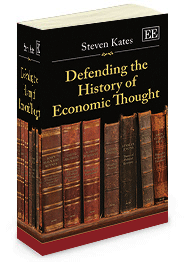
Defending the History of Economic Thought

defending the history of economic thought

My Defending the History of Economic Thought has just been released. As an author, possibly the most interesting part about writing a book is to find the text saying things you had never thought about yourself until you came to write them down. This book is more exceptionally like that than any of the others I’ve written. This is how the text on the back of the book would have read had there been more room:

The aim of this book is to explain the importance of the history of economic thought in the curriculum of economists. Most discussions of this kind are devoted to explaining why such study is of value to the individual economist. It is, of course, but that is not the main point of this book. This book reaches out past the individual to explain the crucial role and importance of the history of economic thought in the study of economics itself. As the book tries to explain, without its history at the core of the curriculum, economics is a lesser subject, less penetrating, less interesting and of much less social value.

It is the orientation that historians of economics give to economics in general that may be its great value. The mainstream is continuously challenged because historians of economics keep bringing other perhaps wrongly neglected economic traditions into the conversation.

The sad reality is that almost no economist being educated today has detailed knowledge of the people who built the ideas found in their texts nor do they know how those ideas evolved. Worse yet, they know almost nothing of those ideas no longer found in our modern texts, many of which had once been central in economic discourse but which have since been moved onto the back shelf for no better reason than because they are no longer part of the mainstream. This book explains not just why anyone who wishes to understand economic theory must understand the history of economics but also, and much more importantly, why the history of economic thought must be preserved as a core component within the economics curriculum if economic theory is to progress.

This fascinating and thought-provoking book will prove invaluable reading for academics, researchers, lecturers and students across the expansive economics field.

The details on where to get a copy of the book may be found here.

The Ten Pillars of Economic Wisdom

The Ten Pillars of Economic Wisdom
By David R. Henderson

1. TANSTAAFL: There ain’t no such thing as a free lunch.

2. Incentives matter; incentives affect behavior.

3. Economic thinking is thinking on the margin.

4. The only way to create wealth is to move resources from a lower-valued to a higher-valued use. Corollary: Both sides gain from exchange.

5. Information is valuable and costly, and most information that’s valuable is inherently decentralized.

6. Every action has unintended consequences; you can never do only one thing.

7. The value of a good or a service is subjective.

8. Creating jobs is not the same as creating wealth.

9. The only way to increase a nation’s real income is to increase its real output.

10. Competition is a hardy weed, not a delicate flower.

Numbers 4 and 9 are core elements of Say’s Law.