Our 40th anniversary is tomorrow

Tomorrow is our 40th wedding anniversary and other than in dwelling on how many years have gone by, I could not be more happy. When I was young, teenager-ish, I came across an article about Charles Boyer’s own 40th anniversary.* Boyer was the ultimate French luuver, and there he had been married to one person, rather than being a man with many women, as is the ideal in these decadent times of ours. And in reply my mother said that the true sign of a great lover is that he can keep the same woman happy for the whole of her life. In fact, literature up until that time was about finding and winning the perfect girl. Today, such a notion would not work for Hollywood nor for most “romantic” fiction. Certainly very few boys would buy into it. It is numbers that matter, a Don Giovanni type love-life that counts as the standard of excellence. A bad standard since it is one that leads to so much unhappiness and discontent. Marrying your high school “sweetheart” is the last thing on anyone’s mind for virtually everyone in our Western world today. And not until I have arrived at this moment myself did it really occur to me that this truly is the ideal, just as my Mother had said all those years ago, bless her.

So here we are at 40 years. Alas, were these normal times we would be having a big, big party, bringing together all of our friends, and with it being a Sunday we could have started early and gone on all day and into the night. But being in the odd times we are, it will just have to be a catered romantic dinner for two around our kitchen table.

The story of how we met I have told many times so will tell it again. It was at a Fancy Dress party – on April Fools Day, in fact. I had been invited by an old friend I used to know from my early days in Melbourne. It was a Saturday night and I came dressed as an American tourist, in a Hawaiian shirt, shorts, thongs and a roll of toilet paper in my back pocket. And into this room came the prettiest, most engaging girl I had seen in a very long time who was easily the most enchanting woman I had ever come upon. Upbeat, happy, full of laughter and adventure. She came as a 1920s flapper which she was the perfect embodiment of. She worked the room coming towards where I was, and finally made it to me after about an hour. My eyes had, of course, never left her – and as she tells it herself, she was working her way towards me since I, bless my soul, was her perfect type, at least from a distance. 

We then sat and chatted, talked about this and that – I actually still remember the conversation surprisingly well – and then I offered to drive her home when it was all over, in my beat up 25-year old Cortina. Which would have been fine except that the car would not start and needed a push-start from everyone else to finally get the engine to turn over. She was definitely not looking for wealth and status. So we drove out to the airport and back to charge the engine, and then after a night of more chat and more coffee and cake, we went on the Sunday morning to see her best friends to see how I would fit into her life, and then we went to see my best friends, so that I could do the same. And then we met again on the Monday in the city since we were both working not all that far from each other.

But this morning at work was the moment that mattered. I told the story at our wedding and a number of times since. It is known, and I do mention it from time to time, that before I became the sober man of the right and a proper bourgeoisie, I had been a long-haired hippy new-left loon, even having gone so far as to live in a “commune” in Vancouver, hanging out with all forms of disreputable types, of whom I was amongst the more disreputable. This, mind you, when I had already become a B.A./M.A. I was at work in the morning in the Economics Department of one of our Big Four banks, and I went to the chap who did the mining analysis and forecasts and asked to borrow his copy of the I Ching. The I Ching, if you don’t know it, is an ancient Chinese “oracle” to which you can pose various questions about what to do, and which will provide answers that usually requires a certain kind of wavering judgment and careful interpretation to make sense of. My friend David used the I Ching, along with his astrological charting plus numerology, to make his forecasts for the mining industry. Bear that in mind next time you think about buying shares, whether bank shares or mining shares. I might just mention that he eventually left the bank because he was sure that there was going to be a California earthquake as foretold by Edgar Cayce, that would send a tidal wave across the Pacific leading to mass drownings in Melbourne. David therefore sold up his beautiful house in Carlton and moved to Nimbin. I only once again ever saw him, at an economics conference, where he presented a paper on the use of astrology in making economic predictions.

But on this day, being already very familiar with the I Ching from my earlier days, I asked to borrow his copy, which is the last time I ever used it or any other form of forecasting technique, other than, of course, economic theory. And I asked David for the book and put the fateful question: Should I marry this girl? I might also here mention that I introduced these devices to my children by telling them that they are a fun part of life, but the moment you find even the slightest tweak of a notion entering their heads that these things will accurately foretell anything, they must be discarded and never be used again. That is my advice to everyone. Now let me return to that moment in 1978.

And here was the point about the question. I was a young lad, only just having turned thirty. I was living the life that many young lads at that time of life foolishly prefer to live. And having met the perfect girl, the reason I was going into this further investigation of the proper course of action was, I am ashamed to admit, so that I might find some reason, anything at all, where is that straw for me to grasp, not to continue along this path towards marriage, but so that I could have some reason not to. And as you might know with all of these devices, there is a certain fuzziness that allows you to read things in many different ways. An easy way out, right?

I tossed the coins and then the most astonishing thing happened. And this was the only time this had ever happened. It gave me an absolutely clear answer that was unambiguous in stating without any possible way to equivocate: YOU SHOULD MARRY THIS GIRL!

And it was even worse than that. The way the oracle works is that there are almost always “Change Lines” in the result so that what might be the advice at the moment of consultation will over time slither into its opposite or at least towards some other answer. But here, for the first and only time in all the times I had used the I Ching where there were no Change Lines. How it was on that day in 1988 would be how it would be for all times. Honestly, I was truly amazed since nothing like it had ever happened before. It is a rare occurrence, I can tell you.

And so it has turned out. The entire universe in its cosmic unfolding had told me in no uncertain terms that this was the girl I must marry if I sought happiness and a blessed life of marital contentment that would continue forward exactly how it had  begun. I now know this is the only form of true happiness, the only one that counts. The greatest of all of G-d’s blessings is a happy marriage. 

I will add something else which I have only found out recently, but which when I read turns out to have been exactly what I did in wending my way towards that moment. And in its own way this is as mystical an approach, and no doubt about as accurate as my tossing the coins to consult the I Ching. This time, however, it is by using advanced statistical methods to find your one true love and companion for life (I think this may only works for males, by the way, but perhaps not). Let me quote from the text. This is from Amir D. Aczel: Chance: A Guide to Gambling, Love, the Stock Market & Just about Everything Else, p86):

“You will maximize your probability of finding the best spouse if you date about thirty-seven percent of the available candidates in your life, and then choose to stay with the next candidate who is better than all the previous ones.

“This is, indeed, a strange-sounding rule. But mathematicians have proved it works better than any other. The number thirty-seven percent is an approximation of the exact number 1/e, where e is the base for natural logarithms, or 2.71828.” 

The science is settled, and you don’t want to go around arguing with science, do you?

We have had a remarkably friction-free 40 years, although I do have to say there is that one area where we do not perfectly line up, and as with many couples, it is with politics. We have managed to work it through, but as it turns out, of the two of us, she is the more conservative, the most hardline on the right. I may waver here or there, but she never, and apparently from a very young age. 

There we are in the photo below, me looking as cheerful and debonair as ever.

The only lesson I feel I have learned in all this time is that what is best in life is to turn seventy and find you have been happily married to the same person for the previous forty years.


* Charles Boyer was the husband of British actress Pat Paterson, whom he met at a dinner party in 1934. The two became engaged after two weeks of courtship and were married three months later. The marriage lasted 44 years until her death.

Today is the eighth anniversary of this blog!!

And this is the 5408th post since I began. Started just for fun, and still doing it just for fun. But from it wrote the first book ever published, so far as I know, that consists entirely of blog posts from a blog: The Art of the Impossible: A Blog History of the Election of Donald J Trump as President. Even more gripping to read now as we head into the re-election. The next book I might put together is a collection of posts of mine on Say’s Law. The blog, as I have noted before, was really a means to communicate with my children who, bless their hearts, still tolerate my writing, and dare I say it, even agree with me, at least some of the time, and perhaps even most of the time. Now lots more people come onto the site each day and I am really happy to see you all here. In the meantime, Hi Joshi.

Why did Marx single out Mill for criticism but never answer him?

A Question asked on Marx and Mill.

What were the theoretical issues when Marx and Marxian economists criticized John Stuart Mill as vulgarizer of classical system?

What is the real content of vulgarization, when they claim that J.S. Mill vulgarized Ricardo’s teachings? In what sense is he blamed to have opened the way to neoclassical economics?
Béla Balassa once wrote in his paper “Karl Marx and John Stuart Mill” (Weltwirtschaftliches Archiv, Bd. 83, (1959), pp. 147-165):
  •  Marx’s treatment of John Stuart Mill is one of the great puzzles of history of economic thought. Reading Marx (and his followers) one gets the impression that Mill was an insignificant figure whose writings exemplify the “decline” of Ricardian economics. Whenever Marx mentions Mill’s name (which does not happen very frequently) he v\never forgets to add some derogatory comment. (p.147)
In another paper (John Stuart Mill and the Law of Markets, The Quarterly Journal of Economics Vol. 73, No. 2 (May, 1959), pp. 263-274) he wrote:
  • For present-day economists [Mill] represents a “half-way house” between Ricardo and Marshall; for Marxists he is the apologist personified, sharing the responsibility with many others for the “decline” of Ricardian economics.(p.263)
I wonder why John Stuart Mill was so unduly ill-treated by Marx and Marxian economists.

Then answer is, of course, that Marx had no answers to what Mill wrote, neither economically nor ethically. But is Marx’s animosity to Mill the reason virtually no economist will read Mill today?

My missing reply to Roy Grieve

Getting an anti-Keynesian article published is very difficult. The following is an interesting parable of our times. There are lots of additional details left out here, but this captures the essence of the story. This short note will be published in the forthcoming issue of the History of Economics Review along with the article by Roy Grieve which I had been asked to reply to.

A Note on My Missing Reply to Roy Grieve
Steve Kates

It is quite a shame the article I had written in reply to Roy Grieve’s will not be published along with his. When his paper was submitted in 2018, I was asked by the editor to write a reply which I quite happily did. Thereafter, I heard nothing for two years until I was told what I had written was not suitable, would not be published, and was offered a truncated version of my paper that I could include instead.

The problem with my paper I was told was that I did not address the core issue Roy had raised which was the wages fund. Since Roy was replying to a paper I had written, the probability that I might have a better idea of what the issues are ought to be seen as extremely high. The editor nevertheless continues to believe the central issue is the wages fund. Since the paper Roy was replying to is titled, ‘Mill’s Fourth Fundamental Proposition on Capital: A Paradox Explained’ (Kates 2015), that ought to be recognized as the issue we were debating. In my reply to the editor, I made it clear the wages fund had nothing to do with Mill’s argument, nor did I wish to contribute further. Mill’s proposition by the way, if true, completely undermines Keynesian economics and modern macro. In Mill’s words, ‘demand for commodities is not demand for labour’ – increases in aggregate demand do not lead to increases in employment.

Roy understood that leaving out my paper diminished the impact that having his paper and my reply together would have had. He therefore wrote to the editor to suggest I add something on the wages fund. And I agreed. I wrote to the editor and said that I was prepared to write an article along these lines:

1. The wages fund has nothing of significance to do with Mill’s Fourth Proposition on Capital.
2. The ‘wages fund’, if understood properly, makes perfect sense.
3. The wages fund, if understood properly, is even an integral part of modern economic theory.
4. Much of the difficulty in understanding the classical view on the wages fund is due to the shifts in terminology since the middle of the nineteenth century.

The final point is the theme of my latest book, Classical Economic Theory and the Modern Economy (Kates 2020a), where all this is discussed more generally. In the end, I have been offered these 600 words. You cannot therefore see within the pages of the journal either my response to Roy or my explanation of the wages fund in modern terms.

Let me therefore add this. I admire Roy’s paper which does something almost never seen. He explains my argument in defending Mill, not only understanding exactly what I had written but also understanding Mill’s argument to near perfection. He nevertheless argues in his paper Mill’s Fourth Proposition depended on the wages fund, so that when Mill abandoned the wages fund in 1869, he had pulled the rug out from under his own Fourth Proposition. If you read my reply to Roy, you will see that I do not agree.

You can read my original reply to Roy at SSRN (Kates 2020b). My explanation of why the wages fund is even to this day embodied within modern economic theory will have to remain a mystery.

Steve Kates
steve.kates@gmail.com
Submitted 11 June 2020

References

Kates, S. 2015. ‘Mill’s Fourth Fundamental Proposition on Capital: A Paradox Explained.’ Journal of the History of Economic Thought 37 (1): 39–56.

Kates, S. 2020a. Classical Economic Theory and the Modern Economy. Cheltenham, UK: Edward Elgar.

Kates, S. 2020b. ‘The Single Most Important Issue in Economics Today: A Reply to Roy Grieve on Mill’s Fourth Proposition on Capital’. SSRN.

Have I ever mentioned before that the level of unemployment is unrelated to the level of aggregate demand?

In the news today.

RECOVERY SUMMER! Record jobs gain of 4.8 million in June smashes expectations; unemployment rate falls to 11.1%. Democrats, media hardest hit.

`
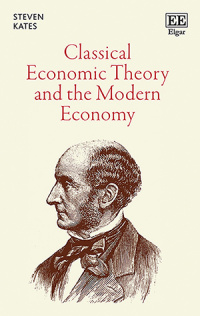
By the way, my latest book has just been released: Classical Economic Theory and the Modern Economy. The two references on the back cover:

‘In Classical Economic Theory and the Modern Economy, Kates seeks to correct this dangerous intellectual detour economists took due to Keynes and finally get modern economists to practice economics beyond the shadow of Keynes. It is a Herculean task, but armed with J.B. Say and especially J.S. Mill, Steven Kates makes as strong an effort for resurrection of classical economy theory as can be marshaled. This will be a must read for all students of economics, and a compelling contribution to the history of economic doctrine.’
– Peter Boettke, George Mason University, US

‘This book delivers hard blows to the tenets of modern economics, retells its history and evolution, and pokes holes at our misperceptions of classical economic theory. The result is as much a burial of the macroeconomics of Keynes as it is a resuscitation of the classical economics of J.S. Mill.’
– Per Bylund, Oklahoma State University, US

For a change, we have two people commenting on a book who actually seem to have read it and know what it says.

Reifying a classification

In my previous post on how useless Keynesian economics is I wrote:

A Keynesian believes that economies are driven from the demand side and that recessions are due to a deficiency of demand. The cure for recessions are therefore increased public spending to increase the level of demand, raise the level of activity and return an economy to full employment. You know, from the equation Y=C+I+G etc, where more G leads to more Y and therefore more jobs. Introduced into economic theory in 1936, there has never been a single occasion when a Keynesian “stimulus” has led to a recovery. Not one, not ever.

The first comment was by 2dogs who wrote:

The problem with this is that it is a logic fallacy known as “reifying a classification”.

Y=C+I+G is merely a classification system, not some empirical result. One can create classifications to divide up the total transactions any number of different ways. The totals resulting are completely arbitrary; none of the classifications so created have a real existence in and of themselves. Suggesting that increasing the size of one classification will increase the overall total is mindless paper shuffling. I could just as easily create a different classification system that demonstrated the need to increase in the amount of money paid to me.

This, let me tell you, was a revelation. I have never heard of this particular form of fallacy nor has anyone ever before brought it to my attention. I often compare, and discuss in my text, the difference between the identity

Y ≡ C + I + G

which is the formula for calculating the National Accounts since it is essentially an accounting measure which is just true by definition, and this:

Y = C + I + G

which is the fundamental equation of modern macro, which says that an increase of any of the elements on the right side, such as an increase in government spending of any kind represented by G will lead to an automatic increase in output, represented by the letter Y. In fact, according to theory, Y will increase even more than whatever G is increased by because of supposed multiplier effects. The difference was highlighted by Duncan in a comment on the original article I cited.

Keynesian economics says that if you borrow $1m to dig a hole and $1m to fill it in you have ‘created’ $2m of ‘production’ and jobs.

In reality you have subtracted $2m from your wealth.

That is exactly right but requires a return to pre-Keynesian kinds of thinking. Why that is not obvious beyond argument I cannot work out. Nevertheless, the argument has now progressed so that even loss-making operations, or even activities that are wholly wasteful, can contribute to growth by adding to the number of jobs. Is it not obvious how stupid this is? No it’s not, and here’s part of the proof: With economic recovery far from assured, the PM’s nerve may be fraying by the ever unreliable Ross Gittens:

The plain truth is that the only way out of deep recessions is for governments to spend their way out….

Recessions always involve the private sector – businesses and households – contracting and the public sector expanding to take up the slack and get things moving again. In our particular circumstances, six years of weak wage growth and record household housing debt means consumers have little scope to start spending big.

This is economically illogical but such arguments are now almost universally held. And he even notices that we have already had six years of weak wages growth following the so-called stimulus packages that followed the GFC. It would never occur to him, nor to the millions of trained economists around the world, that real wages have fallen not in spite of the stimulus spending but because of them.

Would the real anti-Keynesian economist please stand up

Classical Economic Theory and the Modern Economy

Here there are two anti-Keynesians in Australia and we both disagree with each other. The headline in the paper was kind of all right – It’s Keynes’s fault – again we go into debt to ‘stimulate’ the economy – but so incoherent was this as an anti-Keynesian rant that it has left me completely nonplussed (defined as: “so surprised and confused that one is unsure how to react”).

A Keynesian believes that economies are driven from the demand side and that recessions are due to a deficiency of demand. The cure for recessions are therefore increased public spending to increase the level of demand, raise the level of activity and return an economy to full employment. You know, from the equation Y=C+I+G etc, where more G leads to more Y and therefore more jobs. Introduced into economic theory in 1936, there has never been a single occasion when a Keynesian “stimulus” has led to a recovery. Not one, not ever.

I should also add that Keynes, in writing his General Theory, made a point about his rejecting this concept called “Say’s Law”. Mere detail to others who enter these discussions. And while I sort of agree with the conclusion, I am completely foxed by how it was arrived at:

Cutting government spending should take precedence over raising taxes. Reduced public spending, particularly on industry assistance and overlap in spending at federal-state levels, should be central to the recovery program.

This should be accompanied by tax reform (including to internationally uncompetitive company tax rates), business deregulation and industrial relations reform. Without this, our economy will remain in limp convalescence for decades.

That raising taxes is even an option is beyond me, but as for cutting public spending I am all in. But unless you understand the reasoning behind the pre-Keynesian position and Say’s Law, you won’t understand what needs to be done, and especially why it needs to be done. Everyone seems to be in for “infrastructure spending” but if we haven’t learned from the NBN, there is no hope for any of us.

Which reminds me that my latest book – Classical Economic Theory and the Modern Economy – is being released just this month.

Economic theory reached its zenith of analytical power and depth of understanding in the middle of the nineteenth century among John Stuart Mill and his contemporaries. This book explains what took place in the ensuing Marginal Revolution and Keynesian Revolution that left economists less able to understand how economies operate. It explores the false mythology that has obscured the arguments of classical economists, providing a pathway into the theory they developed.

I read other economists today and laugh since what else is there to do? Real wages have been falling across the world – other than in the US and then only until recently – since the stimulus programs that followed the GFC. If you want to know why, you could always buy the book, or at least get your library to order it in.

T.R. Malthus’s Principles of Political Economy first edition was published in 1820

This is the 200th anniversary of the publication of the first edition of Thomas Robert Malthus’s Principles of Political Economy in 1820.

The funny thing is that I was thinking about the publication of Malthus’s first edition of his Principles only because I was thinking about how hard it is to maintain friendships with other economists who differ with our own views, which from that led me onto thinking about the greatest friendship in the history of economics, the friendship between David Ricardo and Robert Malthus, and how Ricardo had written to Malthus, just before he died, that even had they agreed on everything instead of disagreeing on everything – which was more or less the truth of it – he could not have liked Malthus any more than he did. It really is how economic discourse should be undertaken. And from that it occurred to me that the publication of Malthus’s text led onto the General Glut debate, the formulation of what we now call Say’s Law, which then instigated the Keynesian Revolution and thereon to modern macroeconomic theory. There can hardly be an anniversary in the entire history of economics more significant than that.

The second edition from The Liberty Press can be found online here.

The Outline

Malthus may have been the single most influential economist who has ever lived – Karl Marx included. In his own time there was his Essay on Population which was a crucial element in the structure of economic theory as well as a good deal of social policy in his own time and for long after. Far more important, however, was his Principles of Political Economy, published exactly two hundred years ago this year in 1820, which touched off a debate over the possibility of a “general glut” – demand deficiency – that has had two sets of consequences. In his own time and until 1936, the mainstream of the economics community were united in denying the possibility of a general glut, that is in denying the possibility of over-production as a cause of recession and high unemployment. But then, of even more significance, John Maynard Keynes, following his coming across the general glut debate in his reading of Malthus’s correspondence with Ricardo at the trough of the Great Depression in 1932, was set on the road to write The General Theory in which the possibility of a general glut – a deficiency in the level of aggregate demand – was developed so that an under-employment equilibrium was seen as not only possible but common.  Virtually the whole of mainstream economic theory has as a result accepted Malthus’s conclusion down through to the present day.

Malthus published his economics text Principles of Political Economy exactly two hundred years ago in 1820, but what made its publication so notable was that Malthus was already world-famous because he had previously published his Essay on Population in 1798 (a book which has never since then been out of print). Malthus’s Principles was not therefore just another text on economic theory but was authored by the most famous “public intellectual” of his time.

In so far as economic theory was concerned, it was a generally standard account for its time, except that he argued that the recessions that had followed the Napoleonic Wars which had ended in 1815 were due to a general glut, or in modern terms, to a deficiency of demand. The notion of a general glut needed to be distinguished from a particular glut. That an individual product could be produced in quantities so large that not all production could be sold was recognised as obviously true. A general glut, however, suggested that not just individual products, but an excess of output in general of everything could be produced.

The reason that a general glut might occur was due to over-saving. Production was being channelled into proportionately too large a flow of capital goods rather than into consumer demand. The additional capital was creating a flow of output beyond the willingness of the population to consume everything that had been produced, leading to a general glut and a high level of unemployment.

His solution was that the landed aristocracy be encouraged to spend more and invest less.

This proposition led to what has since been called “the general glut debate” which, according to Thomas Sowell, continued through until 1848, only finally coming to an end with the publication in that year of John Stuart Mill’s own Principles of Political Economy.

The core question of the general glut debate was whether it was even conceivable in a world of scarcity that the productive powers of an economy could overwhelm the willingness of a community to buy everything that had been produced. It was conceded by all that too much of any individual product might be produced, and that if there was a large disorganisation in the specific goods and serviced being produced an economy might end up in a downturn where many might lose their jobs.

Virtually every economist at the time entered into this debate.

But the economic consensus was that an economy could not produce more than an economy.

McCulloch/Torrens

They may be wrong but at least they’re consistent

Labor industrial relations spokesman Tony Burke said it was “now well established that penalty rate cuts have not created new jobs”. “Continuing with this flawed strategy is the last thing we need right now; we don’t need more cuts, we need people spending to lift Australia out of recession,” he said.

That’s from The Oz. The amount of economic damage these Keynesian clowns have caused is astounding. And as social diseases go, this seems to be the most difficult to eradicate. Toxic stupidity. And I will say it again and invite anyone to show any instance where this has turned out to be wrong: No Keynesian stimulus has ever led to a fall in unemployment and an increase in economic growth.

I mention it only because the nonsensical belief that spending leads to higher levels of production – when it is higher levels of production which lead to higher spending – is just routine anti-capitalist, anti-free market rhetoric without a scrap of evidence to support it.

Might add this while I’m here since Dangerous Dan Andrews is amongst the worst of them. In this case its its this: Coronavirus: Black Lives Matter protest kills off commonsense.

Victorian Premier Daniel Andrews (left) and Black Lives Matter protesters gather in Melbourne on Saturday. Pictures: File

The Black Lives Matter marches in Melbourne and everywhere else signalled the death of commonsense in Australia.

No social distancing, an infectious demographic and deep-seated carelessness have combined to produce the obvious.

Actually, it’s about the only good thing Andrews has done since it will bring the lockdown to an earlier end than might otherwise have happened.

Classical economics and the unemployment rate in the United States

As anyone who understands classical economic theory would understand – which might include around half a dozen people across the world today – “demand for commodities is not demand for labour”. That is John Stuart Mill’s Fourth Fundamental Proposition on Capital. The number of jobs in an economy is unrelated to the level of aggregate demand. This, I need hardly tell you, is in direct contradiction of the whole of modern macroeconomic theory. Which brings us to the latest jobs report in the United States. U.S. Economy Adds Record 2.5 Million Jobs in May, Unemployment Rate Falls to 13.3%.

The U.S. Bureau of Labor Statistics (BLS) reported the U.S. economy added 2.5 million jobs, the largest gain ever recorded and the unemployment rate fell to 13.3 in May.

Well economic good news of such a colossal dimension cannot be allowed to stand on its own so this is what the media reported on instead: Fake News: Media Rush to Decry Trump Quote on George Floyd During Jobs Report Presser – Except He Didn’t Say It

President Trump held a press conference/signing ceremony today at the Rose Garden where he talked about the good news revealed by the BLS’s report before signing a bill that will “give recipients of government small business loans during the coronavirus more flexibility in how they spend the money.”

During the speech he gave before signing the bill, Trump also talked about a number of issues including racial equality in the context of the death of George Floyd last Monday, which happened after Minneapolis police officer Derek Chauvin had his knee on Floyd’s neck for nearly 9 minutes.

CBS News is one of the few news outlets that actually reported Trump’s comments accurately while providing some context:

But black unemployment rose slightly from 16.7% in April to 16.8% in May, in a month the president declared a “tribute to equality” as the nation protests racial discrimination and police brutality. Mr. Trump also seemed to declare success after a week of protests that swept the nation.

“Equal justice under the law must mean that every American receives equal treatment in every encounter with law enforcement, regardless of race, color, gender or creed, they have to receive fair treatment from law enforcement,” the president said. “They have to receive it. We all saw what happened last week. We can’t let that happen. Hopefully, George is looking down right now and saying this is a great thing that’s happening for our country. This is a great day for him, it’s a great day for everybody. This is a great day for everybody. This is a great, great day in terms of equality.”

See for yourself.

Wouldn’t have mentioned it except this media lie was the first thing said to me by my wife this morning.

For added pleasure, you might also wish to read this as well: Paul Krugman Caught in Hilarious Self-Own After Furiously Spinning Conspiracy Theories About Good Jobs Report.