A history that goes back about twelve months

As I knew I would do, as soon as I came across Mark Blyth’s Austerity: the history of a dangerous idea that I would buy it. Not all the way through it yet, but to help you understand just how useful it is, let me note first that on the back cover the very first of the people quoted to expain why someone ought to buy the book is written by John Quiggin. “An essential guide for anyone who wants to understand the current depression”. How austerity can be used to explain anything over the past five years up until the end of last year I will try to work out in making sense of the book.

As to its contents, this is the only reference to Say’s Law, found on page 137:

The policy objective of these institutions was therefore the encouragement of ‘achievement competition’ rather than ‘impediment competition,’ whereby the quality of products manufactured would create the demand for them, in a modern supply-side restatement of Say’s Law.

Is life really long enough for me to read the rest?

From Catallaxy on 3 July 2013.

Arnold Kling on George Gilder

I will want to write my own post on George Gilder’s brilliant Knowledge and Power but I have just run across this review by Arnold Kling who is favourably mentioned in the book. Kling is not all that enamoured with the book, as seen in this passage:

Gilder would argue that redistribution is baked into the methodology of economic models that downplay agency and instead treat economic outcomes as random. For example, finance professors will describe the effort to “beat the market” when investing in stocks as a sort of coin-flipping tournament. Start with a very large number of players, have them each flip a coin five times, and see which flippers get the most heads. Some players will get heads five times in a row, making it appear that they are very skilled coin-flippers. By analogy, if we start with a large number of stock market investors, a few of them will outperform the market several years in a row. These sorts of models imply that wealth accumulation results from a combination of risk taking and luck. Instead, Gilder insists that it results from better knowledge, which has been used to create products and services that promote human flourishing. (He would make an exception, of course, for knowledge that only exploits government-created noise.)

In Gilder’s view, entrepreneurs create information where none existed before. Rather than sustain the equilibrium, their role is to disturb it.

On this issue, I have mixed views. On the one hand, when it comes to business success, I agree with Gilder. Even though luck plays some role, skill matters much more, because there are so many little choices that must be made wisely in order for an enterprise to succeed. The more skilled business team usually will win, just as in tennis the more skilled player usually will win. On the other hand, with financial speculation, skill and luck are more difficult to separate. To me, financial speculation is more like a multiple-choice question on a test. One can easily make a good choice for a bad reason, or vice-versa.

There is much to quarrel with in Gilder’s book. For one, his political and social conservatism will put off many readers. Also, in his attempts to sharpen the contrast between his views and those of other thinkers, he often paints a caricature of the individual he is criticizing. For example, his depiction of Burton Malkiel, the American economist best known for his support of the efficient market hypothesis, as an adherent of technical analysis was completely unfair.

Funny business this. His political and social conservatism hardly put off this reader since, to tell the truth, I didn’t even notice it. As far as I can see, there was little ideology as such, only a drawing of the implications of the basic premises that his arguments were built upon.

When do you think they’ll work out that government spending doesn’t create jobs?

From The Wall Street Journal but quoted from Instapundit:

The recession ended four years ago. But for many job seekers, it hasn’t felt like much of a recovery. Nearly 12 million Americans were unemployed in May, down from a peak of more than 15 million, but still more than four million higher than when the recession began in December 2007. Millions more have given up looking for work and no longer count as unemployed. The share of the population that is working or looking for work stands near a three-decade low.

The Waffle Street Tales – Say’s Law as Literature

Say’s Law has entered the world of literature. No longer is it mere economics but is now embedded in an extraordinary story that is both enlightening, instructive and funny all at the same time. The book is titled Waffle Street: the Confession and Rehabilitation of a Financier, it’s by a chap named James Adams and it is now into its second edition.

The story is this and is basically a first person adventure based on his own personal experience during the post-2009 crash. Jimmy Adams goes from hedge funds to a Waffle House [think a downmarket Pancake Parlour], from a seller of securities to a server of hash browns and grits. Along the way he learns some actual lessons about how economies work, Say’s Law being at the top of the list. It’s a book that you will read for its entertainment alone, but the message is very clear – and it is not a message found between the lines but in almost every chapter. Only adding value creates jobs, growth and the ability to demand.

The video is the trailer for the book and has been put together by John Papola of the Keynes-Hayek Rap. And if that’s not enough to get you to go off and order your copy, there is Doug French, the President of the Mises Institute, who has written a truly insightful review of his own which you can find here. The core quote from Doug:

But Adams does scrap with John Maynard Keynes in the pages of Waffle Street, lamenting, ‘How far we’ve fallen’ in the area of economics education. Pointing out that Say’s Treatise was once the top economics textbook in America, he explains that now, ‘Instead of learning sound doctrine, today’s undergraduates are inundated with principles that will not bear the scrutiny of common sense and experience.’

There are not many places you can go to find out about Say’s Law in the world today and there’s much else besides. You can read my book or you can read Jimmy’s. Preferably you will read both but Jimmy’s is much funnier than mine.

[Originally posted on Catallaxy on 19 August 2011]

Unwarranted fallacies and delusions

The Trades Hall at the corner of Victoria and Lygon Street has a book fair this weekend which I went along to with everyone else at ten to eleven just as it opened. On again on Sunday if you’re in Melbourne.

But the real reason I mention it was because I picked up an 1873 first edition of Herbert Spencer’s The Study of Sociology for $4 which is a bargain but nothing exceptional. They are on Abebooks for around $US50. But really, what was fascinating to me was found on the very first page which I here quote. He is discussing how even the intelligent and educated end up holding absolutely ridiculous opinions:

Now, as then, may be daily heard among other classes, opinions just as decided and just as unwarranted. By men called educated, the old plea for extravagant expenditure, that ‘it is good for trade,’ is still continually urged with full belief in its sufficiency. Scarcely any decrease is observable in the fallacy that whatever gives employment is beneficial: no regard being had to the value for ulterior purposes of that which the labour produces; no question being asked what would have resulted had the capital which paid for the labour taken some other channel and paid for some other labour. Neither criticism nor explanation modifies these beliefs. When there is again an opening for them they are expressed with undiminished confidence. Along with delusions of this kind go whole families of others. [p1-2]

What words he uses! “Unwarranted”. “Fallacy”. “Delusions”. Yes, yes. All that and more. And do I not know for myself that “neither criticism nor explanation modifies these beliefs”. You just cannot stop people believing that extravagant expenditure is good for trade and jobs no matter how often reality shows them it is a belief that is simply untrue. He goes on:

People who think that the relations between expenditure and production are so simple, naturally assume simplicity in other relations among social phenomena. Is there distress somewhere? They suppose nothing more is required than to subscribe money for relieving it. On the one hand, they never trace the reactive effects which charitable donations work on bank accounts, on the surplus-capital bankers have to lend, on the productive activity which the capital now abstracted would have set up, on the number of labourers who would have received wages and who now go without wages—they do not perceive that certain necessaries of life have been withheld from one man who would have exchanged useful work for them, and given to another who perhaps persistently evades working.

And the same paragraph continues:

Nor, on the other hand, do they look beyond the immediate mitigation of misery. They deliberately shut their eyes to the fact that as fast as they increase the provision for those who live without labour, so fast do they increase the number of those who live without labour; and that with an ever-increasing distribution of alms, there comes an ever-increasing outcry for more alms. Similarly throughout all their political thinking. Proximate causes and proximate results are alone contemplated.

But this is the bit I like the best. Just think of blaming recession on a deficiency of aggregate demand and you will see why this appeals to me as much as it does:

There is scarcely any consciousness that the original causes are often numerous and widely different from the apparent cause; and that beyond each immediate result there will be multitudinous remote results, most of them quite incalculable.

By coincidence, there was a resurrected article yesterday on the Mises Daily website that had been written by Henry Hazlitt in 1969 which was posted under the title, From Spencer’s 1884 to Orwell’s 1984. I will merely repeat two of the quotes from Spencer that Hazlitt had chosen but the entire article is quite worth the read. Firstly Spencer in 1884 complains about the increasingly intrusive regulations that are becoming worse by the year:

Regulations have been made in yearly growing numbers, restraining the citizen in directions where his actions were previously unchecked, and compelling actions which previously he might perform or not as he liked; and at the same time heavier public burdens … have further restricted his freedom, by lessening that portion of his earnings which he can spend as he pleases, and augmenting the portion taken from him to be spent as public agents please.

And then he note that governments are reducing self-reliance by inserting themselves into what had previously been left to individuals to deal with on their own:

The more numerous public instrumentalities become, the more is there generated in citizens the notion that everything is to be done for them, and nothing by them. Every generation is made less familiar with the attainment of desired ends by individual actions or private agencies; until, eventually, governmental agencies come to be thought of as the only available agencies.

How to teach the history of economic thought

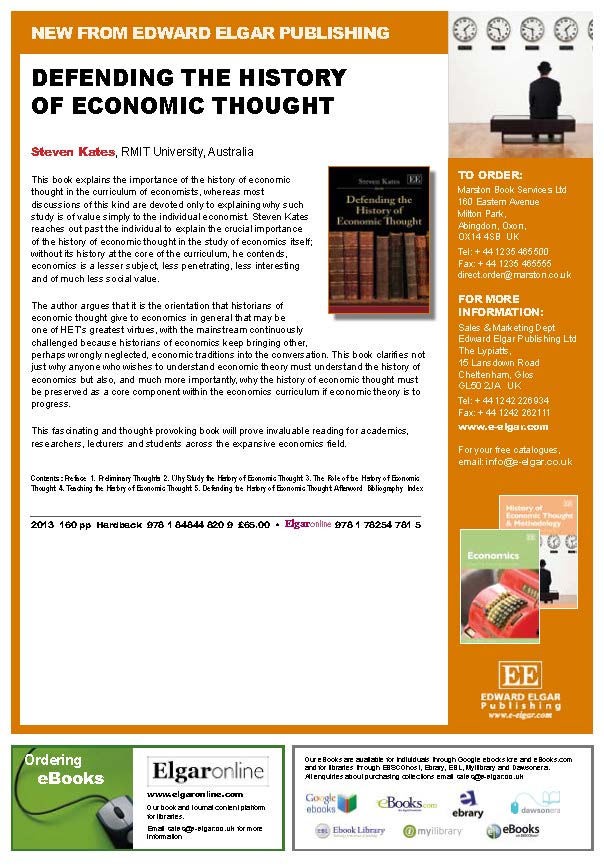
I am actually becoming hopeful that my Defending the History of Economic Thought, which will be released at the end of July, may turn out to be a very useful book. Each time I have gone over it myself, I have found it surprisingly filled with nice ideas about the value and role of the history of economic thought to economists. And it’s because I started from a different question than most others: why does the subject matter of economics need the history of economic thought to be taught to economists. Anyway, the following question was posted by Howard Baetjer Jr at the Austrian website the other day:

Dear Austrian list members,

I get to teach History of Economic Thought next term! I’m eager but ignorant and looking for guidance.

  • What textbook (if any) should I use?
  • What outside readings should I assign?
  • If you have a syllabus that has worked well for you, would you share it with me and let me copy freely, giving you credit on my syllabus for what I take from yours? (Steve Horwitz did this for me years ago for Money and Banking; it has been immensely valuable.)
  • Do you have any particular approach to recommend?

I am very much aware of Larry White’s The Clash Of Economic Ideas; I’m reading it now, loving it, and almost finished. Peter Boettke’s Living Economics is next on my reading list:

  • Would you recommend that I use one or both? If so, along with a standard textbook or not?
  • Any sage advice for me as embark on these unfamiliar seas?

I would appreciate any suggestions, comments, warnings, recommendations of any kind. I’m not good at reinventing wheels.

Gratefully in advance,

Howie

And here is my reply:

It is good to see history of economic thought still on the curriculum. My Defending the History of Economic Thought is being published next month by Edward Elgar in which I devote a chapter to discussing how I think HET ought to be taught. And the approach I discuss is not just to use a modern HET text and then look backwards from today but to use actual mainstream textbooks of the time to explore how a typical economist would have looked at the various economic issues back then. As an example, one might choose a series of contemporary textbooks such as McCulloch 1825, Mill 1848, Taylor 1913 and Samuelson 1948, each of which can now be purchased in a cheap edition, and then examine various themes such as the notion of market adjustment, their theory of monopoly, their theory of value, the business cycle, or whatever else might be of interest to compare how these were approached in different eras. Looking only at the great names and the great discoveries has an interest of its own. But if you are also interested in understanding how economists looked at the world during different periods of time, this is the approach I would adopt. The book is out next month but if you are interested in a copy of the chapter on teaching HET, just let me know.

And the funny thing is that there is probably no other subject whose history can profitably be taught in that way. The controversies are still alive and almost no issue is ever settled for all time. A very funny subject, economics.

Should one teach Marx as part of HET?

David Henderson had the following blog post today at Economic Liberty

On a short blog post today, Daniel Kuehn, preparing to teach an undergraduate course in the history of economic thought, writes:

I wish I could completely skip Marx… does that make me a bad person? I suppose I shouldn’t. A few in the department would probably be miffed too if they found out.

First, Daniel, it doesn’t make you a bad person. Indeed, my respect for you just rose from what was already a reasonably high level.

Second, that reminds me of a true story. My friend Chris Jehn, while a Ph.D. student in the University of Chicago’s economics program in the late 1960s or early 1970s, took a course in the history of economic thought from the late George Stigler. Many people might have forgotten this, or perhaps never knew it because George was known mainly for his work in industrial organization and regulation, but the history of thought was one of George’s passions and it was an area in which published a lot in the 1940s and 1950s.

Back to the story. The first day of class, Stigler handed out a pretty comprehensive syllabus and started going over it in class. A student with a foreign voice raised his hand. ‘Yes,’ said Stigler (and if I could do the voice in this blog, you would hear a reasonable imitation of Stigler’s distinctive voice.)

‘Professor Stigler, I see that there is nothing on the syllabus by Karl Marx. Why is that?’

Stigler paused and then answered: ‘Marx was a lousy economist.’

So this was my comment on whether or not Marx should be taught as part of an HET course:

My Defending the History of Economic Thought is about to be published next month by Edward Elgar. In it I devote a chapter to discussing how I think the history of economic thought should be taught with one of the main points I make being that Marxist economics should not be. HET in my view is either about how the economics we find in our texts evolved through time into what we see. Or is it about how the mainstream of the profession answered particular economic questions during different periods of time in the past. In neither case would I think that the inclusion of Marxist economic theory would be relevant.

It’s not whether Marxist theory is good or bad economics but whether it fits into the point of an HET course which is to understand the evolution of mainstream economic theory.

Prelinger archive

The Prelinger Archive seems to be a vast storehouse of old footage from ancient days. It has come t light because The Atlantic has put up a video from 1961 on what they have titled, no doubt ironically, The Wonderful World of Capitalism.

The problem is a Keynesian problem. The goods and services can be produced but how are we going to get people to buy the volume of output that can now be produced. The answer is marketing which is to be the saviour.

It is also somewhat noteworthy that the portrayal of this vast outpouring of goods and services was put together at the very end of the Eisenhower administration, at the very moment that Kennedy and Johnson would start the unwinding process of this productive miracle.